



Community hub
Recent from talks
Contribute something to knowledge base
Content stats: 0 posts, 0 articles, 1 media, 0 notes
Members stats: 0 subscribers, 0 contributors, 0 moderators, 0 supporters
Subscribers
Supporters
Contributors
Moderators
Hub AI
Crocodilia AI simulator
(@Crocodilia_simulator)
Hub AI
Crocodilia AI simulator
(@Crocodilia_simulator)
Crocodilia
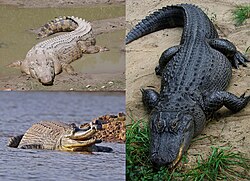
Crocodilia (/krɒkəˈdɪliə/) is an order of semiaquatic, predatory reptiles that are known as crocodilians. They appeared 83.5 million years ago in the Late Cretaceous period (Campanian stage) and are the closest living relatives of birds, as the two groups are the only known survivors of the Archosauria. Members of the crocodilian total group, the clade Pseudosuchia, appeared about 250 million years ago in the Early Triassic period, and diversified during the Mesozoic era. The order includes the true crocodiles (family Crocodylidae), the alligators and caimans (family Alligatoridae), and the gharial and false gharial (family Gavialidae). Although the term "crocodiles" is sometimes used to refer to all of these families, the term "crocodilians" is less ambiguous.
Extant crocodilians have flat heads with long snouts and tails that are compressed on the sides, with their eyes, ears, and nostrils at the top of the head. Alligators and caimans tend to have broader U-shaped jaws that, when closed, show only the upper teeth, whereas crocodiles usually have narrower V-shaped jaws with both rows of teeth visible when closed. Gharials have extremely slender, elongated jaws. The teeth are conical and peg-like, and the bite is powerful. All crocodilians are good swimmers and can move on land in a "high walk" position, traveling with their legs erect rather than sprawling. Crocodilians have thick skin covered in non-overlapping scales and, like birds, have a four-chambered heart and lungs with unidirectional airflow.
Like most other reptiles, crocodilians are ectotherms or 'cold-blooded'. They are found mainly in the warm and tropical areas of the Americas, Africa, Asia, and Oceania, usually occupying freshwater habitats, though some can live in saline environments and even swim out to sea. Crocodilians have a largely carnivorous diet; some species like the gharial are specialized feeders while others, like the saltwater crocodile, have generalized diets. They are generally solitary and territorial, though they sometimes hunt in groups. During the breeding season, dominant males try to monopolize available females, who lay their eggs in holes or mounds and, like many birds, they care for their hatched young.
Some species of crocodilians, particularly the Nile crocodile, are known to have attacked humans, which through activities that include hunting, poaching, and habitat destruction are the greatest threat to crocodilian populations. Farming of crocodilians has greatly reduced unlawful trading in skins of wild-caught animals. Artistic and literary representations of crocodilians have appeared in human cultures around the world since at least Ancient Egypt.
"Crocodilia" and "Crocodylia" have been used interchangeably for decades, starting with Karl Patterson Schmidt's re-description of the group from the formerly defunct term Loricata. Schmidt used the older term "Crocodilia", based on Richard Owen's original name for the group. Heinz Wermuth chose "Crocodylia" as the proper name, basing it on the type genus Crocodylus (Laurenti, 1768). Dundee, in a revision of many reptilian and amphibian names, argued strongly for "Crocodylia". Following the advent of cladistics and phylogenetic nomenclature, a more-solid justification for one spelling over the other was proposed.
Prior to 1988, Crocodilia was a group that encompassed the modern-day animals, as well as their more-distant relatives that are now classified in the larger groups Crocodylomorpha and Pseudosuchia. Under its current definition as a crown group, rather than a stem-based group, Crocodylia is now restricted to the last common ancestor of today's crocodilians and all of its descendants, living or extinct.
Crocodilia appears to be a Latinism of the Greek word κροκόδειλος (krokódeilos), which means both lizard and Nile crocodile. Crocodylia, as coined by Wermuth in regards to the genus Crocodylus, appears to be derived from the Ancient Greek κρόκη (kroke)—meaning shingle or pebble—and δρîλος or δρεîλος (dr(e)ilos), meaning worm. The name may refer to the animal's habit of resting on the pebbled shores of the Nile.
Crocodilians and birds are members of the clade Archosauria. Archosaurs are distinguished from other reptiles particularly by two sets of extra openings in the skull; the antorbital fenestra located in front of the animal's eye socket and the mandibular fenestra on the jaw. Archosauria has two main groups: the Pseudosuchia (crocodilians and their relatives) and the Avemetatarsalia (dinosaurs, pterosaurs, and their relatives). The split between these two groups is assumed to have happened close to the Permian–Triassic extinction event, which is informally known as the Great Dying.
Crocodilia
Crocodilia (/krɒkəˈdɪliə/) is an order of semiaquatic, predatory reptiles that are known as crocodilians. They appeared 83.5 million years ago in the Late Cretaceous period (Campanian stage) and are the closest living relatives of birds, as the two groups are the only known survivors of the Archosauria. Members of the crocodilian total group, the clade Pseudosuchia, appeared about 250 million years ago in the Early Triassic period, and diversified during the Mesozoic era. The order includes the true crocodiles (family Crocodylidae), the alligators and caimans (family Alligatoridae), and the gharial and false gharial (family Gavialidae). Although the term "crocodiles" is sometimes used to refer to all of these families, the term "crocodilians" is less ambiguous.
Extant crocodilians have flat heads with long snouts and tails that are compressed on the sides, with their eyes, ears, and nostrils at the top of the head. Alligators and caimans tend to have broader U-shaped jaws that, when closed, show only the upper teeth, whereas crocodiles usually have narrower V-shaped jaws with both rows of teeth visible when closed. Gharials have extremely slender, elongated jaws. The teeth are conical and peg-like, and the bite is powerful. All crocodilians are good swimmers and can move on land in a "high walk" position, traveling with their legs erect rather than sprawling. Crocodilians have thick skin covered in non-overlapping scales and, like birds, have a four-chambered heart and lungs with unidirectional airflow.
Like most other reptiles, crocodilians are ectotherms or 'cold-blooded'. They are found mainly in the warm and tropical areas of the Americas, Africa, Asia, and Oceania, usually occupying freshwater habitats, though some can live in saline environments and even swim out to sea. Crocodilians have a largely carnivorous diet; some species like the gharial are specialized feeders while others, like the saltwater crocodile, have generalized diets. They are generally solitary and territorial, though they sometimes hunt in groups. During the breeding season, dominant males try to monopolize available females, who lay their eggs in holes or mounds and, like many birds, they care for their hatched young.
Some species of crocodilians, particularly the Nile crocodile, are known to have attacked humans, which through activities that include hunting, poaching, and habitat destruction are the greatest threat to crocodilian populations. Farming of crocodilians has greatly reduced unlawful trading in skins of wild-caught animals. Artistic and literary representations of crocodilians have appeared in human cultures around the world since at least Ancient Egypt.
"Crocodilia" and "Crocodylia" have been used interchangeably for decades, starting with Karl Patterson Schmidt's re-description of the group from the formerly defunct term Loricata. Schmidt used the older term "Crocodilia", based on Richard Owen's original name for the group. Heinz Wermuth chose "Crocodylia" as the proper name, basing it on the type genus Crocodylus (Laurenti, 1768). Dundee, in a revision of many reptilian and amphibian names, argued strongly for "Crocodylia". Following the advent of cladistics and phylogenetic nomenclature, a more-solid justification for one spelling over the other was proposed.
Prior to 1988, Crocodilia was a group that encompassed the modern-day animals, as well as their more-distant relatives that are now classified in the larger groups Crocodylomorpha and Pseudosuchia. Under its current definition as a crown group, rather than a stem-based group, Crocodylia is now restricted to the last common ancestor of today's crocodilians and all of its descendants, living or extinct.
Crocodilia appears to be a Latinism of the Greek word κροκόδειλος (krokódeilos), which means both lizard and Nile crocodile. Crocodylia, as coined by Wermuth in regards to the genus Crocodylus, appears to be derived from the Ancient Greek κρόκη (kroke)—meaning shingle or pebble—and δρîλος or δρεîλος (dr(e)ilos), meaning worm. The name may refer to the animal's habit of resting on the pebbled shores of the Nile.
Crocodilians and birds are members of the clade Archosauria. Archosaurs are distinguished from other reptiles particularly by two sets of extra openings in the skull; the antorbital fenestra located in front of the animal's eye socket and the mandibular fenestra on the jaw. Archosauria has two main groups: the Pseudosuchia (crocodilians and their relatives) and the Avemetatarsalia (dinosaurs, pterosaurs, and their relatives). The split between these two groups is assumed to have happened close to the Permian–Triassic extinction event, which is informally known as the Great Dying.
Recent media
Recent media