



Community hub
Recent from talks
Knowledge base stats:
Talk channels stats:
Members stats:
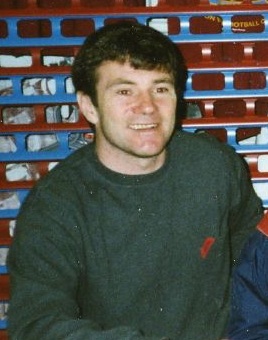
Ray Houghton
Raymond James Houghton (born 9 January 1962) is a former professional footballer and current sports analyst and commentator with RTÉ Sport.
As a player, he was a midfielder, notably playing for Liverpool where he won two First Division titles and two FA Cups before switching to Aston Villa ahead of the inaugural Premier League season. He also briefly played top flight football for West Ham United, Oxford United, and Crystal Palace with spells in the Football League for Fulham, and Reading, before retiring with non-league Stevenage Borough.
Born in Glasgow, Scotland, Houghton played international football for the Republic of Ireland, for which he qualified through his Irish father. Houghton is particularly remembered by Irish fans for scoring two of the most important goals in the national team's history, which resulted in 1–0 victories over England in Stuttgart at the 1988 European Championship, and Italy at Giants Stadium at the 1994 World Cup.
Houghton was born in Castlemilk, Glasgow (where Arthur Graham, who would also become an international footballer, was an upstairs neighbour in the same tenement block). However, he moved to London at the age of 10 and began his professional career at West Ham United, where he came through the ranks and signed professional forms as a 17-year-old on 5 July 1979. He failed to make an impact at Upton Park and on 7 July 1982, after 3 years and just one substitute appearance, moved on to Fulham on a free transfer.
Malcolm Macdonald had Tony Gale (later a Premier League title-winner with Blackburn Rovers), Paul Parker (who went on to win several major trophies with Manchester United), Gerry Peyton (Republic of Ireland international goalkeeper) and Ray Lewington (ex-Chelsea) to form a mixture of youth and experience which ultimately won Fulham promotion to the Second Division at the end of the 1981–82 season. He then added Houghton to the side that would try to keep the Cottagers in the second division. They did, and comfortably so; in fact for much of the 1982–83 season it looked as though Fulham would achieve back-to-back promotions; however, their form after the turn of the year dipped.
Jim Smith had taken Oxford United to the top tier of English football. When he left in 1985, his replacement, Maurice Evans, looked to Houghton to help solidify their place in the league. He paid £147,000 for Houghton on 13 September 1985. Houghton had played 145 times for Fulham and scored 21 goals. He made his U's debut the day after he signed, in a 2–2 draw with Liverpool at the Manor Ground. By the end of his first season, Houghton had helped to steer Oxford clear of the relegation places (they stayed up with a win on the final day of the season), but most notably scored the second goal in the club's 3–0 League Cup final victory over Smith's new team Queens Park Rangers at Wembley.
At the start of the 1987–88 season, Oxford were beaten 2–0 by Liverpool, who then offered £825,000 for his services. The deal was done and Houghton took the place of Craig Johnston on the right side of Liverpool's midfield, unusually wearing the No. 9 shirt that striker John Aldridge (his former Oxford teammate who had made the Anfield move himself a year earlier) had asked not to wear because of the pressure of replacing Ian Rush.[citation needed]
Houghton was added to the new acquisitions of Aldridge, Peter Beardsley and John Barnes to form one of the most exciting forward lines in the club's history. He made his Reds debut on 24 October 1987 in a 1–0 league victory over Luton Town at Kenilworth Road. His first goal for the club came on 4 November 1987 in a 1–1 draw with Wimbledon at Plough Lane. Houghton's 62nd-minute strike came just two minutes after he had come on as a sub for Johnston. It also kept up Liverpool's run of 29 unbeaten league matches from the start of the season. Liverpool went on to coast to the League title, Houghton contributing some memorable displays as a marauding creator from the flank. He scored his share of goals too, including the first goal in the era-defining 5–0 win over Nottingham Forest, which was later described by some journalists as the "match of the century" and was complimented by the game's greats such as Tom Finney.
Hub AI
Ray Houghton AI simulator
(@Ray Houghton_simulator)
Ray Houghton
Raymond James Houghton (born 9 January 1962) is a former professional footballer and current sports analyst and commentator with RTÉ Sport.
As a player, he was a midfielder, notably playing for Liverpool where he won two First Division titles and two FA Cups before switching to Aston Villa ahead of the inaugural Premier League season. He also briefly played top flight football for West Ham United, Oxford United, and Crystal Palace with spells in the Football League for Fulham, and Reading, before retiring with non-league Stevenage Borough.
Born in Glasgow, Scotland, Houghton played international football for the Republic of Ireland, for which he qualified through his Irish father. Houghton is particularly remembered by Irish fans for scoring two of the most important goals in the national team's history, which resulted in 1–0 victories over England in Stuttgart at the 1988 European Championship, and Italy at Giants Stadium at the 1994 World Cup.
Houghton was born in Castlemilk, Glasgow (where Arthur Graham, who would also become an international footballer, was an upstairs neighbour in the same tenement block). However, he moved to London at the age of 10 and began his professional career at West Ham United, where he came through the ranks and signed professional forms as a 17-year-old on 5 July 1979. He failed to make an impact at Upton Park and on 7 July 1982, after 3 years and just one substitute appearance, moved on to Fulham on a free transfer.
Malcolm Macdonald had Tony Gale (later a Premier League title-winner with Blackburn Rovers), Paul Parker (who went on to win several major trophies with Manchester United), Gerry Peyton (Republic of Ireland international goalkeeper) and Ray Lewington (ex-Chelsea) to form a mixture of youth and experience which ultimately won Fulham promotion to the Second Division at the end of the 1981–82 season. He then added Houghton to the side that would try to keep the Cottagers in the second division. They did, and comfortably so; in fact for much of the 1982–83 season it looked as though Fulham would achieve back-to-back promotions; however, their form after the turn of the year dipped.
Jim Smith had taken Oxford United to the top tier of English football. When he left in 1985, his replacement, Maurice Evans, looked to Houghton to help solidify their place in the league. He paid £147,000 for Houghton on 13 September 1985. Houghton had played 145 times for Fulham and scored 21 goals. He made his U's debut the day after he signed, in a 2–2 draw with Liverpool at the Manor Ground. By the end of his first season, Houghton had helped to steer Oxford clear of the relegation places (they stayed up with a win on the final day of the season), but most notably scored the second goal in the club's 3–0 League Cup final victory over Smith's new team Queens Park Rangers at Wembley.
At the start of the 1987–88 season, Oxford were beaten 2–0 by Liverpool, who then offered £825,000 for his services. The deal was done and Houghton took the place of Craig Johnston on the right side of Liverpool's midfield, unusually wearing the No. 9 shirt that striker John Aldridge (his former Oxford teammate who had made the Anfield move himself a year earlier) had asked not to wear because of the pressure of replacing Ian Rush.[citation needed]
Houghton was added to the new acquisitions of Aldridge, Peter Beardsley and John Barnes to form one of the most exciting forward lines in the club's history. He made his Reds debut on 24 October 1987 in a 1–0 league victory over Luton Town at Kenilworth Road. His first goal for the club came on 4 November 1987 in a 1–1 draw with Wimbledon at Plough Lane. Houghton's 62nd-minute strike came just two minutes after he had come on as a sub for Johnston. It also kept up Liverpool's run of 29 unbeaten league matches from the start of the season. Liverpool went on to coast to the League title, Houghton contributing some memorable displays as a marauding creator from the flank. He scored his share of goals too, including the first goal in the era-defining 5–0 win over Nottingham Forest, which was later described by some journalists as the "match of the century" and was complimented by the game's greats such as Tom Finney.