Hubbry Logo
Realized varianceRealized varianceMain
Open search
Realized variance
Community hub
Realized variance
logo
7 pages, 0 posts
0 subscribers
Be the first to start a discussion here.
Realized variance
Realized variance
from Wikipedia

Realized variance or realised variance (RV, see spelling differences) is the sum of squared returns. For instance the RV can be the sum of squared daily returns for a particular month, which would yield a measure of price variation over this month. More commonly, the realized variance is computed as the sum of squared intraday returns for a particular day.

The realized variance is useful because it provides a relatively accurate measure of volatility[1] which is useful for many purposes, including volatility forecasting and forecast evaluation.

[edit]

Unlike the variance the realized variance is a random quantity.

The realized volatility is the square root of the realized variance, or the square root of the RV multiplied by a suitable constant to bring the measure of volatility to an annualized scale. For instance, if the RV is computed as the sum of squared daily returns for some month, then an annualized realized volatility is given by .

Properties under ideal conditions

[edit]

Under ideal circumstances the RV consistently estimates the quadratic variation of the price process that the returns are computed from.[2] Ole E. Barndorff-Nielsen and Neil Shephard (2002), Journal of the Royal Statistical Society, Series B, 63, 2002, 253–280.

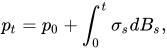
For instance suppose that the price process is given by the stochastic integral
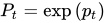
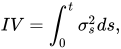
where is a standard Brownian motion, and is some (possibly random) process for which the integrated variance,

is well defined.

The realized variance based on intraday returns is given by where the intraday returns may be defined by

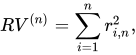
Then it has been shown that, as the realized variance converges to IV in probability. Moreover, the RV also converges in distribution in the sense that

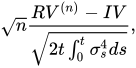
is approximately distributed as a standard normal random variables when is large.

Properties when prices are measured with noise

[edit]

When prices are measured with noise the RV may not estimate the desired quantity.[3] This problem motivated the development of a wide range of robust realized measures of volatility, such as the realized kernel estimator.[4]

See also

[edit]

Notes

[edit]
Revisions and contributorsEdit on WikipediaRead on Wikipedia
from Grokipedia
Realized variance is a non-parametric used in to measure the ex-post of an asset's price process over a specified time interval, typically computed as the sum of squared intraday returns sampled at high frequencies, such as five-minute intervals. This approach provides a direct, model-free of the integrated variance, which represents the accumulated squared volatility contributions from both continuous price movements and jumps in the underlying . As the sampling frequency increases, realized variance converges in probability to the true under standard assumptions, making it a consistent and efficient superior to traditional low-frequency measures like daily squared returns. Theoretically, realized variance is grounded in continuous-time stochastic processes, where the price dynamics follow an Itô : dp(t)=μ(t)dt+[σ(t)](/page/Sigma)dW(t)+dp(t) = \mu(t) dt + [\sigma(t)](/page/Sigma) dW(t) + jump components, and the [p,p]t=0t[σ2(s)](/page/Sigma)ds+[p,p]_t = \int_0^t [\sigma^2(s)](/page/Sigma) ds + \sum squared jumps. For a day divided into MM intraday periods, it is calculated as RVt=j=1Mrt,j2RV_t = \sum_{j=1}^M r_{t,j}^2, where rt,j=log(pt,j)log(pt,j1)r_{t,j} = \log(p_{t,j}) - \log(p_{t,j-1}) are the log returns. This formulation accounts for noise through bias-corrected variants, such as two-scale or kernel-based estimators, which mitigate the effects of bid-ask bounce and other trading frictions at ultra-high frequencies. The concept traces its origins to Robert Merton's 1980 proposal for using high-frequency data to estimate integrated variance, but it gained prominence in the late through empirical applications in markets. Seminal work by Torben and Tim Bollerslev in 1998 demonstrated that aggregating 288 five-minute squared returns yields accurate daily volatility measures, validating ARCH/GARCH models' forecasting performance when evaluated against this benchmark. Subsequent advancements, including extensions by , Bollerslev, Diebold, and Labys in 2003, incorporated long-memory dynamics via vector autoregressive models on log realized variances, enhancing multi-period forecasts. In practice, realized variance underpins volatility forecasting, risk management, and derivative pricing, with models like the heterogeneous autoregressive (HAR) framework capturing persistent patterns in volatility persistence. It has been applied to equities, currencies, and commodities, enabling precise Value-at-Risk (VaR) calculations and portfolio optimization by providing superior proxies for latent volatility compared to parametric alternatives. Despite challenges from noise and jumps, ongoing refinements ensure its robustness in high-frequency trading environments.

Core Concepts

Definition and Motivation

Realized variance (RV), also known as realized volatility squared, serves as a nonparametric of the integrated variance of an asset's log-price process over a fixed time interval, such as a , by summing the squared intraday returns sampled at high frequencies. This approach approximates the of the underlying continuous price process, which captures the true economic volatility arising from continuous price fluctuations in efficient markets. The motivation for realized variance stems from the shortcomings of traditional low-frequency volatility estimators, such as those based on daily close-to-close returns or parametric models like GARCH, which often suffer from measurement errors, model misspecification, and inability to precisely quantify ex-post volatility without imposing strong distributional assumptions. By exploiting the availability of high-frequency transaction data, RV provides a model-free, consistent ex-post measure that directly leverages the information content in intraday price movements to estimate the latent integrated variance more accurately, enabling better , , and in financial applications. This nonparametric framework originated from the practical need to discern genuine market volatility from noise in increasingly data-rich environments, particularly as expanded access to tick-by-tick observations. Conceptually, the roots of realized variance trace back to the mathematical theory of stochastic processes, where quantifies the pathwise variability of semimartingales, a class encompassing most financial price models. Empirically, its development gained traction in the with the proliferation of high-frequency data, building on earlier explorations of summed squared returns for variance decomposition in low-frequency settings, such as daily data analyses of stock return persistence. Initial applications focused on markets, where 5-minute intraday sampling demonstrated RV's superiority in volatility measurement over coarser alternatives. As an illustrative example, consider a stock's observed at 5-minute intervals throughout the trading day. The intraday returns are computed as rt,i=log(Pt,i)log(Pt,i1)r_{t,i} = \log(P_{t,i}) - \log(P_{t,i-1}) for i=1,,Mi = 1, \dots, M, where Pt,iP_{t,i} denotes the at the ii-th interval on day tt, and MM is the total number of such intervals (e.g., 78 for a 6.5-hour day). The realized variance for that day is then RVt=i=1Mrt,i2RV_t = \sum_{i=1}^M r_{t,i}^2, which converges to the integrated variance as the sampling frequency increases under ideal conditions.

Mathematical Formulation

The log-price process XtX_t is modeled as a continuous Itô over the time interval [0,T][0, T], satisfying the dXt=μtdt+σtdWt,dX_t = \mu_t \, dt + \sigma_t \, dW_t, where WtW_t denotes a standard , μt\mu_t represents the drift process, and σt>0\sigma_t > 0 is the spot volatility process assumed to be with locally square-integrable paths. The integrated variance, which quantifies the accumulated squared volatility over the horizon, is then given by 0Tσt2dt.\int_0^T \sigma_t^2 \, dt. This setup captures the continuous component of price dynamics without discontinuous jumps. The realized variance estimator RVTRV_T is constructed from high-frequency observations of XtX_t as RVT=i=1n(XtiXti1)2,RV_T = \sum_{i=1}^n (X_{t_i} - X_{t_{i-1}})^2, where the sampling times are equidistant with ti=iT/nt_i = iT/n for i=1,,ni = 1, \dots, n, and nn \to \infty corresponds to the high-frequency sampling limit. This sum of squared intraday returns serves as a nonparametric measure of ex-post variation in log prices. The formulation relies on several key assumptions for its validity: the price process exhibits no jumps (ensuring continuity of paths), the time horizon TT is fixed (e.g., corresponding to one trading day), and observations are sampled at increasingly fine intervals to achieve consistency in the limit. Under these ideal conditions—where the semimartingale is of finite variation in the drift and the volatility process is independent of the Brownian innovation—RVTRV_T converges in probability to the quadratic variation process XT=0Tσt2dt\langle X \rangle_T = \int_0^T \sigma_t^2 \, dt.

Estimation Methods

Under Ideal Conditions

Under ideal conditions, realized variance is estimated from high-frequency intraday price data assuming the underlying price process is an Itô , with no errors such as bid-ask bounce or other microstructure effects, and using sampling intervals throughout the trading day. These assumptions align with the price process being modeled as a , where the log-price follows a driven by a , possibly with a jump component, without additive . In this setting, the estimator leverages the property of such processes to approximate the unobservable directly from observable returns. The computation proceeds in a straightforward step-by-step manner using intraday log-returns. First, collect observed log-prices pti=logPtip_{t_i} = \log P_{t_i} at nn equidistant time points ti=iΔtt_i = i \Delta t over the interval [0,T][0, T], where Δt=T/n\Delta t = T/n is the sampling interval. Next, calculate the intraday log-returns rti=ptipti1r_{t_i} = p_{t_i} - p_{t_{i-1}} for i=1,,ni = 1, \dots, n. The realized variance RVRV is then obtained by summing the squared returns: RV=i=1nrti2.RV = \sum_{i=1}^n r_{t_i}^2. This sum provides a nonparametric estimate of the period's without requiring parametric assumptions about the drift or volatility dynamics. The choice of sampling frequency significantly influences the precision; for instance, using 5-minute intervals (common in markets, yielding n288n \approx 288 per trading day) offers a robust , while finer 1-minute sampling (n1440n \approx 1440) further reduces under these ideal conditions, as the estimator's efficiency improves with higher nn. As the sampling frequency increases (nn \to \infty, or equivalently Δt0\Delta t \to 0), the realized variance converges in probability to the , defined as [p,p]T=0Tσs2ds+0<sT(Δps)2,[p, p]_T = \int_0^T \sigma_s^2 \, ds + \sum_{0 < s \leq T} (\Delta p_s)^2, where σs2\sigma_s^2 denotes the spot variance at time ss, the is the continuous integrated variance, and the sum captures squared jumps. This consistency holds under the stated assumptions, with the exhibiting an asymptotic mixed Gaussian distribution scaled by n\sqrt{n}
Add your contribution
Related Hubs
User Avatar
No comments yet.