Hubbry Logo
Rebel RandallRebel RandallMain
Open search
Rebel Randall
Community hub
Rebel Randall
logo
8 pages, 0 posts
0 subscribers
Be the first to start a discussion here.
Rebel Randall
Rebel Randall
from Wikipedia

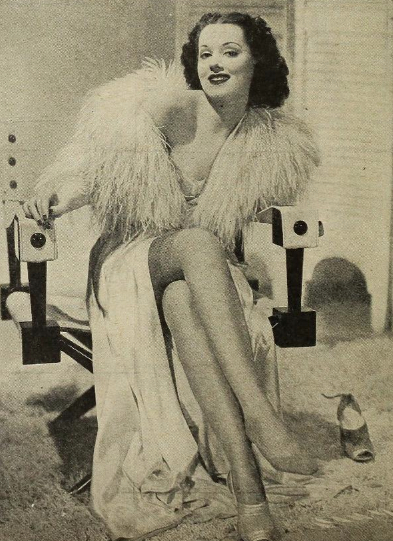
Rebel Randall (born Alaine Charlotte Dorothy Brandes, January 22, 1922 – July 22, 2010[1]), was an American film actress and radio personality.[2] She appeared in approximately 50 films between 1940 and 1956.

Key Information

Career

[edit]

She was a popular G.I. pin-up girl during the 1940s and did several layouts, including one for Esquire magazine. She did a stint as "The Coca-Cola Girl" in advertisements and was a disc jockey for the Armed Forces Radio Services and hosted a show called "Radio Calling". In the 1950s, Rebel discovered that a New Orleans stripper began using her name and she had to legally stop her.

According to an interview with Mike Barnum in the December 2009 issue of "Classic Images", she got her initial start after winning a scholarship to the Max Reinhardt Workshop in Hollywood where she appeared as Queen Titania in a version of "A Midsummer Night's Dream. Once a John Robert Powers model before going to Hollywood. Born and raised in Chicago, and graduated from Foreman High School.

A glamorous brunette, she is remembered for her several dozen cinematic appearances from the early 1940s thru the mid 1950s. After making a name for herself doing radio commercials, she moved to Hollywood where she made her 1940 silver screen bow in "Turnabout". Working as a Paramount contract player, she was seen in numerous features of the day, among them 1941's "The Lone Rider in Ghost Town", "In Old Oklahoma" and "The Powers Girl" (both 1943), the 1945 "Booby Dupes", and 1945's "The Shadow Returns".

During World War II, Rebel also worked as a Powers model, was a popular GI pin-up girl, was featured as "Esquire" magazine's centerfold at least twice, and had two failed marriages to radio personality William Mann Moore, A.K.A. Peter Potter; in 1949, she was named "The Most Beautiful Girl on TV".

In September 1953, Rebel married wealthy actor and businessman Glenn Thompson in an ill-starred union that lasted only a few days due to her husband's apparent mental instability, the marriage ending in annulment.

Last seen on the screen in the 1956 short "Come on Seven", she lived the rest of her days in Southern California, was for a time the face of Coca-Cola, had romances with several high-profile men, though she never married again, gradually faded from view, and died after spending her final years in a nursing facility. A number of her films are preserved on DVD.

Politics

[edit]

Although some sources list her as a Republican, she was an active Democrat for decades. She ran for congress against Ernest Z. Robles in Imperial County in 1972. She later founded Women's United International, which supported Jimmy Carter in his campaigns. Their correspondence is preserved at the Presidential Library.[3]

Favorite quotes

[edit]
  • "I loved my work and I took it seriously."
  • "One of the problems of being an actor is that you work, and then you don't work. The time that you don't work might be extensive and you do still have to continue to live."

Selected filmography

[edit]

References

[edit]
[edit]
Revisions and contributorsEdit on WikipediaRead on Wikipedia
from Grokipedia
''Rebel Randall'' was an American actress, model, and radio personality known for her prolific work in films during the 1940s and 1950s, her status as a prominent pin-up girl during World War II, and her influential role as one of Hollywood's first female disc jockeys on Armed Forces Radio Service programs. Born Alaine Charlotte Dorothy Brandes on January 22, 1922, in Chicago, Illinois, she pursued acting after winning a scholarship to the Max Reinhardt Workshop in Hollywood, leading to a contract with Paramount Pictures where her professional name became Rebel Randall. She appeared in approximately fifty films and shorts, including comedy two-reelers with the Three Stooges such as Cuckoo Cavaliers, westerns like In Old California opposite John Wayne, and features such as Dead or Alive and The Shadow Returns. As a popular wartime pin-up girl, she posed for Esquire magazine layouts and served as a Coca-Cola spokeswoman, earning titles like "Glamour Girl of Hollywood" and recognition as an "American Beauty—Western Style." In the early 1950s, she achieved widespread popularity hosting the Armed Forces Radio Service program America Calling on KCBS, which facilitated phone calls between overseas servicemen and their families at her own expense and drew the most listener mail of any show on the network. She also hosted other radio and television programs, including Jukebox U.S.A. and Auction-aire for Libby Foods. Rebel Randall died on July 22, 2010, in Riverside, California.

Early life

Childhood in Chicago

Rebel Randall was born Alaine Charlotte Dorothy Brandes on January 22, 1922, in Chicago, Illinois. From an early age, she displayed precocious talents in beauty and dance that garnered local recognition in the city. Around age three in approximately 1925, she won a beauty contest and was named the most beautiful child. By about age five in 1927, she was recognized as the best dancer in an operetta. Her childhood performances extended to the stage, where she appeared in Chicago productions including The Wild Duck and Long Voyage Home. During Chicago's Century of Progress exposition in 1933–1934, she was designated the foremost dancer at Enchanted Island, highlighting her prominence as a young performer amid the city's major world's fair. These early accomplishments in beauty contests, dance, and theater marked her initial foray into public performance in Chicago before her eventual move to Hollywood for advanced training.

Education and early talents

Rebel Randall graduated from Foreman High School in Chicago around 1938-1940, reportedly as valedictorian according to some accounts. She demonstrated early academic and artistic promise by winning scholarships to Northwestern University through art contests held in Illinois. She further pursued her interest in performance with a scholarship to the Goodman Theater in Chicago, where she began developing her acting and stage skills. During this period, she also gained early professional experience in dancing and stage productions in Chicago. In approximately 1940, she received a scholarship to the prestigious Max Reinhardt Workshop in Hollywood, where she performed the role of Queen Titania in a production of A Midsummer Night's Dream. During her training there, she attracted the attention of Paramount scouts.

Entry into entertainment

Modeling and beauty contests

Rebel Randall began her career as a model in Chicago, where she was represented by the John Robert Powers agency. Around 1940, she was crowned "Ad Queen of Chicago" by the Chicago Federated Advertising Club. That same year, she received further recognition when the Motion Pictures Still Photographers Association named her "Movie Glamour Girl of 1940." She also appeared as "The Coca-Cola Girl" in advertisements, a role that contributed to her early visibility in commercial glamour work. Her early pin-up and magazine layouts included features in Esquire magazine, which helped establish her glamorous image and laid the groundwork for her rising fame as a pin-up figure leading into World War II.

Training at Max Reinhardt Workshop

Before moving to Hollywood, Randall studied at the Goodman Theater in Chicago, which led to her being offered a scholarship to the Max Reinhardt Workshop. She relocated to Hollywood to study acting under the famed theater director's program. During her time at the workshop, she honed her skills in professional stage performance. Upon her time at the workshop, Randall's performance drew the attention of Paramount talent scouts. This led to her signing a contract with Paramount Pictures, where Paramount changed her name to Rebel Randall. She soon began taking early bit roles at the studio as part of her transition to film.

Film career

Paramount contract and early roles

Rebel Randall signed a stock contract with Paramount Pictures after scouts noticed her while she was studying at the Max Reinhardt Workshop, and the studio changed her name from Alaine Brandes to Rebel Randall. She refused the standard starting salary of $50 per week offered to most stock players and negotiated successfully for $100 per week, though she still considered the pay too low. During her time under contract, she appeared in bit roles and other early films, including a role in Holiday Inn (1942), where she performed in blackface alongside stars Bing Crosby and Marjorie Reynolds. She also had parts in The Lone Rider in Ghost Town (1941), Sin Town (1942), and In Old Oklahoma (also known as War of the Wildcats, 1943). On the set of The Lone Rider in Ghost Town, she experienced a frightening incident when her horse ran away uncontrollably during the opening scene. Dissatisfied with the frivolous nature of her assignments, particularly after the blackface role in Holiday Inn, Randall left Paramount after one year. The studio attempted to retain her by offering $750 per week, but she declined and sought her release, an event later reported in the press by columnist Louella Parsons.

Comedy shorts and B-westerns

Rebel Randall frequently appeared in Columbia Pictures' two-reel comedy shorts throughout the 1940s, collaborating with various comedians and often sharing the screen with Christine McIntyre, whom she described as a very sweet girl and highly talented performer capable of singing, comedy, and virtually anything, noting that McIntyre was a staple beautiful blonde in many Columbia shorts as part of their ensemble. She made appearances in shorts with the Three Stooges, including Booby Dupes (1945), which she regarded as her favorite, recalling that she wore a bathing suit while the Stooges followed her around. Randall praised Curly Howard as the funniest of the group, stating that "everything about him was funny," while noting that Shemp Howard was good too. In B-westerns, she played the female lead opposite Tex Ritter and Dave O'Brien in Dead or Alive (1944), a PRC production where the Texas Rangers infiltrate an outlaw gang. She held Dave O'Brien in particularly high regard as a comedian, calling him the funniest guy and the best comedian, highlighting his great talent as a humorist who could make everybody laugh, though he could also play straight roles effectively.

Later films and collaborations

Rebel Randall continued her screen work through the mid-1940s, appearing in supporting and bit roles across several feature films. She portrayed a Powers Agency Model in The Powers Girl (1943) and the Woman in bed in Hit the Ice (1943). In 1945 she appeared as a Girl in tailor shop in A Thousand and One Nights and in Here Come the Co-Eds (1945). The following year she played Lenore Jessup in The Shadow Returns (1946), took an uncredited role in The Stranger (1946), and appeared as a Chorus girl in Night and Day (1946). These projects placed her alongside prominent performers including Abbott and Costello in Hit the Ice and Here Come the Co-Eds, Cary Grant in Night and Day, and Orson Welles in The Stranger. Her film appearances grew less frequent in the later 1940s and into the 1950s, often limited to minor parts. She made her final screen appearance in the 1956 comedy short Come on Seven, playing the First Golddigger. Across her career she appeared in approximately 50 films between 1940 and 1956. In the 1950s Randall transitioned to broadcasting, where she found greater prominence as a radio personality.

Pin-up and glamour modeling

Broadcasting career

Radio work with Armed Forces Radio Service

In the fall of 1952, Rebel Randall achieved notable success in radio as Hollywood's only female disc jockey, hosting the Armed Forces Radio Service program "America Calling" broadcast on KCBS. The show combined disc jockey selections of popular music with a distinctive feature in which she personally funded and arranged free overseas telephone calls connecting U.S. servicemen stationed abroad with their families back home. Only one minute of each call was aired, after which the remainder of the conversation remained private; Randall reportedly covered phone expenses herself at a cost of at least $2,000 per month. "America Calling" was highly popular and received the most listener mail of any show on the network. She also hosted another Armed Forces Radio Service program, "Jukebox, U.S.A.," which was reported as the network's biggest mail-getter in November 1952 and earned some of its highest ratings. These programs, aired during the Korean War era, represented her primary contributions to the Armed Forces Radio Service, emphasizing music and direct support for troops overseas.

Television appearances

Rebel Randall was named "The Most Beautiful Girl on TV" in 1949, an accolade that recognized her striking presence during the nascent years of commercial television. In the early 1950s, she hosted the daytime television program Auction-aire, sponsored by Libby Foods. The show featured her as the central host, conducting auctions of various items in a format that blended entertainment with product promotion for the sponsor. Her television visibility was supported by her glamour image from earlier modeling and film work.

Personal life

Marriages and relationships

Rebel Randall was married three times. Her first husband was William Mann Moore, professionally known as Peter Potter, a radio host and disc jockey. They married in May 1943, but divorced in April 1944. They remarried in 1946, and their second divorce was finalized on October 9, 1947. Her second marriage was to Glenn Thompson (also referred to as Glenn Burgess) on September 21, 1953. She filed for annulment in October 1953, testifying that theirs was a "kissless" honeymoon and that they never lived as husband and wife. The annulment was granted in December 1953. Her third marriage was to Walter J. Hurd on January 5, 1967; they divorced on May 17, 1977. In the 1950s, Randall took legal action against a stripper in New Orleans who was using her name professionally. Publicity from her career occasionally referenced romances, but these remain unconfirmed and were likely promotional in nature.

Later years and death

Later activities

After retiring from acting following her final screen appearance in the 1956 short film Come on Seven, Rebel Randall faded from public view in the entertainment industry. She spent her later years in Southern California, residing in Palm Springs during the 1990s and into the early 2000s, later in Cathedral City, and briefly at the Valencia Palms Nursing Home in Indio in May 2010. In 1973, Randall helped found Woman's United International, an organization focused on the aid and assistance of women, and served as founder of its Riverside County Chapter, based in Palm Springs. As an active Democrat, she ran unsuccessfully for Congress in California's 37th District in 1974 and supported Jimmy Carter's campaigns through her group, with correspondence between Randall and Carter from that period preserved at the Jimmy Carter Presidential Library.

Death

Rebel Randall died on July 22, 2010, at the age of 88 in Riverside, California. She had spent her final years in a nursing facility. She was interred at Desert Memorial Park in Cathedral City, California.
Add your contribution
Related Hubs
User Avatar
No comments yet.