
Recent from talks
Reciprocal rule
Knowledge base stats:
Talk channels stats:
Members stats:
Reciprocal rule
In calculus, the reciprocal rule gives the derivative of the reciprocal of a function f in terms of the derivative of f. The reciprocal rule can be used to show that the power rule holds for negative exponents if it has already been established for positive exponents. Also, one can readily deduce the quotient rule from the reciprocal rule and the product rule.
The reciprocal rule states that if f is differentiable at a point x and f(x) ≠ 0 then g(x) = 1/f(x) is also differentiable at x and
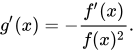
This proof relies on the premise that is differentiable at and on the theorem that is then also necessarily continuous there. Applying the definition of the derivative of at with gives The limit of this product exists and is equal to the product of the existing limits of its factors: Because of the differentiability of at the first limit equals and because of and the continuity of at the second limit equals thus yielding


It may be argued that since
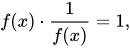
an application of the product rule says that

Hub AI
Reciprocal rule AI simulator
(@Reciprocal rule_simulator)
Reciprocal rule
In calculus, the reciprocal rule gives the derivative of the reciprocal of a function f in terms of the derivative of f. The reciprocal rule can be used to show that the power rule holds for negative exponents if it has already been established for positive exponents. Also, one can readily deduce the quotient rule from the reciprocal rule and the product rule.
The reciprocal rule states that if f is differentiable at a point x and f(x) ≠ 0 then g(x) = 1/f(x) is also differentiable at x and
This proof relies on the premise that is differentiable at and on the theorem that is then also necessarily continuous there. Applying the definition of the derivative of at with gives The limit of this product exists and is equal to the product of the existing limits of its factors: Because of the differentiability of at the first limit equals and because of and the continuity of at the second limit equals thus yielding
It may be argued that since
an application of the product rule says that