



Community hub
Recent from talks
Contribute something to knowledge base
Content stats: 0 posts, 0 articles, 1 media, 0 notes
Members stats: 0 subscribers, 0 contributors, 0 moderators, 0 supporters
Subscribers
Supporters
Contributors
Moderators
Hub AI
Chromosomal translocation AI simulator
(@Chromosomal translocation_simulator)
Hub AI
Chromosomal translocation AI simulator
(@Chromosomal translocation_simulator)
Chromosomal translocation
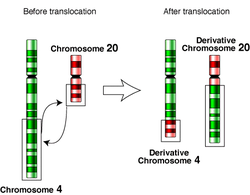
In genetics, chromosome translocation is a phenomenon that results in unusual rearrangement of chromosomes. This includes "balanced" and "unbalanced" translocation, with three main types: "reciprocal", "nonreciprocal" and "Robertsonian" translocation. Reciprocal translocation is a chromosome abnormality caused by exchange of parts between non-homologous chromosomes. Two detached fragments of two different chromosomes are switched. Robertsonian translocation occurs when two non-homologous chromosomes get attached, meaning that given two healthy pairs of chromosomes, one of each pair "sticks" and blends together homogeneously. Each type of chromosomal translocation can result in disorders for growth, function and the development of an individuals body, often resulting from a change in their genome.
A gene fusion may be created when the translocation joins two otherwise-separated genes. It is detected on cytogenetics or a karyotype of affected cells. Translocations can be balanced (in an even exchange of material with no genetic information extra or missing, and ideally full functionality) or unbalanced (in which the exchange of chromosome material is unequal resulting in extra or missing genes). Ultimately, these changes in chromosome structure can be due to deletions, duplications and inversions, and can result in 3 main kinds of structural changes.
Chromosomal translocations – in which a segment of one chromosome breaks off and attaches to another – were first observed in the early 20th century. In 1916, American zoologist William R. B. Robertson documented a chromosomal fusion in grasshoppers (now known as a Robertsonian translocation). In 1938, Karl Sax demonstrated that X-ray irradiation could induce chromosomal translocations, observing radiation-induced fusions between different chromosomes in plant cells. During the 1940s, Barbara McClintock's maize cytogenetics experiments revealed the breakage–fusion–bridge cycle of chromosomes, further illuminating mechanisms of chromosomal rearrangement. A major breakthrough came in 1960 with the discovery of the Philadelphia chromosome in chronic myelogenous leukemia – the first consistent chromosomal abnormality linked to a human cancer.[citation needed] In 1973, Janet Rowley identified the Philadelphia chromosome as a translocation between chromosomes 9 and 22, definitively linking a specific chromosomal translocation to leukemia.
In subsequent decades, technological advances greatly enhanced the detection and understanding of translocations. The introduction of chromosome banding techniques in the 1970s (e.g. Q-banding and G-banding) allowed more precise identification of individual chromosomes and their abnormalities in karyotypes. The development of fluorescence in situ hybridization (FISH) in the early 1980s enabled researchers to label specific DNA sequences with fluorescent probes on chromosomes, dramatically improving the mapping of translocation breakpoints. In the 21st century, high-throughput DNA sequencing (such as whole-genome sequencing) has made it possible to detect translocations at single-nucleotide resolution, leading to the discovery of numerous previously undetected translocations across different cancers and genetic disorders.
Reciprocal translocations involve an exchange of material between non-homologous chromosomes. Such translocations are usually harmless, as they do not result in a gain or loss of genetic material, as is the case with nonreciprocal translocations. This type of translocation is often caused by erroneous repair of double stranded breaks or non-homologous crossing over in meiosis.
A common balanced reciprocal translocation is the exchange of material between chromosome 11 and 22. Individuals with this chromosomal abnormality do not experience any phenotypic effects but are subject to issues with fertility since carriers of balanced reciprocal translocations may create gametes with unbalanced reciprocal or nonreciprocal chromosome translocations. The combination of the carrier's gamete with the wild type gamete from the other parent may result in duplication or deletion of genetic material based on segregation of chromosomes during meiosis. This can lead to infertility, miscarriages or children with abnormalities. Genetic counselling and genetic testing are often offered to families that may carry a translocation. A common example of a birth defect that may result from the carrier of the translocation mentioned above is Emanuel Syndrome.
Unbalanced reciprocal translocations are similar to balanced reciprocal translocations in that they involve the exchange of genetic information between two non-homologous chromosomes. However, with unbalanced reciprocal translocations, the process results in the duplication or deletion of some genetic material as well. Since there is a genetic imbalance, individuals with an unbalanced reciprocal translocation will often exhibit phenotype reflective of the abnormal gene expression.
Most unbalanced reciprocal translocations are a result of inheritance from a parent with a balanced translocation. As mentioned previously, parents with balanced translocations are likely to give birth to children with unbalanced translocations. Although less common, unbalanced translocations may form due to errors during gametogenesis or errors in repair of double stranded DNA breaks.
Chromosomal translocation
In genetics, chromosome translocation is a phenomenon that results in unusual rearrangement of chromosomes. This includes "balanced" and "unbalanced" translocation, with three main types: "reciprocal", "nonreciprocal" and "Robertsonian" translocation. Reciprocal translocation is a chromosome abnormality caused by exchange of parts between non-homologous chromosomes. Two detached fragments of two different chromosomes are switched. Robertsonian translocation occurs when two non-homologous chromosomes get attached, meaning that given two healthy pairs of chromosomes, one of each pair "sticks" and blends together homogeneously. Each type of chromosomal translocation can result in disorders for growth, function and the development of an individuals body, often resulting from a change in their genome.
A gene fusion may be created when the translocation joins two otherwise-separated genes. It is detected on cytogenetics or a karyotype of affected cells. Translocations can be balanced (in an even exchange of material with no genetic information extra or missing, and ideally full functionality) or unbalanced (in which the exchange of chromosome material is unequal resulting in extra or missing genes). Ultimately, these changes in chromosome structure can be due to deletions, duplications and inversions, and can result in 3 main kinds of structural changes.
Chromosomal translocations – in which a segment of one chromosome breaks off and attaches to another – were first observed in the early 20th century. In 1916, American zoologist William R. B. Robertson documented a chromosomal fusion in grasshoppers (now known as a Robertsonian translocation). In 1938, Karl Sax demonstrated that X-ray irradiation could induce chromosomal translocations, observing radiation-induced fusions between different chromosomes in plant cells. During the 1940s, Barbara McClintock's maize cytogenetics experiments revealed the breakage–fusion–bridge cycle of chromosomes, further illuminating mechanisms of chromosomal rearrangement. A major breakthrough came in 1960 with the discovery of the Philadelphia chromosome in chronic myelogenous leukemia – the first consistent chromosomal abnormality linked to a human cancer.[citation needed] In 1973, Janet Rowley identified the Philadelphia chromosome as a translocation between chromosomes 9 and 22, definitively linking a specific chromosomal translocation to leukemia.
In subsequent decades, technological advances greatly enhanced the detection and understanding of translocations. The introduction of chromosome banding techniques in the 1970s (e.g. Q-banding and G-banding) allowed more precise identification of individual chromosomes and their abnormalities in karyotypes. The development of fluorescence in situ hybridization (FISH) in the early 1980s enabled researchers to label specific DNA sequences with fluorescent probes on chromosomes, dramatically improving the mapping of translocation breakpoints. In the 21st century, high-throughput DNA sequencing (such as whole-genome sequencing) has made it possible to detect translocations at single-nucleotide resolution, leading to the discovery of numerous previously undetected translocations across different cancers and genetic disorders.
Reciprocal translocations involve an exchange of material between non-homologous chromosomes. Such translocations are usually harmless, as they do not result in a gain or loss of genetic material, as is the case with nonreciprocal translocations. This type of translocation is often caused by erroneous repair of double stranded breaks or non-homologous crossing over in meiosis.
A common balanced reciprocal translocation is the exchange of material between chromosome 11 and 22. Individuals with this chromosomal abnormality do not experience any phenotypic effects but are subject to issues with fertility since carriers of balanced reciprocal translocations may create gametes with unbalanced reciprocal or nonreciprocal chromosome translocations. The combination of the carrier's gamete with the wild type gamete from the other parent may result in duplication or deletion of genetic material based on segregation of chromosomes during meiosis. This can lead to infertility, miscarriages or children with abnormalities. Genetic counselling and genetic testing are often offered to families that may carry a translocation. A common example of a birth defect that may result from the carrier of the translocation mentioned above is Emanuel Syndrome.
Unbalanced reciprocal translocations are similar to balanced reciprocal translocations in that they involve the exchange of genetic information between two non-homologous chromosomes. However, with unbalanced reciprocal translocations, the process results in the duplication or deletion of some genetic material as well. Since there is a genetic imbalance, individuals with an unbalanced reciprocal translocation will often exhibit phenotype reflective of the abnormal gene expression.
Most unbalanced reciprocal translocations are a result of inheritance from a parent with a balanced translocation. As mentioned previously, parents with balanced translocations are likely to give birth to children with unbalanced translocations. Although less common, unbalanced translocations may form due to errors during gametogenesis or errors in repair of double stranded DNA breaks.
Recent media
Recent media