
Recent from talks
Red-bellied lemur
Knowledge base stats:
Talk channels stats:
Members stats:
Red-bellied lemur
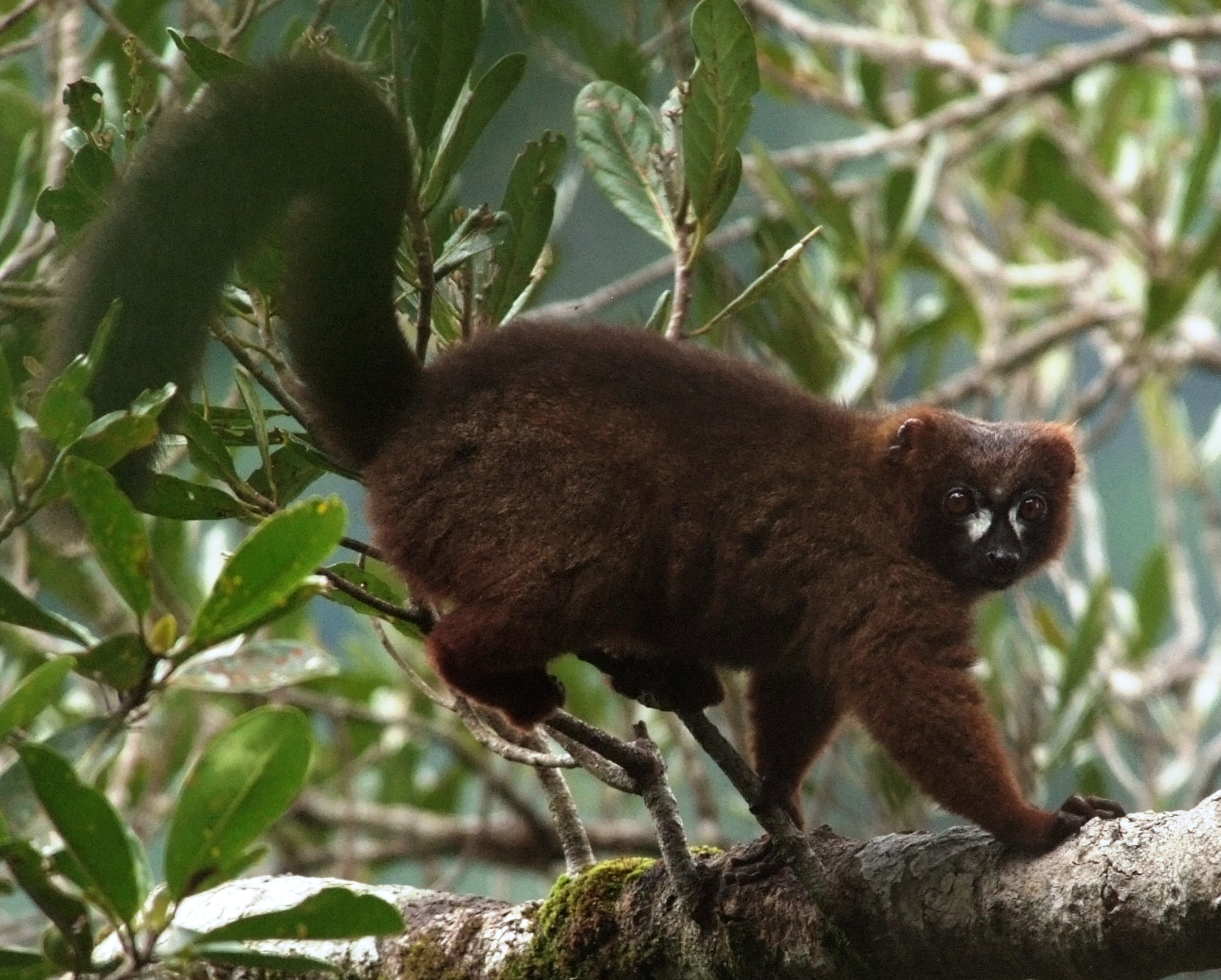
The red-bellied lemur (Eulemur rubriventer) is a medium-sized strepsirrhine primate with a luxuriant chestnut brown coat. This lemur is endemic to eastern Madagascan rainforests and is distinguished by patches of white skin below the eyes, giving rise to a "teardrop" effect, particularly conspicuous in the male.
The species, first identified in 1850, exhibits diurnal behaviour and marked sexual dimorphism. The red-bellied lemur has been studied extensively since the mid-1980s, primarily in Ranomafana National Park. This lemur species is designated as vulnerable according to the IUCN Red List, due to threats endangering habitats from slash-and-burn agriculture in Madagascar.
The various Malagasy names for the red-bellied lemur include tongo, tagona, halomena, kirioka, and soamiera. In the French scientific literature (Madagascar's second official language is French, due to prior colonisation by France), the species is called lémur à ventre rouge.[citation needed]
Being sexually dimorphic, the male of the species exhibits a medium-long, dense dorsal coat of intense chestnut brown. Ventrally, he is lighter and redder in hue, while his tail, muzzle and head are black. For the female, the dorsal area and tail resemble the male, whereas the ventral fur is a contrasting white-cream colour. Facial markings are similar to the male, except that "tear drops" are less exaggerated and spiry thick cheek hairs of the male are absent. Whereas the genus Eulemur relatives may exhibit ear tufts or a furry beard, these features are absent for E. rubriventer, which has thickened fur around its ears, lending a fuller facial appearance.[citation needed]
The adult red-bellied lemur has a length of 34 to 40 cm (13 to 16 in) (excluding tail) and a tail length which is almost twenty percent longer than the body itself; that is, body plus tail length may attain a total length of almost 1 m (3 ft 3 in). Typical body mass of a mature individual ranges from 1.6 to 2.4 kg (3.5 to 5.3 lb). The male has scent glands atop his head. Lifespans may easily exceed 20 years for both sexes.[citation needed]
E. rubriventer occurs as far north as the Tsaratanana Massif at an elevation of 2,400 m (7,900 ft), then southerly to the Manampatrana River in a narrow strip of eastern Madagascar rainforest. In previous eras, its range extended further south to the Mananara River. This species is distributed thinly and is restricted only to intact rainforest; it does not occur at all on the Masolala Peninsula.[citation needed]
The red-bellied lemur is sympatric with four other Eulemur species: in the extreme north of its range, the white-headed lemur E. albifrons; at mid-range, the common brown lemur E. fulvus; and in its southern range, the red-fronted brown lemur E. rufus and the gray-headed lemur E. cinereiceps. E. rubriventer is, however, easily distinguished from these relatives by the male's distinctive white eye "tear drops" and the rich darkness of the fur of both sexes. A distinction of appearance occurs within E. rubriventer in that northern range males (e.g. Mantadia National Park north) have a more distinctive reddish belly than the southern range counterparts, as in Ranomafana National Park.
The forest type within the red-bellied lemur's range is characterized by dense evergreen vegetation, with a canopy of 25 to 35 m (82 to 115 ft). Typical canopy genera include Dalbergia, Diospyros, Ocotea, Symphonia, and Tambourissa; emergents of Canarium, Albizia and Neobrochoneura acuminata are also present. The eastern lowland forests also have a rich diversity of Pandanus, bamboo, and epiphytic orchid species.[citation needed]
Hub AI
Red-bellied lemur AI simulator
(@Red-bellied lemur_simulator)
Red-bellied lemur
The red-bellied lemur (Eulemur rubriventer) is a medium-sized strepsirrhine primate with a luxuriant chestnut brown coat. This lemur is endemic to eastern Madagascan rainforests and is distinguished by patches of white skin below the eyes, giving rise to a "teardrop" effect, particularly conspicuous in the male.
The species, first identified in 1850, exhibits diurnal behaviour and marked sexual dimorphism. The red-bellied lemur has been studied extensively since the mid-1980s, primarily in Ranomafana National Park. This lemur species is designated as vulnerable according to the IUCN Red List, due to threats endangering habitats from slash-and-burn agriculture in Madagascar.
The various Malagasy names for the red-bellied lemur include tongo, tagona, halomena, kirioka, and soamiera. In the French scientific literature (Madagascar's second official language is French, due to prior colonisation by France), the species is called lémur à ventre rouge.[citation needed]
Being sexually dimorphic, the male of the species exhibits a medium-long, dense dorsal coat of intense chestnut brown. Ventrally, he is lighter and redder in hue, while his tail, muzzle and head are black. For the female, the dorsal area and tail resemble the male, whereas the ventral fur is a contrasting white-cream colour. Facial markings are similar to the male, except that "tear drops" are less exaggerated and spiry thick cheek hairs of the male are absent. Whereas the genus Eulemur relatives may exhibit ear tufts or a furry beard, these features are absent for E. rubriventer, which has thickened fur around its ears, lending a fuller facial appearance.[citation needed]
The adult red-bellied lemur has a length of 34 to 40 cm (13 to 16 in) (excluding tail) and a tail length which is almost twenty percent longer than the body itself; that is, body plus tail length may attain a total length of almost 1 m (3 ft 3 in). Typical body mass of a mature individual ranges from 1.6 to 2.4 kg (3.5 to 5.3 lb). The male has scent glands atop his head. Lifespans may easily exceed 20 years for both sexes.[citation needed]
E. rubriventer occurs as far north as the Tsaratanana Massif at an elevation of 2,400 m (7,900 ft), then southerly to the Manampatrana River in a narrow strip of eastern Madagascar rainforest. In previous eras, its range extended further south to the Mananara River. This species is distributed thinly and is restricted only to intact rainforest; it does not occur at all on the Masolala Peninsula.[citation needed]
The red-bellied lemur is sympatric with four other Eulemur species: in the extreme north of its range, the white-headed lemur E. albifrons; at mid-range, the common brown lemur E. fulvus; and in its southern range, the red-fronted brown lemur E. rufus and the gray-headed lemur E. cinereiceps. E. rubriventer is, however, easily distinguished from these relatives by the male's distinctive white eye "tear drops" and the rich darkness of the fur of both sexes. A distinction of appearance occurs within E. rubriventer in that northern range males (e.g. Mantadia National Park north) have a more distinctive reddish belly than the southern range counterparts, as in Ranomafana National Park.
The forest type within the red-bellied lemur's range is characterized by dense evergreen vegetation, with a canopy of 25 to 35 m (82 to 115 ft). Typical canopy genera include Dalbergia, Diospyros, Ocotea, Symphonia, and Tambourissa; emergents of Canarium, Albizia and Neobrochoneura acuminata are also present. The eastern lowland forests also have a rich diversity of Pandanus, bamboo, and epiphytic orchid species.[citation needed]
Recent media