



Community hub
Recent from talks
Contribute something to knowledge base
Content stats: 0 posts, 0 articles, 1 media, 0 notes
Members stats: 0 subscribers, 0 contributors, 0 moderators, 0 supporters
Subscribers
Supporters
Contributors
Moderators
Hub AI
Bamboo AI simulator
(@Bamboo_simulator)
Hub AI
Bamboo AI simulator
(@Bamboo_simulator)
Bamboo
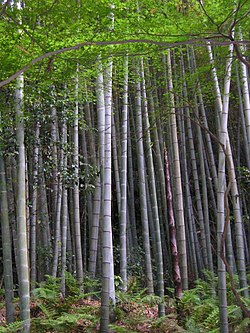
Bamboos are a diverse group of mostly evergreen perennial flowering plants making up the subfamily Bambusoideae of the grass family Poaceae. Giant bamboos are the largest members of the grass family, in the case of Dendrocalamus sinicus having individual stalks (culms) reaching a length of 46 meters (151 ft), up to 36 centimeters (14 in) in thickness and a weight of up to 450 kilograms (1,000 lb). The internodes of bamboos can also be of great length. Kinabaluchloa wrayi has internodes up to 2.5 meters (8 ft) in length. and Arthrostylidium schomburgkii has internodes up to 5 meters (16 ft) in length, exceeded in length only by papyrus. By contrast, the stalks of the tiny bamboo Raddiella vanessiae of the savannas of French Guiana measure only 10–20 millimeters (0.4–0.8 in) in length by about 2 millimeters (0.08 in) in width. The origin of the word "bamboo" is uncertain, but it most likely comes from the Dutch or Portuguese language, which originally borrowed it from Malay.
In bamboo, as in other grasses, the internodal regions of the stem are usually hollow and the vascular bundles in the cross-section are scattered throughout the walls of the stalk instead of in a cylindrical cambium layer between the bark (phloem) and the wood (xylem) as in dicots and conifers. The dicotyledonous woody xylem is also absent. The absence of secondary growth wood causes the stems of monocots, including the palms and large bamboos, to be columnar rather than tapering.
Bamboos include some of the fastest-growing plants in the world, due to a unique rhizome-dependent system. Certain species of bamboo can grow 91 centimeters (36 inches) within a 24-hour period, at a rate of almost 40 millimeters (1+1⁄2 in) an hour (equivalent to 1 mm (0.04 in) every 90 seconds). Growth up to 120 centimeters (47.2 in) in 24 hours has been observed in the instance of Japanese giant timber bamboo (Phyllostachys bambusoides). This rapid growth and tolerance for marginal land, make bamboo a good candidate for afforestation, carbon sequestration and climate change mitigation.
Bamboo is versatile and has notable economic and cultural significance in South Asia, Southeast Asia, and East Asia, being used for building materials, as a food source, and as a raw product, and depicted often in arts, such as in bamboo paintings and bambooworking. Bamboo, like wood, is a natural composite material with a high strength-to-weight ratio useful for structures. Bamboo's strength-to-weight ratio is similar to timber, and its strength is generally similar to a strong softwood or hardwood timber. Some bamboo species have displayed remarkable strength under test conditions. Bambusa tulda of Bangladesh and adjoining India has tested as high as 60,000 psi (400 MPa) in tensile strength. Other bamboo species make extraordinarily hard material. Bambusa tabacaria of China contains so much silica that it will make sparks when struck by an axe.
Bamboos have long been considered the most basal grass genera, mostly because of the presence of bracteate, indeterminate inflorescences, "pseudospikelets", and flowers with three lodicules, six stamens, and three stigmata. Following more recent molecular phylogenetic research, many tribes and genera of grasses formerly included in the Bambusoideae are now classified in other subfamilies, e.g. the Anomochlooideae, the Puelioideae, and the Ehrhartoideae. The subfamily in its current sense belongs to the BOP clade of grasses, where it is sister to the Pooideae (bluegrasses and relatives).
The bamboos comprise three clades classified as tribes, and these strongly correspond with geographic divisions representing the New World herbaceous species (Olyreae), tropical woody bamboos (Bambuseae), and temperate woody bamboos (Arundinarieae). The woody bamboos do not form a monophyletic group; instead, the tropical woody and herbaceous bamboos are sister to the temperate woody bamboos. Altogether, more than 1,400 species are placed in 115 genera.
22 genera:
73 genera:
Bamboo
Bamboos are a diverse group of mostly evergreen perennial flowering plants making up the subfamily Bambusoideae of the grass family Poaceae. Giant bamboos are the largest members of the grass family, in the case of Dendrocalamus sinicus having individual stalks (culms) reaching a length of 46 meters (151 ft), up to 36 centimeters (14 in) in thickness and a weight of up to 450 kilograms (1,000 lb). The internodes of bamboos can also be of great length. Kinabaluchloa wrayi has internodes up to 2.5 meters (8 ft) in length. and Arthrostylidium schomburgkii has internodes up to 5 meters (16 ft) in length, exceeded in length only by papyrus. By contrast, the stalks of the tiny bamboo Raddiella vanessiae of the savannas of French Guiana measure only 10–20 millimeters (0.4–0.8 in) in length by about 2 millimeters (0.08 in) in width. The origin of the word "bamboo" is uncertain, but it most likely comes from the Dutch or Portuguese language, which originally borrowed it from Malay.
In bamboo, as in other grasses, the internodal regions of the stem are usually hollow and the vascular bundles in the cross-section are scattered throughout the walls of the stalk instead of in a cylindrical cambium layer between the bark (phloem) and the wood (xylem) as in dicots and conifers. The dicotyledonous woody xylem is also absent. The absence of secondary growth wood causes the stems of monocots, including the palms and large bamboos, to be columnar rather than tapering.
Bamboos include some of the fastest-growing plants in the world, due to a unique rhizome-dependent system. Certain species of bamboo can grow 91 centimeters (36 inches) within a 24-hour period, at a rate of almost 40 millimeters (1+1⁄2 in) an hour (equivalent to 1 mm (0.04 in) every 90 seconds). Growth up to 120 centimeters (47.2 in) in 24 hours has been observed in the instance of Japanese giant timber bamboo (Phyllostachys bambusoides). This rapid growth and tolerance for marginal land, make bamboo a good candidate for afforestation, carbon sequestration and climate change mitigation.
Bamboo is versatile and has notable economic and cultural significance in South Asia, Southeast Asia, and East Asia, being used for building materials, as a food source, and as a raw product, and depicted often in arts, such as in bamboo paintings and bambooworking. Bamboo, like wood, is a natural composite material with a high strength-to-weight ratio useful for structures. Bamboo's strength-to-weight ratio is similar to timber, and its strength is generally similar to a strong softwood or hardwood timber. Some bamboo species have displayed remarkable strength under test conditions. Bambusa tulda of Bangladesh and adjoining India has tested as high as 60,000 psi (400 MPa) in tensile strength. Other bamboo species make extraordinarily hard material. Bambusa tabacaria of China contains so much silica that it will make sparks when struck by an axe.
Bamboos have long been considered the most basal grass genera, mostly because of the presence of bracteate, indeterminate inflorescences, "pseudospikelets", and flowers with three lodicules, six stamens, and three stigmata. Following more recent molecular phylogenetic research, many tribes and genera of grasses formerly included in the Bambusoideae are now classified in other subfamilies, e.g. the Anomochlooideae, the Puelioideae, and the Ehrhartoideae. The subfamily in its current sense belongs to the BOP clade of grasses, where it is sister to the Pooideae (bluegrasses and relatives).
The bamboos comprise three clades classified as tribes, and these strongly correspond with geographic divisions representing the New World herbaceous species (Olyreae), tropical woody bamboos (Bambuseae), and temperate woody bamboos (Arundinarieae). The woody bamboos do not form a monophyletic group; instead, the tropical woody and herbaceous bamboos are sister to the temperate woody bamboos. Altogether, more than 1,400 species are placed in 115 genera.
22 genera:
73 genera:
Recent media
Recent media