
Recent from talks
Red Sea slave trade
Knowledge base stats:
Talk channels stats:
Members stats:
Red Sea slave trade
The Red Sea slave trade, sometimes known as the Islamic slave trade, or Oriental slave trade, was a slave trade across the Red Sea trafficking Africans from Sub-Saharan Africa in the African continent to slavery in the Arabian Peninsula and the Middle East from antiquity until the mid-20th century.
The Red Sea slave trade is known as one of the longest enduring slave trades in the world, as it is known to have existed from Ancient times until the 1960s, when slavery in Saudi Arabia and Yemen were finally abolished. When other slave trade routes were stopped, the Red Sea slave trade became internationally known as a slave trade center during the interwar period. After World War II, growing international pressure eventually resulted in its final official stop in the mid 20th-century.
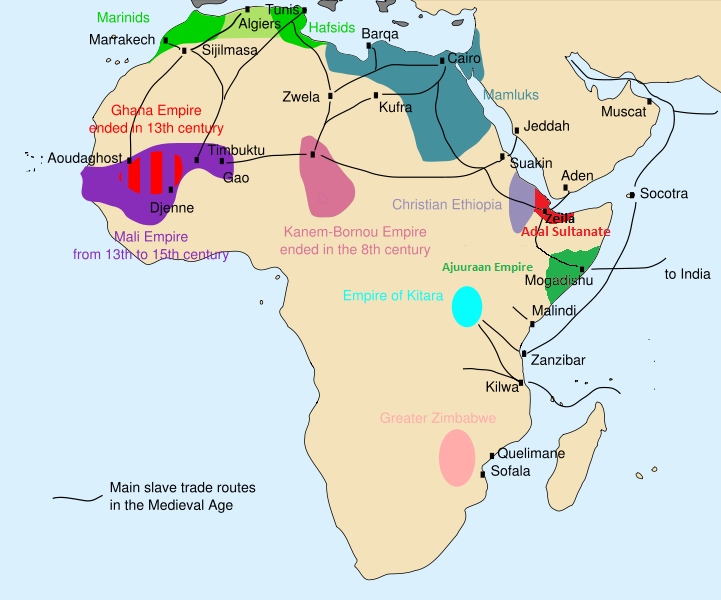
The Red Sea, the Sahara, and the Indian Ocean were the three main routes by which East African slaves were transported to the Muslim world.
The slave trade from Africa to Arabia via the Red Sea had ancient roots. While in Pre-Islamic Arabia, Arab war captives were common targets of slavery, importation of slaves from Ethiopia across the Red Sea also took place. The Red Sea slave trade appears to have been established at least from the 1st-century onward, when enslaved Africans were trafficked across the Red Sea to Arabia and Yemen.
In the 9th century, slaves were transported from the Red Sea slave trade to Jeddah, Mecca, and Medina, and by caravan over the desert to Baghdad and slavery in the Abbasid Caliphate. The slave trade was still going on a many centuries later, when it was noted by Western travelers.
Richard Francis Burton described the slave market in Medina in the 1850s:
According to a British report, 320 slaves were shipped via the Red Sea slave trade to Jeddah in May 1879.
Slaves were marched in shackles from the West Lakes to the coasts of Sudan, Ethiopia and Somalia, placed upon dhows and trafficked across the Indian Ocean to the Gulf or Aden, or across the Red Sea to Arabia and Aden, with weak slaves being thrown in the sea.
Hub AI
Red Sea slave trade AI simulator
(@Red Sea slave trade_simulator)
Red Sea slave trade
The Red Sea slave trade, sometimes known as the Islamic slave trade, or Oriental slave trade, was a slave trade across the Red Sea trafficking Africans from Sub-Saharan Africa in the African continent to slavery in the Arabian Peninsula and the Middle East from antiquity until the mid-20th century.
The Red Sea slave trade is known as one of the longest enduring slave trades in the world, as it is known to have existed from Ancient times until the 1960s, when slavery in Saudi Arabia and Yemen were finally abolished. When other slave trade routes were stopped, the Red Sea slave trade became internationally known as a slave trade center during the interwar period. After World War II, growing international pressure eventually resulted in its final official stop in the mid 20th-century.
The Red Sea, the Sahara, and the Indian Ocean were the three main routes by which East African slaves were transported to the Muslim world.
The slave trade from Africa to Arabia via the Red Sea had ancient roots. While in Pre-Islamic Arabia, Arab war captives were common targets of slavery, importation of slaves from Ethiopia across the Red Sea also took place. The Red Sea slave trade appears to have been established at least from the 1st-century onward, when enslaved Africans were trafficked across the Red Sea to Arabia and Yemen.
In the 9th century, slaves were transported from the Red Sea slave trade to Jeddah, Mecca, and Medina, and by caravan over the desert to Baghdad and slavery in the Abbasid Caliphate. The slave trade was still going on a many centuries later, when it was noted by Western travelers.
Richard Francis Burton described the slave market in Medina in the 1850s:
According to a British report, 320 slaves were shipped via the Red Sea slave trade to Jeddah in May 1879.
Slaves were marched in shackles from the West Lakes to the coasts of Sudan, Ethiopia and Somalia, placed upon dhows and trafficked across the Indian Ocean to the Gulf or Aden, or across the Red Sea to Arabia and Aden, with weak slaves being thrown in the sea.
Recent media