Hubbry Logo
MedinaMedinaMain
Open search
Medina
Community hub
Medina
logo
8 pages, 0 posts
0 subscribers
Be the first to start a discussion here.
Medina
Medina
from Wikipedia

Key Information

Medina,[a] officially al-Madinah al-Munawwarah,[b] also known as Taybah[c] and known in pre-Islamic times as Yathrib,[d] is the capital and administrative centre of Medina Province in the Hejaz region of western Saudi Arabia. It is one of the oldest and most important places in Islamic history. The second holiest city in Islam, the population as of 2022 is 1,477,023, making it the fourth-most populous city in the country. Around 58.5% of the population are Saudi citizens and 41.5% are foreigners.[4] Located at the core of the Medina Province in the western reaches of the country, the city is distributed over 589 km2 (227 sq mi), of which 293 km2 (113 sq mi) constitutes the city's urban area, while the rest is occupied by the Hejaz Mountains, empty valleys, agricultural spaces and older dormant volcanoes.

Medina is generally considered to be the "cradle of Islamic culture and civilization".[5] The city is considered to be the second-holiest of three key cities in Islamic tradition, with Makkah and Jerusalem serving as the holiest and third-holiest cities respectively. Al-Masjid al-Nabawi (lit.'The Prophet's Mosque') is of exceptional importance in Islam and serves as burial site of the prophet Muhammad, by whom the mosque was built in 622 CE (first year of the Hijrah). Observant Muslims usually visit his tomb, or rawdhah, at least once in their lifetime during a pilgrimage known as Ziyarat, although this is not obligatory.[6] The original name of the city before the advent of Islam was Yathrib (Arabic: يَثْرِب), and it is referred to by this name in Chapter 33 (Al-Aḥzāb, lit.'The Confederates') of the Quran. It was renamed to Madīnat an-Nabī (lit.'City of the Prophet' or 'The Prophet's City') after and later to al-Madinah al-Munawwarah (lit.'The Enlightened City') before being simplified and shortened to its modern name, Madinah (lit.'The City'), from which the English-language spelling of "Medina" is derived. Saudi road signage uses Madinah and al-Madinah al-Munawwarah interchangeably.[6]

The city existed for over 1,500 years before Muhammad's migration from Mecca,[7] known as the Hijrah. Medina was the capital of a rapidly increasing Muslim caliphate under Muhammad's leadership, serving as its base of operations and as the cradle of Islam, where Muhammad's ummah (lit.'nation')—composed of Medinan citizens (Ansar) as well as those who immigrated with Muhammad (Muhajirun), who were collectively known as the Sahabah—gained huge influence. Medina is home to three prominent mosques, namely al-Masjid an-Nabawi, Quba Mosque, and Masjid al-Qiblatayn, with the Quba Mosque being the oldest in Islam. A larger portion of the Qur'an was revealed in Medina in contrast to the earlier Meccan surahs.[8][9]

Much like most of the Hejaz, Medina has seen numerous exchanges of power within its comparatively short existence. The region has been controlled by Jewish-Arabian tribes (up until the fifth century CE), the ʽAws and Khazraj (up until Muhammad's arrival), Muhammad and the Rashidun (622–660), the Umayyads (660–749), the Abbasids (749–1254), the Mamluks of Egypt (1254–1517), the Ottomans (1517–1805), the First Saudi State (1805–1811), Muhammad Ali of Egypt (1811–1840), the Ottomans for a second time (1840–1918), the Sharifate of Mecca under the Hashemites (1918–1925) and finally is in the hands of the present-day Kingdom of Saudi Arabia (1925–present).[6]

In addition to visiting for Ziyarah, tourists come to visit the other prominent mosques and landmarks in the city that hold religious significance such as Mount Uhud, Al-Baqi' cemetery and the Seven Mosques among others. The Saudi government has also carried out the destruction of several historical structures and archaeological sites, both in Medina and Mecca.[10]

Names

[edit]

Yathrib

[edit]

Before the advent of Islam, the city was known as Yathrib (Arabic: يَثْرِب, romanisedYaṯrib; pronounced [ˈjaθrɪb]). The word Yathrib appears in an inscription found in Harran, belongs to the Babylonian king Nabonidus (6th century BCE)[11] and is well attested in several texts in the subsequent centuries.[12] The name has also been recorded in Āyah (verse) 13 of Surah (chapter) 33 of the Qur'an.[Quran 33:13] and is thus known to have been the name of the city up to the Battle of the Trench. According to Islamic tradition, Muhammad later forbade calling the city by this name.[13]

Taybah and Tabah

[edit]
8th century rock inscription discovered in Medina, refers to the city as 'Taybah'

Sometime after the battle, Muhammad renamed the city Taybah (the Kind or the Good) (Arabic pronunciation: [ˈtˤajba]; طَيْبَة)[14] and Tabah (Arabic: طَابَة)[15] which is of similar meaning. This name is also used to refer to the city in the popular folk song, "Ya Taybah!" (O Taybah!). The two names are combined in another name the city is known by, Taybat at-Tabah (the Kindest of the Kind).

Madinah

[edit]

The city has also simply been called Al-Madinah (i.e. 'The City') in some ahadith[15]. The names al-Madīnah an-Nabawiyyah (ٱلْمَدِيْنَة ٱلنَّبَوِيَّة) and Madīnat un-Nabī (both meaning "City of the Prophet" or "The Prophet's City") and al-Madīnat ul-Munawwarah ("The Enlightened City") are all derivatives of this word. This is also the most commonly accepted modern name of the city, used in official documents and road signage, along with Madinah.

History

[edit]

Medina is home to several distinguished sites and landmarks, most of which are mosques and hold historic significance. These include the three aforementioned mosques, Masjid al-Fath (also known as Masjid al-Khandaq), the Seven Mosques, the Baqi' Cemetery where the graves of many famous Islamic figures are presumed to be located; directly to the southeast of the Prophet's Mosque, the Uhud mountain, site of the eponymous Battle of Uhud and the King Fahd Glorious Qur'an Printing Complex where most modern Qur'anic Mus'hafs are printed.

Early history

[edit]

Medina has been inhabited at least 1500 years before the Hijra, or approximately the 9th century BCE.[7] By the fourth century, Arab tribes began to encroach from Yemen, and there were three prominent Jewish tribes that inhabited the city around the time of Muhammad: the Banu Qaynuqa, the Banu Qurayza, and Banu Nadir.[16] Ibn Khordadbeh later reported that during the Persian Empire's domination in Hejaz, the Banu Qurayza served as tax collectors for the Persian Shah.[17][full citation needed]

The situation changed after the arrival of two new Arab tribes, the 'Aws or Banu 'Aws and the Khazraj, also known as the Banu Khazraj. At first, these tribes were allied with the Jewish tribes who ruled the region, but they later revolted and became independent.[18]

17th century CE bronze token the inscription below reads 'Madinah Shareef' (Noble City)
17th century bronze token depicting prophet's Mosque, the inscription below reads 'Madinah Shareef' (Noble City)

Under the 'Aws and Khazraj

[edit]

Toward the end of the 5th century,[19] the Jewish rulers lost control of the city to the two Arab tribes.

Most modern historians accept the claim of the Muslim sources that after the revolt, the Jewish tribes became clients of the 'Aws and the Khazraj.[20] However, according to Scottish scholar, William Montgomery Watt, the clientship of the Jewish tribes is not borne out by the historical accounts of the period prior to 627, and he maintained that the Jewish populace retained a measure of political independence.[18]

Early Muslim chronicler Ibn Ishaq tells of an ancient conflict between the last Yemenite king of the Himyarite Kingdom[21] and the residents of Yathrib. When the king was passing by the oasis, the residents killed his son, and the Yemenite ruler threatened to exterminate the people and cut down the palms. According to Ibn Ishaq, he was stopped from doing so by two rabbis from the Banu Qurayza tribe, who implored the king to spare the oasis because it was the place "to which a prophet of the Quraysh would migrate in time to come, and it would be his home and resting-place." The Yemenite king thus did not destroy the town and converted to Judaism. He took the rabbis with him, and in Mecca, they reportedly recognised the Ka'bah as a structure built by Abraham and advised the king "to do what the people of Mecca did: to circumambulate the structure, to venerate and honor it, to shave his head and to behave with all humility until he had left its precincts." On approaching Yemen, tells Ibn Ishaq, the rabbis demonstrated to the local people a miracle by coming out of a fire unscathed and the Yemenites accepted Judaism.[22]

Eventually the Banu 'Aws and the Banu Khazraj became hostile to each other and by the time of Muhammad's Hijrah (emigration) to Medina in 622, they had been fighting for 120 years and were sworn enemies[23] The Banu Nadir and the Banu Qurayza were allied with the 'Aws, while the Banu Qaynuqa sided with the Khazraj.[24] They fought a total of four wars.[18]

Their last and bloodiest known battle was the Battle of Bu'ath,[18] fought a few years prior to the arrival of Muhammad.[16] The outcome of the battle was inconclusive, and the feud continued. 'Abd Allah ibn Ubayy, one Khazraj chief, had refused to take part in the battle, which earned him a reputation for equity and peacefulness. He was the most respected inhabitant of the city prior to Muhammad's arrival. To solve the ongoing feud, concerned residents of Yathrib met secretly with Muhammad in 'Aqaba, a place outside Mecca, inviting him and his small group of believers to come to the city, where Muhammad could serve a mediator between the factions and his community could practice its faith freely.

Under Muhammad and the Rashidun

[edit]
Muhammad built the Quba'a Masjid upon his arrival at Medina and is said to have visited the mosque every Saturday afternoon.

In 622, Muhammad and an estimated 70 Meccan Muhajirun left Mecca over a period of a few months for sanctuary in Yathrib, an event that transformed the religious and political landscape of the city completely; the longstanding enmity between the Aus and Khazraj tribes was dampened as many of the two Arab tribes and some local Jews embraced the new religion of Islam. Muhammad, linked to the Khazraj through his great-grandmother, was agreed on as the leader of the city.

According to Ibn Ishaq, all parties in the area agreed to the Constitution of Medina, which committed all parties to mutual cooperation under the leadership of Muhammad. The nature of this document as recorded by Ibn Ishaq and transmitted by Ibn Hisham is the subject of dispute among modern Western historians, many of whom maintain that this "treaty" is possibly a collage of different agreements, oral rather than written, of different dates, and that it is not clear exactly when they were made. Other scholars, however, both Western and Muslim, argue that the text of the agreement—whether a single document originally or several—is possibly one of the oldest Islamic texts we possess.[25] In Yemenite Jewish sources, another treaty was drafted between Muhammad and his Jewish subjects, known as Kitāb Dimmat al-Nabi, written in the 3rd year of the Hijra (625), and which gave express liberty to Jews living in Arabia to observe the Sabbath and to grow-out their side-locks. In return, they were to pay the jizya annually for protection by their patrons, while the Muslims would pay the Zakat tax.[26][6]

Battle of Uhud

[edit]
Mount Uhud, with the old Mosque of the Leader of Martyrs (جامع سيد الشهداء), named after Muhammad's uncle, Hamza ibn Abdul Muttalib, in the foreground. The mosque was demolished in 2012 and a new, larger mosque with the same name was built in its place.[27]

In the year 625, Abu Sufyan ibn Harb, a senior chieftain of Mecca who later converted to Islam, led a Meccan force against Medina. Muhammad marched out to meet the Qurayshi army with an estimated 1,000 troops, but just as the army approached the battlefield, 300 men under 'Abd Allah ibn Ubayy withdrew, dealing a severe blow to the Muslim army's morale. Muhammad continued marching with his now 700-strong force and ordered a group of 50 archers to climb a small hill, now called Jabal ar-Rummaah (The Archers' Hill) to keep an eye on the Meccan's cavalry and to provide protection to the rear of the Muslim's army. As the battle heated up, the Meccans were forced to retreat. The frontline was pushed further and further away from the archers and foreseeing the battle to be a victory for the Muslims, the archers decided to leave their posts to pursue the retreating Meccans. A small party, however, stayed behind; pleading the rest to not disobey Muhammad's orders.

Seeing that the archers were starting to descend from the hill, Khalid ibn al-Walid commanded his unit to ambush the hill and his cavalry unit pursued the descending archers were systematically slain by being caught in the plain ahead of the hill and the frontline, watched upon by their desperate comrades who stayed behind up in the hill who were shooting arrows to thwart the raiders, but with little to no effect. However, the Meccans did not capitalise on their advantage by invading Medina and returned to Mecca. The Madanis (people of Medina) suffered heavy losses, and Muhammad was injured.[28]

Battle of the Trench

[edit]
Three of the Seven Mosques at the site of the Battle of the Trench were combined into the modern Masjid al-Fath, here pictured with Jabal Sal'aa in the background and a shop selling local goods in the foreground.

In 627, Abu Sufyan led another force toward Medina. Knowing of his intentions, Muhammad asked for proposals for defending the northern flank of the city, as the east and west were protected by volcanic rocks and the south was covered with palm trees. Salman al-Farsi, a Persian Sahabi who was familiar with Sasanian war tactics recommended digging a trench to protect the city and Muhammad accepted it. The subsequent siege came to be known as the Battle of the Trench and the Battle of the Confederates. After a month-long siege and various skirmishes, the Meccans withdrew again due to the harsh winter.

During the siege, Abu Sufyan contacted the Jewish tribe of Banu Qurayza and formed an agreement with them, to attack the Muslim defenders and effectively encircle the defenders. It was however discovered by the Muslims and thwarted. This was in breach of the Constitution of Medina and after the Meccan withdrawal, Muhammad immediately marched against the Qurayza and laid siege to their strongholds. The Jewish forces eventually surrendered. Some members of the Aws negotiated on behalf of their old allies and Muhammad agreed to appoint one of their chiefs who had converted to Islam, Sa'd ibn Mu'adh, as judge. Sa'ad judged that all male members of the tribe should be killed and the women and children enslaved.[29][30] This action was conceived of as a defensive measure to ensure that the Muslim community could be confident of its continued survival in Medina. The French historian Robert Mantran proposes that from this point of view it was successful—from this point on, the Muslims were no longer primarily concerned with survival but with expansion and conquest.[31]

In the ten years following the hijra, Medina formed the base from which Muhammad and the Muslim army attacked and were attacked, and it was from here that he marched on Mecca, entering it without battle in 630. Despite Muhammad's tribal connection to Mecca, the growing importance of Mecca in Islam, the significance of the Ka'bah as the centre of the Islamic world, as the direction of prayer (Qibla), and in the Islamic pilgrimage (Hajj), Muhammad returned to Medina, which remained for some years the most important city of Islam and the base of operations of the early Rashidun Caliphate.[6]

The city is presumed to have been renamed Madinat al-Nabi ("City of the Prophet" in Arabic) in honour of Muhammad's prophethood and the city being the site of his burial. Alternatively, Lucien Gubbay suggests the name Medina could also have been a derivative from the Aramaic word Medinta, which the Jewish inhabitants could have used for the city.[32]

Under the first three caliphs Abu Bakr, Umar, and Uthman, Medina was the capital of a rapidly increasing Muslim Empire. During the reign of 'Uthman ibn al-Affan, the third caliph, a party of Arabs from Egypt, disgruntled at some of his political decisions, attacked Medina in 656 and assassinated him in his own home. Ali, the fourth caliph, changed the capital of the caliphate from Medina to Kufa in Iraq for being in a more strategic location. Since then, Medina's importance dwindled, becoming more a place of religious importance than of political power. Medina witnessed little to no economic growth during and after Ali's reign.[6]

The Green Dome was built in 1297 over Muhammad's rawdhah (residence) and site of burial.

Under subsequent Islamic regimes

[edit]

Umayyad Caliphate

[edit]

After al-Hasan, the son of 'Ali, ceded power to Mu'awiyah I, son of Abu Sufyan, Mu'awiyah marched into Kufa, Ali's capital, and received the allegiance of the local 'Iraqis. This is considered to be the beginning of the Umayyad caliphate. Mu'awiyah's governors took special care of Medina and dug the 'Ayn az-Zarqa'a ("Blue Spring") spring along with a project that included the creation of underground ducts for the purposes of irrigation. Dams were built in some of the wadis and the subsequent agricultural boom led to the strengthening of the economy.

The Gold dinar of Umar II, also known as 'Umar ibn Abdulaziz or the Fifth of the Rightly Guided Caliphs.

Following a period of unrest during the Second Fitna in 679, Husayn ibn 'Ali was martyred at Karbala and Yazid assumed unchecked control for the next three years. In 682, Abd Allah ibn al-Zubayr declared himself Caliph of Mecca and the people of Medina swore allegiance to him. This led to an eight-year-long period of economic distress for the city. In 692, the Umayyads regained power and Medina experienced its second period of huge economic growth. Trade improved and more people moved into the city. The banks of Wadi al-'Aqiq were now lush with greenery. This period of peace and prosperity coincided with the rule of 'Umar ibn Abdulaziz, who many consider to be the fifth of the Rashidun.[6]

Abbasid Caliphate

[edit]

Abdulbasit A. Badr, in his book, Madinah, The Enlightened City: History and Landmarks, divides this period into three distinct phases:[6]

Tomb of Salahuddin al-Ayyubi, who started a tradition of greatly funding Medina and protecting pilgrims visiting the holy city.
The Medina sanctuary and Green Dome, photographed in 1880 by Muhammad Sadiq. The dome was built during the Mamluk period, but given its signature colour by the Ottomans nearly 600 years later.

Badr describes the period between 749 and 974 as a push-and-pull between peace and political turmoil, while Medina continued to pay allegiance to the Abbasids. From 974 to 1151, the Sharifate of Medina was in a liaison with the Fatimids, even though the political stand between the two remained turbulent and did not exceed the normal allegiance. From 1151 onwards, Medina paid allegiance to the Zengids, and the Emir Nuruddin Zengi took care of the roads used by pilgrims and funded the fixing of the water sources and streets. When he visited Medina in 1162, he ordered the construction of a new wall that encompassed the new urban areas outside the old city wall. Zengi was succeeded by Saladin, founder of the Ayyubid dynasty, who supported Qasim ibn Muhanna, the Sharif of Medina, and greatly funded the growth of the city while slashing taxes paid by the pilgrims.[6] He also funded the Bedouins who lived on the routes used by pilgrims to protect them on their journeys. The later Abbasids also continued to fund the expenses of the city. While Medina was formally allied with the Abbasids during this period, they maintained closer relations with the Zengids and Ayyubids. The historic city formed an oval, surrounded by a strong wall, 30 to 40 ft (9.1 to 12.2 m) high, dating from this period, and was flanked with towers. Of its four gates, the Bab al-Salam ("The Gate of Peace"), was remarked for its beauty. Beyond the walls of the city, the west and south were suburbs consisting of low houses, yards, gardens and plantations.[6]

Mamluk Sultanate of Cairo

[edit]

After the fall of Baghdad, the capital of the Abbasid Empire, to the Mongols, the Mamluk Sultanate of Cairo took over the Egyptian governorate and effectively gained control of Medina.[6] In 1258, Medina was threatened by lava from the Harrat Rahat volcanic region but was narrowly saved from being burnt after the lava turned northward.[6][33][34] During Mamluk reign, the Masjid an-Nabawi caught fire twice. Once in 1256, when the storage caught fire, burning the entire mosque, and the other time in 1481, when the masjid was struck by lightning. This period also coincided with an increase in scholarly activity in Medina, with scholars such as Ibn Farhun, Al-Hafiz Zain al-Din al-'Iraqi, Al Sakhawi and others settling in the city.[6] The striking iconic Green Dome also found its beginnings as a cupola built under Mamluk Sultan al-Mansur Qalawun as-Salihi in 1297.[6]

Al-Baqi in the Ottoman Empire

[edit]

First Ottoman period

[edit]

In 1517, the first Ottoman period began with Selim I's conquest of Mamluk Egypt. This added Medina to their territory and they continued the tradition of showering Medina with money and aid. In 1532, Suleiman the Magnificent built a secure fortress around the city and constructed a strong castle armed by an Ottoman battalion to protect the city. This is also the period in which many of the Prophet's Mosque's modern features were built even though it was not painted green yet.[35] These suburbs also had walls and gates. The Ottoman sultans took a keen interest in the Prophet's Mosque and redesigned it over and over to suit their preferences.

Muhammad Ali, who kept Medina in the hands of the Ottoman Empire for around 30 years after taking it from the First Saudi State.

First Saudi insurgency

[edit]

As the Ottomans' hold over their domains broke loose, the Madanis pledged alliance to Saud bin Abdulaziz, founder of the First Saudi state in 1805, who quickly took over the city. In 1811, Muhammad Ali of Egypt, Ottoman commander and Wali of Egypt, commanded two armies under each of his two sons to seize Medina, the first one, under the elder Towson Pasha, failed to take Medina. But the second one, a larger army under the command of Ibrahim Pasha, succeeded after battling a fierce resistance movement.[6]

Muhammad Ali's era

[edit]

After defeating his Saudi foes, Muhammad Ali took over governance of Medina and although he did not formally declare independence, his governance took on more of a semi-autonomous style. Muhammad's sons, Towson and Ibrahim, alternated in the governance of the city. Ibrahim renovated the city's walls and the Prophet's Mosque. He established a grand provision distribution centre (taqiyya) to distribute food and alms to the needy and Medina lived a period of security and peace.[citation needed] In 1840, Muhammad moved his troops out of the city and officially handed the city to the central Ottoman command.[6]

Second Ottoman period

[edit]
The Hejaz railway track near Wadi Rum in Jordan. Jordan uses the railway today for transporting phosphate.

Four years in 1844, after Muhammad Ali's departure, Davud Pasha was given the position of governor of Medina under the Ottoman sultan.[6] Davud was responsible for renovating the Prophet's Mosque on Sultan Abdulmejid I's orders.[6] When Abdul Hamid II assumed power, he made Medina stand out of the desert with a number of modern marvels, including a radio communication station, a power plant for the Prophet's Mosque and its immediate vicinity, a telegraph line between Medina and Constantinople, and the Hejaz railway which ran from Damascus to Medina with a planned extension to Mecca.[6] Built between 1904 and 1908, the railway aimed to facilitate the pilgrimage journey and strengthen Ottoman control over the region.[36] Within one decade, the population of the city multiplied by leaps and bounds and reached 80,000.[6] Around this time, Medina started falling prey to a new threat, the Hashemite Sharifate of Mecca in the south. Medina witnessed the longest siege in its history during and after World War I.[6]

Modern history

[edit]

Sharifate of Mecca and Saudi conquest

[edit]

The Sharif of Mecca, Husayn ibn Ali, first attacked Medina on 6 June 1916, in the middle of World War I.[6] Four days later, Husayn held Medina in a bitter 3-year siege, during which the people faced food shortages, widespread disease and mass emigration.[6] Fakhri Pasha, governor of Medina, tenaciously held on during the Siege of Medina from 10 June 1916 and refused to surrender and held on another 72 days after the Armistice of Moudros, until he was arrested by his own men and the city was taken over by the Sharifate on 10 January 1919.[6][37] Husayn largely won the war due to his alliance with the British. In anticipation of the plunder and destruction to follow, Fakhri Pasha secretly dispatched the Sacred Relics of Muhammad to the Ottoman capital, Istanbul.[38] As of 1920, the British described Medina as "much more self-supporting than Mecca."[39] After the Great War, the Sharif of Mecca, Sayyid Hussein bin Ali was proclaimed King of an independent Hejaz. Soon after, the people of Medina secretly entered an agreement with Ibn Saud in 1924, and his son, Prince Mohammed bin Abdulaziz conquered Medina as part of the Saudi conquest of Hejaz on 5 December 1925 which gave way to the whole of the Hejaz being incorporated into the modern Kingdom of Saudi Arabia.[6]

Under the Kingdom of Saudi Arabia

[edit]

The Kingdom of Saudi Arabia focused more on the expansion of the city and the demolition of former sites that according to them violated Islamic principles and Islamic law such as the tombs at al-Baqi. Nowadays, the city mostly only holds religious significance and as such, just like Mecca, has given rise to a number of hotels surrounding the Al-Masjid an-Nabawi, which unlike the Masjid Al-Ḥarām, is equipped with an underground parking. The old city's walls have been destroyed and replaced with the three ring roads that encircle Medina today, named in order of length, King Faisal Road, King Abdullah Road and King Khalid Road. Medina's ring roads generally see less traffic overall compared to the four ring roads of Mecca.

An international airport, named the Prince Mohammed Bin Abdulaziz International Airport, now serves the city and is located on Highway 340, known locally as the Old Qassim Road. The city now sits at the crossroads of two major Saudi Arabian highways, Highway 60, known as the Qassim–Medina Highway, and Highway 15 which connects the city to Mecca in the south and onward and Tabuk in the north and onward, known as the Al Hijrah Highway or Al Hijrah Road, after Muhammad's journey.

Medina from International Space Station, 2017. Note that North is to the right.

The old Ottoman railway system was shut down after their departure from the region and the old railway station has now been converted into a museum. The city has recently seen another connection and mode of transport between it and Mecca, the Haramain high-speed railway line connects the two cities via King Abdullah Economic City near Rabigh, King Abdulaziz International Airport and the city of Jeddah in under 3 hours.

Though the city's sacred core of the old city is off limits to non-Muslims, the Haram area of Medina itself is much smaller than that of Mecca and Medina has recently seen an increase in the number of Muslim and Non-Muslim expatriate workers of other nationalities, most commonly South Asian peoples and people from other countries in the Gulf Cooperation Council. Almost all of the historic city has been demolished in the Saudi era. The rebuilt city is centred on the vastly expanded al-Masjid an-Nabawi.

Destruction of heritage in Medina

[edit]

Saudi Arabia upholds Wahhabism as its religious ideology,[10] which is hostile to any reverence given to historical or religious places of significance for fear that it may give rise to shirk (idolatry). As a consequence, under Saudi rule, Medina has suffered from considerable destruction of its physical heritage including the loss of many buildings over a thousand years old.[10][40] Critics have described this as "Saudi vandalism" and claim that 300 historic sites linked to Muhammad, his family or companions have been lost in Medina and Mecca over the last 50 years.[41] The most famous example of this is the demolition of al-Baqi.[10]

The train which Fakhri Pasha used to transport the Sacred Relics from Medina to Istanbul.

Geography

[edit]
Mount Uhud at night. The mountain is currently the highest peak in Medina and stands at 1,077 m (3,533 ft) of elevation.

Medina is located in the Hejaz region which is a 200 km (120 mi) wide strip between the Nafud desert and the Red Sea.[6] Located approximately 720 km (450 mi) northwest of Riyadh which is at the centre of the Saudi desert, the city is 250 km (160 mi) away from the west coast of Saudi Arabia and at an elevation of approximately 620 m (2,030 ft) above sea level. It lies at 39º36' longitude east and 24º28' latitude north. It covers an area of about 589 km2 (227 sq mi). The city has been divided into twelve districts, 7 of which have been categorised as urban districts, while the other 5 have been categorised as suburban.

Elevation

[edit]

Like most cities in the Hejaz region, Medina is situated at a relatively high elevation. Almost two times as high as Mecca, the city is situated at 620 m (2,030 ft) above sea level. Mount Uhud is the highest peak in Medina and is 1,077 meters (3,533 feet) tall.

Topography

[edit]

Medina is a desert oasis surrounded by the Hejaz Mountains and volcanic hills. The soil surrounding Medina consists of mostly basalt, while the hills, especially noticeable to the south of the city, are volcanic ash which dates to the first geological period of the Paleozoic Era. It is surrounded by a number of famous mountains, most notably Jabal Al-Hujjaj (The Pilgrims' Mountain) to the west, Sal'aa Mountain to the north-west, Jabal al-'Ir or Caravan Mountain to the south and Mount Uhud to the north. The city is situated on a flat mountain plateau at the tripoint of the three valleys (wadis) of Wadi al 'Aql, Wadi al 'Aqiq, and Wadi al Himdh, for this reason, there are large green areas amidst a dry deserted mountainous region.[6]

Climate

[edit]

Under the Köppen climate classification, Medina falls in a hot desert climate region (BWh). Summers are extremely hot and dry with daytime temperatures averaging about 43 °C (109 °F) with nights about 29 °C (84 °F). Temperatures above 45 °C (113 °F) are not unusual between June and September. Winters are milder, with temperatures from 8 °C (46 °F) at night to 25 °C (77 °F) in the day. There is very little rainfall, which falls almost entirely between November and May. In summer, the wind is north-western, while in the spring and winters, is south-western.

Climate data for Medina (1991–2020)
Month Jan Feb Mar Apr May Jun Jul Aug Sep Oct Nov Dec Year
Record high °C (°F) 33.2
(91.8)
36.6
(97.9)
40.0
(104.0)
43.0
(109.4)
46.0
(114.8)
48.1
(118.6)
49.0
(120.2)
48.5
(119.3)
46.4
(115.5)
43.5
(110.3)
37.1
(98.8)
33.0
(91.4)
49.0
(120.2)
Mean daily maximum °C (°F) 24.4
(75.9)
27.0
(80.6)
30.8
(87.4)
35.5
(95.9)
39.7
(103.5)
43.0
(109.4)
43.0
(109.4)
43.8
(110.8)
42.3
(108.1)
37.3
(99.1)
30.4
(86.7)
26.0
(78.8)
35.3
(95.5)
Daily mean °C (°F) 18.3
(64.9)
20.7
(69.3)
24.4
(75.9)
28.9
(84.0)
33.3
(91.9)
36.6
(97.9)
36.8
(98.2)
37.4
(99.3)
35.9
(96.6)
30.7
(87.3)
24.3
(75.7)
20.0
(68.0)
28.9
(84.1)
Mean daily minimum °C (°F) 12.1
(53.8)
14.1
(57.4)
17.4
(63.3)
21.7
(71.1)
25.9
(78.6)
29.0
(84.2)
29.8
(85.6)
30.5
(86.9)
28.6
(83.5)
23.5
(74.3)
18.0
(64.4)
14.0
(57.2)
22.1
(71.7)
Record low °C (°F) 1.0
(33.8)
1.4
(34.5)
7.0
(44.6)
11.5
(52.7)
14.0
(57.2)
21.7
(71.1)
22.0
(71.6)
23.0
(73.4)
18.2
(64.8)
11.6
(52.9)
5.0
(41.0)
3.0
(37.4)
1.0
(33.8)
Average precipitation mm (inches) 8.6
(0.34)
3.0
(0.12)
5.3
(0.21)
6.5
(0.26)
4.5
(0.18)
0.2
(0.01)
1.3
(0.05)
3.9
(0.15)
0.3
(0.01)
5.2
(0.20)
13.9
(0.55)
7.0
(0.28)
59.7
(2.35)
Average precipitation days (≥ 1.0 mm) 0.9 0.3 0.6 0.9 0.8 0.1 0.2 0.6 0.1 0.8 1.4 0.8 7.4
Average relative humidity (%) 38 31 25 32 17 12 14 16 14 19 32 38 24
Mean monthly sunshine hours 251.1 243.0 288.3 282.0 297.6 318.0 319.3 294.5 279.0 291.4 255.0 251.1 3,370.3
Mean daily sunshine hours 8.1 8.6 9.3 9.4 9.6 10.6 10.3 9.5 9.3 9.4 8.5 8.1 9.2
Source 1: World Meteorological Organization,[42] Jeddah Regional Climate Center[43]
Source 2: Deutscher Wetterdienst (sunshine hours, 1999–2010)[44]

Significance in Islam

[edit]

Medina's importance as a religious site derives from the presence of two mosques, Masjid Quba'a and al-Masjid an-Nabawi. Both of these mosques were built by Muhammad himself. Islamic scriptures emphasise the sacredness of Medina. Medina is mentioned several times in the Quran; two examples are Surah At-Tawbah (verse 101) and Al-Hashr (verse 8). Medinan suras are typically longer than their Meccan counterparts and they are also larger in number. Muhammad al-Bukhari recorded in Sahih Bukhari that Anas ibn Malik quoted Muhammad as saying:

"Medina is a sanctuary from that place to that. Its trees should not be cut and no heresy should be innovated nor any sin should be committed in it, and whoever innovates in it an heresy or commits sins (bad deeds), then he will incur the curse of God, the angels, and all the people."

The Prophet's Mosque (al-Masjid an-Nabawi)

[edit]

According to Islamic tradition, a prayer in The Prophet's Mosque equates to 1,000 prayers in any other mosque except the Masjid al-Haram[45] where one prayer equates to 100,000 prayers in any other mosque.[45] The mosque was initially just an open space for prayer with a raised and covered minbar (pulpit) built within seven months and was located beside Muhammad's rawdhah (residence, although the word literally means garden) to its side along with the houses of his wives. The mosque was expanded several times throughout history, with many of its internal features developed over time to suit contemporary standards.

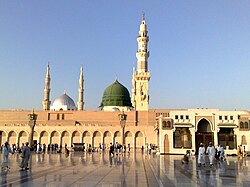
The modern Prophet's Mosque is famed for the Green Dome situated directly above Muhammad's rawdhah, which currently serves as the burial site for Muhammad, Abu Bakr al-Siddiq and Umar ibn al-Khattab and is used in road signage along with its signature minaret as an icon for Medina itself. The entire piazza of the mosque is shaded from the sun by 250 membrane umbrellas.

Panoramic view of the Prophet's Mosque, from the east at sunset.

Quba'a Mosque

[edit]
The Quba Mosque at night

It is Sunnah to perform prayer at the Quba'a Mosque. According to a hadith, Sahl ibn Hunayf reported that Muhammad said,

"Whoever purifies himself in his house, then comes to the mosque of Quba' and prays in it, he will have a reward like the Umrah pilgrimage."[13][45]

and in another narration,

"Whoever goes out until he comes to this mosque – meaning the Mosque of Quba' – and prays there, that will be equivalent to 'Umrah."[13]

It has been recorded by al-Bukhari and Muslim that Muhammad used to go to Quba'a every Saturday to offer two rak'ahs of Sunnah prayer. The mosque at Quba'a was built by Muhammad himself upon his arrival to the old city of Medina. Quba'a and the mosque has been referred in the Qur'an indirectly in Surah At-Tawbah, verse 108.

Other sites

[edit]

Masjid al-Qiblatayn

[edit]

Masjid al-Qiblatayn is another mosque historically important to Muslims. Muslims believe that Muhammad was commanded to change his direction of prayer (qibla) from praying toward Jerusalem to praying toward the Ka'bah at Mecca, as he was commanded in Surah Al-Baqarah, verses 143 and 144.[46] The mosque is currently being expanded to be able to hold more than 4,000 worshippers.[47]

Masjid al-Fath and the Seven Mosques

[edit]

Three of these historic six mosques were combined recently into the larger Masjid al-Fath with an open courtyard.[6] Sunni sources contend that there is no hadith or any other evidence to prove that Muhammad may have said something about the virtue of these mosques.

Al-Baqi' Cemetery

[edit]

Al-Baqi' is a significant cemetery in Medina where several family members of Muhammad, caliphs and scholars are known to have been buried.[6]

In Islamic eschatology

[edit]

End of civilisation

[edit]

Concerning the end of civilisation in Medina, Abu Hurairah is recorded to have said that Muhammad said:[48]

"The people will leave Medina in spite of the best state it will have, and none except the wild birds and the beasts of prey will live in it, and the last persons who will die will be two shepherds from the tribe of Muzaina, who will be driving their sheep towards Medina, but will find nobody in it, and when they reach the valley of Thaniyat-al-Wada'h, they will fall down on their faces dead."[48] (al-Bukhari, Vol. 3, Book 30, Hadith 98)

Sufyan ibn Abu Zuhair said Muhammad said:[48]

"Yemen will be conquered and some people will migrate (from Medina) and will urge their families, and those who will obey them to migrate (to Yemen) although Medina will be better for them; if they but knew. Sham will also be conquered and some people will migrate (from Medina) and will urge their families and those who will obey them, to migrate (to Sham) although Medina will be better for them; if they but knew. 'Iraq will be conquered and some people will migrate (from Medina) and will urge their families and those who will obey them to migrate (to 'Iraq) although Medina will be better for them; if they but knew."[48] (al-Bukhari, Vol. 3, Book 30, Hadith 99)

Protection from plague and ad-Dajjal (the False Messiah)

[edit]

With regards to Medina's protection from plague and ad-Dajjal, the following ahadith were recorded:

by Abu Bakra:[48]

"The terror caused by Al-Masih Ad-Dajjal will not enter Medina and at that time Medina will have seven gates and there will be two angels at each gate guarding them."[48] (al-Bukhari, Vol. 3, Book 30, Hadith 103)

by Abu Hurairah:

"There are angels guarding the entrances (or roads) of Medina, neither plague nor Ad-Dajjal will be able to enter it."[48] (al-Bukhari, Vol. 3, Book 30, Hadith 104)

Demographics

[edit]
Medina Sex Pyramid Chart as of 2018[49]

As of 2018, the recorded population of Medina province was 2,188,138,[49] with a growth rate of 2.32%.[50] Being a destination of Muslims from around the world, Medina witnesses illegal immigration after performing Hajj or Umrah, despite the strict rules the government has enforced. However, the Central Hajj Commissioner Prince Khalid bin Faisal stated that the numbers of illegal staying visitors dropped by 29% in 2018.[51]

Religion

[edit]

As with most cities in Saudi Arabia, Islam is the religion followed by the majority of the population of Medina.

Sunnis of different schools (Hanafi, Maliki, Shafi'i and Hanbali) constitute the majority, while there is a significant Shia minority in and around Medina, such as the Nakhawila. Outside the haram, there are significant numbers of Non-Muslim migrant workers and expats.

Culture

[edit]

Similar to that of Mecca, Medina exhibits a cross-cultural environment, a city where people of many nationalities and cultures live together and interact with each other on a daily basis. This only helps the King Fahd Complex for the Printing of the Holy Quran. Established in 1985, the biggest publisher of Quran in the world, it employs around 1100 people and publishes 361 different publications in many languages. It is reported that more than 400,000 people from around the world visit the complex every year.[52][53] Every visitor is gifted a free copy of the Qur'an at the end of a tour of the facility.[53]

Museums and arts

[edit]

The Al Madinah Museum has several exhibits concerning the cultural and historical heritage of the city featuring different archeological collections, visual galleries and rare images of the old city.[54] It also includes the Hejaz Railway Museum. The Dar Al Madinah Museum opened in 2011 and it uncovers the history of Medina specialising in the architectural and urban heritage of the city.[55] There is no archeology or architecture from the time of Mohammed, except what remains of a few stone defensive towers[56] The Holy Qur'an Exhibition houses rare manuscripts of the Quran, along with other exhibitions that encircle the Masjid an-Nabawi.[57]

Madinah Arts Center

The Madinah Arts Center, founded in 2018 and operated by the MMDA's Cultural Wing, focuses on modern and contemporary arts. The centre aims to enhance arts and enrich the artistic and cultural movement of society, empowering artists of all groups and ages. As of February 2020, before the implementation of social distancing measures and curfews, it held more than 13 group and solo art galleries, along with weekly workshops and discussions. The centre is located in King Fahd Park, close to Quba Mosque on an area of 8,200 square meters (88,000 square feet)[58]

In 2018, the MMDA launched Madinah Forum of Arabic Calligraphy, an annual forum to celebrate Arabic calligraphy and renowned Arabic calligraphers. The event includes discussions about Arabic calligraphy, and a gallery to show the work of 50 Arabic calligraphers from 10 countries.[59] The Dar al-Qalam Center for Arabic Calligraphy is located to the northwest of the Masjid an-Nabawi, just across the Hejaz Railway Museum. In April 2020, it was announced that the centre was renamed the Prince Mohammed bin Salman Center for Arabic Calligraphy, and upgraded to an international hub for Arabic Calligraphers, in conjunction with the "Year of Arabic Calligraphy" event organised by the Ministry of Culture during the years 2020 and 2021.[60]

Other projects launched by the MMDA Cultural Wing include the Madinah Forum of Live Sculpture held at Quba Square, with 16 sculptors from 11 countries. The forum aimed to celebrate sculpture as it is an ancient art, and to attract young artists to this form of art.[61]

Economy

[edit]
Panel representing the Mosque of Medina. Found in İznik, Turkey, 18th century. Composite body, silicate coat, transparent glaze, underglaze painted.
Prince Mohammad bin Abdulaziz International Airport

Historically, Medina's economy was dependent on the sale of dates and other agricultural activities. As of 1920, 139 varieties of dates were being grown in the area, along with other vegetables.[62] Religious tourism plays a major part in Medina's economy, being the second holiest city in Islam, and holding many historical Islamic locations, it attracts more than 7 million annual visitors who come to perform Hajj during the Hajj season, and Umrah throughout the year.[63]

Medina has two industrial areas, the larger one was established in 2003 with a total area of 10,000,000 m2, and managed by the Saudi Authority for Industrial Cities and Technology Zones (MODON). It is located 50 km (31 mi) from Prince Mohammed bin Abdulaziz International Airport, and 200 km (120 mi) from Yanbu Commercial Port, and has 236 factories, which produce petroleum products, building materials, food products, and many other products.[64] The Knowledge Economic City (KEC) is a Saudi Arabian joint stock company founded in 2010. It focuses on real estate development and knowledge-based industries.[65] The project is under development and is expected to highly increase the number of jobs in Medina by its completion.[66]

Human resources

[edit]

Education and scholarly activity

[edit]

Primary and secondary education

[edit]

The Ministry of Education is the governing body of education in the al-Madinah Province and it operates 724 and 773 public schools for boys and girls respectively throughout the province.[67] Taibah High School is one of the most notable schools in Saudi Arabia. Established in 1942, it was the second-largest school in the country at that time. Saudi ministers and government officials have graduated from this high school.[68]

Higher education and research

[edit]

Taibah University is a public university providing higher education for the residents of the province, it has 28 colleges, of which 16 are in Medina. It offers 89 academic programs and has a strength of 69210 students as of 2020.[69] The Islamic University, established in 1961, is the oldest higher education institution in the region, with around 22000 students enrolled. It offers majors in Sharia, Qur'an, Usul ad-Din, Hadith, and the Arabic language.[70] The university offers Bachelor of Arts degrees and also Master's and Doctorate degrees.[71] The admission is open to Muslims based on scholarships programs that provide accommodation and living expenses. In 2012, the university expanded its programs by establishing the College of Science, which offers Engineering and Computer science majors.[72] Al Madinah College of Technology, which is governed by TVTC, offers a variety of degree programs including electrical engineering, mechanical engineering, computer sciences and electronic sciences.[circular reference] Private universities at Medina include University of Prince Muqrin, the Arab Open University, and Al Rayyan Colleges.

Transport

[edit]

Air

[edit]
Prince Mohammed bin Abdulaziz Airport

Medina is served by the Prince Mohammad bin Abdulaziz International Airport located off Highway 340. It handles domestic flights, while it has scheduled international services to regional destinations in the Middle East. It is the fourth-busiest airport in Saudi Arabia, handling 8,144,790 passengers in 2018.[73] The airport project was announced as the world's best by Engineering News-Record's 3rd Annual Global Best Projects Competition held on 10 September 2015.[74][75] The airport also received the first Leadership in Energy and Environmental Design (LEED) Gold certificate in the MENA region.[76] The airport receives higher numbers of passengers during the Hajj.

A government-run bus in Medina at Salam Rd. Station

Roads

[edit]

In 2015, the MMDA announced Darb as-Sunnah (Sunnah Path) Project, which aims to develop and transform the 3 km (1.9 mi) Quba'a Road connecting the Quba'a Mosque to the al-Masjid an-Nabawi to an avenue, paving the whole road for pedestrians and providing service facilities to the visitors. The project also aims to revive the Sunnah where Muhammed used to walk from his house (al-Masjid an-Nabawi) to Quba'a every Saturday afternoon.[77]

The city of Medina lies at the junction of two of the most important Saudi highways, Highway 60 and Highway 15. Highway 15 connects Medina to Mecca in the south and onward and Tabuk and Jordan in the north. Highway 60 connects the city with Yanbu, a port city on the Red Sea in the west and Al Qassim in the east. The city is served by three ring roads: King Faisal Road, a 5 km ring road that surrounds Al-Masjid an-Nabawi and the downtown area, King Abdullah Road, a 27 km road that surrounds most of urban Medina and King Khalid Road is the biggest ring road that surrounds the whole city and some rural areas with 60 km of roads.

Bus and rapid transit

[edit]
Haramain high-speed railway station at Medina

The bus transport system in Medina was established in 2012 by the MMDA and is operated by SAPTCO. The newly established bus system includes 10 lines connecting different regions of the city to Masjid an-Nabawi and the downtown area, and serves around 20,000 passengers on a daily basis.[78][79] In 2017, the MMDA launched the Madinah Sightseeing Bus service. Open top buses take passengers on sightseeing trips throughout the day with two lines and 11 destinations, including Masjid an-Nabawi, Quba'a Mosque and Masjid al-Qiblatayn and offers audio tour guidance with eight different languages.[80] By the end of 2019, the MMDA announced its plan to expand the bus network with 15 BRT lines. The project was set to be done in 2023.[81] In 2015, the MMDA announced a three-line metro project in extension to the public transportation master plan in Medina.[82]

Rail

[edit]

The historic Ottoman Hejaz railway was abandoned following World War One and the Medina railway station was converted into a museum by the Saudi government. The Haramain High Speed Railway (HHR) came into operation in 2018, linking Medina and Mecca, and passes through three stations: Jeddah, King Abdul Aziz International Airport, and King Abdullah Economic City.[83] It runs along 444 kilometers (276 miles) with a speed of 300 km/h, and has an annual capacity of 60 million passengers.[84]

Services at Medina station
  • Preceding station Saudi Arabia Railways Following station
    Terminus Haramain High Speed Railway King Abdullah Economic City
    towards Mecca

Notable people

[edit]

See also

[edit]

References

[edit]

Further reading

[edit]
[edit]
Revisions and contributorsEdit on WikipediaRead on Wikipedia
from Grokipedia
Medina, officially Al Madinah Al Munawwarah ("The Radiant City"), is a city in western Saudi Arabia's region, serving as the capital of and home to approximately 1.6 million residents as of 2024. It is the second holiest city in after , distinguished by the —the migration of and his early followers from in 622 CE to escape persecution, an event that marks year one of the Islamic (Hijri) calendar and the founding of the first Muslim polity. Originally known as Yathrib, a multi-tribal oasis settlement with Arab and Jewish clans, Medina became the base for 's leadership, where he drafted the to govern diverse communities under Islamic authority and engaged in pivotal conflicts such as the (624 CE), (625 CE), and Battle of the Trench (627 CE), which shaped the expansion of through military and diplomatic means. The city's central landmark, (the ), constructed by upon arrival and later expanded, houses his tomb alongside those of early caliphs and , drawing millions of Muslim pilgrims annually for ziyarah visits outside the season, though access to the core holy sites is restricted to Muslims. Other defining sites include the , considered the oldest mosque in , and , site of a key early battle; historically, the city witnessed the expulsion or execution of Jewish tribes like following alleged treason during sieges, reflecting the causal dynamics of tribal alliances and betrayals in the consolidation of 's rule. Today, Medina functions as a modern urban center with agricultural roots in date palms and grains, sustained by and Saudi state development, while maintaining prohibitions on non-Muslim entry to preserve its sanctity.

Etymology and Names

Pre-Islamic Designations

Prior to the advent of , the oasis settlement now known as Medina was primarily designated Yathrib (Arabic: يَثْرِب), a name attested in multiple ancient sources spanning the Hellenistic to late antique periods. This designation appears in Ptolemy's (c. 150 CE) as Iathrippa, identifying the location within the broader Arabian context of oases along routes. A Nabataean inscription from the pre-Islamic era explicitly references Yathrib as a place name, confirming its usage among northwestern Arabian communities engaged in caravan and agriculture. The etymology of Yathrib remains uncertain, though linguistic analysis links it to authentic nomenclature with parallels in South Arabian inscriptions, suggesting origins tied to local tribal or hydrological features rather than monumental urban foundations. No definitive derivation from specific agricultural or eponymous tribal roots has been established through epigraphic evidence, distinguishing it from more elaborately documented toponyms in Mesopotamian or Nabataean records. Archaeological investigations in the Yathrib oasis reveal patterns of sustained habitation focused on cultivation and subterranean water channels, with settlement continuity estimated at 1,500 to 1,700 years prior to the CE, yet lacking evidence of large-scale pre-Islamic monumental or . Comprehensive excavations remain limited, with no systematic surveys yielding artifacts or structures indicative of centralized pagan sites that persisted into later eras; the reflects decentralized tribal affiliations rather than enduring religious .

Islamic and Modern Names

Following the Hijra in 622 CE, the oasis settlement of Yathrib was redesignated Madinah, the Arabic term for "the city," to denote its transformation into the organized political and religious center of the nascent Islamic under Muhammad's leadership. This nomenclature emphasized the consolidation of diverse tribes into a unified urban polity, distinct from its prior tribal status. Islamic traditions attribute additional honorific names to Madinah, such as Taybah (the pure or good) and Tabah (the repentant or purified), rooted in prophetic that invoke divine favor and moral elevation. A narrated by Jabir ibn Samura records stating, "Allah has named Madinah Tabah," linking the name to the city's role in expelling impurity akin to metal. These terms derive etymologically from the Arabic root t-y-b, connoting goodness, uprightness, and purification, as evidenced in multiple sahih collections. In modern Saudi administration, the full official designation is Al-Madinah al-Munawwarah ("the Enlightened City"), a title emphasizing its illumination by prophetic presence and , adopted consistently since the establishment of the Saudi state in without substantive modifications amid or state-building efforts. This form appears in governmental documents and signage, preserving theological connotations over secular rebranding.

Pre-Islamic History

Ancient Foundations and Jewish Settlements

The region encompassing modern Medina, known pre-Islamically as Yathrib, exhibits evidence of human habitation dating to the Late Bronze Age, characterized by oasis-based settlements reliant on for agriculture and . Archaeological surveys in nearby oases, such as and , reveal fortified structures and systems from approximately 2400 BCE, indicating gradual urbanization patterns in northwest Arabia where scattered communities exploited palm groves and wells amid arid conditions. Direct excavations in Yathrib proper remain limited due to ongoing development and preservation restrictions, but surface artifacts and regional parallels suggest similar subsistence strategies, with no indications of large-scale urban centers prior to the . Jewish communities established themselves in Yathrib by at least the CE, likely migrating from southern or amid post-Roman disruptions, though earlier North Arabian inscriptions attest to Jewish presence in the broader Ḥijāz oases from the 6th century BCE. These settlers focused on fortified agricultural enclaves, introducing advanced techniques that supported intensive cultivation, a staple crop yielding up to 50-80 kg per tree annually in fertile wadis. Their lands, comprising dispersed plots of palm orchards and associated wells, formed the economic backbone of the oasis, enabling in dried dates and related goods with caravan routes linking to and the . The primary Jewish tribes—Banu Qaynuqa, Banu Nadir, and —operated as semi-autonomous clans amid a fragmented dominated by groups like the Aws and Khazraj, with alliances shifting through chronic inter-tribal raids rather than cohesive . Records of these settlements are sparse before 622 CE, derived mainly from later oral traditions embedded in literature and corroborated by incidental archaeological finds like stone tools and shards, underscoring a pattern of insular, agriculturally specialized communities vulnerable to incursions. No unified Jewish emerged; instead, tribal and economic self-sufficiency perpetuated divisions, with the and Qurayza holding stronger defensive forts around key water sources.

Tribal Conflicts under Aws and Khazraj

The Aws and Khazraj, two Arab tribes originating from the Sabaean region of , migrated northward to the oasis of Yathrib in the centuries preceding the CE, likely driven by economic shifts such as the rise of trade routes that diminished Yemen's commercial centrality. Upon arrival, they encountered established Jewish clans, including the , , and , who dominated agriculture through fortified settlements and control of irrigation systems, rendering the incoming Arabs initially subordinate as clients or laborers in a hierarchical tribal order lacking egalitarian mechanisms. Inter-tribal hostilities escalated as Aws and Khazraj vied for dominance over Yathrib's limited resources, particularly wells, for date cultivation, and access to caravan routes, fostering a cycle of revenge-based warfare that persisted for over a century. The most devastating clash, the Battle of Bu'ath around 620 CE, exemplified this chronic violence, involving mass mobilization and leaving both tribes depleted, with feuds so pervasive that residents avoided venturing outdoors unprotected. These conflicts, rooted in resource scarcity amid oasis overcrowding rather than ideological differences, drew in Jewish allies on both sides, further entrenching divisions without resolution through internal arbitration. By the early 7th century, exhaustion from unrelenting strife prompted Aws and Khazraj leaders to seek an external neutral arbiter, culminating in pledges at where select members approached for , viewing his role as a pragmatic means to forge alliances and stabilize control rather than precipitate widespread ideological adherence. This invitation reflected causal imperatives of survival in a zero-sum environment of tribal competition, prioritizing cessation of hostilities over transformative belief systems.

Founding of the Islamic Community

Hijra and Initial Settlement

In 622 CE, and his followers migrated from to Yathrib (later Medina), a journey of approximately 320 kilometers prompted by escalating persecution from authorities who sought to eliminate the nascent Muslim community. Accompanied initially by , evaded pursuers by hiding in the Cave of Thawr before proceeding northward, with most followers having emigrated earlier in smaller groups. Upon arriving at Quba, a settlement on Yathrib's outskirts, around the 8th of (corresponding to early September 622 CE), oversaw the construction of the using bricks and adobe, serving as the first dedicated site for Islamic congregational prayer and symbolizing the community's shift toward organized settlement. He remained there for four days, during which some companions joined in building efforts, before advancing to central Yathrib amid enthusiastic reception from local tribes. In Medina, Muhammad mediated disputes between the rival Aws and Khazraj tribes, who had invited him partly to arbitrate their conflicts, and elicited oaths of allegiance () from their leaders, thereby consolidating his authority as arbiter and head of the emerging polity. To mitigate the Muhajirun's economic hardship—having forfeited assets in —he implemented mu'akhat, systematically pairing each migrant with an Ansar (Medinan supporter) to share property, dates, and wells, fostering mutual aid without formal inheritance transfer in all instances. This arrangement provided logistical stability, enabling the migrants' integration and averting potential destitution amid Medina's agrarian economy.

Constitution of Medina: Structure and Implications

The Constitution of Medina, promulgated by Muhammad in 622 CE following the Hijra, consisted of roughly 47 clauses forming a pact among the Muslim emigrants (Muhajirun), Medinan supporters (Ansar), and resident Jewish tribes, transmitted primarily through Ibn Ishaq's Sirat Rasul Allah (d. 767 CE). It structured governance as a tribal confederation under prophetic authority, with the opening clauses defining the ummah—the community of believers—as a unified polity bound by mutual aid, where "the believers are brothers" and disputes revert to Allah and Muhammad for arbitration (clauses 1–23). Subsequent provisions equalized blood money (diya) payments across groups to avert vendettas, mandated collective defense against external aggression ("assistance against him who attacks the people of this document"), and prohibited separate treaties with Medina's enemies without consensus (clauses 15, 37–41). Jewish tribes, such as Banu Aws and affiliates, retained religious autonomy ("the Jews have their religion and the Muslims have theirs") and shared fiscal burdens like ransom for captives, but operated within the overarching ummah framework, subordinating tribal autonomy to the Prophet's leadership (clauses 24–47). This structure implied a hierarchical order prioritizing Muslim cohesion and security, with Jewish inclusion as conditional allies rather than equals; the ummah explicitly declared collective loyalty paramount ("it is one to the exclusion of others"), enabling unified action while allowing Jewish self-governance in internal affairs, provided no aid to adversaries. Provisions for treaty breaches permitted severance, foreshadowing expulsions like that of in 624 CE for alleged disloyalty post-Badr, underscoring enforcement through Islamic arbitration over tribal customs. As a religiously binding covenant commencing "In the name of , the Compassionate, the Merciful," it embedded (divine unity) and prophetic authority, functioning as a transitional pact later supplanted by derived from Quranic injunctions on and , rather than enduring as independent law. Authenticity derives from early sira chains, with broad scholarly acceptance despite debates: some, like R.B. Serjeant, posit influences from Jewish tribal pacts or composite drafting, yet the document's coherence and alignment with 7th-century Arabian contexts affirm its as a proto-constitutional instrument. Implications reject anachronistic ; the pact's ummah-centric realism fostered pragmatic pluralism for survival amid Meccan threats, but hinged on allegiance to Muhammad's rule, not reciprocal equality—Jewish semi-autonomy was revocable, reflecting causal priorities of Islamic expansion over indefinite tolerance. Modern idealizations as a secular model falter against its explicit religious primacy and subordinate status for non-Muslims, evident in the absence of shared and later fiscal impositions like absent in the itself.

Internal Reforms and Brotherhood

In the early months following the Hijra in 622 CE, abolished pre-Islamic blood feuds known as those of the period, declaring an end to cycles of tribal vengeance among Muslims to promote communal stability. This reform substituted monetary compensation (diyya) for retaliatory killings, reducing intertribal conflicts that had long plagued Yathrib's Aws and Khazraj clans, though enforcement relied on the emerging Islamic authority's coercive power rather than voluntary tribal consensus alone. To integrate the impoverished emigrants from with the wealthier Ansar locals of Medina, instituted the mu'akhat, a pact of brotherhood pairing approximately 90 individuals—half from each group—into familial bonds of mutual economic support and inheritance rights, fostering social cohesion amid resource scarcity. These pairings, conducted in the first or second year after the Hijra, encouraged Ansar to share property and livelihoods with , effectively redistributing wealth informally while prioritizing Islamic over blood ties, though the arrangement's success depended on Ansar compliance and did not erase underlying economic disparities. Complementing these social ties, was formalized as obligatory almsgiving in the second year of the Hijra (circa 623-624 CE), mandating 2.5% of surplus wealth for the community's welfare, including support for the poor, debtors, and stranded travelers, which institutionalized and curbed hoarding in Medina's agrarian economy. This system, collected and distributed under Muhammad's oversight, enhanced internal unity by addressing destitution but required state-like enforcement to prevent evasion, marking a shift from voluntary charity to structured fiscal obligation. Muhammad promoted racial equality in principle, exemplified by elevating , an Abyssinian former slave, to the role of the first around 622-623 CE, tasking him with the public despite his non-Arab origins and low pre-Islamic status, signaling merit over lineage. However, while such appointments challenged tribal hierarchies, the community's political and military core remained Arab-dominated, with non-Arabs like Bilal integrated as valued companions yet rarely ascending to independent leadership, reflecting practical reliance on Meccan emigrants for doctrinal authority. For women, reforms granted daughters and wives inheritance shares—typically half that of male counterparts—from estates, a departure from pre-Islamic norms where females often inherited nothing and were themselves treated as inheritable property, as codified in Medinan revelations around 623 CE. These rights, alongside protections against , elevated women's legal status amid Medina's tribal context, though practices like veiling and domestic persisted or intensified post-Hijra, maintaining gender distinctions in public roles and underscoring that reforms balanced empowerment with prevailing patriarchal structures.

Military and Political Conflicts under

Battle of Badr and Early Victories

The took place on 13 March 624 CE near the wells of Badr, approximately 130 kilometers southwest of , as led a Muslim force of about 313 fighters—comprising emigrants from and local Medinese supporters—in pursuit of a wealthy Meccan trade caravan returning from . This interception prompted the of to dispatch a relief army of roughly 1,000 warriors under leaders like Abu Jahl, escalating the encounter into open battle. Muhammad positioned his outnumbered troops to control the primary water sources at Badr, depriving the Meccans of hydration and forcing them to advance across open vulnerable to defensive and engagements. The ' cohesion stemmed from their unified purpose and willingness to fight to the , fostering superior against a Meccan force hampered by internal divisions, logistical strains from the march, and underestimation of their foes' resolve. These factors— control, disciplined formation, and motivational disparity—enabled the smaller force to the attackers after several hours of , with Meccan casualties estimated at 70 killed (including key nobles) and 70 captured, compared to 14 Muslim . Captives were handled through a ransom system, where most paid monetary equivalents or secured release via tribal negotiations, while a subset of literate prisoners bartered freedom by instructing in reading and writing—an expedient measure to build capabilities amid scarce resources. This approach prioritized economic and educational gains over immediate execution or unconditional release, aligning with the nascent 's survival needs rather than establishing a novel humanitarian precedent. The victory decisively enhanced Medina's prestige across Arabia, signaling the viability of Muhammad's leadership and deterring opportunistic raids on the city while compelling neutral tribes to reassess alliances. Emboldened, Muhammad initiated follow-up expeditions (ghazawat), targeting vulnerable groups like the Sulaym and tribes to secure plunder, enforce tribute, and extend influence without provoking major retaliation immediately after Badr.

Battle of Uhud and Setbacks

The took place on 23 March 625 CE (, 3 AH), pitting a Meccan army of about 3,000 warriors against roughly 700 Muslim fighters from Medina, who advanced to meet the invaders at the base of to avoid urban fighting. positioned the Muslims with their backs to the mountain for defensive advantage and stationed 50 archers on a strategic pass, explicitly ordering them under penalty of death not to abandon their post whether the Muslims appeared to win or lose, to guard against any . Initially, the routed the Meccan center through superior close combat, prompting most archers—despite warnings from their commander —to descend the hill in pursuit of abandoned spoils, driven by greed and overconfidence in victory. This critical lapse exposed the Muslim rear to a swift by Meccan under , who exploited the unguarded pass to encircle and panic the disorganized ranks, turning tactical success into rout. The reversal inflicted approximately 70 Muslim fatalities, including the prominent warrior , 's uncle, slain by the Abyssinian slave using a thrown in for a prior kin's death. himself sustained severe injuries, including a broken , facial gashes from thrown stones, and damage to his , leading to false rumors of his death that nearly shattered morale until he rallied the survivors with calls of "I am the , no lie!" Meccan forces, suffering around 22 deaths, claimed victory and mutilated some Muslim corpses but withdrew without pressing into Medina, lacking the cohesion for a decisive . While no territory changed hands, the engagement revealed profound internal discipline failures—rooted in individual avarice overriding collective strategy—as the of defeat, testing resilience and foreshadowing the costs of lax adherence amid existential threats.

Battle of the Trench and Expulsion of Jewish Tribes

In 625 CE, tensions escalated after the when the , a prominent Jewish in Medina, were accused of plotting to assassinate by dropping a from a rooftop during a , an act interpreted as a violation of the Constitution of Medina's mutual defense clauses. The was given ten days to leave Medina, departing with their movable property but forfeiting immovable assets like date palms, which were confiscated to fund the Muslim community's needs; this expulsion stemmed from their alleged alliances with Meccan enemies, breaching the pact's prohibition on aiding external foes against the ummah. The resettled in but continued intrigue, later joining the confederacy against Medina by promising Bedouin half their date harvest in exchange for military support. By 5 AH (January–April 627 CE), the leader Abu Sufyan assembled a confederate force of roughly 10,000 fighters, comprising Meccans, clans like the , and Jewish exiles including , aiming to decisively crush the Muslims in Medina after prior inconclusive campaigns. , commanding about 3,000 defenders, opted against open battle and implemented a defensive measure: excavating a (khandaq) along Medina's vulnerable northern perimeter, a concept borrowed from Persian warfare tactics and suggested by Salman al-Farsi, a recent convert familiar with Sassanid engineering against charges. Approximately 3,000–4,000 diggers completed the 3–5 meter deep and wide ditch over six weeks amid harsh labor, with verses from al-Ahzab reportedly recited to sustain morale during the effort. The siege commenced in late March or early April 627 CE and lasted around 24–30 days, with confederate unable to breach the despite probing attacks and exchanges that inflicted limited casualties, including six killed. Internal fractures emerged when Nuaym ibn Masud, a covert Muslim convert, sowed distrust by falsely warning each faction—the , , and —of the others' potential betrayal, exploiting their fragile alliances. Compounding this, a severe storm with gale-force winds, heavy rain, and freezing temperatures in late winter uprooted confederate tents, drowned livestock, and halted supplies, prompting Abu Sufyan's retreat without a decisive engagement; traditional Muslim sources attribute this weather as divine intervention, while causal factors include the 's efficacy against nomadic horsemen unaccustomed to prolonged sieges and distractions from Persian-Sassanid conflicts diverting potential reinforcements. During the siege, the Banu Qurayza, Medina's remaining major Jewish tribe, initially professed neutrality but were accused of for secretly negotiating with the confederates to open a southern front, contravening the Constitution of Medina's stipulations that Jewish tribes defend the city collectively and abstain from aiding external aggressors, akin to wartime betrayal penalties in ancient pacts. Post-siege, blockaded their fortified settlements for 25 days until surrender, after which they requested arbitration from , an Aws tribal leader and former ally wounded in the battle, whose endorsed as binding per their customs. Sa'd decreed execution for the tribe's adult males (defined by pubic hair onset as combatants), enslavement of women and children, and of property, drawing from Deuteronomy's prescriptions for treasonous cities in wartime (e.g., total destruction for non-surrendering foes), a ruling traditional accounts claim aligned with Qurayza's own Torah-based laws rather than Quranic retaliation. Ibn Ishaq's Sirah, the earliest biographical compilation (ca. 767 CE), reports 600–700 or up to 900 men beheaded in groups over ditches dug in Medina's market, with one woman executed for killing a via ; variant traditions cite 400–900, reflecting oral transmission discrepancies but consistent on for perceived near-fatal betrayal that exposed to encirclement. Sunni exegetes defend the verdict as impartial enforcement of the violated Medina compact and Jewish legal norms, emphasizing Sa'd's non-Muslim status and the tribe's self-selected arbiter, countering claims of vengeance by noting spared non-combatants integrated or ransomed later. Critics, including some modern historians, label it a disproportionate to the threat, questioning Ibn Ishaq's reliability due to sira literature's hagiographic tendencies and lack of contemporaneous non-Muslim corroboration, though archaeological silence on early Medina limits empirical refutation and ancient Near Eastern precedents (e.g., Assyrian or biblical sieges) routinely applied capital penalties for internal amid existential wars. This episode marked the expulsion or subjugation of Medina's major Jewish tribes, shifting demographics toward Muslim dominance while underscoring the pact's causal role in enforcing communal loyalty conditions.

Conquest of Mecca and Consolidation

The Treaty of Hudaybiyyah, concluded in March 628 CE (6 AH) between representing the Muslim community of and the tribe of , established a ten-year truce that recognized the Medinan state's legitimacy and permitted to perform the following year, though it appeared concessional to the Muslims at the time. This diplomatic agreement eroded after Quraysh allies attacked the tribe, a Medinan ally, violating the treaty's terms and prompting to mobilize an army of approximately 10,000 from toward in late 629 or early 630 CE (8 AH, ). The conquest proved largely bloodless, as the , facing overwhelming numbers, opted for surrender upon 's approach; only minor skirmishes resulted in about a dozen deaths, with granting general to former persecutors upon entering on January 11, 630 CE, declaring "Go, you are free" to most, except a few individuals implicated in specific assassinations like . This leniency, rooted in strategic forgiveness to foster loyalty, contrasted with prior tribal warfare norms and facilitated rapid integration of Meccan elites into the Medinan-led polity, though it masked underlying coercion via military disparity. Upon securing Mecca, Muhammad directed the purification of the Kaaba, overseeing the destruction of roughly 360 idols housed within and around it—including Hubal, the principal deity—using his staff and invoking monotheistic restoration, an act symbolizing the supplanting of polytheistic Arabian traditions with exclusive worship of Allah and decisively curtailing idol-centric rituals central to pre-Islamic Meccan economy and identity. This ideological purge, executed without reported resistance, established monotheistic dominance over the sanctuary, previously a pan-Arabian pilgrimage hub, thereby redirecting its prestige toward the Islamic ummah headquartered in Medina. In the conquest's aftermath, mass conversions ensued across Arabia, with Meccan largely submitting amid the prestige of victory and implicit pressure—traditional accounts emphasize voluntary adherence, yet some historical analyses highlight coerced elements, such as a reported four-month ultimatum for non-Muslims to convert or depart , accelerating the erosion of organized . Delegations from tribes nationwide pledged allegiance to Medina, effectively ending major resistance to Islamic hegemony by mid-630 CE, though provisional accommodations for residual practices persisted in peripheral areas until further consolidations like the redistributed spoils and reinforced central authority.

Early Islamic Caliphates

Rashidun Era Expansions

Following the death of in 632 CE, assumed the in Medina and immediately confronted widespread and tribal rebellions across Arabia known as the , which lasted until 633 CE. Operating from Medina as the political and religious center, dispatched armies to suppress false prophets like in Yamama and Tulayha in northern Arabia, ultimately restoring central authority and unifying the peninsula under Islamic rule by early 633 CE. This stabilization prevented fragmentation and enabled subsequent outward expansions, with Medina serving as the caliphal headquarters for coordinating military and administrative efforts. Under ibn al-Khattab (r. 634–644 CE), Medina retained its status as capital amid rapid conquests of Byzantine , including the fall of in 634 CE, and Sassanid Persia, yet administrative burdens increasingly drew focus toward frontier regions without formally relocating the seat of power. formalized the bait al-mal, a centralized treasury in Medina, to manage war spoils (fay'), land taxes (), and stipends (ata') distributed equitably among based on precedence in and family needs, marking an early fiscal institution for state welfare and expansion funding. He appointed Abdullah ibn Arqam as treasury officer, assisted by companions like Abdur Rahman ibn Awf, ensuring revenues from conquered territories supported Medina's residents and the broader community. The underwent its first major expansion around 638–639 CE (17 AH) under , tripling its area to accommodate growing congregations from Arabian tribes and early migrants, with additions of stone walls, a , and expanded prayer halls using materials from local palm trunks and imported timber. This reflected Medina's evolving role in housing administrative diwans for military registers and pensions, though the departure of many sahabah—such as governors to and —began diluting the city's demographic centrality as companions integrated into provincial garrisons () like and . During ibn Affan (r. 644–656 CE) and ibn Abi Talib (r. 656–661 CE), Medina continued as the caliphal base amid further consolidations, including naval expansions and standardization of the , but internal fitnas and reliance on provincial armies underscored the shift toward decentralized governance, with Medina's influence waning relative to conquered metropolises by 661 CE.

Umayyad and Abbasid Administrations

Under the (661–750 CE), Medina's political influence waned as the dynasty established its capital in , prioritizing Syrian interests over the Hijazi heartland. This shift fostered resentment among Medinans, culminating in revolts against perceived impious rule, notably following the killing of at in 680 CE, which intensified anti-Umayyad sentiment. In 683 CE, the people of Medina expelled the Umayyad governor and pledged allegiance to Abdullah ibn al-Zubayr, prompting Caliph to dispatch an army under ; the ensuing resulted in the sack of the city, with reports of up to 10,000 deaths, widespread looting, and enslavement of inhabitants over three days. Despite such turmoil, Umayyad caliphs undertook infrastructural projects, including al-Walid I's substantial expansion of the around 706–715 CE, which involved demolishing outer walls and adding columns and arcades to accommodate growing congregations. The Abbasid Revolution of 750 CE overthrew the Umayyads, yet Medina's administrative role further diminished as the new dynasty centered power in , viewing the city primarily as a religious site rather than a political hub. Abbasid caliphs extended patronage to Medina's scholarly traditions, supporting the compilation of collections amid a broader efflorescence of Islamic jurisprudence; Medina emerged as a key center for the , exemplified by ibn Anas's Muwatta, codified circa 760–795 CE, which drew on local transmissions of prophetic traditions. Economically, Medina sustained itself through pilgrimage traffic and associated trade, with routes funneling revenue from levies, commerce in provisions, and agricultural estates in the surrounding oases, bolstered by caliphal grants despite episodic neglect. Architectural developments continued under Abbasid oversight, as (r. 775–785 CE) expanded the northward, incorporating twenty additional doors and enhancing its capacity without fundamentally altering the urban layout. Unlike politically volatile or , Medina avoided major destruction during this era, preserving its sanctity as the Prophet's burial site and a for religious scholarship, though local autonomy eroded under centralized Abbasid fiscal policies. By the 9th–10th centuries, as Abbasid authority fragmented, Medina's role solidified as a peripheral yet symbolically vital node in the Islamic world, reliant on its perennial draw for pilgrims and scholars rather than imperial administration.

Medieval Islamic Rule

Ayyubid and Mamluk Periods

Following the decline of Abbasid authority, Medina came under the influence of the based in , which exerted suzerainty over the region from 1171 to 1250. , founder of the dynasty, supported the local Qasim ibn Muhanna and provided substantial funding for urban development and religious infrastructure in Medina, enhancing its role as a key pilgrimage site. This patronage helped legitimize Ayyubid rule by positioning the dynasty as guardians of Islam's holy cities, though direct administration remained with local Hejazi elites. The Ayyubids prioritized securing pilgrimage routes amid regional instability, including threats from nomadic tribes, but focused primarily on broader efforts against in the rather than extensive fortifications in Medina itself. Economic stability derived partly from endowments originating from Egyptian lands, which funded maintenance and supported resident scholars and the poor, fostering a modest urban economy centered on . Tribal incursions were mitigated through alliances with local groups and occasional military expeditions from , preserving relative order without major upheavals. The , which overthrew the Ayyubids in 1250 and ruled until 1517, maintained Egyptian oversight of Medina, appointing governors and dispatching forces to protect caravans from raids. This military presence ensured safer passage for pilgrims, bolstering Medina's economy through increased traffic and associated trade, sustained by expanded networks that allocated revenues from Syrian and Egyptian properties for local welfare and . Devastating plagues, including the Black Death of 1347–1351 that struck the Hejaz, prompted extensive restorations of religious sites; Mamluk sultans like al-Nasir Muhammad (r. 1293–1341, with interruptions) and later Qaitbay (r. 1468–1496) invested in rebuilding mosques damaged by epidemics and neglect. Qaitbay specifically oversaw major renovations to the Prophet's Mosque in 1483 CE, incorporating Mamluk architectural elements such as enhanced minbars and ablution facilities. These efforts, often framed as pious duties, also served to reinforce Cairo's political legitimacy over the holy cities amid recurring tribal threats, which were contained through fortified caravan routes and subsidies to loyal tribes.

Ottoman Integration and Challenges

Following the Ottoman conquest of the in 1517, Medina was incorporated into the empire as part of the region, with the submitting to Selim I's authority and administering the holy cities under Ottoman . Ottoman emphasized protection of pilgrimage routes and maintenance of religious sites, though direct control was often delegated to local Sharifs who served as nominal vassals. To secure the city against raids and enhance defensibility, Ottoman authorities constructed or reinforced Medina's city walls in the sixteenth century, including forts along the northern perimeter, as part of broader to organize sacred spaces and public institutions. By the late nineteenth century, under Sultan Abdul Hamid II, Ottoman efforts extended to modernization with the planning and construction of the , initiated around 1900 to link to Medina (reached in 1908), facilitating travel and imperial connectivity across arid terrain. Significant challenges arose from the rise of the First Saudi State, allied with Wahhabi forces under Muhammad ibn Saud, who captured Medina in April 1805 and initiated the systematic dismantling of domes, mausolea, and structures over graves in the Baqi Cemetery and elsewhere, actions framed by Wahhabi doctrine as essential to eradicate shirk—associative practices violating strict (monotheism)—and to purge influences from Ottoman-backed Sharifs perceived as enabling polytheistic deviations. This insurgency positioned the Wahhabis as ideological opponents to Ottoman religious pluralism, targeting sites built over prophetic companions' graves as conducive to rather than mere historical preservation. In response, Sultan Mahmud II commissioned in 1811 to suppress the Wahhabis; his son Tusun Pasha's forces retook Medina in November 1812 after the , restoring Ottoman and enabling partial reconstruction of damaged sites under Sharifian administration. The subsequent period until 1918 saw renewed Ottoman oversight with incremental European-inspired reforms, such as railway engineering drawing on international expertise, though local resistance and fiscal constraints limited deeper integration.

Modern Transformations

Hashemite Sharifate and Saudi Unification

Following the of 1916, in which Sharif Hussein bin Ali allied with Britain against the , Hussein proclaimed himself King of the on October 2, 1916, establishing rule over the region including and Medina. This alliance, formalized through the McMahon-Hussein correspondence promising Arab , enabled Hashemite forces to capture key sites like in June 1916, but post-war British subsidies sustained the regime amid economic dependence on pilgrimage revenues. Tensions with Abdulaziz , ruler of the Nejd, escalated in the of 1918–1919, a conflict over the fertile oasis of Khurma where tribal loyalties divided. Ibn Saud's forces decisively defeated Hashemite troops led by Hussein's son Abdullah at the Battle of Turabah on April 10, 1919, securing Nejd influence and exposing Hashemite military vulnerabilities. A temporary truce followed, but underlying rivalries persisted as Hussein's 1924 self-proclamation as Caliph on March 11 alienated Muslim opinion and prompted Ibn Saud to declare . The decisive Saudi campaign began in August 1924, with warriors capturing Ta'if on September 5 after fierce resistance, followed by on October 13, prompting Hussein's abdication in favor of his son . surrendered to Saudi forces on December 5, 1925, without major fighting, marking the effective end of Hashemite control over the city's defenses. fell shortly after on December 23, completing the conquest by late 1925. This unification under Ibn Saud's centralized authority stabilized the Hejaz by curtailing chronic tribal skirmishes and factional divisions that had plagued the fragmented Sharifate, whose economy—reliant on variable pilgrim influxes—faced strains from reduced British financial support after 1923 and unpopular tax hikes on visitors. Saudi governance imposed uniform administration, enhancing security for religious sites like Masjid an-Nabawi and reinforcing longstanding prohibitions on non-Muslim entry into Medina to prevent external interference and preserve sanctity.

Wahhabi Influence and Heritage Policies

Following the Saudi of Medina in , Wahhabi authorities, adhering to the teachings of against veneration of graves and structures as forms of (polytheism), ordered the demolition of numerous historical sites. These included domed mausoleums and shrines in , as well as early mosques and graves associated with the Prophet Muhammad's companions, with systematic destruction commencing on April 25, , under the directive of King Abdulaziz ibn Saud. The policy aimed to enforce strict (monotheism) by eliminating markers perceived to encourage , such as domes and ornate gravestones, which Wahhabi doctrine views as innovations () deviating from prophetic practice. Subsequent expansions of and the Masjid an-Nabawi in the 1990s and 2000s involved further leveling of grave markers and adjacent historical remnants to accommodate growing pilgrim numbers and modern , continuing the Wahhabi prioritization of functional space over visible heritage. Saudi officials justified these actions as purification efforts to prevent any form of , aligning with fatwas from Wahhabi clerics that unmarked graves suffice for remembrance without risk of excess. Critics, including historians documenting the loss of tangible links to early , argue this has erased irreplaceable archaeological context, though Saudi perspectives emphasize doctrinal fidelity over material preservation. The demolitions elicited protests from both Shia and Sunni Muslim scholars worldwide, who condemned the actions as unwarranted destruction of sacred history lacking explicit prophetic , with annual rallies held in countries including , and since the 1920s. In 2014, a proposal published in a Saudi academic journal by a royal advisor advocated relocating the Prophet Muhammad's remains from their chamber in Masjid an-Nabawi to an unmarked grave in Al-Baqi to avert potential , drawing sharp rebukes for risking Muslim unity before Saudi authorities disavowed it as unofficial. Amid these tensions, has enacted balancing measures through heritage legislation, such as the Antiquities, Museums, and Urban Heritage Law, and in the , the Heritage Commission has registered thousands of sites nationwide while undertaking restoration projects in Medina to safeguard select religious locations compatible with Wahhabi norms. These efforts include documenting and protecting archaeological features during urban developments, reflecting a pragmatic shift toward selective preservation under Vision 2030 without altering core doctrinal stances on graves.

Post-1932 Development under Saudi Kingdom

Following the formal establishment of the on , 1932, Medina integrated into a unified national framework under King Abdulaziz Al Saud, ending prior regional instabilities and enabling systematic infrastructure investments. The city's governance shifted toward centralized administration, with initial focus on basic utilities like electricity and water supply, funded initially through pilgrimage revenues and later bolstered by oil discoveries in the 1930s. This period marked the onset of modern roads, hospitals, and schools, transforming Medina from a semi-isolated oasis into a burgeoning urban center while prioritizing the preservation of its religious core. Expansions of Masjid an-Nabawi, the , exemplified oil-era infrastructure priorities, with King Abdulaziz commissioning the first major Saudi project in 1948, which doubled the mosque's area and added facilities for increased capacity. Subsequent rulers, including Kings Saud and Faisal, oversaw further enlargements in the and , incorporating air-conditioned halls and elevated prayer areas to handle surging pilgrim volumes, expanding the total covered space to approximately 400,000 square meters by the . These developments accommodated from about 51,000 residents in 1950 to roughly 1.5 million by the early , fueled by migration for in , hospitality, and administration. Saudi policies rigorously enforced the zone encircling Masjid an-Nabawi and adjacent sacred sites, barring non-Muslims from entry to maintain ritual purity, a restriction rooted in Islamic tradition and upheld through signage, checkpoints, and legal penalties. Security enhancements addressed extremist threats, including al-Qaeda-linked incidents in the early 2000s and a 2016 bombing near the that killed four guards, prompting advanced , rapid-response units, and pilgrim screening protocols. These measures contributed to relative stability, reducing prior vulnerabilities to transnational militancy. Economically, Medina transitioned from an agrarian base reliant on date palm cultivation and oasis farming—historically supporting local trade—to a service-dominated centered on , with hospitality, transport, and retail sectors expanding to serve millions of annual visitors. By the late 20th century, agricultural output, while still notable with over 22,000 holdings, comprised a diminishing share of compared to pilgrimage-related services, reflecting national oil revenues redirected toward urban diversification.

Recent Mega-Projects and Vision 2030

As part of Saudi Arabia's Vision 2030 initiative to diversify the economy beyond oil dependency, the Madinah region has advanced over 224 development projects valued at more than SR200 billion ($53 billion) as of October 2025. These efforts encompass expansions to religious infrastructure, such as enhancements to Masjid an-Nabawi and surrounding facilities, alongside and transport hubs designed to support increased pilgrimage and flows. The sector in Madinah recorded a 190% cumulative growth from 2022 to 2024, driven by infrastructure investments including expanded airports, highways, and distribution networks. Tourism in Madinah surged to over 18 million visitors in 2024, marking an 18.7% increase from 14.1 million in 2023 and a substantial rise from 8.2 million in 2022, fueled by improved accessibility and Vision 2030-aligned hospitality developments. This influx has spurred a boom, with Madinah's real estate transaction values jumping 49% year-over-year in the first half of 2025, outpacing and other major cities through new residential units and commercial properties. The region's contracting sector grew 31% in 2024, reflecting heightened demand for construction tied to these expansions. Infrastructure enhancements include the National Water Company's (NWC) implementation of 23 water and sewage projects across Madinah, valued at over SAR814 million ($217 million) as of June 2025, comprising 15 urban water initiatives, four rural water projects, eight urban sewage efforts, and four rural sewage networks totaling over 54 kilometers of pipelines. These projects aim to expand service coverage and efficiency, supporting population growth from and residency while aligning with Vision 2030's sustainability and non-oil economic pillars.

Geography

Location and Topography


Medina lies in the Hejaz region of western Saudi Arabia, at coordinates approximately 24°28′N 39°36′E, situated about 450 kilometers north of Mecca along major transport routes including the Haramain High-Speed Railway. The city's strategic position in the Hejaz facilitates connectivity between key religious centers, influencing regional infrastructure development.
The urban area spans 589 square kilometers, encompassing a core sacred zone known as the Haram al-Madinah, bounded traditionally by Mount 'Ayr to the south and Mount Thawr to the north, with a radius extending roughly 12 miles from the Prophet's Mosque. Medina occupies a fertile plain at an elevation of approximately 620 meters above sea level, nestled in a valley amid the Hejaz Mountains, which rise on three sides and feature rugged terrain with peaks reaching up to 2,100 meters in the northern range.
Surrounding the plain are extensive volcanic lava fields, including Harrat Khaybar to the north covering over 14,000 square kilometers and Harrat Rahat to the south spanning 20,000 square kilometers, contributing to the basalt-dominated topography and historical oases sustained by underground aquifers that support date palm groves. The region's wadi systems pose flash flood risks, addressed through post-1960s engineering efforts such as drainage channels and barriers integrated into urban planning to protect the expanding city layout.

Climate and Environmental Factors

Medina exhibits a hot classified as BWh under the Köppen system, characterized by extreme aridity and temperature extremes. Annual average temperatures hover around 24°C (75°F), with summer highs frequently surpassing 43°C (110°F) and winter lows dipping to about 12°C (54°F). is minimal, averaging 50-60 mm annually, mostly occurring in sporadic winter showers that fail to alleviate the persistent conditions. Environmental challenges stem primarily from this hyper-arid setting, where sandstorms driven by shamal winds periodically reduce to near zero, impacting air quality and daily activities. The scarcity of natural freshwater sources exacerbates issues, as the region relies heavily on imported desalinated —constituting over 60% of Saudi Arabia's total supply—and non-renewable aquifers, which face rapid depletion from over-extraction via modern pumping. Historically, ancient water systems like qanats (underground channels) and flash floods supported limited around Medina, but these have been supplanted by deep-well pumping since the mid-20th century, accelerating drawdown rates estimated at several meters per year in western Saudi basins. Vision 2030's green initiatives, including the Saudi Green Initiative and expanded capacity targeting 8.5 million cubic meters daily by 2025, seek to mitigate through efficiency measures and , yet projections indicate persistent deficits of 20-25% in urban supply amid rising demands from and pilgrimage.

Religious Significance

Masjid an-Nabawi as Central Site

Masjid an-Nabawi was constructed in 622 CE by shortly after his arrival in Medina following the Hijra from , serving as the initial center for communal prayers and governance. The original structure measured approximately 1,050 square meters, built with palm trunks, mud bricks, and simple roofing. Successive expansions occurred under early caliphs, but major modern enlargements took place during the Saudi era, particularly from 1985 to 1990 under King Fahd, which increased the mosque's area significantly and incorporated air-conditioned facilities along with additional minarets. These developments raised the capacity to accommodate over 600,000 worshippers during peak times by the early , with further projects aiming for up to 1.8 million. The mosque features the Rawdah, the area between the Prophet's pulpit (minbar) and his burial chamber, regarded in hadith as one of the gardens of Paradise where prayers are particularly accepted. Visitors seek to pray in this zone, though access is regulated to manage crowds, with distinct green carpeting marking the space. At the southeastern corner lies the , erected in the 13th century CE over the chamber containing Muhammad's tomb alongside those of and , painted green in the Ottoman period. In Salafi interpretations prevalent in , the site is venerated as a place of prayer and reflection on the Prophet's life, but supplications are directed solely to , rejecting practices seen as grave worship. Unlike the in , where tawaf (circumambulation) around the forms a core ritual, Masjid an-Nabawi lacks such a prescribed circling practice, with worship centered on congregational prayers, individual supplications, and Rawdah visits.

Associated Mosques and Historical Locations

, established in 622 CE by the Prophet Muhammad during his migration from , stands as the oldest extant mosque in , located approximately 3 kilometers southwest of Masjid an-Nabawi. Built with the assistance of companions using mud bricks and date palm trunks, it symbolizes the foundational act of communal worship in the early Muslim community. The site has undergone multiple reconstructions, including expansions in the , yet retains its historical significance as a place of reward for , as referenced in Islamic tradition. Masjid al-Qiblatayn, situated in the Bani Salama district of Medina, commemorates the change in the direction of prayer (qibla) from Jerusalem's Al-Aqsa Mosque to the Kaaba in Mecca, occurring in Rajab 2 AH (circa 623–624 CE) during a congregational prayer led by the Prophet. Originally a simple prayer area, the mosque was formalized post-event and features two mihrabs marking the dual orientations, though modern renovations have aligned it solely toward Mecca. This location underscores a pivotal theological shift commanded in the Quran (Surah Al-Baqarah 2:144), affirming Mecca's centrality in Islamic ritual. The Seven Mosques complex, positioned at the base of Mount Sila' on Medina's northern outskirts, consists of six small structures (originally seven) denoting the command posts of Muslim forces during the in 627 CE (5 AH). These include (Mosque of Victory), where the Prophet reportedly prayed and received revelations of triumph amid the siege by confederate tribes; Masjid Salman al-Farsi, honoring the Persian companion who proposed the trench strategy; and others named after figures like and . , the largest in the group, served as a key vantage for supplications during the prolonged standoff, which ended with the dispersal of enemies due to harsh weather and internal discord. The sites, rebuilt in the , preserve minimal original architecture but mark strategic positions in this defensive engagement that solidified Medina's security. Saudi policies emphasizing and aversion to potential have resulted in the razing of numerous historical mosques and sites in Medina throughout the , with estimates indicating over 98% of the kingdom's religious heritage structures demolished since 1985 to facilitate expansions and prevent practices. Examples include early mosques like those of Fatima al-Zahra and al-Manaratayn, cleared for urban development around Masjid an-Nabawi, reflecting a doctrinal preference for simplicity over archaeological retention. While recent Heritage Commission efforts register thousands of sites for documentation, Medina's approach remains one of minimal excavation and reconstruction, prioritizing religious purity over comprehensive preservation. Access to these mosques and associated locations is restricted to only, with non-Muslims permitted in Medina's outer city but barred from entering the sacred precincts, including the mosques themselves and their immediate vicinities, to maintain the site's ritual exclusivity as per Islamic and Saudi regulations.

Al-Baqi Cemetery and Burials

Jannat al-Baqi, located adjacent to Masjid an-Nabawi in Medina, functions as the primary burial ground for , including over 10,000 companions (Sahaba) of the . Notable interments encompass family members of the , such as his son Ibrahim and daughter , alongside key figures like Uthman ibn Maz'un, the first companion buried there circa 624 CE. Shia traditions highlight the graves of four Imams: (d. 670 CE), Ali ibn Husayn Zayn al-Abidin (d. 713 CE), Muhammad ibn Ali al-Baqir (d. 733 CE), and Ja'far ibn Muhammad as-Sadiq (d. 765 CE), positioned collectively without distinguishing markers. Saudi authorities leveled the cemetery's structures on April 21, 1925 (8 Shawwal 1345 AH), demolishing domes, mausoleums, and grave markers under Wahhabi doctrine, which views such edifices as conducive to shirk (associating partners with God) through saint veneration. This action, authorized by a fatwa from Medina's clerics and executed during King Abdulaziz ibn Saud's consolidation of control, aligned with prior Wahhabi demolitions in 1806 and aimed to enforce uniformity in burial practices emphasizing tawhid (God's oneness). Post-demolition, graves remain largely unmarked and leveled to promote equality among the deceased, reflecting the policy that no individual burial should elevate beyond others in piety or status. Shia communities express ongoing grievances over the 1925 destruction, particularly the effacement of shrines honoring the Imams from Husayn's lineage, viewing it as an assault on reverence for the Prophet's household (). Annual commemorations on 8 , termed "," include protests and calls for reconstruction, framing the event as a historical perpetuated by Saudi Wahhabism's , though Saudi policy maintains the measures prevent and align with prophetic traditions against grave embellishments.

Role in Islamic Eschatology

In Islamic eschatology, Medina holds a prophesied role of sanctuary amid end-time tribulations, as detailed in authentic hadith collections. The Prophet Muhammad stated that the Dajjal, the false messiah, would enter every town except Mecca and Medina, with angels guarding Medina's entrances to prevent his ingress. Similarly, Medina is described as shielded from plagues and other terrors associated with the Dajjal's emergence, reinforcing its status as a divinely protected haven until the final judgment. These narrations, classified as sahih (authentic) in Sunni tradition, underscore Medina's eschatological immunity without empirical precedent, as no such events have occurred to date. Interpretations of these prophecies vary: literal readings, prevalent in Salafi scholarship, posit physical barriers enforced by angelic forces, barring literal entry by the Dajjal or pestilences into the city's bounds. Metaphorical views, advanced by some contemporary scholars, frame this protection as symbolic of the spiritual fortitude of Medina's righteous inhabitants, emphasizing moral purity over geographic inviolability amid trials. Neither interpretation finds Quranic corroboration, relying instead on chains traced to companions like and Abu Huraira, whose authenticity is affirmed by hadith critics like al-Bukhari but subject to scrutiny for potential amplification in later apocalyptic lore. Regarding the , hadiths affirm his descent from the Prophet's lineage via Fatimah but do not centrally locate his emergence in Medina, though secondary traditions suggest he may initially arise there before relocating to . These eschatological traditions lack verifiable fulfillment, serving primarily as motivators for and devotion rather than predictive timelines, influencing millions of to seek Medina's purported safeguards. Salafi literalism, while grounding such beliefs in unadorned texts, has drawn critique for fostering speculative apocalyptic fervor that diverges from Quranic reticence on specifics, potentially prioritizing untested prophecies over ethical imperatives. Nonetheless, the cultural resonance endures, embedding Medina in narratives of ultimate divine preservation.

Demographics

Population Statistics and Composition

As of 2025, Medina's population is estimated at 1,625,000 residents. This figure reflects steady urban growth driven by expansions and labor inflows, with the city proper accounting for the majority within the broader Madinah region, which had 1,477,047 inhabitants per the 2022 . Demographic composition in Medina mirrors national patterns but with a higher proportion of Saudi nationals due to residency policies in the region; approximately 58% are Saudi citizens, predominantly ethnic , while 42% are expatriates. Expatriates originate mainly from (Indians, , ) and other Arab states (, ), employed in , services, and maintenance sectors. The city's core exhibits high , reaching about 5,000 persons per square kilometer, concentrated around historical and administrative centers, with sparser development in peripheral zones. Labor migration contributes to imbalances, with males comprising roughly 62% of the total , skewed further among expatriates where male workers dominate low-skilled roles. This disparity arises from patterns favoring single male migrants for temporary contracts, contrasting with more balanced ratios among Saudi nationals.

Religious Demographics and Restrictions

Medina's population consists almost exclusively of Muslims, as Saudi Arabian citizenship law mandates adherence to and prohibits for non-Muslims. Among citizens, the overwhelming majority are Sunni Muslims following the of , heavily shaped by Wahhabi doctrines promoted by the Saudi state since its founding. A small Shia minority, estimated at less than 1% locally and comprising indigenous Twelver communities known as the Nakhawila, resides primarily in peripheral villages around the city rather than the core urban areas. Non-Muslims, including expatriate workers who form a significant portion of Saudi Arabia's overall labor force, face strict entry prohibitions into Medina's central sacred precincts, encompassing the and adjacent holy sites, to preserve ritual purity and prevent potential security threats. These restrictions trace to classical Islamic traditions limiting access to the two holiest cities but were formalized and rigorously enforced following the Wahhabi forces' conquest of Medina in 1925, which ousted Hashemite rule and aligned the city under stricter Salafi oversight. While non-Muslims may transit outer commercial zones or live in designated peripheral compounds under tolerance for economic utility, public practice of other faiths remains banned nationwide, with violations risking or worse. Under Sharia-based legal codes applied uniformly across , apostasy from constitutes a capital offense punishable by death, though executions for this specific charge have been rare in recent decades as courts often require repentance periods. In Medina, as elsewhere, this penalty underscores the enforcement of Islamic orthodoxy, with religious police historically monitoring compliance to deter deviation amid the city's status as a pilgrimage hub. Shia residents, despite nominal protections for private worship, encounter systemic , including restrictions on public rituals and occasional clashes during commemorations near holy sites.

Economy

Pilgrimage-Driven Tourism

In 2024, Medina welcomed approximately 18 million visitors, primarily Muslim pilgrims performing or visiting the (Masjid an-Nabawi), marking a substantial increase from 14.1 million in 2023. These visitors, many combining their pilgrimage with Medina visits, drive economic activity through expenditures on accommodations, transportation, and services, with 2023 visitor spending in Medina exceeding 49.7 billion Saudi riyals (approximately $13.25 billion USD). Religious overall, including Medina's role, contributes about $12 billion annually to Saudi Arabia's , accounting for nearly 20% of non-oil GDP and supporting over 900,000 jobs as of 2023. Peak seasons, such as Ramadan and the Hajj period, strain infrastructure with overcrowding at key sites like Masjid an-Nabawi, leading to capacity limits and logistical challenges despite expansions in hotel beds and transport links. Saudi authorities have responded with Vision 2030 initiatives to boost pilgrim capacity to 15 million Umrah performers by 2025 and 30 million overall by 2030, including digital booking systems for accommodations in Medina and enhanced facilities around historical mosques. These measures aim to sustain revenue growth while mitigating congestion, though enforcement of quotas and health protocols remains critical during high-volume months. Non-religious tourism remains negligible due to Medina's status as a , where access to the central area, including Masjid an-Nabawi, is restricted to ; non-Muslims may enter outer zones but face cultural and regulatory barriers limiting broader appeal. This focus preserves Medina's pilgrimage-centric economy, with diversification efforts prioritizing religious infrastructure over secular attractions.

Infrastructure, Logistics, and Diversification

Medina's contracting sector recorded a 31.1% growth in activity during 2024, fueled by expansions in projects, developments, and regulatory simplifications in licensing. This surge reflects broader investments in urban expansion and support facilities, contributing to by creating non-oil-dependent employment and enhancing local supply chains. The Haramain High-Speed Railway, operational since 2018 and spanning 453 kilometers to connect Medina with , , and , has bolstered logistics efficiency by reducing transit times and integrating passenger and potential freight capacities. This infrastructure supports Vision 2030's logistics program, which aims to position as a global hub through enhanced multimodal networks, thereby stabilizing Medina's economy against fluctuations in traditional sectors. Economic diversification efforts in Medina include the Medina Knowledge Economic City, a planned hub for advanced education, technology, and innovation, intended to foster knowledge-based industries and reduce reliance on resource extraction. Complementing national reforms under Vision 2030, which pivot from historical subsidies toward growth, recent policies have loosened restrictions on foreign investment in firms operating in Medina, enabling non-Saudis to acquire stakes in designated projects. These measures promote capital inflows and sectoral broadening, linking infrastructural advancements to long-term resilience.

Recent Growth Metrics (2023-2025)

Medina's sector rebounded robustly post-COVID, with visitor numbers exceeding 18 million in , an 18.7% increase from 14.1 million in 2023 and more than double the 8.2 million recorded in 2022. This growth, driven by expanded capacities and international arrivals, contributed to broader economic expansion in and services.
YearVisitors (millions)
20228.2
202314.1
2024>18
The sector experienced a 190% expansion over recent years, equating to an average annual growth of 38%, fueled by enhanced hubs and trade facilitation aligned with goals. Complementing this, over 224 projects valued at more than $53 billion were underway in Medina as of 2025, targeting , utilities, and urban expansion to sustain the influx of pilgrims and investors. Residential real estate transaction values in Medina surged 49% year-on-year in the first half of 2025, with volumes up 38%, outpacing and positioning the city as Saudi Arabia's leading market amid pilgrimage-driven demand. This appreciation, while boosting , reflected inflationary pressures from supply constraints in a high-growth environment, with national costs contributing to a 1.5% annual rate in mid-2024. Workforce participation in reached 24% in Medina's first quarter of 2025, indicating robust job creation but potential strains from rapid scaling. Overall, these metrics underscored Medina's alignment with Vision 2030, with the Madinah Chamber's 2025 economic report highlighting sustained inflows across , , and .

Education and Intellectual Life

Traditional Scholarship and Madrasas

Medina has long served as a pivotal center for Islamic scholarship, tracing back to the compilation of Imam Malik ibn Anas's Muwatta in the 8th century, which drew on oral transmissions from the Prophet Muhammad's companions and systematized legal rulings based on Medinan practice. Traditional madrasas in the city historically accommodated scholars from multiple Sunni madhabs, including the dominant in the Hijaz, alongside Shafi'i and Hanbali influences, fostering debates on (jurisprudence) that emphasized (consensus) and local custom alongside . This pluralism allowed for diverse interpretations, with institutions like early Dar al-Hadith serving as hubs for memorization, authentication, and transmission of prophetic traditions, contributing to canonical collections such as those by Bukhari and Muslim, who traveled to Medina for verification. Following Saudi conquest of the Hijaz in 1925, Wahhabi reforms under reshaped these madrasas, prioritizing a Salafi methodology that rejected (unquestioning adherence to madhabs) in favor of direct based on and sahih (authentic) alone. Dar al-Hadith al-Madinah, established in the as part of broader Saudi initiatives, exemplifies this shift, focusing on rigorous hadith compilation and grading while aligning curricula with Hanbali literalism and anti-bid'ah () stances, effectively marginalizing non-Salafi scholars and texts. Achievements include extensive digitization and projects, such as multi-volume hadith encyclopedias and authentication efforts that have standardized Salafi readings globally, training thousands of students who propagate these compilations via scholarships at institutions like the Islamic University of Medina. Critics, including Saudi intellectuals acknowledging sectarian diversity, argue that this Salafi dominance has narrowed intellectual pluralism by suppressing madhab-specific methodologies and Sufi-influenced exegeses historically present in Hijazi , leading to a more rigid, exclusionary that prioritizes (declaring heresy) over dialectical engagement. Such reforms, while enhancing accessibility, have been faulted for detaching from broader Islamic intellectual traditions, fostering uniformity at the expense of interpretive depth evident in pre-Wahhabi eras. Studies in Medina's madrasas maintain strict gender segregation, with dedicated facilities for women established as early as to teach Quran recitation, basic , and , ensuring physical separation from male domains while limiting advanced female scholarship to parallel but subordinate tracks under male oversight. This structure aligns with Salafi emphases on and distinct gender roles, restricting co-educational discourse and confining women's contributions primarily to domestic propagation of learned material.

Modern Educational Institutions

The Islamic University of Medina, established in 1961 by King Saud bin Abdulaziz Al Saud, specializes in and language instruction, drawing students primarily from non-Arabic-speaking Muslim-majority countries to propagate Sunni Islamic scholarship. It enrolls approximately 16,865 students, with over 13,000 being international from more than 170 nations, emphasizing , scholarships, and a curriculum focused on Quranic sciences, , , and related disciplines. This international orientation has positioned it as a key hub for global Islamic learning, though its programs remain predominantly theological rather than secular. Taibah University, founded in 2003 in Medina, serves as the primary public higher education institution for local and regional students, offering a broader range of programs across 28 colleges including sciences, , , and . With an enrollment exceeding 74,000 students as of recent data, it has undergone expansions aligned with , integrating STEM fields through initiatives like enhanced graduate research programs and partnerships for innovation in health sciences and technology. These developments aim to diversify from traditional rote-based Islamic education toward applied skills, including AI and tracks, though implementation faces challenges in faculty quality and research output. Medina's adult literacy rate mirrors Saudi Arabia's national figure, approaching 99% by 2025 following sustained government campaigns that eradicated widespread illiteracy from earlier decades. However, the broader , including curricula, has drawn criticism for overreliance on rote and teacher-centered instruction, which prioritizes factual recall over or problem-solving—issues acknowledged in Vision 2030 reforms pushing for interactive and tech-integrated methods. Such approaches, rooted in traditional influences, limit adaptability to global job markets despite high enrollment and infrastructure investments.

Transportation and Infrastructure

Air Connectivity

Prince Mohammad bin Abdulaziz International Airport (IATA: MED), situated southeast of Medina, functions as the city's main aviation hub, primarily facilitating access for and pilgrims. In 2024, the airport processed its 10 millionth , underscoring its role in handling high volumes of religious travelers amid Saudi Arabia's expanding . Ongoing expansions target peak seasons, including construction of a new 39,000-square-meter domestic terminal (T2) and upgrades to the existing international terminal to improve flow and capacity for millions of annual visitors. These developments, revealed in designs from 2024, prioritize efficient processing of pilgrim surges while integrating with Medina's status as Islam's second holiest city. The airport's flight network emphasizes direct connections from Muslim-majority countries, including (), (), (), and (), operated by carriers like , , , and . This focus aligns with Medina's religious significance, where non-Muslims face territorial restrictions prohibiting entry to the central holy areas, though the airport itself permits transit. Commercial routes from non-Muslim-majority countries remain absent, limiting access to pilgrimage-oriented traffic.

Road and Rail Networks

The Haramain High-Speed Railway connects Medina to over a distance of approximately 450 kilometers, with intermediate stops at and , facilitating rapid transit between the two holy cities. The line, which spans 453 kilometers in total, began full commercial operations on October 11, 2018, after initial trials earlier that month, utilizing 35 trains capable of speeds up to 300 kilometers per hour and reducing travel time to about two hours. This infrastructure supports pilgrimage traffic and regional connectivity, serving millions of passengers annually without reliance on traditional roadways for intercity high-speed movement. Medina's road network integrates with national highways, notably the 410-kilometer Jeddah-al-Madinah al-Munawwarah Highway, which provides direct access to the Red Sea port city and supports freight and passenger flow. Saudi Arabia's broader highway system, including connections via Highway 40, links Medina eastward and southward, though the kingdom maintains a largely toll-free road network without widespread user fees or taxes on major routes. Efforts to manage congestion incorporate smart city technologies, such as AI-driven traffic monitoring and predictive systems under the Al Madinah Smart City initiative, which optimize flow around high-volume areas like pilgrimage routes. These include automated enforcement via the Saher system for violations and data analytics to reduce bottlenecks, though implementation focuses on broader urban efficiency rather than Medina-specific tolling.

Public Transit Developments

The Madinah () project, initiated as part of Saudi Arabia's Vision 2030, aims to establish a network covering 80-90% of the city's urban zone by 2030 through up to 500 stations, focusing on reducing congestion and enhancing mobility for residents and pilgrims. In September , the project advanced with development of dedicated BRT corridors to streamline pilgrim and navigation. An Egis-led secured a in August from the Al Madinah Region Development Authority to manage and oversight, emphasizing economic diversification and connectivity goals. The existing Madinah Bus network, operated by SAPTCO, expanded significantly in April 2025 with nine new routes, increasing to 177 buses traversing 639 kilometers and serving 455 stations, including 195 shared stops integrated with key sites. This includes dedicated routes linking to the Haramain High Speed Railway Station and Prophet's Mosque, with three free shuttle stations launched in March 2025 to provide direct access to seven primary entry points around Al-Masjid An-Nabawi, facilitating pilgrim influx during peak seasons. Further, a fleet of 200 modern buses was deployed in March 2024 specifically for transporting visitors to Al-Masjid An-Nabawi and Masjid Quba during Ramadan, demonstrating coordination with mosque expansion areas to handle seasonal demand. Vision 2030 initiatives incorporate digital tools for pilgrim navigation, such as the "Visitors" app tailored for access, offering real-time guidance and multilingual support to streamline movement amid . Broader smart applications, including interactive maps and systems, were enhanced by May 2025 to provide instant information and route optimization for holy sites. Efforts toward adoption face constraints from Medina's extreme heat, where high temperatures reduce battery efficiency and range, complicating widespread implementation despite national pushes under Vision 2030 for emission reductions. While tests of models like Yutong's E11Pro demonstrated viability in over 60°C surface conditions in , operational challenges in sustained desert climates limit scaling in Medina's public fleet.

Cultural and Social Aspects

Museums and Preservation Efforts

The Hejaz Railway Museum, established in 2006 at the restored Ottoman railway station in Medina, preserves artifacts and documents related to the narrow-gauge that operated from to Medina between 1908 and 1920 CE, highlighting engineering feats and historical transport links disrupted by sabotage. The museum features locomotives, photographs, and exhibits on Ottoman construction under Sultan Abdul Hamid II, serving as a focal point for Medina's rail heritage amid broader Saudi efforts to document pre-modern infrastructure. Other institutions, such as Dar Al Madinah Museum in the Knowledge Economic City, display interactive exhibits on the Prophet Muhammad's life and early Islamic history using artifacts and multimedia, opened to promote educational tourism without figurative representations. The International Fair and Museum of the Prophet's Biography, launched in 2021, employs modern interactive displays to narrate Islamic origins, reflecting a preference for doctrinal and biographical content over artistic depictions due to longstanding Islamic , particularly enforced under Wahhabi doctrines that prohibit images of living beings to avert . Preservation initiatives by the Madinah Region Development Authority include restorations of sites like the Battle of the Trench area and Ghars Well, completed in recent years to maintain structural integrity while accommodating pilgrim access, as part of Vision 2030's cultural tourism push. Virtual heritage projects, such as the Madinah Virtual Heritage installation, utilize VR reconstructions to simulate historical landscapes and mosques, compensating for physical constraints in the holy city where expansions prioritize capacity over antiquities. However, these efforts occur against documented physical losses: estimates indicate over 98% of Medina's historical and religious sites have been demolished since 1985, including early mosques and cemetery structures in al-Baqi, razed in phases from 1806 onward and again post-1925 Saudi conquest to eliminate perceived shrines fostering superstition, per reports from heritage advocacy groups. Critics attribute such demolitions to iconoclastic policies rooted in Salafi interpretations prioritizing tawhid over material relics, resulting in limited emphasis on traditional arts or archaeological parks within Medina proper, with regional sites like Hegra preserved separately but urban Medina favoring modern replicas over original fabrics.

Daily Life and Social Norms

Daily life in Medina is governed by strict adherence to Islamic principles, with routines centered on the five daily prayers, particularly those performed at the , which draws residents and visitors alike for communal worship. Businesses and public services pause during prayer times, reflecting the city's status as Islam's second holiest site, where religious observance supersedes commercial activity. Social interactions emphasize and , prohibiting public displays of affection, alcohol consumption, and non-halal foods, with violations subject to social censure or legal penalties under Sharia-derived laws. Gender segregation remains a core norm, enforced in public spaces such as restaurants, which feature family sections inaccessible to unrelated men, and educational or recreational facilities divided by . Women typically wear abayas and headscarves in public, while men don thobes, aligning with cultural expectations of derived from Wahhabi interpretations of prevalent in the region. These practices stem from longstanding tribal and religious traditions that prioritize for men and women outside familial contexts, though recent national reforms since 2018, including women's right to drive, have introduced limited changes without altering Medina's conservative fabric. Expatriates, who support the pilgrimage economy and services, operate under the residency system, a sponsor-dependent permit requiring annual renewal and compliance with labor and behavioral rules, with non-compliance leading to fines, imprisonment, or deportation. punishments, such as flogging for or for , are applied through courts, historically bolstered by the religious police (Mutawa), whose street-level enforcement of dress and segregation peaked until their powers were curtailed in via royal decree, shifting oversight to regular police while preserving penal codes. Family structures are patriarchal and extended, with kinship ties influencing residence, decision-making, and social support, as elders command respect and large households foster interdependence amid high youth populations. The Islamic calendar, punctuated by Ramadan fasting and the Hajj season in Dhul-Hijjah, disrupts routines with pilgrim influxes that strain resources and heighten communal devotion, often involving family accompaniment to rituals for spiritual bonding. Among Medina's youth, tensions arise between traditional norms and digital modernization, as smartphones and apps facilitate social networking and , yet usage adheres to prohibitions on unfiltered content or inter-gender mingling, contrasting the religious police's diminished but lingering legacy of moral oversight. These dynamics reflect broader Saudi shifts under Vision 2030, promoting controlled liberalization while Medina's religious primacy sustains resistance to rapid secular influences.

Notable Residents and Figures

Medina's prominence in Islamic history stems from its role as the destination of the Prophet 's Hijra in 622 CE, where he established the , uniting diverse tribes under Islamic governance. resided there until his death on June 8, 632 CE, and his tomb within Masjid an-Nabawi remains a focal point for pilgrims. Among the Sahaba, key residents included al-Siddiq (573–634 CE), the first caliph who succeeded and is buried adjacent to him in Masjid an-Nabawi; Umar ibn al-Khattab (584–644 CE), the second caliph known for administrative expansions and also interred there; and Uthman ibn Affan (576–656 CE), the third caliph buried in Jannat al-Baqi cemetery. Other notable companions were (d. 665 CE), a primary scribe of the who contributed to its compilation under and mastered in Medina, and (d. circa 674 CE), an Ansar who hosted upon arrival and participated in early conquests. The Tabi'un era featured the Seven Fuqaha of Medina, early jurists who transmitted knowledge from the Sahaba: Sa'id ibn al-Musayyib (d. 715 CE), a leading scholar; (d. 712 CE), nephew of bint Abi Bakr; ibn Abi Bakr (d. 706 CE); Ubayd Allah ibn Abdullah ibn Utba (d. 698 CE); ibn Abd al-Rahman (d. 715 CE); Abu Bakr ibn (d. 715 CE); and Salim ibn Abdullah (d. 722 CE). These figures emphasized Medina's practice-based , influencing Sunni jurisprudence. Prominent later scholars include (711–795 CE), born and based in Medina, whose al-Muwatta compilation reflects local traditions and forms the basis of the , taught to generations in the city. (702–765 CE), the sixth Shia Imam, was born in Medina, engaged in theological debates, and transmitted knowledge there until his death. In modern times, Medina hosts scholars affiliated with the , founded in 1961, such as and faculty contributing to global , though specific long-term residents emphasize religious scholarship over secular fame. King Fahd bin Abdulaziz (1921–2005), as Saudi ruler from 1982 to 2005, directed major expansions of Masjid an-Nabawi, accommodating millions, reflecting state-driven development prioritizing infrastructure. Critics, including heritage advocates, have raised concerns over demolitions of historical sites like Ottoman-era structures for such projects, arguing for preservation of Medina's pre-modern architectural legacy amid rapid modernization.

References

Add your contribution
Related Hubs
User Avatar
No comments yet.