



Community hub
Recent from talks
Knowledge base stats:
Talk channels stats:
Members stats:
Reef
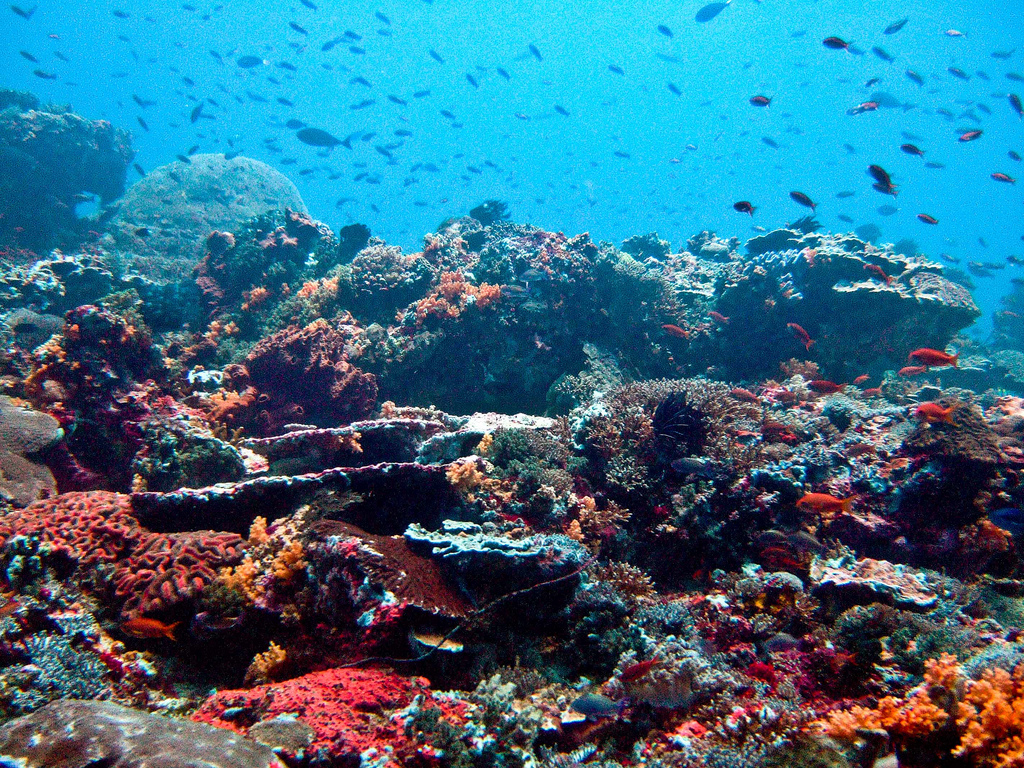
A reef is a ridge or shoal of rock, coral, or similar relatively stable material lying beneath the surface of a natural body of water. Many reefs result from natural, abiotic (non-living) processes such as deposition of sand or wave erosion planing down rock outcrops. However, reefs such as the coral reefs of tropical waters are formed by biotic (living) processes, dominated by corals and coralline algae. Artificial reefs, such as shipwrecks and other man-made underwater structures, may occur intentionally or as the result of an accident. These are sometimes designed to increase the physical complexity of featureless sand bottoms to attract a more diverse range of organisms. They provide shelter to various aquatic animals which help prevent extinction. Another reason reefs are put in place is for aquaculture, and fish farmers who are looking to improve their businesses sometimes invest in them. Reefs are often quite near to the surface, but not all definitions require this.
Earth's largest coral reef system is the Great Barrier Reef in Australia, at a length of over 2,300 kilometres (1,400 miles).
The word "reef" traces its origins back to the Old Norse word rif, meaning "rib" or "reef". Rif comes from the Proto-Germanic term ribją meaning "rib".
Reefs may be classified in terms of their origin, geographical location, depth, and topography. For example a tropical coral fringing reef, or a temperate rocky intertidal reef.
A variety of biotic reef types exists, including oyster reefs and sponge reefs, but the most massive and widely distributed are tropical coral reefs. Although corals are major contributors to the framework and bulk material comprising a coral reef, the organisms most responsible for reef growth against the constant assault from ocean waves are calcareous algae, especially, although not entirely, coralline algae.
Oyster larvae prefer to settle on adult oysters and thereby develop layers building upwards. These eventually form a fairly massive hard stony calcium carbonate structure on which other reef organisms like sponges and seaweeds can grow, and provide a habitat for mobile benthic organisms.
These biotic reef types take on additional names depending upon how the reef lies in relation to the land, if any. Reef types include fringing reefs, barrier reefs, and atolls. A fringing reef is a reef that is attached to an island. Whereas, a barrier reef forms a calcareous barrier around an island, resulting in a lagoon between the shore and the reef. Conversely, an atoll is a ring reef with no land present.
The reef front, facing the ocean, is a high energy locale. Whereas, the internal lagoon will be at a lower energy with fine grained sediments.
Hub AI
Reef AI simulator
(@Reef_simulator)
Reef
A reef is a ridge or shoal of rock, coral, or similar relatively stable material lying beneath the surface of a natural body of water. Many reefs result from natural, abiotic (non-living) processes such as deposition of sand or wave erosion planing down rock outcrops. However, reefs such as the coral reefs of tropical waters are formed by biotic (living) processes, dominated by corals and coralline algae. Artificial reefs, such as shipwrecks and other man-made underwater structures, may occur intentionally or as the result of an accident. These are sometimes designed to increase the physical complexity of featureless sand bottoms to attract a more diverse range of organisms. They provide shelter to various aquatic animals which help prevent extinction. Another reason reefs are put in place is for aquaculture, and fish farmers who are looking to improve their businesses sometimes invest in them. Reefs are often quite near to the surface, but not all definitions require this.
Earth's largest coral reef system is the Great Barrier Reef in Australia, at a length of over 2,300 kilometres (1,400 miles).
The word "reef" traces its origins back to the Old Norse word rif, meaning "rib" or "reef". Rif comes from the Proto-Germanic term ribją meaning "rib".
Reefs may be classified in terms of their origin, geographical location, depth, and topography. For example a tropical coral fringing reef, or a temperate rocky intertidal reef.
A variety of biotic reef types exists, including oyster reefs and sponge reefs, but the most massive and widely distributed are tropical coral reefs. Although corals are major contributors to the framework and bulk material comprising a coral reef, the organisms most responsible for reef growth against the constant assault from ocean waves are calcareous algae, especially, although not entirely, coralline algae.
Oyster larvae prefer to settle on adult oysters and thereby develop layers building upwards. These eventually form a fairly massive hard stony calcium carbonate structure on which other reef organisms like sponges and seaweeds can grow, and provide a habitat for mobile benthic organisms.
These biotic reef types take on additional names depending upon how the reef lies in relation to the land, if any. Reef types include fringing reefs, barrier reefs, and atolls. A fringing reef is a reef that is attached to an island. Whereas, a barrier reef forms a calcareous barrier around an island, resulting in a lagoon between the shore and the reef. Conversely, an atoll is a ring reef with no land present.
The reef front, facing the ocean, is a high energy locale. Whereas, the internal lagoon will be at a lower energy with fine grained sediments.