Hubbry Logo
ReefReefMain
Open search
Reef
Community hub
Reef
logo
8 pages, 0 posts
0 subscribers
Be the first to start a discussion here.
Contribute something
Reef
Reef
from Wikipedia
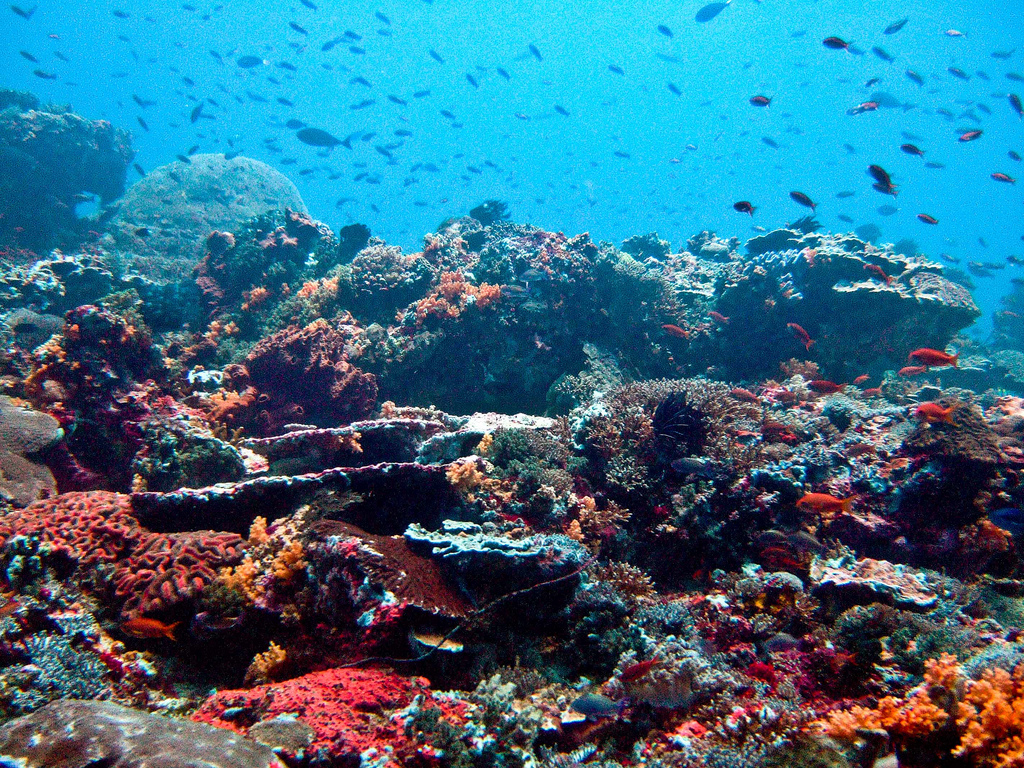
Coral reef at Nusa Lembongan, Bali, Indonesia
Pamalican island with surrounding reef, Sulu Sea, Philippines
A reef surrounding an islet
Reefs off Vanatinai Island in the Louisiade Archipelago

A reef is a ridge or shoal of rock, coral, or similar relatively stable material lying beneath the surface of a natural body of water.[1] Many reefs result from natural, abiotic (non-living) processes such as deposition of sand or wave erosion planing down rock outcrops. However, reefs such as the coral reefs of tropical waters are formed by biotic (living) processes, dominated by corals and coralline algae. Artificial reefs, such as shipwrecks and other man-made underwater structures, may occur intentionally or as the result of an accident. These are sometimes designed to increase the physical complexity of featureless sand bottoms to attract a more diverse range of organisms. They provide shelter to various aquatic animals which help prevent extinction.[2] Another reason reefs are put in place is for aquaculture, and fish farmers who are looking to improve their businesses sometimes invest in them.[3] Reefs are often quite near to the surface, but not all definitions require this.[1]

Earth's largest coral reef system is the Great Barrier Reef in Australia, at a length of over 2,300 kilometres (1,400 miles).

Etymology

[edit]

The word "reef" traces its origins back to the Old Norse word rif, meaning "rib" or "reef". Rif comes from the Proto-Germanic term ribją meaning "rib".[4]

Classification

[edit]

Reefs may be classified in terms of their origin, geographical location, depth, and topography. For example a tropical coral fringing reef, or a temperate rocky intertidal reef.

Biotic

[edit]
Part of Great Barrier Reef

A variety of biotic reef types exists, including oyster reefs and sponge reefs, but the most massive and widely distributed are tropical coral reefs.[1] Although corals are major contributors to the framework and bulk material comprising a coral reef, the organisms most responsible for reef growth against the constant assault from ocean waves are calcareous algae, especially, although not entirely, coralline algae.

Oyster larvae prefer to settle on adult oysters and thereby develop layers building upwards. These eventually form a fairly massive hard stony calcium carbonate structure on which other reef organisms like sponges and seaweeds can grow, and provide a habitat for mobile benthic organisms.[1]

These biotic reef types take on additional names depending upon how the reef lies in relation to the land, if any. Reef types include fringing reefs, barrier reefs, and atolls. A fringing reef is a reef that is attached to an island. Whereas, a barrier reef forms a calcareous barrier around an island, resulting in a lagoon between the shore and the reef. Conversely, an atoll is a ring reef with no land present.

The reef front, facing the ocean, is a high energy locale. Whereas, the internal lagoon will be at a lower energy with fine grained sediments.

Mounds

[edit]

Both mounds and reefs are considered to be varieties of organosedimentary buildups, which are sedimentary features, built by the interaction of organisms and their environment. These interactions have a synoptic relief and whose biotic composition differs from that found on and beneath the surrounding sea floor. However, reefs are held up by a macroscopic skeletal framework, as what is seen on coral reefs. Corals and calcareous algae grow on top of one another, forming a three-dimensional framework that is modified in various ways by other organisms and inorganic processes.[5]

Conversely, mounds lack a macroscopic skeletal framework. Instead, they are built by microorganisms or by organisms that also lack a skeletal framework. A microbial mound might be built exclusively or primarily by cyanobacteria. Examples of biostromes formed by cyanobacteria occur in the Great Salt Lake in Utah, United States, and in Shark Bay on the coast of Western Australia.[5][6]

Cyanobacteria do not have skeletons, and individual organisms are microscopic. However, they can encourage the precipitation or accumulation of calcium carbonate to produce distinct sediment bodies in composition that have relief on the seafloor. Cyanobacterial mounds were most abundant before the evolution of shelly macroscopic organisms, but they still exist today. Stromatolites, for instance, are microbial mounds with a laminated internal structure. Whereas, bryozoans and crinoids, common contributors to marine sediments during the Mississippian period, produce a different kind of mound. Although bryozoans are small and crinoid skeletons disintegrate, bryozoan and crinoid meadows can persist over time and produce compositionally distinct bodies of sediment with depositional relief.[5][7]

The Proterozoic Belt Supergroup contains evidence of possible microbial mat and dome structures similar to stromatolite and chicken reef complexes.[clarification needed][5][8]

Geologic

[edit]

Rocky reefs are underwater outcrops of rock projecting above the adjacent unconsolidated surface with varying relief. They can be found in depth ranges from intertidal to deep water and provide a substrate for a large range of sessile benthic organisms, and shelter for a large range of mobile organisms.[9] They are often located in sub-tropical, temperate, and sub-polar latitudes.

Structures

[edit]
Fossil brain coral (Diploria) at the Windley Key Fossil Reef Geological State Park. US Quarter near top for scale.

Ancient reefs buried within stratigraphic sections are of considerable interest to geologists because they provide paleo-environmental information about the location in Earth's history. In addition, reef structures within a sequence of sedimentary rocks provide a discontinuity which may serve as a trap or conduit for fossil fuels or mineralizing fluids to form petroleum or ore deposits.[10]

Corals, including some major extinct groups Rugosa and Tabulata, have been important reef builders through much of the Phanerozoic since the Ordovician Period. However, other organism groups, such as calcifying algae, especially members of the red algae (Rhodophyta), and molluscs (especially the rudist bivalves during the Cretaceous Period) have created massive structures at various times.

During the Cambrian Period, the conical or tubular skeletons of Archaeocyatha, an extinct group of uncertain affinities (possibly sponges), built reefs.[11] Other groups, such as the Bryozoa, have been important interstitial organisms, living between the framework builders. The corals which build reefs today, the Scleractinia, arose after the Permian–Triassic extinction event that wiped out the earlier rugose corals (as well as many other groups). They became increasingly important reef builders throughout the Mesozoic Era.[12] They may have arisen from a rugose coral ancestor.

Rugose corals built their skeletons of calcite and have a different symmetry from that of the scleractinian corals, whose skeletons are aragonite.[13] However, there are some unusual examples of well-preserved aragonitic rugose corals in the Late Permian. In addition, calcite has been reported in the initial post-larval calcification in a few scleractinian corals. Nevertheless, scleractinian corals (which arose in the middle Triassic) may have arisen from a non-calcifying ancestor independent of the rugosan corals (which disappeared in the late Permian).[5]

Artificial

[edit]

An artificial reef is a human-created underwater structure, typically built to promote marine life in areas with a generally featureless bottom, to control erosion, block ship passage, block the use of trawling nets,[14] or improve surfing.[15]

Many reefs are built using objects that were built for other purposes, for example by sinking oil rigs (through the Rigs-to-Reefs program), scuttling ships, or by deploying rubble or construction debris. Other artificial reefs are purpose built (e.g. the reef balls and Electrified Reefs). Shipwrecks become artificial reefs on the seafloor. Regardless of construction method, artificial reefs generally provide stable hard surfaces where algae and invertebrates such as barnacles, corals, and oysters attach; the accumulation of attached marine life in turn provides intricate structure and food for assemblages of fish.

See also

[edit]

References

[edit]

Sources

[edit]
  • Shears N.T. (2007) Biogeography, community structure and biological habitat types of subtidal reefs on the South Island West Coast, New Zealand. Science for Conservation 281. p 53. Department of Conservation, New Zealand. [1]
  • "General Information on Reefs." General Information on Reefs – Reef & Ocean Ecology Lab. Accessed February 1, 2024. https://www.reefoceanlab.org.au/resources/general-information-on-reefs/#:~:text=Rocky%20reefs%20are%20more%20typical,many%20parts%20of%20New%20Zealand.
  • "Coral Reefs ~ Marinebio Conservation Society." MarineBio Conservation Society, November 10, 2023. https://www.marinebio.org/creatures/coral-reefs/#:~:text=Organisms%20responsible%20for%20building%20tropical,and%20the%20Tropic%20of%20Cancer.
[edit]
Revisions and contributorsEdit on WikipediaRead on Wikipedia
from Grokipedia
A reef is a ridge or shoal of rock, , or similar stable material lying beneath the surface of a body of water, often providing and ecological structure in marine environments. reefs, a prominent type of biotic reef, are complex underwater ecosystems built primarily by colonies of polyps—tiny, soft-bodied related to and sea anemones—that secrete hard exoskeletons, creating rigid structures in shallow, tropical marine environments. These reefs form over thousands of years as polyps grow atop one another on hard substrates like rock or previous layers, typically between 30° north and south latitudes in warm, sunlit waters less than 50 meters deep. Coral reefs exhibit extraordinary , supporting approximately 25% of all known marine species despite occupying less than 0.1% of the ocean floor, including over 7,000 species in areas like the . The corals themselves rely on a symbiotic relationship with microscopic called , which provide energy through in exchange for nutrients and protection, enabling reef growth in nutrient-poor waters. This intricate web of interactions fosters habitats for , , and other organisms, making reefs among the most diverse ecosystems on . There are three main types of coral reefs: fringing reefs, which develop directly adjacent to coastlines; barrier reefs, separated from shore by lagoons or channels, such as Australia's spanning over 2,000 kilometers; and atolls, ring-shaped reefs encircling lagoons formed as volcanic islands subside over time. These structures provide essential ecological services, including coastal protection against and storms, fisheries that sustain over 500 million people for food and income, and recreational opportunities generating tens of billions of U.S. dollars annually. However, coral reefs face severe threats from both natural and human sources, including warming temperatures causing widespread bleaching—such as the 2014–2017 global event that affected 70% of reefs and the ongoing 2023–2025 event impacting 84% of the world's reefs—and , , and destructive practices. Despite their resilience, ongoing and habitat loss underscore the urgency of conservation efforts to preserve these vital marine wonders.

Fundamentals

Definition

A reef is a or of material, typically composed of rock, , or biogenic deposits, that rises from the seafloor in shallow marine waters, often extending near or to the water's surface and forming barriers or elevated habitats. These structures are distinguished by their prominence above the surrounding , usually in depths less than 30 meters, where they play a key role in dissipating wave energy through friction and breaking, reducing . Unlike deeper features such as seamounts, which are volcanic underwater mountains rising from the but typically submerged below 200 meters, or banks, which are broad, flat-topped elevations often lacking biological buildup, reefs are characteristically shallow and more dynamically shaped by surface processes. Atolls, while related as ring-shaped formations enclosing lagoons, differ from linear or fringing reefs by their circular morphology around subsided volcanic foundations. The term "reef" entered marine science through early explorations, with one of the first detailed scientific descriptions provided by Captain in 1770 during his voyage on , when he charted and documented the off after his ship struck it. This encounter marked a pivotal moment in recognizing reefs as significant navigational hazards and geological features, building on prior nautical usage but advancing systematic observation. Coral reefs represent the most iconic examples, formed by calcium carbonate skeletons of coral polyps, but reefs also encompass diverse types such as oyster reefs built from mollusk shells, kelp forests that develop on rocky reefs in temperate waters, and rocky reefs consisting of natural hard substrates like granite outcrops. Reefs may arise from biotic processes involving organismal accumulation or abiotic ones like geological exposures, though the former often dominate in tropical settings.

Etymology

The term "reef" in its marine sense originates from Middle Dutch rif, denoting a or abrasion strip, which entered English around the 1580s primarily through nautical contexts to describe underwater rock or shoals hazardous to navigation. This borrowing reflects the word's association with linear elevations, akin to a rib-like beneath the surface. Cognates appear in related languages, such as rif, referring to a sandbank, , or , underscoring a shared Proto-Germanic root ribją evoking elongated protrusions. In the Indo-Pacific region, the Malay term karang—derived from Proto-Malayo-Polynesian karaŋ meaning or —has influenced local designations for coral structures, often rendered as terumbu karang for coral reefs, highlighting distinct linguistic traditions for similar features. In , "reef" initially signified a navigational peril in 19th-century maritime charts and surveys, but its meaning evolved following Darwin's 1842 publication The Structure and Distribution of Reefs, which proposed theories for reef formation and elevated the term to denote complex ecological and geological structures built by organisms like corals. This shift marked "reef" as a key concept in evolutionary and , moving beyond mere hazards to emphasize biotic construction processes. Beyond marine applications, "reef" denotes a vein or lode of ore in mining contexts, extending the ridge metaphor to mineral deposits, while in anatomy it occasionally describes coral-like tissue formations, though such usages remain secondary to the primary oceanic connotation.

Classification

Biotic Reefs

Biotic reefs are underwater structures primarily constructed by living organisms that secrete hard calcareous materials, forming complex frameworks that support diverse marine life. These reefs develop through biological accretion, where colonies of sessile invertebrates or algae build upon substrates over time. The most widespread and ecologically significant type is the coral reef, built by scleractinian corals in symbiosis with zooxanthellae in warm, shallow tropical waters. Other notable biotic reefs include oyster reefs, formed by dense aggregations of bivalves such as the (Crassostrea virginica) in temperate coastal estuaries, which stabilize sediments and filter water. Vermetid reefs are constructed by tube-dwelling gastropods in subtropical intertidal zones, creating encrusting platforms. Serpulid reefs, built by calcareous tube-forming worms, occur in various coastal environments, while algal reefs, dominated by coralline red algae, contribute to temperate and polar reef systems. These biotic formations typically exhibit high structural complexity and compared to abiotic counterparts.

Abiotic Reefs

Abiotic reefs are marine structures primarily formed by non-living geological processes, such as erosion, sedimentation, and tectonic activity, resulting in hard substrates like rocky outcrops or pavement without substantial biogenic contributions. These formations provide elevated or consolidated seafloor features that influence local hydrodynamics and serve as habitats, distinct from organism-built structures. Key subtypes include rocky reefs, composed of exposed granite, basalt, or limestone outcrops that protrude from the seabed, creating irregular surfaces shaped by underlying geology. Sediment reefs arise from the physical accumulation and compaction of non-biogenic materials, such as shell hash or coarse sediments, forming stable, low-relief mounds or pavements in shallow waters. In polar regions, ice-scour reefs develop where grounded icebergs or sea ice repeatedly abrade the seafloor, stripping away soft sediments to reveal or sculpt hard, boulder-strewn substrates. Formation of abiotic reefs involves physical agents like persistent wave action, which erodes coastal rock into platforms and subtidal ridges, or ocean , where nutrient-rich deep waters promote chemical cementation to create indurated hardgrounds. A prominent example is the extensive rocky reefs along the , where high-energy swells sculpt Tertiary limestone into sheer cliffs and offshore pinnacles over broad shelf areas. Tectonic uplift can also expose or elevate preexisting rock formations, enhancing their reef-like prominence in coastal zones. Abiotic reefs are widespread along high-energy coastlines globally, from temperate shelves to polar margins, often spanning larger spatial extents than biotic reefs due to the ubiquity of substrates and erosional features. However, they generally possess lower structural complexity, with simpler from geological exposure rather than intricate frameworks, limiting vertical and microhabitat diversity compared to biogenic systems.

Artificial Reefs

Artificial reefs are human-made underwater structures intentionally placed on the seafloor to mimic natural reef habitats, fostering marine biodiversity and providing ecological benefits. The concept dates back to ancient civilizations, where and Romans deliberately sank structures such as wooden barriers to block harbor entrances and deter naval threats, effectively creating early forms of submerged habitats. A modern surge in artificial reef deployment began after , driven by the scuttling of decommissioned vessels to repurpose surplus ships as fish aggregating structures, particularly in coastal regions seeking to bolster fisheries. These structures serve multiple purposes, including enhancing fisheries by attracting and concentrating populations, supporting diving through wreck sites, providing coastal protection against and surges, and aiding restoration in degraded areas. For instance, Florida's artificial reef program has deployed over 3,800 public structures since the to support these goals, with ongoing efforts funded by state and federal partnerships. Common materials include prefabricated concrete modules designed for durability and coral attachment, decommissioned vessels cleaned of contaminants before sinking, and tire aggregates bound with concrete for cost-effective deployment. However, tire-based reefs have faced environmental caveats, as rubber can degrade and leach or contribute to microplastic over time. Emerging eco-engineered options, such as biodegradable ceramics or hybrid cements mimicking natural substrates, aim to minimize long-term impacts while promoting sustainable colonization. Studies indicate that artificial reefs can increase local biomass by 20-50% compared to unstructured seafloors, enhancing overall productivity through provision, though effectiveness varies by design and location. Risks such as material leaching underscore the need for rigorous to avoid unintended ecological harm.

Formation and Development

Biological Processes

Biological processes in biotic reefs primarily involve the symbiotic interactions and physiological mechanisms that enable the precipitation of (CaCO₃) skeletons, fostering vertical growth and structural integrity. In scleractinian corals, the dominant reef-builders, occurs through the deposition of crystals within the coral's extracellular calcifying fluid, facilitated by the symbiosis with algae known as . These symbionts, residing in the coral's gastrodermal cells, perform that elevates the local by consuming CO₂, thereby promoting the saturation state of with respect to CaCO₃ and accelerating skeleton formation by up to threefold in the light compared to . The core for this precipitation is: \ceCa2++2HCO3>CaCO3+CO2+H2O\ce{Ca^{2+} + 2HCO3^- -> CaCO3 + CO2 + H2O} This process, observed across tropical reef systems, relies on the uptake of calcium ions and bicarbonate from seawater, with zooxanthellae recycling metabolic byproducts to sustain high calcification efficiency. Reef growth dynamics are characterized by vertical accretion, where the cumulative skeleton deposition outpaces erosion to build framework height. Typical rates range from 5 to 20 mm per year in healthy Indo-Pacific reefs, enabling some systems to historically match sea-level rise during periods of rapid change, such as the early Holocene. These rates are modulated by environmental factors including light intensity for symbiont photosynthesis, nutrient availability that supports symbiont density, and the stability of the coral-algal symbiosis, with optimal conditions yielding higher accretion in shallow, sunlit zones. Variations occur regionally, with arborescent Acropora-dominated assemblages achieving up to 20 mm year⁻¹, underscoring the role of species composition in maintaining growth potential. Ecological succession in reefs progresses from initial colonization by to stable climax communities, ensuring continuous framework development. Bare substrates, often exposed after disturbances, are first settled by filamentous algae and , which stabilize surfaces and provide sites for larval attachment. Over time, these give way to intermediate stages dominated by macroalgae and juvenile corals, culminating in diverse climax assemblages led by branching and massive corals that form the structural canopy. This sequence, spanning years to decades, is balanced by from organisms like excavating sponges (e.g., Cliona spp.) and (e.g., Scarus and Chlorurus genera), which remove 0.5–2 kg m⁻² year⁻¹ of , preventing overgrowth and nutrients while limiting net erosion to support long-term accretion. Coral adaptations distinguish reef-building (hermatypic) from non-building (ahermatypic) species, optimizing biotic reef formation in the . Hermatypic corals, such as those in genera , Porites, and Pocillopora, harbor and exhibit rapid in sunlit, shallow waters (typically <30 m depth), contributing the bulk of framework construction across vast regions like the and . In contrast, ahermatypic corals lack symbionts, grow slowly without forming reefs, and thrive in deeper or turbid environments, serving auxiliary roles in rather than structural development. These distinctions highlight how hermatypic traits enable reefs to persist in dynamic tropical conditions.

Geological Processes

Tectonic processes play a pivotal role in shaping reef morphology, particularly through subsidence and uplift. of volcanic foundations allows reefs to maintain pace with sinking substrates, as proposed in Charles Darwin's 1842 theory, where fringing reefs around volcanic islands evolve into barrier reefs and eventually atolls as the island into the ocean. This model, supported by subsequent geological observations, explains the circular structure of many Pacific atolls formed over millions of years of gradual descent at rates of 0.1 to 0.4 mm per year. Conversely, tectonic uplift exposes reefs above , creating emergent platforms; for instance, the Ningaloo Reef in features uplifted reef terraces resulting from regional tectonic activity along the , preserving fossil reef sequences up to 125,000 years old. Sedimentation and further influence reef development by building and sculpting carbonate platforms, where reefs often form protective margins around broader depositional systems. platforms develop through the accumulation of skeletal debris and chemical precipitates in shallow, tropical seas, with reefs acting as wave-resistant rims that trap sediments and promote infilling. During the epoch, post-glacial sea-level rise of approximately 120 meters since the around 20,000 years ago has driven rapid reef accretion and platform expansion, enabling modern reefs to colonize flooded shelves at rates up to 10 mm per year in response to transgressive conditions. , particularly from storm surges and , sculpts platform edges, while sediment export from reefs contributes to off-platform deposition, maintaining the dynamic balance of these systems. Reef zonation reflects bathymetric and hydrodynamic controls, delineating distinct morphological zones across depth gradients. The fore-reef slope descends steeply from the reef crest into deeper waters, often reaching inclinations of 45–90 degrees and extending to depths of 50 meters or more, where decreasing and increasing limit framework development. In contrast, back-reef lagoons form shallow, sediment-filled depressions landward of the crest, protected from open-ocean waves and typically 1–10 meters deep, fostering finer-grained deposits and influencing overall reef asymmetry. These zonation patterns, observed in models from both fringing and barrier reefs, are governed by bathymetric variations that dictate distribution and pathways. The geological record of reefs spans over 500 million years, revealing evolutionary shifts in structure and composition from ancient to modern forms. The geological record of reefs spans billions of years, with microbial reefs such as dating back to the eon over 3.5 billion years ago. Significant skeletal reefs first appear in the period around 485 million years ago, with extensive development in the (419–359 million years ago), where stromatoporoids and other organisms built substantial skeletal frameworks in shallow marine environments, alongside persisting . These ancient structures, such as the stromatolite-dominated reefs in the Canadian Rockies, demonstrate early carbonate platform dynamics and highlight the long-term persistence of reef-building processes amid changing ocean chemistry and tectonics. Over time, reef evolution has adapted to multiple mass extinctions, with and examples showing increasing complexity in platform margins.

Ecology and Biodiversity

Habitat Functions

Reefs provide essential physical habitats through their topographic complexity, which creates diverse microhabitats including crevices, overhangs, and branching structures that serve as shelters, nurseries, and foraging areas for a wide array of marine organisms. This structural heterogeneity reduces predation pressure on juvenile fishes and by offering refuges that limit predator access and encounter rates. For instance, experimental studies on assemblages demonstrate that higher habitat complexity significantly lowers predation mortality, allowing recruits to survive and contribute to population replenishment. In addition to , reefs play critical hydrodynamic roles by attenuating wave energy and stabilizing coastal s. Barrier and fringing reefs act as natural breakwaters, dissipating up to 97% of incident wave energy on average, which protects shorelines from and reduces in adjacent lagoons. This wave reduction also promotes sediment deposition and prevents resuspension, maintaining stable substrates for benthic communities and preventing loss from . Reefs function as biogeochemical hotspots for cycling, supporting elevated through algal symbionts, turf algae, and microbial communities that exceed rates in surrounding open ocean waters by factors of 3 to 5 times. The within reef systems efficiently recycles dissolved organic matter and , sustaining high rates of production and retention of energy in the . This enhanced underpins the , with benthic and planktonic processes driving rapid turnover. Furthermore, reefs facilitate ecological connectivity by serving as in larval dispersal networks, where currents transport planktonic larvae across distances of hundreds of kilometers to replenish distant populations. This connectivity maintains and resilience across reef systems, linking isolated patches through passive and behavioral dispersal mechanisms.

Key Organisms and Interactions

Coral reefs are dominated by scleractinian , with over 1,000 species worldwide forming the structural foundation of these ecosystems through their skeletons. These reef-building corals, such as branching and massive forms, provide complexity that supports diverse assemblages. Herbivorous , including (family Scaridae), play a critical role by grazing on that could otherwise outcompete juvenile corals for space and light. Invertebrates like sea urchins (e.g., ) act as key grazers, consuming macroalgae and maintaining reef balance, while mollusks such as giant clams ( spp.) and snails contribute to filtration and predation dynamics. Microbes, particularly nitrogen-fixing bacteria like within the coral , enhance nutrient availability in nutrient-poor reef waters by converting atmospheric nitrogen into usable forms. The trophic structure of reef ecosystems relies on intricate interactions that regulate community composition. Herbivory by and urchins controls algal proliferation, preventing overgrowth that inhibits recruitment and growth; for instance, large species scrape turf algae and excavate substrates, promoting space availability. Predatory outbreaks, such as those of the (Acanthaster planci), disrupt this balance by voraciously consuming live tissue, leading to rapid declines in cover—outbreaks have historically reduced by up to 90% in affected areas. Mutualistic relationships further stabilize the system; , like the (Labroides dimidiatus), remove ectoparasites from client species including sharks and larger reef fish, fostering health and reducing stress in a symbiotic exchange where cleaners gain nutrition. Reef biodiversity hotspots exemplify the concentration of species richness and unique interactions. The Coral Triangle, spanning , the , and neighboring regions, harbors nearly 600 coral species—about 75% of the global total—alongside over 2,000 reef species, creating a nexus of evolutionary divergence and ecological connectivity. Isolated reefs, such as those in , exhibit high rates approaching 30% for and , driven by geographic barriers that promote and limit . Disturbances like mass bleaching events can trigger phase shifts, altering reef dynamics toward algal dominance. Following the 2016 global bleaching event—part of the prolonged 2014–2017 episode that exposed more than 70% of the world's reefs to bleaching-level stress—contributed to an approximately 14% loss of global coral cover between 2009 and 2018, often resulting in macroalgal overgrowth where populations were insufficient to restore balance. More recently, the ongoing fourth global bleaching event (2023–present) has impacted 84% of the world's reefs as of April 2025, highlighting the increasing frequency of such disturbances due to . These shifts reduce structural complexity and , though resilient reefs recover through enhanced herbivory and when disturbances subside.

Human Dimensions

Economic and Cultural Importance

Coral reefs contribute significantly to global economies through fisheries, tourism, and emerging pharmaceutical industries. Reef-associated fisheries support an estimated 6 million fishers worldwide and produce around 1.4 million tons of annually, valued at approximately $6.8 billion, providing essential protein and livelihoods for coastal communities. centered on coral reefs generates about $36 billion in annual revenue globally, supporting millions of jobs in diving, , and coastal recreation. Additionally, marine organisms from reef ecosystems have yielded pharmaceuticals such as , a non-opioid pain reliever derived from the venom of cone snails (), approved by the FDA in 2004 for severe management. Beyond direct economic outputs, reefs play a vital role in protecting coastal infrastructure from and storms, averting billions in potential damages. alone, coral reefs provide $1.8 billion annually in flood protection benefits by reducing wave energy and shielding properties and economic activities. For instance, the System safeguards coastal assets, saving an estimated $231 million to $347 million per year in avoided damages from tropical storms and . Reefs hold profound cultural significance for many societies, particularly indigenous communities in the Pacific, where they inform systems and spiritual practices. Polynesian navigators historically used reef patterns and the refraction of ocean swells around s as key cues for across vast expanses, integrating these observations with stars and currents to settle remote islands. In Pacific cultures, reefs embody spiritual connections to ancestors and the sea, serving as sacred sites in rituals and lore that emphasize harmony with marine ecosystems. Reefs also feature prominently in and , symbolizing resilience and interconnectedness; for example, Charles Darwin's 1842 descriptions of formation influenced scientific narratives, while contemporary works like the Institute for Figuring's Hyperbolic Crochet Coral Reef project use to evoke reef and fragility. Historically, reefs have driven trade economies, most notably through pearl diving in the Arabian Gulf, which dates back to around 2000 BCE based on archaeological evidence from . This industry dominated regional commerce until the mid-20th century, supplying up to 80% of the world's natural pearls and employing tens of thousands in seasonal dives, before transitioning to modern techniques that now produce cultured pearls sustainably.

Threats and Conservation

Coral reefs face a multitude of anthropogenic threats that exacerbate their vulnerability. Climate change, primarily through ocean warming, is the most severe global pressure, with temperature increases of approximately 1°C above seasonal norms triggering widespread coral bleaching events that expel symbiotic algae, leading to coral starvation and mortality. For instance, recurrent bleaching on the Great Barrier Reef from 2016 to 2022, followed by further events in 2024–2025, has resulted in significant cumulative losses of nearly 50% of coral cover in northern sections due to consecutive mass events, with a 14% region-wide decline noted in recent surveys. The fourth global coral bleaching event, ongoing from 2023 to 2025, has impacted 84% of the world's coral reefs across 82 countries, territories, and economies. Overfishing depletes herbivorous fish populations essential for controlling algae growth, allowing overgrowth that smothers corals, while destructive fishing practices physically damage reef structures. Pollution, including nutrient runoff and plastics, further stresses reefs; an estimated 11 million metric tons of plastic enter oceans annually, with debris directly contacting and abrading corals, where 89% of affected corals develop disease. Coastal development contributes through sedimentation and habitat fragmentation, smothering corals and altering water quality in nearshore areas. Natural stressors compound these human-induced pressures, occasionally causing acute damage. Hurricanes and tropical storms physically break coral structures and stir up sediments that reduce light penetration, hindering photosynthesis. Outbreaks of the crown-of-thorns starfish, a corallivorous predator, can devastate large reef areas by consuming up to 90% of live coral cover during population surges, often triggered by overfishing of its natural predators. Emerging diseases, such as stony coral tissue loss disease (SCTLD), rapidly kill multiple coral species by causing tissue necrosis, with outbreaks spreading across the Caribbean and Florida reefs since 2014, affecting over 20 species and leading to high mortality rates within weeks. Conservation strategies aim to mitigate these threats through protective measures and active intervention. Marine protected areas (MPAs) restrict fishing and development, covering approximately 18–20% of global coral reefs as of 2020, which helps enhance coral resilience and within designated zones. Restoration initiatives, such as coral gardening in , involve fragmenting healthy corals, growing them in underwater nurseries, and outplanting them to reefs, with organizations like the Coral Restoration Foundation deploying tens of thousands of corals annually to bolster depleted populations. International agreements, including the UN Convention on Biological Diversity's Aichi Targets (2011–2020), prioritized coral conservation by promoting ecosystem-based management and threat reduction, influencing subsequent frameworks like the . Future projections underscore the urgency of , with IPCC assessments indicating that without limiting warming to 1.5°C, coral reefs could experience 70–90% global loss by 2050 due to intensified bleaching and acidification, rising to over 99% at 2°C. These declines threaten the economic services reefs provide, such as fisheries and , valued in billions annually.

References

  1. https://www.coastalwiki.org/wiki/Reef
  2. https://en.wiktionary.org/wiki/reef
  3. https://www.coastalwiki.org/wiki/Coral_reefs
Add your contribution
Related Hubs
Contribute something
User Avatar
No comments yet.