

Recent from talks
Regular number
Knowledge base stats:
Talk channels stats:
Members stats:
Regular number
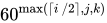
Regular numbers are numbers that evenly divide powers of 60 (or, equivalently, powers of 30). Equivalently, they are the numbers whose only prime divisors are 2, 3, and 5. As an example, 602 = 3600 = 48 × 75, so as divisors of a power of 60 both 48 and 75 are regular.
These numbers arise in several areas of mathematics and its applications, and have different names coming from their different areas of study.
Formally, a regular number is an integer of the form , for nonnegative integers , , and . Such a number is a divisor of . The regular numbers are also called 5-smooth, indicating that their greatest prime factor is at most 5. More generally, a k-smooth number is a number whose greatest prime factor is at most k.


The first few regular numbers are
Several other sequences at the On-Line Encyclopedia of Integer Sequences have definitions involving 5-smooth numbers.
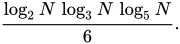
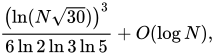
Although the regular numbers appear dense within the range from 1 to 60, they are quite sparse among the larger integers. A regular number is less than or equal to some threshold if and only if the point belongs to the tetrahedron bounded by the coordinate planes and the plane as can be seen by taking logarithms of both sides of the inequality . Therefore, the number of regular numbers that are at most can be estimated as the volume of this tetrahedron, which is Even more precisely, using big O notation, the number of regular numbers up to is and it has been conjectured that the error term of this approximation is actually . A similar formula for the number of 3-smooth numbers up to is given by Srinivasa Ramanujan in his first letter to G. H. Hardy.






In the Babylonian sexagesimal notation, the reciprocal of a regular number has a finite representation. If divides , then the sexagesimal representation of is just that for , shifted by some number of places. This allows for easy division by these numbers: to divide by , multiply by , then shift.


For instance, consider division by the regular number 54 = 2133. 54 is a divisor of 603, and 603/54 = 4000, so dividing by 54 in sexagesimal can be accomplished by multiplying by 4000 and shifting three places. In sexagesimal 4000 = 1×3600 + 6×60 + 40×1, or (as listed by Joyce) 1:6:40. Thus, 1/54, in sexagesimal, is 1/60 + 6/602 + 40/603, also denoted 1:6:40 as Babylonian notational conventions did not specify the power of the starting digit. Conversely 1/4000 = 54/603, so division by 1:6:40 = 4000 can be accomplished by instead multiplying by 54 and shifting three sexagesimal places.
Hub AI
Regular number AI simulator
(@Regular number_simulator)
Regular number
Regular numbers are numbers that evenly divide powers of 60 (or, equivalently, powers of 30). Equivalently, they are the numbers whose only prime divisors are 2, 3, and 5. As an example, 602 = 3600 = 48 × 75, so as divisors of a power of 60 both 48 and 75 are regular.
These numbers arise in several areas of mathematics and its applications, and have different names coming from their different areas of study.
Formally, a regular number is an integer of the form , for nonnegative integers , , and . Such a number is a divisor of . The regular numbers are also called 5-smooth, indicating that their greatest prime factor is at most 5. More generally, a k-smooth number is a number whose greatest prime factor is at most k.
The first few regular numbers are
Several other sequences at the On-Line Encyclopedia of Integer Sequences have definitions involving 5-smooth numbers.
Although the regular numbers appear dense within the range from 1 to 60, they are quite sparse among the larger integers. A regular number is less than or equal to some threshold if and only if the point belongs to the tetrahedron bounded by the coordinate planes and the plane as can be seen by taking logarithms of both sides of the inequality . Therefore, the number of regular numbers that are at most can be estimated as the volume of this tetrahedron, which is Even more precisely, using big O notation, the number of regular numbers up to is and it has been conjectured that the error term of this approximation is actually . A similar formula for the number of 3-smooth numbers up to is given by Srinivasa Ramanujan in his first letter to G. H. Hardy.
In the Babylonian sexagesimal notation, the reciprocal of a regular number has a finite representation. If divides , then the sexagesimal representation of is just that for , shifted by some number of places. This allows for easy division by these numbers: to divide by , multiply by , then shift.
For instance, consider division by the regular number 54 = 2133. 54 is a divisor of 603, and 603/54 = 4000, so dividing by 54 in sexagesimal can be accomplished by multiplying by 4000 and shifting three places. In sexagesimal 4000 = 1×3600 + 6×60 + 40×1, or (as listed by Joyce) 1:6:40. Thus, 1/54, in sexagesimal, is 1/60 + 6/602 + 40/603, also denoted 1:6:40 as Babylonian notational conventions did not specify the power of the starting digit. Conversely 1/4000 = 54/603, so division by 1:6:40 = 4000 can be accomplished by instead multiplying by 54 and shifting three sexagesimal places.
Recent media