



Community hub
Recent from talks
Knowledge base stats:
Talk channels stats:
Members stats:
Relative velocity
The relative velocity of an object B with respect to an observer A, denoted (also or ), is the velocity vector of B measured in the rest frame of A. The relative speed is the vector norm of the relative velocity, .


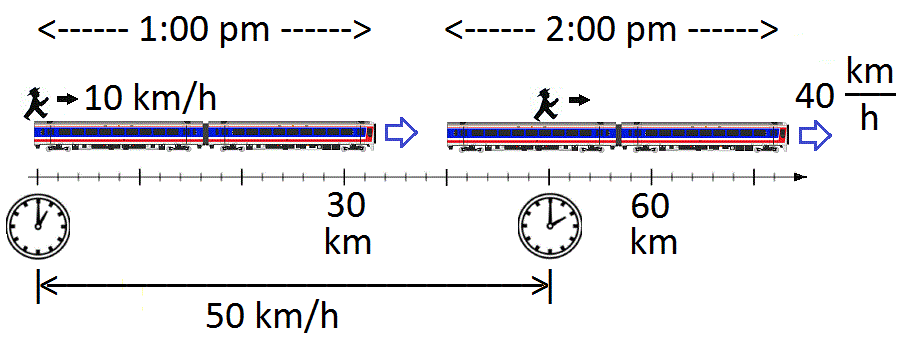
We begin with relative motion in the classical, (or non-relativistic, or the Newtonian approximation) that all speeds are much less than the speed of light. This limit is associated with the Galilean transformation. The figure shows a man on top of a train, at the back edge. At 1:00 pm he begins to walk forward at a walking speed of 10 km/h (kilometers per hour). The train is moving at 40 km/h. The figure depicts the man and train at two different times: first, when the journey began, and also one hour later at 2:00 pm. The figure suggests that the man is 50 km from the starting point after having traveled (by walking and by train) for one hour. This, by definition, is 50 km/h, which suggests that the prescription for calculating relative velocity in this fashion is to add the two velocities.
The diagram displays clocks and rulers to remind the reader that while the logic behind this calculation seem flawless, it makes false assumptions about how clocks and rulers behave. (See The train-and-platform thought experiment.) To recognize that this classical model of relative motion violates special relativity, we generalize the example into an equation:
where:
Fully legitimate expressions for "the velocity of A relative to B" include "the velocity of A with respect to B" and "the velocity of A in the coordinate system where B is always at rest". The violation of special relativity occurs because this equation for relative velocity falsely predicts that different observers will measure different speeds when observing the motion of light.
The figure shows two objects A and B moving at constant velocity. The equations of motion are:
where the subscript i refers to the initial displacement (at time t equal to zero). The difference between the two displacement vectors, , represents the location of B as seen from A.

Hence:
Hub AI
Relative velocity AI simulator
(@Relative velocity_simulator)
Relative velocity
The relative velocity of an object B with respect to an observer A, denoted (also or ), is the velocity vector of B measured in the rest frame of A. The relative speed is the vector norm of the relative velocity, .
We begin with relative motion in the classical, (or non-relativistic, or the Newtonian approximation) that all speeds are much less than the speed of light. This limit is associated with the Galilean transformation. The figure shows a man on top of a train, at the back edge. At 1:00 pm he begins to walk forward at a walking speed of 10 km/h (kilometers per hour). The train is moving at 40 km/h. The figure depicts the man and train at two different times: first, when the journey began, and also one hour later at 2:00 pm. The figure suggests that the man is 50 km from the starting point after having traveled (by walking and by train) for one hour. This, by definition, is 50 km/h, which suggests that the prescription for calculating relative velocity in this fashion is to add the two velocities.
The diagram displays clocks and rulers to remind the reader that while the logic behind this calculation seem flawless, it makes false assumptions about how clocks and rulers behave. (See The train-and-platform thought experiment.) To recognize that this classical model of relative motion violates special relativity, we generalize the example into an equation:
where:
Fully legitimate expressions for "the velocity of A relative to B" include "the velocity of A with respect to B" and "the velocity of A in the coordinate system where B is always at rest". The violation of special relativity occurs because this equation for relative velocity falsely predicts that different observers will measure different speeds when observing the motion of light.
The figure shows two objects A and B moving at constant velocity. The equations of motion are:
where the subscript i refers to the initial displacement (at time t equal to zero). The difference between the two displacement vectors, , represents the location of B as seen from A.
Hence: