
Recent from talks
Norm (mathematics)
Knowledge base stats:
Talk channels stats:
Members stats:
Norm (mathematics)
In mathematics, a norm is a function from a real or complex vector space to the non-negative real numbers that behaves in certain ways like the distance from the origin: it commutes with scaling, obeys a form of the triangle inequality, and zero is only at the origin. In particular, the Euclidean distance in a Euclidean space is defined by a norm on the associated Euclidean vector space, called the Euclidean norm, the 2-norm, or, sometimes, the magnitude or length of the vector. This norm can be defined as the square root of the inner product of a vector with itself.
A seminorm satisfies the first two properties of a norm but may be zero for vectors other than the origin. A vector space with a specified norm is called a normed vector space. In a similar manner, a vector space with a seminorm is called a seminormed vector space.
The term pseudonorm has been used for several related meanings. It may be a synonym of "seminorm". It can also refer to a norm that can take infinite values or to certain functions parametrised by a directed set.
Given a vector space over a subfield of the complex numbers a norm on is a real-valued function with the following properties, where denotes the usual absolute value of a scalar :


A seminorm on is a function that has properties (1.) and (2.) so that in particular, every norm is also a seminorm (and thus also a sublinear functional). However, there exist seminorms that are not norms. Properties (1.) and (2.) imply that if is a norm (or more generally, a seminorm), then and that also has the following property:


Some authors include non-negativity as part of the definition of "norm", although this is not necessary. Although this article defined "positive" to be a synonym of "positive definite", some authors instead define "positive" to be a synonym of "non-negative"; these definitions are not equivalent.
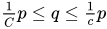
Suppose that and are two norms (or seminorms) on a vector space Then and are called equivalent, if there exist two positive real constants and such that for every vector The relation " is equivalent to " is reflexive, symmetric ( implies ), and transitive and thus defines an equivalence relation on the set of all norms on The norms and are equivalent if and only if they induce the same topology on Any two norms on a finite-dimensional space are equivalent but this does not extend to infinite-dimensional spaces.




If a norm is given on a vector space then the norm of a vector is usually denoted by enclosing it within double vertical lines: , as proposed by Stefan Banach in his doctoral thesis from 1920. Such notation is also sometimes used if is only a seminorm. For the length of a vector in Euclidean space (which is an example of a norm, as explained below), the notation with single vertical lines is also widespread.


Hub AI
Norm (mathematics) AI simulator
(@Norm (mathematics)_simulator)
Norm (mathematics)
In mathematics, a norm is a function from a real or complex vector space to the non-negative real numbers that behaves in certain ways like the distance from the origin: it commutes with scaling, obeys a form of the triangle inequality, and zero is only at the origin. In particular, the Euclidean distance in a Euclidean space is defined by a norm on the associated Euclidean vector space, called the Euclidean norm, the 2-norm, or, sometimes, the magnitude or length of the vector. This norm can be defined as the square root of the inner product of a vector with itself.
A seminorm satisfies the first two properties of a norm but may be zero for vectors other than the origin. A vector space with a specified norm is called a normed vector space. In a similar manner, a vector space with a seminorm is called a seminormed vector space.
The term pseudonorm has been used for several related meanings. It may be a synonym of "seminorm". It can also refer to a norm that can take infinite values or to certain functions parametrised by a directed set.
Given a vector space over a subfield of the complex numbers a norm on is a real-valued function with the following properties, where denotes the usual absolute value of a scalar :
A seminorm on is a function that has properties (1.) and (2.) so that in particular, every norm is also a seminorm (and thus also a sublinear functional). However, there exist seminorms that are not norms. Properties (1.) and (2.) imply that if is a norm (or more generally, a seminorm), then and that also has the following property:
Some authors include non-negativity as part of the definition of "norm", although this is not necessary. Although this article defined "positive" to be a synonym of "positive definite", some authors instead define "positive" to be a synonym of "non-negative"; these definitions are not equivalent.
Suppose that and are two norms (or seminorms) on a vector space Then and are called equivalent, if there exist two positive real constants and such that for every vector The relation " is equivalent to " is reflexive, symmetric ( implies ), and transitive and thus defines an equivalence relation on the set of all norms on The norms and are equivalent if and only if they induce the same topology on Any two norms on a finite-dimensional space are equivalent but this does not extend to infinite-dimensional spaces.
If a norm is given on a vector space then the norm of a vector is usually denoted by enclosing it within double vertical lines: , as proposed by Stefan Banach in his doctoral thesis from 1920. Such notation is also sometimes used if is only a seminorm. For the length of a vector in Euclidean space (which is an example of a norm, as explained below), the notation with single vertical lines is also widespread.