
Recent from talks
Relativistic Doppler effect
Knowledge base stats:
Talk channels stats:
Members stats:
Relativistic Doppler effect
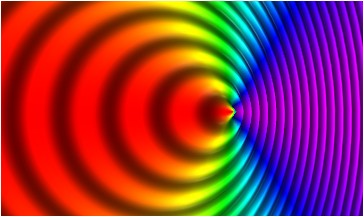
The relativistic Doppler effect is the change in frequency, wavelength and amplitude of light, caused by the relative motion of the source and the observer (as in the classical Doppler effect, first proposed by Christian Doppler in 1842), when taking into account effects described by the special theory of relativity.
The relativistic Doppler effect is different from the non-relativistic Doppler effect as the equations include the time dilation effect of special relativity and do not involve the medium of propagation as a reference point. They describe the total difference in observed frequencies and possess the required Lorentz symmetry.
Astronomers know of three sources of redshift/blueshift: Doppler shifts; gravitational redshifts (due to light exiting a gravitational field); and cosmological expansion (where space itself stretches). This article concerns itself only with Doppler shifts.
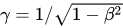
In the following table, it is assumed that for the receiver and the source are moving away from each other, being the relative velocity and the speed of light, and .


Relativistic Doppler shift for the longitudinal case, with source and receiver moving directly towards or away from each other, is often derived as if it were the classical phenomenon, but modified by the addition of a time dilation term. This is the approach employed in first-year physics or mechanics textbooks such as those by Feynman or Morin.
Following this approach towards deriving the relativistic longitudinal Doppler effect, assume the receiver and the source are moving away from each other with a relative speed as measured by an observer on the receiver or the source (The sign convention adopted here is that is negative if the receiver and the source are moving towards each other).

Consider the problem in the reference frame of the source.
Suppose one wavefront arrives at the receiver. The next wavefront is then at a distance away from the receiver (where is the wavelength, is the frequency of the waves that the source emits, and is the speed of light).


Hub AI
Relativistic Doppler effect AI simulator
(@Relativistic Doppler effect_simulator)
Relativistic Doppler effect
The relativistic Doppler effect is the change in frequency, wavelength and amplitude of light, caused by the relative motion of the source and the observer (as in the classical Doppler effect, first proposed by Christian Doppler in 1842), when taking into account effects described by the special theory of relativity.
The relativistic Doppler effect is different from the non-relativistic Doppler effect as the equations include the time dilation effect of special relativity and do not involve the medium of propagation as a reference point. They describe the total difference in observed frequencies and possess the required Lorentz symmetry.
Astronomers know of three sources of redshift/blueshift: Doppler shifts; gravitational redshifts (due to light exiting a gravitational field); and cosmological expansion (where space itself stretches). This article concerns itself only with Doppler shifts.
In the following table, it is assumed that for the receiver and the source are moving away from each other, being the relative velocity and the speed of light, and .
Relativistic Doppler shift for the longitudinal case, with source and receiver moving directly towards or away from each other, is often derived as if it were the classical phenomenon, but modified by the addition of a time dilation term. This is the approach employed in first-year physics or mechanics textbooks such as those by Feynman or Morin.
Following this approach towards deriving the relativistic longitudinal Doppler effect, assume the receiver and the source are moving away from each other with a relative speed as measured by an observer on the receiver or the source (The sign convention adopted here is that is negative if the receiver and the source are moving towards each other).
Consider the problem in the reference frame of the source.
Suppose one wavefront arrives at the receiver. The next wavefront is then at a distance away from the receiver (where is the wavelength, is the frequency of the waves that the source emits, and is the speed of light).
Recent media