
Recent from talks
Religiosam vitam
Knowledge base stats:
Talk channels stats:
Members stats:
Religiosam vitam
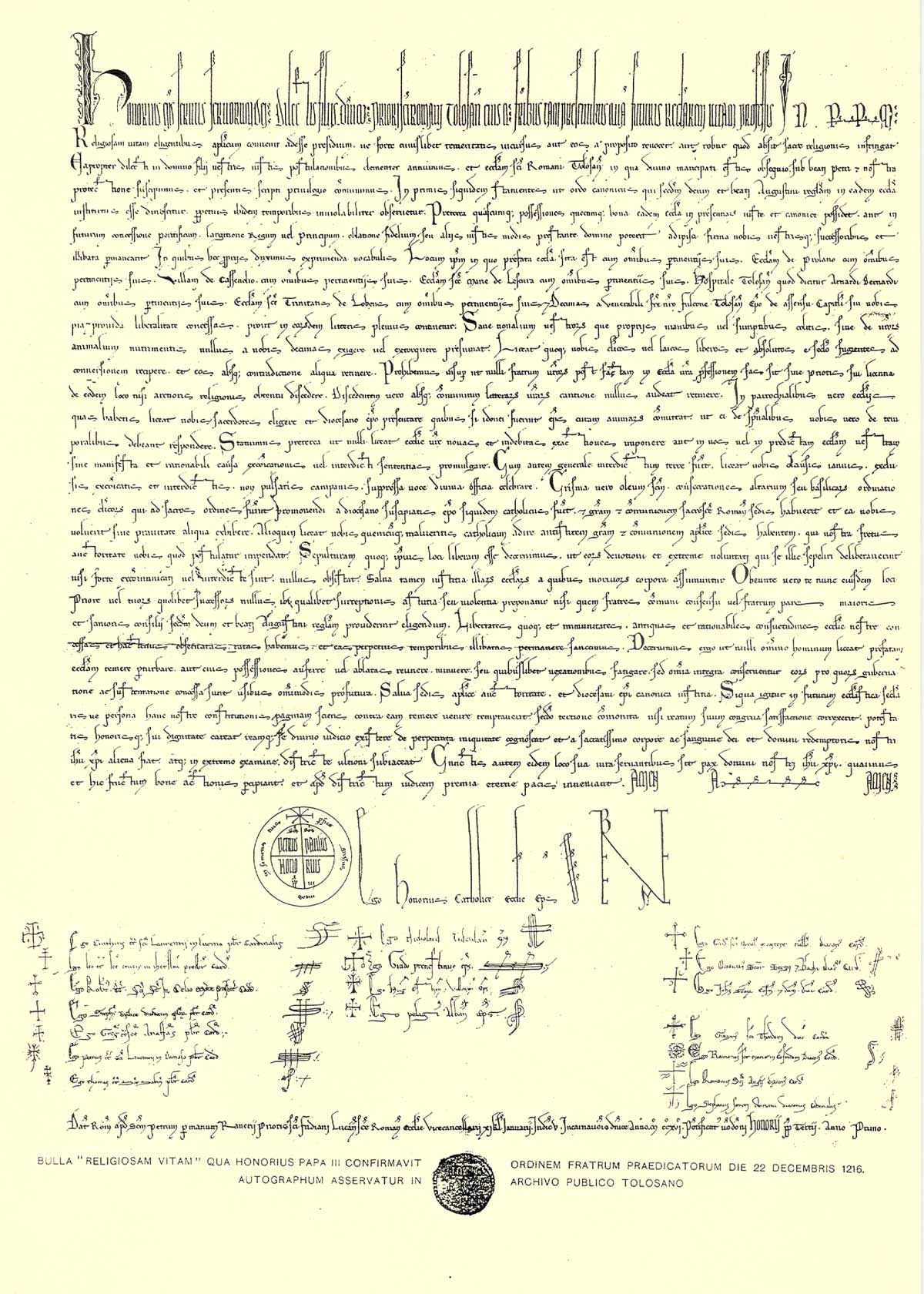
Religiosam vitam is the incipit designating a papal bull issued on 22 December 1216 by Pope Honorius III. It gave universal recognition to the Dominican Order. The order already had monasteries in Rome, Paris and Boulogne and had already been locally recognized by the bishop of Toulouse the year before – its creation had coincided with the Albigensian Crusade in southern France, in whose support the Dominicans had been very active. It adopted the Rule of St Augustine, but was also regulated by rulings and decisions taken by its own regular general chapters.
Honorius, bishop, servant of the servants of God, to the beloved sons Dominic, prior of St. Romanus in Toulouse, and his brethren, both present and future, professed in the regular life. In perpetuum.
It is fitting that apostolic protection should be extended to those choosing the religious life, lest temerarious attacks should possibly turn them away from their purpose or, God forbid, destroy the vigour of the sacred religious institute. Wherefore, beloved sons in the Lord, we benevolently assent to your just requests. We take the Church of St. Romanus in Toulouse, where you have given yourselves to the service of God, under the protection of St. Peter and our own, and we secure it with the present written privilege.
In the first place, indeed, we decree that the canonical Order which is known to be established according to God and the Rule of St. Augustine in the said Church should be inviolably preserved forever.
Moreover, that whatever possessions and whatever goods the said church at present justly and canonically possesses or shall be able, the Lord granting, to acquire in the future through the concession of the popes, the liberality of kings or princes, the offerings of the faithful, or other just means, should belong firmly and inviolably to you and your successors. Among these goods, we have deemed it well to name the following: the place itself where the said church is situated, with its properties; the church of Prouille with its properties; the estate of Caussanel with its properties; the church of St. Mary of Lescure with its properties; the hospice in Toulouse, called “the Hospice of Arnold Bernard,” with its properties; the church of the Holy Trinity in Loubens, with its properties; and the tithes which, in his good and provident liberality, our venerable brother Foulques, the bishop of Toulouse, with the consent of his chapter, has given you, as this is more explicitly contained in his letters.
Also let no one presume to exact or extort from you tithes from the fruits of the lands which you cultivate with your own hands or at your own expense, or from the produce of your animals.
Moreover, you may receive and keep, without opposition from anyone, members of the clergy or the laity who are free men and unencumbered by debt, who flee from the world to enter the religious life.
Furthermore, we prohibit any of your brethren, after they have made profession in your church to depart from it without the permission of their prior, except for the purpose of entering a stricter religious institute. If one should leave, let no one dare to receive him without the authorization of a letter from your community.
Hub AI
Religiosam vitam AI simulator
(@Religiosam vitam_simulator)
Religiosam vitam
Religiosam vitam is the incipit designating a papal bull issued on 22 December 1216 by Pope Honorius III. It gave universal recognition to the Dominican Order. The order already had monasteries in Rome, Paris and Boulogne and had already been locally recognized by the bishop of Toulouse the year before – its creation had coincided with the Albigensian Crusade in southern France, in whose support the Dominicans had been very active. It adopted the Rule of St Augustine, but was also regulated by rulings and decisions taken by its own regular general chapters.
Honorius, bishop, servant of the servants of God, to the beloved sons Dominic, prior of St. Romanus in Toulouse, and his brethren, both present and future, professed in the regular life. In perpetuum.
It is fitting that apostolic protection should be extended to those choosing the religious life, lest temerarious attacks should possibly turn them away from their purpose or, God forbid, destroy the vigour of the sacred religious institute. Wherefore, beloved sons in the Lord, we benevolently assent to your just requests. We take the Church of St. Romanus in Toulouse, where you have given yourselves to the service of God, under the protection of St. Peter and our own, and we secure it with the present written privilege.
In the first place, indeed, we decree that the canonical Order which is known to be established according to God and the Rule of St. Augustine in the said Church should be inviolably preserved forever.
Moreover, that whatever possessions and whatever goods the said church at present justly and canonically possesses or shall be able, the Lord granting, to acquire in the future through the concession of the popes, the liberality of kings or princes, the offerings of the faithful, or other just means, should belong firmly and inviolably to you and your successors. Among these goods, we have deemed it well to name the following: the place itself where the said church is situated, with its properties; the church of Prouille with its properties; the estate of Caussanel with its properties; the church of St. Mary of Lescure with its properties; the hospice in Toulouse, called “the Hospice of Arnold Bernard,” with its properties; the church of the Holy Trinity in Loubens, with its properties; and the tithes which, in his good and provident liberality, our venerable brother Foulques, the bishop of Toulouse, with the consent of his chapter, has given you, as this is more explicitly contained in his letters.
Also let no one presume to exact or extort from you tithes from the fruits of the lands which you cultivate with your own hands or at your own expense, or from the produce of your animals.
Moreover, you may receive and keep, without opposition from anyone, members of the clergy or the laity who are free men and unencumbered by debt, who flee from the world to enter the religious life.
Furthermore, we prohibit any of your brethren, after they have made profession in your church to depart from it without the permission of their prior, except for the purpose of entering a stricter religious institute. If one should leave, let no one dare to receive him without the authorization of a letter from your community.
Recent media