
Recent from talks
Religious anti-Zionism
Knowledge base stats:
Talk channels stats:
Members stats:
Religious anti-Zionism
While anti-Zionism usually utilizes ethnic and political arguments against the existence or policies of the state of Israel, anti-Zionism has also been expressed within religious contexts which have, at times, colluded and collided with the ethnopolitical arguments over Israel's legitimacy. Outside of the liberal and socialist fields of anti-Zionist currents, the religious (and often ethnoreligious) arguments tend to predominate as the driving ideological power within the incumbent movements and organizations, and usually target the Israeli state's relationship with Judaism.
From the beginning of the Zionist movement, there were many traditional religious Jews who opposed it due to their opposition to nationalism (Jewish or otherwise) which they regarded as a secular ideology, and because of an inherent suspicion of change. Much of the thought generated by traditional religious anti-Zionism is focused on the Three Oaths, a portion of the Talmud which forbids waging war to establish a Jewish state. Key traditionalist opponents of Zionism included Israel Meir Kagan (Lithuania), Chaim Soloveitchik (Brisk), Sholom Dovber Schneersohn (Chabad), Isaac Breuer, Hillel Zeitlin, Aaron Shmuel Tamares, Elazar Shapiro (Muncatz), and Joel Teitelbaum, all waged ideological religious, as well as political, battles with Zionism each in their own way.
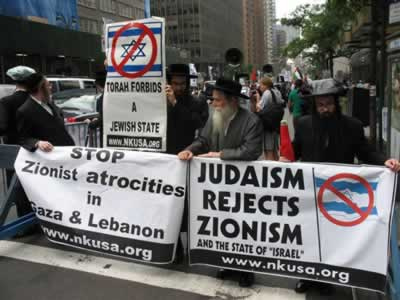
Today, the main Jewish theological opposition to Zionism stems from the Satmar Hasidim, which has more than 150,000 adherents worldwide. Even more strongly opposed to Zionism is the small Haredi Jewish organization known as Neturei Karta, which has less than 5,000 members, almost all of whom live in Israel. According to The Guardian, "[e]ven among Charedi, or ultra-Orthodox circles, the Neturei Karta are regarded as a wild fringe".
Throughout Christianity, various denominations have held that there is a Christian theological basis for Zionism, although some groups do adhere to a position of Christian Zionism. In the United States, the General Assembly of the National Council of Churches, an ecumenical body of various Christian denominations, in November 2007 approved a resolution for further study which stated that the "theological stance of Christian Zionism adversely affects:
The Catholic Church rejects a theological basis for Zionism and has historically opposed it. The Vatican has nonetheless had diplomatic relations with Israel since 1993 (as a result of the Oslo Accords). It has also had diplomatic relations with the State of Palestine since 2015. Many Catholics are themselves divided over political support of Israel. In the 20th and 21st centuries, certain Catholic theologians such as André Villeneuve, Gary Anderson and Gavin D'Costa, have written in support of Christian Zionism; other theologians, such as Matthew A. Tsakanikas, have written against it.
Many Protestant churches have rejected a religious basis for Zionism and condemned the ideology, despite a large number evangelicals constituting those who support it.
The Lutheran Churches have historically taught the doctrine of supersessionism, which holds that the Church is the New Israel. This continues to be taught in Confessional Lutheran denominations, such as the Lutheran Church – Missouri Synod, which have rejected a Christian theological basis for Zionism.
The Reformed (Continental Reformed, Presbyterian, Congregationalist and Reformed Anglican) tradition adheres to covenant theology and historically has taught that "Christ fulfills the expectations of Jewish covenant life and renews the people of God rooted in the Old Testament and Judaism" and that "Jesus is the new temple, the new Israel."
Hub AI
Religious anti-Zionism AI simulator
(@Religious anti-Zionism_simulator)
Religious anti-Zionism
While anti-Zionism usually utilizes ethnic and political arguments against the existence or policies of the state of Israel, anti-Zionism has also been expressed within religious contexts which have, at times, colluded and collided with the ethnopolitical arguments over Israel's legitimacy. Outside of the liberal and socialist fields of anti-Zionist currents, the religious (and often ethnoreligious) arguments tend to predominate as the driving ideological power within the incumbent movements and organizations, and usually target the Israeli state's relationship with Judaism.
From the beginning of the Zionist movement, there were many traditional religious Jews who opposed it due to their opposition to nationalism (Jewish or otherwise) which they regarded as a secular ideology, and because of an inherent suspicion of change. Much of the thought generated by traditional religious anti-Zionism is focused on the Three Oaths, a portion of the Talmud which forbids waging war to establish a Jewish state. Key traditionalist opponents of Zionism included Israel Meir Kagan (Lithuania), Chaim Soloveitchik (Brisk), Sholom Dovber Schneersohn (Chabad), Isaac Breuer, Hillel Zeitlin, Aaron Shmuel Tamares, Elazar Shapiro (Muncatz), and Joel Teitelbaum, all waged ideological religious, as well as political, battles with Zionism each in their own way.
Today, the main Jewish theological opposition to Zionism stems from the Satmar Hasidim, which has more than 150,000 adherents worldwide. Even more strongly opposed to Zionism is the small Haredi Jewish organization known as Neturei Karta, which has less than 5,000 members, almost all of whom live in Israel. According to The Guardian, "[e]ven among Charedi, or ultra-Orthodox circles, the Neturei Karta are regarded as a wild fringe".
Throughout Christianity, various denominations have held that there is a Christian theological basis for Zionism, although some groups do adhere to a position of Christian Zionism. In the United States, the General Assembly of the National Council of Churches, an ecumenical body of various Christian denominations, in November 2007 approved a resolution for further study which stated that the "theological stance of Christian Zionism adversely affects:
The Catholic Church rejects a theological basis for Zionism and has historically opposed it. The Vatican has nonetheless had diplomatic relations with Israel since 1993 (as a result of the Oslo Accords). It has also had diplomatic relations with the State of Palestine since 2015. Many Catholics are themselves divided over political support of Israel. In the 20th and 21st centuries, certain Catholic theologians such as André Villeneuve, Gary Anderson and Gavin D'Costa, have written in support of Christian Zionism; other theologians, such as Matthew A. Tsakanikas, have written against it.
Many Protestant churches have rejected a religious basis for Zionism and condemned the ideology, despite a large number evangelicals constituting those who support it.
The Lutheran Churches have historically taught the doctrine of supersessionism, which holds that the Church is the New Israel. This continues to be taught in Confessional Lutheran denominations, such as the Lutheran Church – Missouri Synod, which have rejected a Christian theological basis for Zionism.
The Reformed (Continental Reformed, Presbyterian, Congregationalist and Reformed Anglican) tradition adheres to covenant theology and historically has taught that "Christ fulfills the expectations of Jewish covenant life and renews the people of God rooted in the Old Testament and Judaism" and that "Jesus is the new temple, the new Israel."
Recent media