Recent from talks
Nothing was collected or created yet.
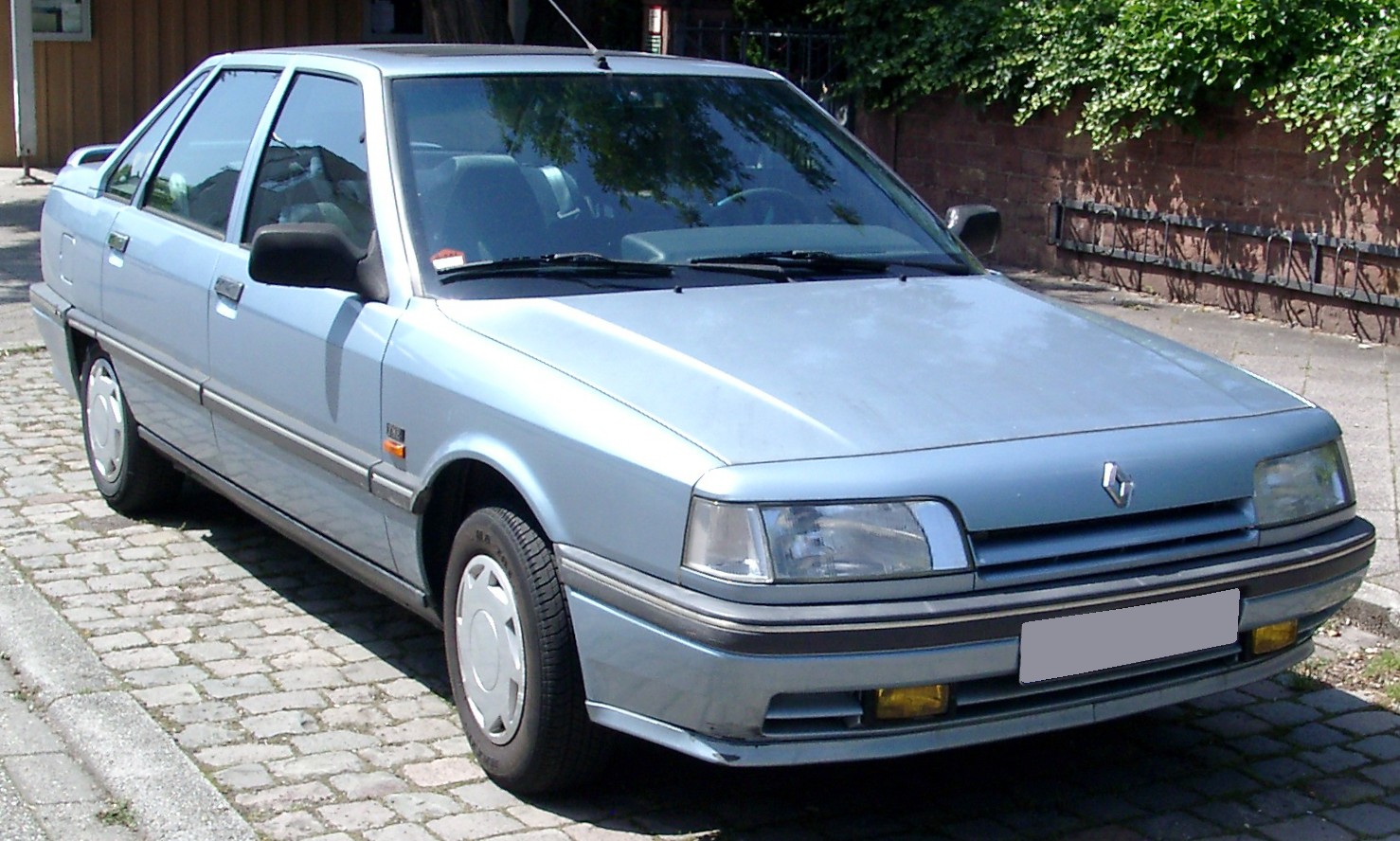
Renault 21
View on Wikipedia
| Renault 21 | |
|---|---|
| Overview | |
| Manufacturer | Renault |
| Also called | Eagle Medallion (U.S. & Canada) Renault Étoile (Colombia) Renault Medallion |
| Production | 1986–1994 1990–1995 (Turkey) |
| Assembly |
|
| Designer | Giorgetto Giugiaro at Italdesign |
| Body and chassis | |
| Class | Mid-size car/Large family car (D) |
| Body style | 4-door saloon 5-door Nevada 5-door liftback |
| Layout | |
| Powertrain | |
| Engine | |
| Transmission | 5-speed manual 3-or-4-speed automatic |
| Dimensions | |
| Wheelbase | 2,600 mm (102.4 in) saloon 2,750 mm (108.3 in) wagon |
| Length | 4,462 mm (175.7 in) saloon 4,644 mm (182.8 in) wagon |
| Width | 1,715 mm (67.5 in) |
| Height | 1,415 mm (55.7 in) saloon 1,421 mm (55.9 in) wagon |
| Curb weight | 1,190 kg (2,624 lb)[1] |
| Chronology | |
| Predecessor | Renault 18 |
| Successor | Renault Laguna |
The Renault 21 is a large family car produced by French automaker Renault between 1986 and 1994. It was also sold in North America initially through American Motors dealers as the Renault Medallion and later through Jeep-Eagle dealers as the Eagle Medallion. A total of 2,096,000 units were produced.[citation needed]
The Renault 21 saloon was launched in the beginning of 1986, as the successor to the successful Renault 18, and this was followed a few months later by the seven seater station wagon, the R21 Nevada, marketed as the Savanna in the United Kingdom. In 1987, What Car? awarded the Renault 21 GTS Best Family Saloon. The Renault 21 Savanna was awarded Car of the Year, as well as Best Family Estate.
Design
[edit]

Unusually, the Renault 21 was offered with disparate engine configurations. The 1.7 litre version featured a transverse engine and transmission, but Renault had no gearbox suitable for a more powerful transverse engine: accordingly, faster versions featured longitudinally mounted engines. The two versions featured (barely perceptibly) different wheel bases: the engines were all relatively compact four-cylinder units and the engine bay was large enough to accept either configuration without reducing passenger space.
However, at a time when production technologies were relatively inflexible, the need to assemble differently configured engine bays on a single production line, along with the supplementary inventory requirements imposed both on Renault and on the dealership network, did compromise the Renault 21's profitability.[citation needed]
The Nevada/Savanna station wagon/estate version was slightly longer than the saloon, and was available configured with seven seats, two of those a forward-facing foldable bench seat for children (up to about age 10) that used up much of the luggage space when up. It had roof rack side rails as standard.[2][3]
History
[edit]First unveiled on 20 November 1985 and officially launched in February 1986, the R21 gave Renault a new competitor in this sector after eight years of the R18, which was declining in popularity after a very strong start to its commercial life. It had a razor like design, which was different from contemporary cars of the era, e.g. the Ford Sierra (with its "jelly mould" design) and the Opel Ascona.[4]
It was sold in right hand drive for the United Kingdom from June 1986.
The car was revamped considerably in May 1989, both technically and aesthetically – the new sleeker outward appearance was similar to the also recently revamped Renault 25, and a liftback body style was also added to the range (which soon became more popular than the saloon in France) along with a sporty 2.0 L Turbo version. Of the saloons, the TXi 2.0 12v and 2.0 turbo were also available with the four-wheel-drive Quadra transmission. The Nevada wagons received four-wheel-drive in the eight-valve 2.0 and in the naturally aspirated 2.1 Diesel, as the 12-valve and the turbo were not available with this body style.[5] The front-wheel-drive 21 Turbo was capable of 227 km/h (141 mph).[6] At the 1989 Frankfurt Motor Show the fuel injected 2.2i model was introduced, originally reserved for the German market (being a different model than the earlier 2.2s built for the US) where insurance and tax regulations suited larger engines with less peak power. Injected engines were equipped by Renix engine control unit, developed by a joint venture by Renault and Bendix. This car was also available with four-wheel-drive, exclusively as a Nevada.[5]
The Renault 21 liftback and saloon petrol models ceased production in the beginning of 1994, following the launch of the all new Laguna liftback, but the diesels and the Nevada/Savanna remained on the market, until their replacement Laguna variants were launched (end of 1994 for the diesels, and end of 1995 for the Nevada/Savanna).
A Renault 21 TSE, donated as a personal gift to Václav Havel by the president of Portugal Mário Soares just before the Velvet Revolution, served for a while as the official state car of the President of Czechoslovakia in 1989.
Other markets
[edit]Argentina
[edit]The R21 was built in Argentina at the Renault facility in Santa Isabel (Córdoba Province) from late 1988 until early 1996. Production continued in Argentina for some years after its demise in European markets. Two body styles were built: saloon and Nevada (station wagon). It has been equipped with both petrol and diesel engines, (carburetor for the early production, fuel injection for the later engines).
The available engines ranged from 1.8 liters (92CV carbureted/95CV injection), 2.0 liters (110CV without catalytic converter/105CV with catalytic converter), up to 2.2 liters (120CV without catalytic converter/110CV with catalytic converter), as well as the 2.1-liter diesel version (72CV)


The liftback was imported from France and called by the trim "Alizé". It was replaced for the Laguna.
Turkey
[edit]The R21 was manufactured in Turkey in the early 1990s, with two different engine and in three different trim levels. The entry level model was simply the 21 (1.7 L), the mid-range trim was called 21 Manager (1.7 L, 90 PS), and at the top-of-the-line sat the 2.0-liter fuel injected "Concorde." Later on, the lower cost 1.6-litre "Optima" and the "Manager 2000" with a 2 L, 122 PS engine were introduced. The Oyak-built Renault 21 was produced and sold up to the end of 1996 in Turkey.
United States and Canada
[edit]The R21 was also sold in the United States and Canada from 1987 to 1988 as the Renault Medallion and later in 1988 until the end of the line in 1989 as the Eagle Medallion with the 2.2 L engine as the only powerplant.[7] However, the car was only on sale for a few months in 1987 before Renault sold its investment in American Motors Corporation (AMC) to Chrysler. AMC dealers were now under the newly formed Jeep-Eagle Division of Chrysler, and now as Jeep-Eagle dealers, they continued to sell the car as the Eagle Medallion until 1989.[8] The North American version had somewhat different styling to comply with front and rear impact regulations and different lighting standards.
Colombia
[edit]The 21 was launched in Colombia in 1987. Initially, it was only available with the four-door saloon body with the 2.0 L longitudinal engine. In October of the same year, the Renault 21 Nevada was launched, with the same engine as the saloon. in 1989 Sociedad de Fabricación de Automotores S.A. (SOFASA) launched a version called RS with the 1.6-liter C2L engine, also used in the TXE version of the Renault 9. In 1990, the name was replaced by the Étoile. This was the first car with electronic fuel injection assembled in Colombia. The three available versions available were:
- TS Saloon, Break, Penta (hatchback body) Engine 1.6 L 73 PS (54 kW; 72 hp), manufactured until 1994
- TX with engine 2.0 L 100 PS (74 kW; 99 hp)
- TXi after called Bravo: engine 2.2 L 128 PS (94 kW; 126 hp).
Engines
[edit]- 1.4 L (1397 cc) petrol OHV 8 valve I4; 68 PS (50 kW; 67 hp); top speed: 165 km/h (103 mph) (Turkish development from C series block, called C2J, also available in Portugal and Yugoslavia)
- 1.4 L (1397 cc) petrol OHV 8 valve I4; 70 PS (51 kW; 69 hp); top speed: 168 km/h (104 mph)
- 1.6 L (1565 cc) petrol OHV 8 valve I4; 73 PS (54 kW; 72 hp); top speed: 165 km/h (103 mph); 0–100 km/h: 12.0 s (Argentinian development from C-series block, called C2L, available in Argentina and Colombia)
- 1.7 L (1721 cc) petrol SOHC 8 valve I4 carb.; 76 PS (56 kW; 75 hp); top speed: 173 km/h (107 mph); 0–100 km/h: 12.0 s (Available in TL and TLE models)
- 1.7 L (1721 cc) petrol SOHC 8 valve I4 SPI; 75 PS (55 kW; 74 hp); top speed: 172 km/h (107 mph); 0–100 km/h: 12.5 s
- 1.7 L (1721 cc) petrol SOHC 8 valve I4 carb.; 90 PS (66 kW; 89 hp); top speed: 185 km/h (115 mph); 0–100 km/h: 10.7 s (Available in TS, RS, GTS and TSE models)
- 1.7 L (1721 cc) petrol SOHC 8 valve I4 carb.; 88 PS (65 kW; 87 hp); top speed: 181 km/h (112 mph)
- 1.7 L (1721 cc) petrol SOHC 8 valve I4 MPI; 95 PS (70 kW; 94 hp); top speed: 185 km/h (115 mph); 0–100 km/h: 10.7 s
- 2.0 L (1995 cc) petrol SOHC 8 valve I4 MPI; 135 PS (99 kW; 133 hp); top speed: 220 km/h (137 mph); 0–100 km/h: 10.9 s (Available in GTX and TXE models)
- 2.0 L (1995 cc) petrol SOHC 12 valve I4; 136 PS (100 kW; 134 hp); top speed: 230 km/h (143 mph) ; 0–100 km/h: 9.2 s (available in the TXi and TXi Quadra models)
- 2.0 L (1995 cc) petrol SOHC 8 valve I4 MPI turbo; 175 PS (129 kW; 173 hp); top speed: 227 km/h (141 mph); 0–100 km/h: 7.4 s (available in Turbo and Turbo Quadra models).
- 2.0 L (1995 cc) petrol SOHC 8 valve I4 MPI turbo; 175 PS (129 kW; 173 hp); top speed: 222 km/h (138 mph); 0–100 km/h: 7.8 s
- 2.2 L (2165 cc) petrol SOHC 8 valve I4 MPI; 110 PS (81 kW; 108 hp); top speed: 192 km/h (119 mph) ; 0–100 km/h: 9.9 s
- 1.9 L (1870 cc) diesel SOHC 8 valve I4; 65 PS (48 kW; 64 hp); top speed: 160 km/h (99 mph); 0–100 km/h: 16.0 s (available in SD and GSD models)
- 2.1 L (2068 cc) diesel SOHC 8 valve I4; 67 PS (49 kW; 66 hp); top speed: 164 km/h (102 mph) ; 0–100 km/h: 15.6 s (available in TD and GTD models)
- 2.1 L (2068 cc) diesel SOHC 8 valve I4; 73 PS (54 kW; 72 hp); top speed: 170 km/h (106 mph) ; 0–100 km/h: 15.1 s
- 2.1 L (2068 cc) diesel SOHC 8 valve I4 turbo; 88 PS (65 kW; 87 hp); top speed: 177 km/h (110 mph) ; 0–100 km/h: 11.8 s
References
[edit]- ^ "Renault 21 Turbo 175 PS (1987-›1992) technical specifications and performance figures". zeperfs.com. Retrieved 13 May 2022.
- ^ Renault 21 Savanna 2.0GTX (PDF) (Report). AA. February 1991. R9105A. Retrieved 4 February 2015.
- ^ Humble, Mike (5 June 2012). "Essay: Not their finest hour - Renault 21". AROnline. Retrieved 4 February 2015.
- ^ "Presentación Renault 21 (20/11/1985) - YouTube". 19 September 2012 – via YouTube.
- ^ a b Mastrostefano, Raffaele, ed. (1990). Quattroruote: Tutte le Auto del Mondo 1990 (in Italian). Milano: Editoriale Domus S.p.A. pp. 843–845.
- ^ Tutte le Auto del Mondo 1990, p. 840
- ^ Burggraaf, René. "History Renault 21/21 Nevada". René's Renault Pages. Archived from the original on 20 February 2008.
- ^ "How Eagle Cars Work". HowStuffWorks.com. 18 June 2007. Retrieved 23 January 2022.
External links
[edit]Renault 21
View on GrokipediaDevelopment and Design
Project Development
The Renault 21 originated as a strategic successor to the Renault 18 family car and the Renault 20/30 executive models, addressing the need for a versatile mid-size vehicle that bridged everyday practicality with upscale appeal in the early 1980s. Designated under internal project code 48, development commenced around 1980 to revitalize Renault's presence in the D-segment, where the aging lineup had lost ground to more modern rivals. The project aimed to consolidate two distinct market roles into a single platform, offering improved interior space utilization through innovative packaging and a more aerodynamic profile to enhance fuel efficiency and high-speed stability.[10][11] Key objectives focused on elevating the model's executive positioning while maintaining family-oriented versatility, directly targeting competitors such as the Ford Sierra, Vauxhall Cavalier, and Austin Montego in Europe, with aspirations to challenge premium entrants like the BMW 5 Series and Citroën BX through superior space efficiency and ride comfort. Engineers prioritized aerodynamic refinement, achieving a low drag coefficient via sleek, wedge-shaped styling that maximized cabin volume without excessive exterior length. Prototyping intensified from 1983, with extensive testing phases emphasizing crash safety, suspension tuning for balanced handling, and durability under varied conditions to meet emerging European regulations. The exterior design, led by Giorgetto Giugiaro at Italdesign, drew inspiration from contemporary concepts like the 1982 Renault Orca, finalizing the silhouette by October 1983 after iterative reviews.[12][11][13] Production planning centered on Renault's French facilities, with primary assembly at the Douai plant in northern France, supplemented by assembly in Haren, Belgium, to scale output for the 1986 model year launch. This setup enabled rapid ramp-up to meet anticipated demand across Europe and export markets. The target debut in February 1986 followed a unveiling on November 20, 1985, marking the culmination of roughly five years of refinement.[14][15] A core engineering challenge involved integrating a front-wheel-drive architecture adaptable to diverse powertrains, particularly accommodating larger inline-four engines in a longitudinal orientation alongside the standard transverse setup for smaller units. This duality necessitated multiple subframes, varying wheelbases (shorter by 2.4 inches for longitudinal applications), and adjusted suspension geometries to mitigate front-end weight bias and preserve handling poise. Packaging constraints for turbocharged variants and provisions for potential V6 compatibility—shared with the related Renault 25 platform—demanded careful optimization of the engine bay and driveline, balancing performance aspirations with manufacturability and cost control. These adaptations, while innovative, contributed to development complexities but ensured flexibility for future variants.[11][12]Styling and Engineering
The Renault 21 featured an exterior design characterized by a sloping nose and a fastback saloon profile, which contributed to its aerodynamic efficiency and modern appearance for a mid-1980s family car.[14] This styling was initially developed in collaboration with Italdesign Giugiaro, whose angular proposals influenced the final fluid lines, including integrated bumpers and a low roofline that evoked a coupé-like silhouette in saloon form.[4] The car's dimensions included a length of 4.46 meters and a wheelbase of 2.67 meters for the saloon variant, providing a spacious interior while maintaining compact proportions suitable for European executive markets.[16] Aerodynamic considerations were central to the Renault 21's engineering, achieving a drag coefficient (Cd) of 0.31 through features such as flush-mounted glass, a steeply raked windscreen, and integrated rear spoilers.[17] Underbody panels and smooth wheel arch liners further reduced turbulence, enhancing fuel efficiency and high-speed stability without compromising everyday usability.[14] These elements positioned the Renault 21 as one of the more aerodynamically refined saloons of its era, with the design prioritizing low wind resistance over aggressive styling cues. The chassis employed a steel unibody construction, emphasizing ride comfort through independent suspension at all four wheels, with MacPherson struts and lower wishbones at the front paired with trailing arms and torsion bars at the rear.[14] Rack-and-pinion steering provided precise handling, tuned more for compliant touring than sharp sportiness, which aligned with the model's executive positioning.[16] This setup delivered a balanced ride over varied road surfaces, contributing to the car's reputation for long-distance refinement. Safety engineering included a reinforced passenger cell to protect occupants during impacts, along with front and rear crumple zones designed to absorb collision energy in line with 1980s European regulations.[18] Higher trims, such as the Turbo models, adopted anti-lock braking system (ABS) as an early option, improving control on slippery surfaces and marking a forward-thinking feature for the segment.[19] Build quality relied on high-strength steel panels, some galvanized for enhanced corrosion resistance, which helped the Renault 21 withstand harsh winter conditions common in Europe.[20] Curb weights varied from approximately 1,100 kg for base models to 1,300 kg for heavier variants like the Turbo, balancing structural integrity with drivability.[21]Interior and Features
The Renault 21 featured a spacious five-seat cabin designed for family use, with generous front legroom of 17.3 inches from the accelerator pedal to the junction of the back seat cushion and squab, and back seat knee room of 8.1 inches.[14] The saloon variant offered a boot capacity of 420 liters, expandable via split-folding rear seats in higher trims for increased versatility.[22] Front seats included height-adjustable cushions with a 7-degree angle change on most versions except base TL and TS models, enhancing driver and passenger comfort.[14] Available in trim levels such as the entry-level TX, mid-range GTS, and upper TSE, the interior combined practicality with executive styling elements.[23] Base models came with cloth upholstery, while mid- and upper trims offered velour or optional leather seating, along with wood accents on the dashboard in luxury variants.[24] Standard equipment across trims included power-assisted steering, an adjustable-height steering wheel on TXE and above, power windows, central locking with remote control, and a stereo system.[14][25] Higher trims added features like electric sunroof, cruise control, and manual climate control for enhanced refinement.[25] Ergonomics emphasized intuitive controls and an airy layout, with slim door panels providing ample elbow room and a wedge-shaped dashboard featuring a tall instrument cluster for better visibility.[26][12] The cabin's overall fit and finish was described as decent and superior to PSA rivals, though materials drew criticism for their plasticky quality when compared to German competitors.[11] Accessibility was aided by wide-opening doors and a low load floor, facilitating easy entry and cargo loading.[12]Production History
Launch and Early Models
The Renault 21 was unveiled at the 1985 Paris Motor Show on November 20 and went on sale across Europe starting in spring 1986, succeeding the Renault 18 as a mid-size family saloon. Sales began in France in March 1986, where it quickly gained traction, capturing 10.5% of the market by June. Initial production occurred primarily at Renault's Sandouville plant near Le Havre, with additional assembly at other French facilities and some subcontracting to meet demand.[27][28][14] The early model range focused on four-door saloons offered in TX, GTS, and TXE trims, catering to a variety of buyers with options for different engine displacements while emphasizing spacious interiors and practical features. The Nevada estate variant, known as the Savanna in some markets, was introduced later in 1986, expanding the lineup with enhanced cargo capacity and optional seven-seater configurations for family use. In its first full year, the Renault 21 achieved sales of 93,907 units in France alone, rising to 132,306 in 1987, contributing to over 226,000 units produced in the initial two years across Europe, mainly at domestic plants.[29][9][28] Contemporary reviews praised the Renault 21 for its competitive value, generous interior space, and competent handling that rivaled contemporaries like the Ford Sierra, positioning it as a versatile family executive option. However, early models faced criticism for reliability concerns, particularly with complex electronics such as dashboard displays and cooling systems, which led to issues like overheating and costly repairs in period assessments. Marketing campaigns highlighted its "French character" and practicality, promoting it as an intelligent choice for executives seeking affordability and multifunctionality over outright luxury.[9][12][30][9]1990 Facelift
The 1989 facelift of the Renault 21, known as Phase II, was introduced in May 1989, marking a mid-cycle refresh three years after the model's launch to sustain market interest.[26][12] Exterior updates focused on the front end with rounder fascia edges, wider headlights, a body-colored bumper replacing the prior black unit, and integrated fog lamps on higher trims like the Turbo.[26] Rear changes included redesigned taillights and bumpers for improved aesthetics and minor aerodynamic refinements, such as smoother air flow around the body.[12] These modifications gave the car a fresher, less angular look while maintaining its overall three-box proportions across sedan, hatchback, and estate body styles. Inside, the facelift brought a redesigned wedge-shaped dashboard with a taller instrument cluster for enhanced visibility and ergonomics, repositioning the stereo higher on the center stack and climate controls below the vents.[26] Trim materials were upgraded for a less brittle feel, and sound insulation was improved to reduce road noise, contributing to better-appointed cabins overall.[12] Mechanical enhancements included stiffer suspension tuning for sharper handling and refined steering for improved responsiveness, alongside the introduction of Phase II engines tuned for stricter emissions compliance.[12] These updates addressed earlier criticisms of vague steering and a soft ride without altering the core independent suspension setup. The facelift extended the model's production life until 1994, with cumulative output surpassing 2 million units by the end of its run.[12]Body Styles and Variants
The Renault 21 was primarily offered as a four-door saloon, measuring approximately 4.46 meters in length and serving as the standard body configuration across all trim levels.[31] This design emphasized a spacious interior for family use while maintaining a sleek, aerodynamic profile penned by Giorgetto Giugiaro.[32] In late 1986, Renault introduced the estate variant, known as the Nevada in most markets and Savanna in the UK, featuring an extended roofline that increased overall length to about 4.64 meters and provided additional cargo capacity of around 674 liters with seats up.[33][34] Higher-trim estate models included options for seven seats and enhanced load-carrying capabilities, making it suitable for larger families or utility needs.[9] A five-door liftback body style was added in May 1989 as part of the Phase II facelift.[30] Among special variants, the 21 Turbo debuted in 1987 as a performance-oriented saloon with a turbocharged engine producing 175 horsepower and upgraded sport suspension for improved handling.[35] The Quadra variant followed in 1989, adding all-wheel drive via a viscous coupling system integrated with an epicyclic center differential to enhance traction in adverse weather conditions; it was available in both saloon and estate forms.[36] Limited editions, such as the 2.0 Automatic and GTX Special Edition, offered automatic transmissions and unique trim packages for select markets.[37] Buyers could customize the Renault 21 with optional alloy wheels, body spoilers, and specialized color schemes, though no convertible or coupe versions were ever produced.[32] The 1989 facelift introduced minor styling refinements to these body styles, including revised bumpers and lighting for a more modern appearance.[9]Powertrains
Petrol Engines
The Renault 21 was equipped with a range of petrol engines, primarily inline-four configurations, all designed for a balance of performance and efficiency in a mid-size executive car. These spark-ignition units featured overhead camshafts and were available in naturally aspirated and turbocharged forms, with displacements from 1.7 to 2.2 liters. Entry-level models relied on the 1.7-liter inline-four or 1.8-liter variants for economical daily driving, while mid-range options included a naturally aspirated 2.0-liter unit, and more powerful variants catered to performance-oriented buyers.[32][38] The base 1.7-liter inline-four engine (F3N code) produced 93 horsepower in its carbureted version, rising to 95 horsepower with fuel injection in later models, and was paired with a five-speed manual transmission for front-wheel drive. This unit delivered a top speed of 175 km/h and accelerated from 0 to 100 km/h in approximately 12 seconds, making it suitable for urban and highway commuting in entry-level trims like the GTL. Fuel consumption averaged around 8 liters per 100 km in mixed conditions. Maintenance involved replacing the timing belt every 60,000 km or four years to prevent valvetrain damage. A 1.8-liter inline-four (F8M code) offered 90-95 hp in some markets for similar economy-focused use.[16][39][40] For enhanced performance, a naturally aspirated 2.0-liter inline-four produced 115-120 hp in trims like the GTX. The turbocharged 2.0-liter inline-four (J7T code), with the intercooled version introduced in 1987, delivered 175 PS at 5,200 rpm and 270 Nm of torque at 3,000 rpm. This setup achieved 0-100 km/h in 7.4 seconds and a top speed of 230 km/h, though early non-intercooled units exhibited noticeable turbo lag below 2,500 rpm, which could affect low-speed responsiveness. Fuel economy ranged from 8 to 10 liters per 100 km, depending on driving style. Like other engines, it required timing belt replacement at similar intervals, with turbo-specific maintenance focusing on intercooler cleaning to mitigate lag over time.[41][42][43] Higher-end executive models featured the 2.2-liter inline-four (J7T base) at 110 horsepower and 169 Nm, providing smoother operation than the base unit. Both met evolving standards through catalytic converters introduced from 1990, reducing hydrocarbon and CO emissions.[44][45][36]| Engine | Displacement | Power | Torque | 0-100 km/h | Top Speed | Notes |
|---|---|---|---|---|---|---|
| 1.7L I4 | 1,721 cm³ | 93-95 hp | 129-140 Nm | 12 s | 175 km/h | Carbureted/injected; entry models[16] |
| 2.0L Turbo I4 | 1,995 cm³ | 175 hp | 270 Nm | 7.4 s | 230 km/h | Intercooled from 1987; turbo lag in early units[41] |
| 2.2L I4 | 2,165 cm³ | 110 hp | 169 Nm | 11 s | 190 km/h | Executive trims; smoother delivery[44] |
