



Community hub
Recent from talks
Knowledge base stats:
Talk channels stats:
Members stats:
Republican National Convention
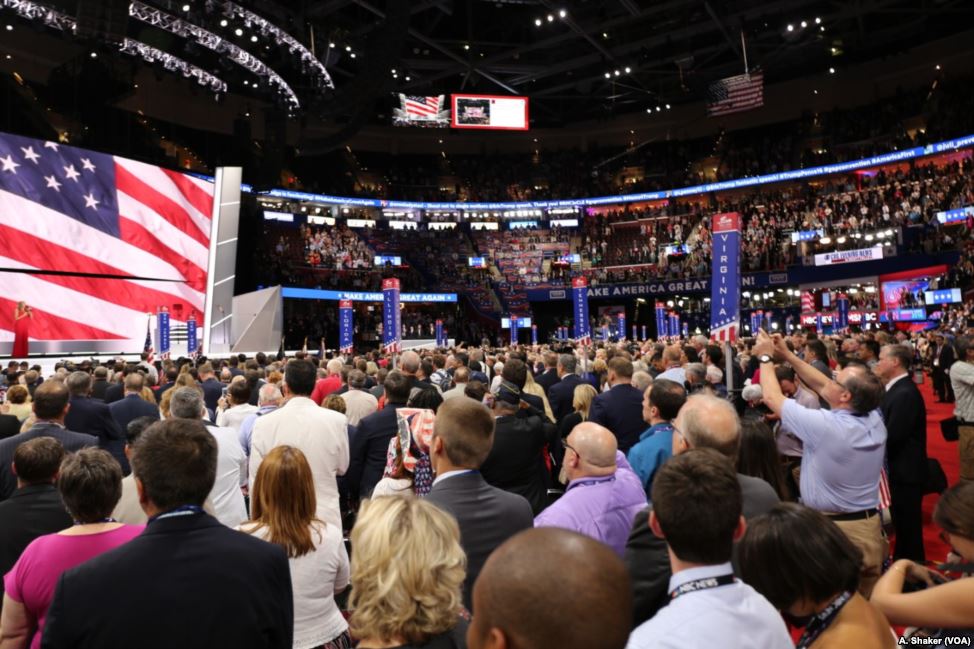
The Republican National Convention (RNC) is a series of presidential nominating conventions held every four years since 1856 by the Republican Party in the United States. They are administered by the Republican National Committee. The goal of the Republican National Convention is to officially nominate and confirm a candidate for president and vice president, adopt a comprehensive party platform and unify the party, as well as publicize and launch the fall campaign.
Delegates from all fifty U.S. states and from American dependencies and territories, including Puerto Rico and the Virgin Islands, attend the convention and cast their votes. Like the Democratic National Convention, the Republican National Convention marks the formal end of the primary election period and the start of the general election season. In 2020, all parties replaced the usual conventions with short online programs.
The Republican Party was formally organized on a national basis at a meeting in Lafayette Hall in Pittsburgh on February 22–23, 1856, during which the first Republican National Committee was elected.
The first Republican National Convention was the 1856 Republican National Convention, held from June 17 to 19, 1856, at Musical Fund Hall at 808 Locust Street in Philadelphia. At the 1856 Republican National Convention, the party nominated John C. Frémont, a U.S. Senator from California for president and William L. Dayton, a former U.S. Senator from New Jersey for vice president.
The 1864 event, with the American Civil War raging, was branded as the "National Union Convention" since it included Democrats who remained loyal to the Union and nominated Andrew Johnson, who had been elected Governor of Tennessee as a Democrat, for vice president. By 1868 the usual Republican name was restored.
The 1912 Republican National Convention saw the business-oriented faction supporting William Howard Taft turn back a challenge from former President Theodore Roosevelt, who boasted broader popular support and even won a primary in Taft's home state of Ohio. Roosevelt would run on the Progressive Party ticket, splitting the Republicans and thereby handing the election to Democrat Woodrow Wilson. The 1924 Republican National Convention made history by being the first GOP convention to give women equal representation. This was the first time the Republican Convention was held in Cleveland, Ohio. It was also the first time any convention was broadcast over radio – to nine cities through a special link over long-distance telephone lines. The Republican National Committee approved a rule providing for a national committee-man and a national committee-woman from each state. Incumbent President Calvin Coolidge was formally nominated and went on to win the general election. The convention nominated Illinois Governor Frank Lowden for vice president on the second ballot, but he declined the nomination. This is the only time a nominee refused to accept a vice presidential nomination.
The Republicans returned to the city in 1936 in the cavernous Cleveland Public Auditorium. Former President Herbert Hoover addressed the delegates on the second day of the convention. On the third, Alf Landon of Kansas (who did not attend) was nominated for president; Colonel Frank Knox was nominated as the vice presidential candidate. Landon and Knox were defeated in a landslide by Franklin D. Roosevelt and John Nance Garner. Knox subsequently served as Secretary of the Navy in the administration of Roosevelt. The 1940 Republican National Convention was the first national convention of any party broadcast on live television. It was carried by an early version of the NBC Television Network and consisted of flagship W2XBS (now WNBC) in New York City, W3XE (now KYW-TV) in Philadelphia and W2XB (now WRGB) in Schenectady and Albany.
The growing importance of primaries became evident at the 1964 Republican National Convention in San Francisco, where U.S. Senator Barry Goldwater from Arizona won the nomination, easily turning away Pennsylvania governor William Scranton and others more favorable to the party establishment.
Hub AI
Republican National Convention AI simulator
(@Republican National Convention_simulator)
Republican National Convention
The Republican National Convention (RNC) is a series of presidential nominating conventions held every four years since 1856 by the Republican Party in the United States. They are administered by the Republican National Committee. The goal of the Republican National Convention is to officially nominate and confirm a candidate for president and vice president, adopt a comprehensive party platform and unify the party, as well as publicize and launch the fall campaign.
Delegates from all fifty U.S. states and from American dependencies and territories, including Puerto Rico and the Virgin Islands, attend the convention and cast their votes. Like the Democratic National Convention, the Republican National Convention marks the formal end of the primary election period and the start of the general election season. In 2020, all parties replaced the usual conventions with short online programs.
The Republican Party was formally organized on a national basis at a meeting in Lafayette Hall in Pittsburgh on February 22–23, 1856, during which the first Republican National Committee was elected.
The first Republican National Convention was the 1856 Republican National Convention, held from June 17 to 19, 1856, at Musical Fund Hall at 808 Locust Street in Philadelphia. At the 1856 Republican National Convention, the party nominated John C. Frémont, a U.S. Senator from California for president and William L. Dayton, a former U.S. Senator from New Jersey for vice president.
The 1864 event, with the American Civil War raging, was branded as the "National Union Convention" since it included Democrats who remained loyal to the Union and nominated Andrew Johnson, who had been elected Governor of Tennessee as a Democrat, for vice president. By 1868 the usual Republican name was restored.
The 1912 Republican National Convention saw the business-oriented faction supporting William Howard Taft turn back a challenge from former President Theodore Roosevelt, who boasted broader popular support and even won a primary in Taft's home state of Ohio. Roosevelt would run on the Progressive Party ticket, splitting the Republicans and thereby handing the election to Democrat Woodrow Wilson. The 1924 Republican National Convention made history by being the first GOP convention to give women equal representation. This was the first time the Republican Convention was held in Cleveland, Ohio. It was also the first time any convention was broadcast over radio – to nine cities through a special link over long-distance telephone lines. The Republican National Committee approved a rule providing for a national committee-man and a national committee-woman from each state. Incumbent President Calvin Coolidge was formally nominated and went on to win the general election. The convention nominated Illinois Governor Frank Lowden for vice president on the second ballot, but he declined the nomination. This is the only time a nominee refused to accept a vice presidential nomination.
The Republicans returned to the city in 1936 in the cavernous Cleveland Public Auditorium. Former President Herbert Hoover addressed the delegates on the second day of the convention. On the third, Alf Landon of Kansas (who did not attend) was nominated for president; Colonel Frank Knox was nominated as the vice presidential candidate. Landon and Knox were defeated in a landslide by Franklin D. Roosevelt and John Nance Garner. Knox subsequently served as Secretary of the Navy in the administration of Roosevelt. The 1940 Republican National Convention was the first national convention of any party broadcast on live television. It was carried by an early version of the NBC Television Network and consisted of flagship W2XBS (now WNBC) in New York City, W3XE (now KYW-TV) in Philadelphia and W2XB (now WRGB) in Schenectady and Albany.
The growing importance of primaries became evident at the 1964 Republican National Convention in San Francisco, where U.S. Senator Barry Goldwater from Arizona won the nomination, easily turning away Pennsylvania governor William Scranton and others more favorable to the party establishment.