


Community hub
Recent from talks
Contribute something
Nothing was collected or created yet.
WNBC (channel 4) is a television station in New York City. It is the flagship station of the NBC television network, owned and operated through its NBC Owned Television Stations division. Under common ownership with Linden, New Jersey–licensed Telemundo outlet WNJU (channel 47), the two stations share studios and offices at 30 Rockefeller Plaza in Midtown Manhattan, co-located with NBC's corporate headquarters, and broadcast from the same transmitter at One World Trade Center; WNJU's facilities in Fort Lee, New Jersey, also serve as WNBC's New Jersey news bureau.
Key Information


WNBC holds the distinction of being the oldest continuously operating commercial television station in the United States.
History
[edit]Experimental operations
[edit]What is now WNBC traces its history to experimental station W2XBS, founded by the Radio Corporation of America (RCA, a co-founder of the National Broadcasting Company), in 1928, just two years after NBC was founded as the first nationwide radio network. Originally a test bed for the experimental RCA Photophone theater television system, W2XBS used the low-definition mechanical television scanning system. Later it was used mostly for reception and interference tests. The call letters W2XBS meant W2XB-south, with W2XB being the call letters of the first experimental station, started a few months earlier at General Electric's (GE) main factory in Schenectady, New York, which evolved into today's WRGB. GE was the parent company of both RCA and NBC, and technical research was done at the Schenectady plant.
The station originally broadcast on the frequencies of 2.0 to 2.1 MHz. In 1929, W2XBS upgraded its transmitter and broadcast facilities to handle transmissions of 60 vertical lines at 20 frames per second, on the frequencies of 2.75 to 2.85 MHz. In 1928, Felix the Cat was one of the first images ever broadcast by television when RCA chose a papier-mâché (later Bakelite) Felix doll for an experimental broadcast on W2XBS. The doll was chosen for its tonal contrast and its ability to withstand the intense lights needed in early television. It was placed on a rotating phonograph turntable and televised for about two hours each day. The doll remained on the turntable for nearly a decade as RCA fine-tuned the picture's definition, and converted to electronic television.[2]
The station left the air sometime in 1933 as RCA turned its attention to all-electronic cathode-ray tube (CRT) television research at its Camden, New Jersey facility, under the leadership of Dr. Vladimir K. Zworykin.
In 1935, the all-electronic CRT system was authorized as a "field test" project and NBC converted a radio studio in the RCA Building in New York City's Rockefeller Center for television use. In mid-1936, small-scale, irregularly scheduled programming began to air to an audience of some 75 receivers in the homes of high-level RCA staff, and a dozen or so sets in a closed circuit viewing room in 52nd-floor offices of the RCA Building. The viewing room often hosted visiting organizations or corporate guests, who saw a live program produced in the studios many floors below.
Viewership of early NBC broadcasts was tightly restricted to those authorized by the company, whose installed set base eventually reached about 200. Technical standards for television broadcasting were in flux as well. Between the time experimental, electronic transmissions began in 1935 and the beginning of commercial television service in 1941, picture definition increased from 343 to 441 lines, and finally (in 1941) to the 525-line standard used for analog television from the start of full commercial service until the end of analog broadcasts in mid-2009. The sound signal was also changed from AM to FM, and the spacing of sound and vision carriers was also changed several times. Shortly after NBC began a semi-regular television transmission schedule in 1938, DuMont Laboratories announced TV sets for sale to the public, a move that RCA was saving for the opening of the World's Fair on April 30, 1939, the day that regularly scheduled television programming was to begin in New York on NBC with much fanfare. In response, NBC ceased all TV broadcasting for several weeks until RCA sets went on sale; regular NBC telecasts commenced the day the fair opened.
-
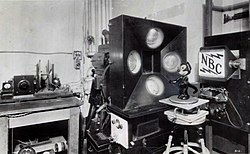 The Felix the Cat doll used by NBC in early television experiments.
 -
 Eddie Albert and Grace Brandt apply makeup for the first television broadcast of a play (November 1936).


Firsts for W2XBS
[edit]As W2XBS broadcasting on "Channel 1" (44–50 MHz), the station scored numerous "firsts". These included: the first televised Broadway drama (June 1938); the first live news event covered by a mobile unit (a fire in an abandoned building in November 1938); the first live telecast of a presidential speech (Franklin D. Roosevelt opening the 1939 New York World's Fair);[3] the first live telecasts of college and Major League Baseball (both in 1939), the first telecast of a National Football League game (also in 1939); the first telecast of a National Hockey League game (early 1940); the first broadcast of religious services (Easter Sunday 1940);[4] the first network (multi-city) telecast of a political convention (the 1940 Republican National Convention, held June 24–28 in the Philadelphia Civic Center) seen also on W3XE in Philadelphia (now KYW-TV) and W2XB in Schenectady (now WRGB); and the broadcast of the feature film The Crooked Circle on June 18, 1940.[5]
In August 1940, W2XBS transmissions were temporarily put on hold, as "Channel 1" was reassigned by the FCC to 50–56 MHz; technical adjustments needed to be made for the conversion. The station returned to the air in October, just in time to broadcast Franklin D. Roosevelt's second and final appearance on live television, when his speech at Madison Square Garden on October 28, 1940, was telecast over W2XBS.[6]
First commercial television station
[edit]On June 24, 1941, W2XBS received a commercial license under the calls WNBT (for "NBC Television"), thus becoming one of the first two fully licensed commercial television stations in the United States, alongside CBS's WCBW on channel 2 (now WCBS-TV), which had evolved from experimental W2XAB. NBC and CBS were instructed to sign on simultaneously on July 1 so that neither of the major broadcast companies could claim exclusively to be "first". However, WNBT signed on at 1:30 pm, one full hour before WCBW. As a result, WNBC (and essentially, NBC) inadvertently holds the distinction as the oldest continuously operating commercial television station (and television network, respectively) in the United States, and also the only one ready to accept sponsors from its beginning.[7] The first program broadcast at 1 p.m. EST by the sign-on/opening ceremony with the U.S. national anthem "The Star-Spangled Banner", followed by an announcement of that day's programs and the commencement of NBC television programming.
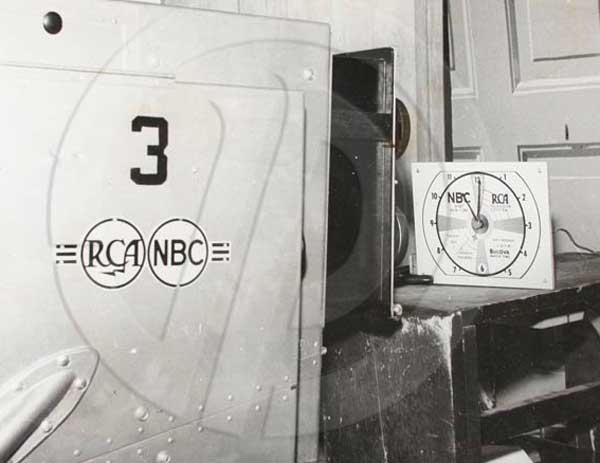
WNBT originally broadcast on channel 1.[8] On its first day on the air, WNBT broadcast the world's first official television advertisement before a baseball game between the Brooklyn Dodgers and Philadelphia Phillies. The announcement for Bulova watches, for which the company paid anywhere from $4.00 to $9.00 (reports vary), displayed a WNBT test pattern modified to look like a clock with the hands showing the time. The Bulova logo, with the phrase "Bulova Watch Time", was shown in the lower right-hand quadrant of the test pattern while the second hand swept around the dial for one minute.[9][10]
Although full commercial telecasting began on July 1, 1941, with the first paid advertisements on WNBT, there had been experimental, non-paid advertising on television as far back as 1930. NBC's earliest non-paid, television commercials may have been those seen during the first Major League Baseball game ever telecast, a game between the Dodgers and the Cincinnati Reds, on August 26, 1939, over W2XBS. To secure the rights to show the game on television, NBC allowed each of the Dodgers' regular radio sponsors at the time to have one commercial during the telecast; these were done by Dodger announcer Red Barber. For Ivory Soap, he held up a bar of the product, for Mobil gas he put on a filling station attendant's cap while giving his spiel, and for Wheaties he poured a bowl of the cereal, added milk and bananas, and took a big spoonful.[11]
The pioneering special interest/documentary show The Voice of Firestone Televues, a television offshoot of The Voice of Firestone, a mainstay on NBC radio since 1928, became the first regularly scheduled TV program not featuring news or sports when it began on WNBT on November 29, 1943. (Though a one-time-only, trial episode of Truth or Consequences aired on WNBT's first week of programming two years earlier; it eventually returned to TV in the 1950s.)
During World War II, RCA diverted key technical TV staff to the U.S. Navy, which was interested in developing a television-guided bomb. WNBT's studio and program staff were placed at the disposal of the New York City Police Department and used for civil defense training telecasts, with only a limited number of weekly programs for general audiences airing during much of the war. Programming began to grow on a small scale during 1944. On April 10, 1944, WNBT began feeding The Voice of Firestone Televues each week to a small network of stations including General Electric's Schenectady station (now called WRGB) and Philco-owned WPTZ (now KYW-TV) in Philadelphia,[12] both of which are now affiliated with CBS (in KYW-TV's case, they are owned by CBS). This series is considered to be the NBC Television Network's first regularly scheduled program.
On May 8, 1945, WNBT broadcast hours of news coverage on the end of World War II in Europe, and remotes from around New York City. This event was pre-promoted by NBC with a direct-mail card sent to television set owners in the New York City area.[13] At one point, a WNBT camera placed atop the marquee of the Astor Hotel in New York City panned the crowd below celebrating the end of the war in Europe.[14] The vivid coverage was a prelude to television's rapid growth after the war ended. In the spring of 1946, the station changed its frequency from VHF channel 1 to channel 4 after channel 1 was removed from use for television broadcasting. From 1946 to 2009, it occupied the 66–72 MHz band of frequencies which had been designated as "channel 3" in the pre-1946 FCC allocation table. It was renumbered Channel 4 in the post-war system (DuMont-owned WABD, now WNYW—had been designated as "Channel 4", before that station moved to the current channel 5 but was only required to retune its video and audio carriers downward by 2 MHz under the new system). In October 1948, WNBT's operations were integrated with those of sister stations WNBC radio (660 AM) and WNBC-FM (97.1).[15]
The station changed its call letters on October 18, 1954, to WRCA-TV (for NBC's then-parent company, Radio Corporation of America or RCA)[16] and on May 22, 1960, channel 4 became WNBC-TV.[17][18][19] NBC had previously used the callsign on its television station in New Britain, Connecticut, from 1957 until it was sold earlier in 1960 (that station is now WVIT, and is once again an NBC-owned station). WNBC-TV also earned a place in broadcasting history as the birthplace of The Tonight Show. It began on the station in 1953 as a local late night program, The Steve Allen Show, and NBC executive Sylvester "Pat" Weaver brought it to the network in 1954. Studio 6B, the show's home under Jack Paar, Johnny Carson and today Jimmy Fallon, was the news studio for WNBC while Tonight was produced in Los Angeles.[citation needed]
On June 1, 1992, channel 4 dropped the "-TV" suffix from its call letters (following the sale in 1988 of its sister radio station WNBC, which is now WFAN) and became simply WNBC, with the new branding slogan along with a new station logo and name "4 New York". The accompanying station image campaign was titled "We're 4 New York" and featured a musical theme composed by Edd Kalehoff. WNBC was rebranded again as "NBC 4" on September 5, 1995, with its newscasts being renamed NewsChannel 4. In July 2007, the "4 New York" branding was revived part time, but in March 2008, it was revived full time.
During the terrorist attacks of September 11, 2001, the transmitter facilities of WNBC, as well as eight other New York City area television stations and several radio stations, were destroyed when two hijacked airplanes crashed into and destroyed the World Trade Center. WNBC broadcast engineer Bill Steckman[20] died in the attack, along with Don DiFranco of WABC-TV; Gerard Copolla of WNET; Steve Jacobson of WPIX; and Bob Pattison and Isaias Rivera of WCBS-TV.[21] In the immediate aftermath, the station temporarily fed its signal to three UHF stations that were still broadcasting (PBS member station WLIW and independent stations WMBC-TV and W26CE).[22] After resuming over-the-air transmissions, the station broadcast from the former transmitter site of Channel 68 in West Orange, New Jersey. Since 2005, WNBC has broadcast its signal from the Empire State Building in midtown Manhattan, returning to the original transmitter site used from the 1930s to the 1970s. On May 9, 2017, it was announced that WNBC would return broadcasting from lower Manhattan at One World Trade Center by the end of the year.[23]
In 2004, WNBC served as the model station for NBC Weather Plus, a 24-hour digital weather channel that aired on its second digital subchannel (4.2) and several local cable systems; other NBC-owned stations launched their own Weather Plus channels in 2005, although Weather Plus was discontinued at the end of 2008.
WNBC ended regular programming on its analog signal, over VHF channel 4, at 12:30 p.m. on June 12, 2009, as part of the federally mandated transition from analog to digital television. The station's digital signal remained on its transition period UHF channel 28,[24] using virtual channel 4.
As part of the SAFER Act,[25] WNBC kept its analog signal on the air until June 26 to inform viewers of the digital television transition. During this time, the station would participate in the "Analog Nightlight" program for two weeks, with a looped video in English and Spanish explaining how to switch to digital reception.[26]
In February 2015, WNBC and the other NBC-owned stations offered live, web-based streaming of programming to subscribers of participating cable and satellite television providers, as provided through the TV Everywhere mobile apps.[27]
On March 15, 2016, NBCUniversal pulled the signals of WNBC and WNJU along with co-owned cable channels USA Network, Bravo, Syfy, MSNBC and CNBC from Dish Network's lineup in the New York metropolitan area as a result of a dispute between NBC and Dish; despite that, Dish claimed NBCUniversal had demanded that it renew its carriage of ten NBC-owned stations and sixteen Telemundo-owned stations, including those removed due to the dispute.[28] Three days later, Dish announced it would continue to carry WNBC, WNJU and five other cable channels for another ten days while the FCC sought arbitration.[29]
On April 13, 2017, it was revealed that WNBC's over-the-air spectrum had been sold in the FCC's spectrum reallocation auction, fetching $214 million.[30] As a result, WNBC's signal was co-located with that of sister station WNJU, which re-located its transmitter to One World Trade Center in 2017. NBC had won similar spectrum bids using Telemundo stations in Chicago and Philadelphia (which entered into in similar arrangements with NBC O&Os WMAQ-TV and WCAU), but stated that in this case, the Telemundo station had a superior signal.[31] WNBC ceased broadcasting on UHF digital channel 28 from the Empire State Building on April 2, 2018, in favor of the shared broadcast with WNJU on channel 36 from One World Trade Center. WNBC along with WNJU later moved channels again on August 1, 2019, at 1 p.m. (EDT) to digital channel 35.[32]
Programming
[edit] |
WNBC has long presented events such as the annual St. Patrick's Day Parade, the National Puerto Rican Day Parade (until 2006, when coverage moved to WNYW and currently WABC-TV), the Columbus Day Parade (until 2010, when coverage moved to WABC-TV), the Macy's Thanksgiving Day Parade, and the Rockefeller Center Christmas Tree Lighting. The Tree Lighting aired exclusively in New York on WNBC until 1997, when NBC began airing it nationally. WNBC has sponsored an annual two-day Health & Fitness Expo Fair at MetLife Stadium every summer. The station has sponsored a Food Drive together with local retailer Stop & Shop named "Feeding Our Families" which has been held on the second Saturday in April since 2017. Beginning in 1995, they were the exclusive local English-language carrier of the annual New York City Marathon until 2013 when WABC-TV took over. From 2010 to 2014, the station was an official local broadcast partner of Discovery Times Square. From 2012 to 2014, the station along with the New York Daily News had partnerships with Mount Sinai Health System, Live Well New York and Popular Community Bank (Popular Tips). The station, along with Maury Povich and Fox owned-and-operated WNYW, co-funded the 1998 PBS documentary NY TV: By the People Who Made It produced by WNET. During the Christmas season, the station has an annual Holiday Sing-Along. The station also produces Visiones, a weekly segment about Hispanic culture, that also airs in Spanish on sister Telemundo station WNJU, and Positively Black, a weekly segment about African-American culture.
As of March 2025, WNBC is one of nine NBC-owned stations that distributes programming either nationally and/or regionally (along with KNTV, KNBC, KNSD, WCAU, WVIT, WTVJ, WMAQ-TV and KXAS-TV).[citation needed]
Sports programming
[edit]Through NBC's coverage of the National Football League, WNBC has televised two Super Bowl championships won by New York teams: the Jets' upset victory over the Baltimore Colts in Super Bowl III, and the Giants' win over the New England Patriots in Super Bowl XLVI. WNBC served as the official flagship carrier of Giants preseason football games until 2023 when WNYW took over the following season. WNBC is the New York area station for NBC's national broadcasts of Sunday Night Football featuring either one of the two teams. The station also served as the default home station of the Jets from 1965 (when NBC became the broadcaster for the American Football League of which the Jets were then a part) until 1997, when WCBS-TV became the new broadcast rightsholder (through CBS) of what was by now the American Football Conference; it also aired occasional New York Giants games from 1970 (with the completion of the AFL/NFL merger) to 1997; these were limited to home interconference contests.
Even as the station became the first to broadcast Major League Baseball games in 1939 with the pioneer broadcast being that of an August 26 doubleheader at Ebbets Field between the Brooklyn Dodgers and the Cincinnati Reds, it does not have any broadcasts today. They are currently on WNYW and WPIX during the season. Baseball broadcasts were expected to return to the station in 2020 as part of the network-wide coverage of the baseball events of the 2020 Summer Olympics in Tokyo, with on-air news updates during the duration of the event; however, the games were postponed to 2021 due to the global effects of the COVID-19 novel coronavirus. The station has aired numerous New York Mets (since 1962) and New York Yankees games (and before 1957, games of the Dodgers and Giants) as part of MLB's broadcast contract with NBC from 1947 to 1989, The Baseball Network in 1995, and playoff-only coverage from 1996 to 2000. The station has aired 18 of the Yankees' World Series appearances (12 of which the team won), and three Mets World Series appearances (two of which the Mets won).
As the network's flagship station, per its NHL on NBC obligations (which ended in 2021), it broadcast several Stanley Cup playoff games all the way to the Cup Finals, in addition to the NHL Game of the Week (if the Rangers, Islanders or New Jersey Devils were playing). It would be only in 2012 when it aired the Stanley Cup Finals as part of the network-wide coverage when the Devils lost out to the Los Angeles Kings. Also, the station aired the 2014 Cup Finals, where the Rangers also lost to the Kings.
From 1990 to 2002, the station aired New York Knicks and New Jersey Nets games through the NBA on NBC; this included the Knicks' appearances in the 1994 and 1999 NBA Finals, as well as the Nets' appearance in the 2002 NBA Finals.
News operation
[edit]From the late 1960s through the 1980s, WNBC was involved in a fierce three-way battle with WCBS-TV and WABC-TV for the top spot in the New York television ratings. This continued during a lean period for NBC as a whole. WNBC's hallmark over the years has been strong coverage of breaking stories, the combination of straight news items and those with light-hearted and/or entertainment elements (as could be seen in such programs as Live at Five and Today in New York), and the generally low turnover of their on-air talent. Many of WNBC's personalities have been at the station for over 20 years. For instance, Chuck Scarborough has served as the station's lead anchor since the debut of NewsCenter 4 on April 29, 1974.[33] Scarborough represents one half of the longest-serving anchor duo in New York television history,[34] the other half being Sue Simmons, who anchored the 11 p.m. report with Scarborough from 1980 to 2012. Len Berman served as lead sports anchor for 27 years, from 1982 to 2009. Senior correspondent Gabe Pressman was at the station from 1956 until his death in 2017, save for a seven-year stint (from 1972 to 1979) at WNEW-TV (now WNYW).
WNBC-TV was the first station on the East Coast to air a two-hour nightly newscast,[33] and the first major-market station in the country to find success in airing a 5 p.m. report, when NewsCenter 4 (a format created for WNBC by pioneering news executive Lee Hanna)[35] was introduced in 1974, a time when channel 4 ran a distant third in the city's local news ratings.[36] The NewsCenter format debuted with a futuristic set described by Hanna as being "the most modern, electronically complicated and sophisticated" facility in the country at that time. A direct, unique style of presenting the news was also implemented, incorporating hard news reports with separate segments devoted to consumer reports, features, and a dedicated weather desk. Hanna declared at the outset, "there will be no happy talk [...] we're not in business to be comedians", a veiled reference to the style of WABC's highly-successful Eyewitness News format.[36] The NewsCenter format became a major success in New York, and NBC subsequently brought it to their owned-and-operated stations in Chicago, Washington, D.C., and Los Angeles.
The NewsCenter4 title was kept by WNBC until September 1, 1980, when the newscasts were renamed News 4 New York. Shortly before then the 5 p.m. program was renamed Live at Five, and the hour was reformatted from a straight news program to a mix of hard news and celebrity interviews, a style that would become known as infotainment. Live at Five eventually became the most-successful local program in New York City, a feat that resulted in landing the show's hosts on the cover of New York magazine. For most of the time during the News 4 New York era of the 1980s and early 1990s, WNBC-TV used various music cues created by Scott Schreer.[37] His theme for News 4 New York was based on a synthesized version of the NBC chimes, with a graphics package featuring a lightning bolt striking its logo from 1980 to 1990, a fancy die-cut "4".
In 1992, the station began calling itself 4 New York and the campaign song, written by Edd Kalehoff, was quickly adopted as the theme for the newscast. The theme was briefly brought back after the September 11 attacks in 2001. In 1995, after the station rebranded itself as "NBC 4" and its newscasts as NewsChannel 4, Kalehoff wrote a new theme called "NBC Stations" featuring the aforementioned NBC chimes. It remained in use for eight years, along with a graphics package using a simple red line for the lower thirds.[citation needed]
The 2003 graphics package was created by Emmy Award-winner Randy Pyburn of Pyburn Films. Pyburn has produced several promotions for the station and the now-defunct Jane's New York specials hosted by former WNBC reporter Jane Hanson. The graphics package was also used on other NBC stations. The music was written by Rampage Music and featured a brassy version of the NBC chimes, and lower thirds featured a shimmering peacock. In March 2008, concurrent with the restoration of the 4 New York branding, the newscasts began to be called News 4 New York once more.[38]
Many WNBC personalities have appeared, and have also moved up to the NBC network, including: Marv Albert, Len Berman, Contessa Brewer, Chris Cimino, Fran Charles, Darlene Rodriguez, Maurice DuBois, Michael Gargiulo, Tony Guida, Jim Hartz, Janice Huff, Matt Lauer, Tom Llamas, Dave Price, Al Roker, Scarborough, and Tom Snyder. In the past, Albert, Berman, Brewer, Charles, Cimino, DuBois, Guida, Hartz, Lauer, Llamas, Roker, Scarborough, and Snyder have worked at WNBC and NBC at the same time. Price, Rodriguez, Huff, and Gargiulo currently work for both. One monthly feature was Berman's Spanning the World, a reel of odd and interesting sports highlights from the past month, including a recorded introduction and closing by NBC staff announcer Don Pardo. The segment aired monthly on Today.
When Simmons joined the station in early 1980, she was paired with Scarborough on both the 6 p.m. and 11 p.m. newscasts. However, for most of the time until 2005, WNBC's weeknight anchor rotation had Simmons and another male anchor (including Jack Cafferty, Guida, Lauer, and briefly Scarborough) at 5 pm; Scarborough and various anchors (John Hambrick, Pat Harper, and Michele Marsh among them) at 6 pm; and Scarborough and Simmons together at 11 pm. That changed in 2005 as Live at Five anchor Jim Rosenfield jumped back to WCBS-TV, where he had once been the noon and 5 p.m. anchor and took on the role as lead anchor for their 5 p.m. and 11 p.m. newscasts.
Former reporter Perri Peltz returned to WNBC to co-anchor Live at Five with Simmons, making New York City one of the few large markets with two female anchors on an evening newscast. The move harkened back to three decades earlier, when the station paired Pia Lindström with Melba Tolliver on its 5 p.m. news hour, creating one of the first all-female anchor teams on a major-market American television station.[39] It was short-lived as Simmons and Peltz were both displaced from Live at Five because of changes in the station's early evening news lineup that went into effect on March 12, 2007: David Ushery and Lynda Baquero became co-anchors of a truncated, 30-minute-long Live at Five broadcast, followed by Peltz with a 30-minute, soft-news program, News 4 You. Simmons was moved to co-anchor at 6 p.m. with Scarborough. On September 13, 2006, WNBC became the first New York City television station to broadcast its newscasts in high definition. On May 5, 2007, WNBC brought back its popular campaign song "We're 4 New York", composed by Kalehoff, after nearly six years off air (after the September 11, 2001, attacks).[40]
In early autumn 2007, additional changes were brought to WNBC's early-evening lineup. On September 10, the station moved the newsmagazine series Extra to 5 pm, and cancelled Live at Five. News 4 You remained at 5:30 pm, but was replaced on October 15, 2007, with a traditional newscast, anchored by Simmons and Michael Gargiulo. The 6 p.m. newscast became anchored by Ushery and Baquero, and New York Nightly News, a new half-hour newscast with Scarborough as sole anchor, debuted at 7 p.m.
These changes did not lead to an increase in WNBC's ratings in the November 2007 sweeps period, partially because of the 2007–08 Writers Guild of America strike. The most shocking of WNBC's ratings decreases was its 11 p.m. newscast, which fell to third place, behind WCBS and WABC.[41] WNBC altered its 5–6 p.m. hour on January 2, 2008, swapping the half-hour news at 5:30 p.m. with Extra. On March 9, 2009, with the launch of New York Nonstop on digital subchannel 4.2, New York Nightly News was moved to the subchannel and expanded to one hour, while Extra was moved back to 7 p.m. and a full hour of news returned to the 5 p.m. hour. Still, WNBC's ratings struggled: during the March 2009 sweeps period, its newscasts were a distant third in all-time slots, except during the weekday mornings, where it remained in second.

On May 7, 2008, NBC Universal announced plans for a major restructuring of WNBC's news department. The centerpiece of the restructuring was the creation of a 24-hour all-news channel on WNBC's second digital subchannel (4.2). Channel 4's news operations were revamped and melded into the all-news channel, which serves as a "content center" for the station's various local distribution platforms. The digital news channel was launched on March 9, 2009. In the fall of 2008, WNBC started beta-testing a new website which was apparently poised to be one of the major platforms for the content center. On November 17, 2008, WNBC moved its news studio from Studio 6B to 7E and rolled out a new set design, graphics package, and theme song written by veteran TV composer Frank Gari. This move came after months of planning the new content newsroom with its 24-hour news digital subchannel. It was also their debut of the updated 4 New York logo, using letters in Media Gothic Bold font and the "New York" wording was switched from its script font to All caps font, which is designed by Brit Redden of Modal Pictures.[42]
On June 16, 2009, WNBC announced that its 5 p.m. newscast would be replaced in September by a one-hour daily lifestyle and entertainment show by LXTV entitled LX New York. After this change, WNBC, with only three hours per day of local news, had the shortest airtime devoted to local news of any "big three" network-owned station. In the fall of 2009, WNBC began sharing its news helicopter with Fox owned-and-operated WNYW (channel 5) as part of a Local News Service agreement. The SkyFox HD helicopter operated by WNYW when used by WNBC was called "Chopper 4" on-air. This agreement ended in 2012, with WNBC returning to use its own helicopter when the contract expired.[43] In the summer of 2010, The Debrief with David Ushery began to air on Sunday at noon on WNBC after launching on New York Nonstop; it now airs Sunday mornings at 5:30 a.m.
LX New York was renamed to New York Live on May 26, 2011. The program was set to move to 3 p.m. on September 12, 2011; at that time, WNBC would resume airing a 5 p.m. newscast.[44] However, due to Hurricane Irene, the 5 p.m. newscast's start date was moved up to August 29, 2011, with New York Live moving to its new 3 p.m. slot then.[45] On November 18, 2011, WNBC launched a noon newscast that replaced The Rundown with Russell and Llamas as the anchors.[46]
In December 2011, WNBC struck a news partnership with non-profit news-reporting organization ProPublica. The organization, which won a Pulitzer Prize in 2010, already has partnerships with several media outlets including USA Today, Reader's Digest, HuffPost and Businessweek. However, ProPublica's reports are incorporated across all NBC O&O stations, not just WNBC. This is part of larger efforts for NBCUniversal's television stations to partner with nonprofit news organizations following its acquisition by Comcast.[47]
WNBC relocated from Studio 7E to Studio 3C (the studio previously used by NBC Nightly News, which now originates from Studio 3B) on April 21, 2012. Channel 4 also updated its graphics and switched to the "L.A. Groove" theme that has been in use by sister station KNBC.[48] On June 15, 2012, Sue Simmons left WNBC as her contract with the station was not renewed.[49] In January 2013, the station expanded its Sunday 11 p.m. newscasts to one hour, possibly to compete with WABC which expanded its late news in January 2012.[50]
On June 6, 2016, WNBC revamped its website. On June 11, 2016, beginning with the 11 p.m. newscast, its news graphics were also changed and it began using Look N graphics from NBC Artworks, becoming the first NBC-owned station to use the new graphics that were rolled out to other NBC-owned stations around this time. On June 13 of the same year, the station debuted its 4 p.m. newscast, thus becoming the second New York television station to expand its newscasts to that time period after WABC-TV (which had their 4 p.m. newscasts since May 2011).[51]
On October 10, 2016, WNBC relocated from studio 3C to studio 3K (the studio also used by Dateline NBC and sister cable network MSNBC), which bears similarities to the previous set in 3C, albeit a lot larger in size and with several changes (i.e. a new weather center area, a touchscreen display similar to Today's Orange Room, an LED wall, and a work space and presentation pod).[52] In fall 2016, WNBC entered a content-sharing agreement with WOR to include news and weather content supplied by the station; WNBC's weather content is also heard on other iHeartMedia radio stations throughout the New York metropolitan area. On December 21, 2016, WNBC announced that it would be launching a new S band weather radar system, called Storm Tracker 4, which is planned to launch in winter 2017.[53] On December 27, 2016, the station announced it would move the midday newscast to 11 a.m. (the first and only 11 a.m. midday newscast in the New York media market), and its locally produced lifestyle/entertainment program New York Live to 11:30 a.m. beginning January 16, 2017. As part of the changes of the daytime lineup at the station, it would move Days of Our Lives from the network's default Eastern Time Zone slot of 1 p.m. to the early time slot of 12 pm, followed by Access Hollywood Live at 1 pm.[54][55]
On June 30, 2017, it was announced that Chuck Scarborough would step down as the anchor of the 11 p.m. newscast on July 14 but would continue to anchor the 6 p.m. newscast. 4 p.m. anchor Stefan Holt, whose father Lester presides over NBC Nightly News down the hall from Studio 3K, assumed duties for the late newscast beginning July 17.[56]
On July 31, 2017, the station expanded its morning newscast Today in New York by a half an hour, beginning at 4 a.m. for a total of three hours; this is the first 4 a.m. newscast in the New York media market since WPIX had one from 2010 to 2014. Six days later on August 6, 2017, the Sunday edition of the morning newscast had an extra half-hour added after 9:30 am; the 6–8 a.m. portion remained unchanged. As part of the changes to the station's Sunday morning lineup, Sunday Today with Willie Geist was moved to the network's recommended time of 8 a.m. followed by the LXTV-produced program Open House NYC at 9 a.m. Meet the Press remained at 10:30 am.[57]
In November 2017, WNBC opened the San Juan news bureau led by bilingual reporter Julio "Gaby" Acevedo; the bureau delivers daily English and Spanish-language news and updates for the station and its sister station WNJU as well as all NBC and Telemundo-owned stations across the country; the new bureau operated through February 2018.[58]
On August 19, 2020, it was announced that after four years with the station, Stefan Holt would be leaving to rejoin Chicago sister station WMAQ-TV to anchor its 4 p.m. and 10 p.m. newscasts, beginning in October. On August 31, 2020, the station announced that 11 a.m. and 5 p.m. news anchor David Ushery would succeed Holt on the 4 p.m. and 11 p.m. newscasts, beginning October 12, 2020; however, due to Holt's early departure on September 25, the official start date was moved up to September 28. Meanwhile, weekend anchor Adam Kuperstein succeeded Ushery in the 11 a.m. and 5 p.m. newscasts.[59]
On June 7, 2021, WNBC started airing a new half-hour weekday 7 p.m. newscast.[60]
In January 2022, WNBC announced plans to launch a new FAST channel called "NBC New York News"; this announcement follows the simultaneous rollout of streaming news channels from its sister stations in Chicago, Miami, Philadelphia and Boston on January 20. The channel was launched on March 17, 2022.[61][62] In 2024, WNBC launched an exclusive 7 a.m. newscast on the channel.[63]
In the summer of 2022, WNBC indicated it would return to Studio 3B, which will be split with WNJU once that station relocates operations to Rockefeller Center.[64]
Notable current on-air staff
[edit] |
- Anchors
- Pat Battle (also reporter)
- Michael Gargiulo
- Darlene Rodriguez
- David Ushery
- Weather
- Janice Huff (Member, AMS) – chief meteorologist
- Maria LaRosa (Member, AMS) – meteorologist
- Raphael Miranda (AMS Seal of Approval) – meteorologist
- Dave Price
- Sports team
- Bruce Beck – sports director; also host of Sports Final with Bruce Beck
- Reporters
- Lynda Baquero – consumer affairs and general assignment reporter
- Jonathan Dienst – chief investigative reporter
- Jacque Reid – co-host of New York Live
- Melissa Russo – political reporter
- Lauren Scala – correspondent for New York Live (formerly served as traffic reporter)
- Ida Siegal – general assignment reporter
Notable alumni
[edit]- Asa Aarons
- Cindy Adams
- Marv Albert
- Tex Antoine
- Len Berman
- Lynn Berry
- Francesco Bilotto
- Contessa Brewer
- Bill Boggs
- Mel Brandt
- Dr. Joyce Brothers
- Jack Cafferty
- Ti-Hua Chang
- Fran Charles
- Linda Church
- Chris Cimino
- Katherine Creag
- Maurice DuBois
- Fred Facey
- Frank Field
- Ira Joe Fisher
- Art Fleming
- Betty Furness
- Arthur Gary
- Andrew Glassman
- Marty Glickman
- Cat Greenleaf
- Erica Grow
- Max Gomez
- Carlos Granda
- Roger Grimsby
- Tony Guida
- Carolyn Gusoff
- John Hambrick
- Steve Handelsman
- Jane Hanson
- Pat Harper
- Reggie Harris
- Jim Hartz
- Stefan Holt
- Wayne Howell
- Don Imus
- John Johnson
- Matt Lauer
- Tom Llamas
- Rick Leventhal
- Pia Lindström
- Otis Livingston
- Lynda Lopez
- Felipe Luciano
- Jeffrey Lyons
- Dave Marash
- Sal Marchiano
- Michele Marsh
- Frank McGee
- John Miller
- Tim Minton
- DeMarco Morgan
- Rob Morrison
- Bruce Morrow
- John Muller
- George Page
- Don Pardo
- Ralph Penza
- Perri Peltz
- Walter Perez
- Deb Placey
- Gabe Pressman
- Shimon Prokupecz[65]
- Audrey Puente
- Howard Reig
- Carol Anne Riddell
- Bobby Rivers
- Vic Roby
- Gloria Rojas[66]
- Al Roker
- Jim Rosenfield
- Jeff Rossen
- Kyle Rote
- Bill Ryan
- Jim Ryan
- Tim Ryan
- Chuck Scarborough (1974–2024)
- Dick Schaap
- Rob Schmitt
- Mike Schneider
- Adam Shapiro
- Sue Simmons (1980–2012)
- Dr. Ian Smith
- Liz Smith
- Tom Snyder
- Scott Stanford
- Howard Stern
- Carl Stokes
- Mike Taibbi
- Felicia Taylor
- Bob Teague
- Melba Tolliver
- Katy Tur
- Sibila Vargas
- Jonathan Vigliotti
- Glen Walker
- Chris Wallace
- Jim Watkins
- Rolonda Watts
- Mary Alice Williams
- Joe Witte
- Bill Wolff
- Lew Wood
Controversies and incidents
[edit]Chopper 4 helicopter crashes
[edit]1998 saw the introduction of a brand-new Chopper 4, a Eurocopter EC135 that the station heavily promoted. The new chopper ended up crashing into the Passaic River near Harrison and Newark, New Jersey on December 3, 1998; reporter Kai Simonsen and pilot Terry Hawes survived.[67]
Hence, the older model, a Eurocopter AS350, was returned to service and remained until May 4, 2004, when it crashed while covering a shooting in Brooklyn. Reporter Andrew Torres, pilot Russ Cowry and pilot trainee Hassan Taan survived the crash and were taken to area hospitals. The crash occurred at about 6:30 p.m. as the crew was preparing for a live report from the scene of a shooting in East Flatbush. Before the cut-in, Chopper 4 appeared to begin a steep nosedive. WABC's own helicopter captured the initial nosedive and the chopper's subsequent tailspin until crashing into a rooftop.[68]
2008 weeknight infomercial issue
[edit]On March 25, 2008, WNBC carried a paid program leading into NBC's Tuesday night prime time and after the 7 p.m. newscast for mortgage lender Lend America, replacing that night's Access Hollywood. Several 'Big Four' stations throughout the United States had carried paid programs leading into prime time in a period during the Great Recession to some varied controversy (and often do to this day during Saturday evenings, a little-trafficked time period with no complaint), but the one airing in New York of the Lend America infomercial, which was hosted by ex-WNBC reporter Joe Avellar, attracted massive criticism from viewers and local media critics, especially involving Avellar's role as host and Lend America's part in the housing crisis, and to a much lesser extent, preemption of regular weeknight programming. Earning the station $130,000 for the 28+1⁄2-minute program, it generated low ratings and led to a quick fallout, with general manager Frank Comerford resigning his position from the station for approving the airtime sale.[69] Although Lend America expressed interest in buying more early access time on the station, WNBC has never again carried a paid program before prime time on weeknights.
Sue Simmons "F-bomb" incident
[edit]On May 12, 2008, a prime time promo for that night's 11 p.m. newscast was thought by anchor Sue Simmons to be on tape for later broadcast but was actually going out live. After completing the first portion of the tease, Simmons noticed co-anchor Chuck Scarborough distracted with something on his on-desk laptop, and thinking the take would be trashed and another take would be shot for air, shouted "The fuck are you doing?" towards him in a manner seemingly meant as an inside joke among colleagues, while YouTube b-roll of a cruise ship departing Manhattan continued to roll before the promo's end.
Later during the actual newscast, Simmons profusely apologized for the live outburst, saying, "I have to acknowledge an unfortunate incident. I used a word that many people find offensive. It was a mistake I made and I'm truly sorry." No further comment was made by the station or Simmons about the incident.[70][71]
Late Show with David Letterman used clips from the promo in several sketches mocking the incident.[72]
I-Team Super Bowl promo editing controversy
[edit]On February 5, 2012, the station premiered the I-Team promo during NBC Sports' coverage of Super Bowl XLVI featuring former NYPD commissioner Ray Kelly, but later on the day after the Super Bowl, they edited out Kelly's clip due to some complaints from rival WCBS-TV. However, the spokesman declined to comment, and criticisms arose from WABC-TV, WNYW, and WPIX, the station's rivals. Station general manager Michael Jack said in the statement that "our investigative team is among the most experienced in the industry, and to suggest that the station won't cover the NYPD fairly, accurately and with balance simply because the commissioner appeared in a station promotional spot is simply not true".[73] After the promo was edited out at the station, Lynda Baquero resigned from the investigative team but continued as a reporter for the station. She was replaced by Pei-Sze Cheng and Jonathan Vigliotti (though Vigliotti later left for WCBS-TV).
Tweet regarding anti-Semitic violence
[edit]On January 2, 2020, WNBC posted a tweet on its Twitter account linking to an Associated Press wire article, syndicated to its website, on the recent wave of anti-Semitic violence in the United States, coming three weeks after a targeted shooting at a kosher supermarket in Jersey City, New Jersey.[74] The text of the message, likely automatically generated by the station's content management system, featured one of three bullet points summarizing the article as a whole, and stated that Orthodox Jews moving from the core of New York and New Jersey and into their own self-established communities on the fringe of the Tri-State area due to gentrification was a reason for an increase of violent anti-Semitic attacks in the broader region;[75]
"With the expansion of Orthodox communities outside NYC has come civic sparring, and some fear the recent violence may be an outgrowth of that conflict"
WNBC's headline, and its inclusion in the tweet, was met with backlash from Jewish groups and people, including the progressive Zionist group Zioness and the Republican Jewish Coalition, which called out the station for "blaming the Orthodox community for the attacks". Others prominent in the community also questioned the message, including Bari Weiss, former New York State Assemblyman Dov Hikind, Ron Kampeas of the Jewish Telegraphic Agency, and The Forward's Batya Ungar-Sargon. The station later apologized for the original headline, deleted the original tweet, and then re-sent the article tweet with an edited headline.[76]
Technical information and subchannels
[edit]
WNJU and WNBC transmit using WNJU's spectrum from an antenna atop One World Trade Center.[1] The stations' signals are multiplexed:
| License | Channel | Res. | Aspect | Short name | Programming |
|---|---|---|---|---|---|
| WNJU | 47.1 | 1080i | 16:9 | WNJU-HD | Telemundo |
| 47.2 | 480i | TeleX | TeleXitos | ||
| WNBC | 4.1 | 1080i | WNBC | NBC | |
| 4.2 | 480i | COZI-TV | Cozi TV | ||
| 4.3 | CRIMES | NBC True CRMZ | |||
| 4.4 | OXYGEN | Oxygen |
On December 20, 2012, WNBC and other NBC-owned stations began carrying Cozi TV. It replaced NBC (New York) Nonstop, which had been carried on digital subchannel 4.2 since 2009.
See also
[edit]


References
[edit]- ^ a b "Facility Technical Data for WNBC". Licensing and Management System. Federal Communications Commission.
- ^ "Felix the Cat". earlytelevision.org. Archived from the original on October 14, 2008. Retrieved June 4, 2012.
- ^ "FDR on TV monitor". dasvidsarnoff.org. Archived from the original on July 13, 2007.
- ^ "First Television Broadcast of Easter Services". Associated Press. March 24, 1940. Retrieved February 14, 2022.
- ^ "1940 Republican Convention on television". broadcastpioneers.com. Archived from the original on May 11, 2008.
- ^ The Magic Window by James Von Schilling Haworth Press 2002 pages 28 and 29
- ^ "Television Programs in 1941". TV Obscurities. November 19, 2008. Archived from the original on August 7, 2011. Retrieved July 30, 2010.
- ^ "NBC History – About Us News Story – WNBC New York". wnbc.com. Archived from the original on January 6, 2007. Retrieved June 4, 2012.
- ^ Stewart, R.W. (July 6, 1941). "Television Goes Into the Entertainment Field as a New Merchandising Medium". The New York Times. Section D. p. 10.
- ^ "WNBT/Bulova Test Pattern". earlytelevision.org. Archived from the original on October 9, 2008. Retrieved October 3, 2008.
- ^ Hoffarth, Tom. "70 years ago today, the Dodgers made TV history - Farther Off the Wall". insidesocal.com. Archived from the original on May 31, 2013. Retrieved December 31, 2016.
- ^ The Complete Directory to Prime Time Network and Cable TV Shows by Tim Brooks, Earle F. Marsh. Ballantine Books, New York
- ^ "1945 April 20, VE Day NBC/WNBT Postcard". tvhistory.tv. Archived from the original on November 9, 2005. Retrieved October 16, 2019.
- ^ "May 8, 1945...Victory in Europe Day, Times Square". eyesofageneration.com. May 8, 2016. Archived from the original on August 24, 2017. Retrieved May 15, 2017.
- ^ "McFadden Heading AM, FM, TV at WNBC" (PDF). Broadcasting-Telecasting. November 1, 1948. p. 30. Retrieved July 10, 2019.
- ^ "RCA replaces NBC in O&O calls" (PDF). Broadcasting – Telecasting. October 4, 1954. p. 78. Retrieved December 30, 2018.
- ^ "WRCA to be WNBC?" (PDF). Broadcasting – Telecasting. April 4, 1960. p. 88. Retrieved December 30, 2018.
- ^ "For the record–Station authorizations, applications–Existing TV stations–Call letters assigned" (PDF). Broadcasting– Telecasting. May 9, 1960. p. 100. Retrieved December 30, 2018.
- ^ "WNBC-AM-FM-TV advertisement" (PDF). Broadcasting - Telecasting. May 23, 1960. pp. 64, 65. Retrieved December 30, 2018.
- ^ Baker, Jeff (October 2001). "In Memoriam - Bill Steckman" (PDF). News @ Eleven. Vol. 3, no. 7. NABET Local 11. Retrieved September 11, 2021.
- ^ Merli, John (September 6, 2011). "A Decade Later, the Loss Still Deep". tvtechnology.com. Retrieved September 11, 2021.
- ^ Dempsey, John (September 20, 2001). "TV beams back into N.Y." Archived from the original on February 20, 2016. Retrieved December 31, 2016.
- ^ Cuozzo, Steve (May 8, 2017). "One World Trade Center adds ION Media as newest broadcaster tenant". New York Post. Retrieved October 16, 2019.
- ^ CDBS Print Archived February 1, 2014, at the Wayback Machine. Fjallfoss.fcc.gov. Retrieved June 4, 2012.
- ^ "UPDATED List of Participants in the Analog Nightlight Program" (PDF). Federal Communications Commission. June 12, 2009. Archived (PDF) from the original on August 12, 2014. Retrieved June 4, 2012.
- ^ "List of Digital Full-Power Stations" (PDF). Archived from the original (PDF) on August 29, 2013.
- ^ "NBC Adds Live TV Everywhere". TV NewsCheck. Archived from the original on April 2, 2015. Retrieved March 27, 2015.
- ^ Villarreal, Yvonne (March 15, 2016). "Satellite giant Dish sues NBC, alleging breach of contract". Los Angeles Times. Archived from the original on March 16, 2016. Retrieved October 16, 2019.
- ^ Lieberman, David (March 18, 2016). "Dish Network Tells FCC It Will Seek Arbitration To Resolve NBCU Dispute". Deadline Hollywood. Archived from the original on March 20, 2016. Retrieved October 16, 2019.
- ^ "FCC Broadcast Television Spectrum Incentive Auction, Auction 1001, Winning Bids" (PDF). Federal Communications Commission. Retrieved July 11, 2018.
- ^ "NBC Makes Over $480 Million From Auction". TVNewsCheck. April 13, 2017. Archived from the original on July 30, 2017. Retrieved April 13, 2017.
- ^ "How to Rescan Your Television to Receive NBC New York's Signal". nbcnewyork.com. November 27, 2017. Retrieved April 8, 2018.
- ^ a b "New anchor at WNBC-TV" (PDF). Broadcasting. March 18, 1974. p. 87. Retrieved June 22, 2024.
- ^ Gaudino •, Linda (March 25, 2024). "Chuck Scarborough celebrates 50 years at NBC New York". NBC New York. Retrieved June 22, 2024.
- ^ "Lee Hanna: TV expert for the candidate debates" (PDF). Broadcasting. August 25, 1980. p. 137. Retrieved June 22, 2024.
- ^ a b "More O&O TV's turn to two-hour newscasts" (PDF). Broadcasting. May 6, 1974. p. 36. Retrieved June 22, 2024.
- ^ Vlan, Victor (September 18, 2012). "That iconic WNBC news theme? Turns out it is composed by NJJ Music". Network News Music. Archived from the original on October 9, 2012. Retrieved February 14, 2015.
- ^ von Meistersinger, Toby (April 1, 2008). "WNBC Does the Time Warp Again". Gothamist. Archived from the original on April 5, 2008. Retrieved April 1, 2008.
- ^ Marlane, Judith (1999). Women in Television News Revisited: Into the Twenty-first Century. University of Texas Press. p. 219. ISBN 0-292-75228-8.
- ^ von Meistersinger, Toby (May 8, 2007). "The Return of We're 4 New York". Gothamist. Archived from the original on April 7, 2008. Retrieved May 8, 2007.
- ^ Huff, Richard (October 9, 2007). ""News 4 You" no longer on WNBC". Daily News. New York. Archived from the original on January 13, 2008. Retrieved May 8, 2008.
- ^ Alex Weprin. TCA: Jimmy Fallon's Late Night to Launch Online Archived December 1, 2008, at the Wayback Machine. Broadcastingcable.com (July 20, 2008). Retrieved June 4, 2012.
- ^ Huff, Richard (December 8, 2011). "WNBC/Ch. 4 slowly rebuilding news presence after era of downsizing". Daily News. New York. Archived from the original on February 1, 2014. Retrieved December 10, 2011.
- ^ Huff, Richard (June 17, 2011). "Local news Ch. 4 to reclaim 5 p.m. slot, making moves to 'position NBC 4 as the market leader'". Daily News. New York. Retrieved June 18, 2011.[dead link]
- ^ Shiba Russell Archived July 27, 2013, at the Wayback Machine. twitter.com
- ^ Barmash, Jerry. (November 18, 2011) WNBC/Channel 4 Brings Noon Newscast Back to Viewers . Mediabistro.com. Retrieved June 4, 2012.
- ^ "NBCUniversal's Non-profit News Partnerships: January 2012 Report" (PDF). Comcast NBCUniversal. Archived (PDF) from the original on January 29, 2013. Retrieved May 13, 2012.
- ^ "NBC New York debuts new studio, graphics, music". NewscastStudio. April 22, 2012. Archived from the original on June 11, 2012. Retrieved April 29, 2012.
- ^ Huff, Richard (March 7, 2012). "New York TV news mainstay Sue Simmons to say farewell to WNBC audiences in June". Daily News. New York. Archived from the original on March 9, 2012. Retrieved March 7, 2012.
- ^ Knox, Merrill (January 7, 2013). "WNBC Expands Sunday Evening Newscast". TVSpy. Archived from the original on July 14, 2014. Retrieved June 7, 2014.
- ^ "4 NBC Stations to Launch Afternoon Newscast". Adweek. January 4, 2016. Archived from the original on May 5, 2016.
- ^ "NBC New York debuts new home, gains more space at 30 Rock". NewscastStudio. October 10, 2016. Archived from the original on October 11, 2016.
- ^ "NYC station promoting new radar". NewscastStudio. December 21, 2016. Archived from the original on December 23, 2016.
- ^ "WNBC is moving its noon newscast and joining the other NBC O&O's at 11:00 a.m." Changing Newscasts Blog. December 27, 2016. Archived from the original on January 1, 2017. Retrieved December 31, 2016.
- ^ Kevin Eck (January 12, 2017). "WNBC Moves Noon Show to 11". TVSpy. Archived from the original on January 14, 2017. Retrieved January 12, 2017.
- ^ Don Kaplan (June 30, 2017). "WNBC anchor Chuck Scarborough leaving late-night job after 42 years for earlier shift". Daily News. New York. Archived from the original on June 30, 2017. Retrieved July 1, 2017.
- ^ "A small minor newscast change... #140". Changing Newscasts Blog. August 5, 2017. Archived from the original on August 16, 2017. Retrieved August 18, 2017.
- ^ "WNBC-WNJU Launch San Juan News Bureau". TVNewsCheck. November 20, 2017. Retrieved November 20, 2017.
- ^ Brian Steinberg (August 31, 2020). "David Ushery Will Co-Anchor Two of WNBC's Most Important Newscasts". Variety. Variety Media, LLC. Retrieved September 7, 2020.
- ^ Eck, Kevin (June 4, 2021). "WNBC, KNBC Add 7 PM Newscasts". adweek.com/tvspy. Retrieved June 4, 2021.
- ^ "Peacock to Launch 24/7 Local News Channels from NBC Owned Television Stations" (Press release). NBC Owned Television Stations/Peacock. January 20, 2022. Retrieved January 20, 2022 – via The Futon Critic.
News channels from NBC 4 New York (WNBC) and NBC 4 Los Angeles (KNBC) will be available to stream for free in the months ahead.
- ^ "NBC New York News, NBC Los Angeles News Go Live On Peacock". Broadcasting & Cable. March 17, 2022. Retrieved March 17, 2022.
- ^ Malone, Michael (January 12, 2024). "NBCUniversal Local FAST Channels See Real Revenue". Broadcasting & Cable. Retrieved January 13, 2024.
- ^ Hill, Michael P. (August 9, 2022). "NBC News confirms plans to split Studio 3B into two spaces". newscaststudio.com. HD Media Ventures LLC. Retrieved August 18, 2022.
- ^ "Shimon Prokupecz Crime and Justice Correspondent". CNN. Retrieved June 1, 2021.
- ^ "Former Eyewitness News reporter Gloria Rojas, NYC's first Latina broadcast journalist, dies". New York: WABC-TV. February 4, 2022.
- ^ McFadden, Robert D. (December 4, 1998). "News Helicopter Crashes in River Near Newark". The New York Times. Section B. p. 5. Archived from the original on May 27, 2015. Retrieved September 7, 2016.
- ^ Tavernise, Sabrina; Newman, Andy (May 5, 2004). "TV helicopter crashes on Brooklyn rooftop". The New York Times. Archived from the original on May 2, 2014. Retrieved May 1, 2014.
- ^ Huff, Richard (March 26, 2008). "Channel 4 lends itself out for 'Lend America'". Daily News. New York. Archived from the original on February 1, 2014. Retrieved March 26, 2008.
- ^ Huff, Richard (May 13, 2008). "Curses! Anchor Sue Simmons slips". Daily News. New York. Archived from the original on February 1, 2014. Retrieved May 13, 2008.
- ^ Hancock, Noelle (May 13, 2008). "Sue Simmons Wants to Know What the F**k You Are Doing". New York. Archived from the original on November 1, 2015. Retrieved August 30, 2015.
- ^ Shea, Danny (May 22, 2008). "David Letterman's Views on Sue's Slip!". HuffPost. Archived from the original on November 13, 2011. Retrieved October 27, 2011.
- ^ Huff, Richard (February 6, 2012). "WNBC/Ch. 4 trims promo featuring NYPD Commissioner Ray Kelly after Super Bowl airing". Daily News. New York. Archived from the original on February 1, 2014. Retrieved February 6, 2012.
- ^ "As Jewish Enclaves Spring Up Around NYC, So Does Intolerance". Voice of America. Associated Press. January 2, 2020. Retrieved December 10, 2022.
- ^ "Anti-Semitism Grows in Jewish Communities in NYC Suburbs". WNBC. Associated Press. January 2, 2020. Retrieved December 10, 2022.
- ^ Nash, Charlie (January 2, 2020). "NBC New York Deletes Tweet on Anti-Semitic Violence After Backlash". Mediaite. Retrieved February 16, 2020.; @NBCNewYork (January 2, 2020). "We are deleting an earlier tweet regarding a story on the recent anti-Semitic attacks in the tri-state area. A new..." (Tweet). Retrieved February 16, 2020 – via Twitter.
- ^ "RabbitEars TV Query for WNJU". rabbitears.info. Archived from the original on January 2, 2017. Retrieved October 1, 2021.
External links
[edit]
- Official website
- "History Cards for WNBC". Federal Communications Commission. (Guide to reading History Cards)
- WNBC-TV logos and screenshots from 1950s to the present day
- WNBC's analog farewell video and signal shutdown, June 26, 2009; archived video at YouTube
- WNBC America Technical Information
- RCA 1936 Television Transmitter and Antenna Array for Station W2XBS
| ||||||||||||||||||||||||||||||||||||||||||||||||||||||||||||||||||||||||||||||||||||||||||||||||||||||||||||||||||||||||||||||||||||


| International | |
|---|---|
| National | |



History
Experimental operations and early innovations
NBC's experimental television operations, precursors to WNBC, originated in 1928 with RCA's station W2XBS at the Van Cortlandt Park research facility in New York, conducting initial transmissions using mechanical scanning technology.[8] Early tests featured a papier-mâché Felix the Cat figurine mounted on a revolving phonograph turntable, providing a high-contrast, heat-resistant image broadcast continuously to calibrate equipment and refine signal stability.[9] By 1930, operations relocated to the Empire State Building, where experimental broadcasts continued, with the Felix image airing for several hours daily to support ongoing technological adjustments by RCA engineers.[10] These efforts demonstrated the feasibility of consistent image transmission over distance, though limited to a small number of receivers among technical staff and affiliates. A major innovation arrived on July 7, 1936, with NBC's first all-electronic television broadcast from Studio 3H at 30 Rockefeller Plaza, featuring a 30-minute variety program of speeches, dances, monologues, and film clips delivered to 225 RCA licensees and NBC affiliates via 9-inch sets with 343-line resolution, green-phosphor displays, and a single iconoscope camera.[11] This event signified the shift from mechanical Nipkow disk systems to fully electronic methods, leveraging Vladimir Zworykin's iconoscope tube for superior image quality and paving the way for practical broadcasting infrastructure. Subsequent experiments included a November 6, 1936, demonstration to 200 invited guests and press, showcasing live acts and films on 12-inch receivers, which highlighted advancements in studio production and reception reliability.[8] These operations established key precedents in electronic scanning, camera technology, and live content adaptation, despite constraints like low resolution and limited audience access.Launch as first commercial station
On July 1, 1941, the Federal Communications Commission (FCC) lifted its ban on television advertising and authorized commercial operations, enabling NBC's experimental station W2XBS in New York City to transition to full commercial broadcasting under the new call letters WNBT.[12][6] This marked WNBT as the first U.S. station to operate commercially, signing on at 1:00 p.m. Eastern Time with an announcement confirming its new status: "This is now WNBT, the first commercial television station on the air."[12][13] The inaugural commercial aired at 2:30 p.m. that afternoon—a static 10-second Bulova Watch Company advertisement featuring a watch face and the tagline "Bulova—Watch of the Nation"—displayed before a live baseball game between the Brooklyn Dodgers and Philadelphia Phillies at Ebbets Field.[14][15] This ad, which cost Bulova $9 (equivalent to about $190 in 2023 dollars), represented the initial paid sponsorship in American television history, though earlier experimental broadcasts had included non-monetized product placements.[14][6] Initial commercial programming on WNBT consisted of limited daily broadcasts, typically four to five hours in the evening on Channel 1 (later reallocated), featuring newsreels, variety shows, and sports events aimed at a small audience equipped with about 7,000 television sets in the New York area.[13][12] Despite wartime restrictions curtailing expansion—such as a freeze on new station licenses from 1942 to 1945—WNBT's launch established the commercial model that propelled television's postwar growth, with NBC leveraging its radio infrastructure for content like President Franklin D. Roosevelt's speeches and early dramatic productions.[6][12]Mid-20th century expansion and rebranding
Following World War II, WNBC (then operating as WNBT) experienced significant expansion in its broadcasting capabilities and programming schedule as television adoption surged nationwide. The Federal Communications Commission lifted its construction freeze on new TV stations in 1945, enabling NBC to enhance its New York flagship's technical infrastructure, including conversions of radio studios at 30 Rockefeller Plaza—such as Studio 8G and 8H—into dedicated television production spaces starting in the late 1940s.[16] This allowed for increased live local programming, with daily broadcast hours expanding from limited pre-war experimental slots to fuller schedules by the early 1950s, incorporating network feeds, variety shows, and early news bulletins.[6] In the 1950s, expansion focused on technological advancements, particularly color television, driven by parent company RCA's innovations. WNBC participated in NBC's pioneering color broadcasts, including the first coast-to-coast color transmission of the Tournament of Roses Parade on January 1, 1954, originating from compatible color studios at Rockefeller Center.[17] By mid-decade, the station aired regular color programming, such as segments of the Colgate Comedy Hour from November 1953 onward, reflecting NBC's investment in color-compatible equipment and facilities to position itself ahead of competitors like CBS.[18] Audience reach grew accordingly, with New York-area TV set ownership rising from fewer than 10,000 in 1946 to over 1 million households by 1955, bolstering WNBC's role as the network's eastern hub. Rebranding efforts in this period centered on call sign changes aligned with corporate identity. On October 18, 1954, WNBT adopted WRCA-TV to honor RCA's ownership of NBC, a shift mirrored across several NBC outlets to emphasize the parent's technological legacy.[19] This lasted until May 22, 1960, when the station reverted to WNBC-TV, restoring a direct tie to the NBC brand amid evolving corporate strategies and to simplify affiliations post-RCA divestitures.[13] These changes coincided with visual identity updates, including the introduction of NBC's color peacock logo in 1956 to promote compatible color viewing.[20]Late 20th century transitions
During the 1970s, WNBC pioneered extended local news formats to compete in New York's competitive market, debuting NewsCenter 4 as the city's first two-hour evening newscast, which emphasized comprehensive coverage and on-air talent like Chuck Scarborough.[13] This format, launched amid rising viewership demands for in-depth reporting, marked a shift from shorter bulletins to magazine-style programming that integrated features and interviews, boosting the station's visibility as NBC's flagship.[13] In 1979, WNBC further innovated with Live at Five, a weekday afternoon program blending hard news, lifestyle segments, and celebrity interviews, designed to capture early evening audiences and differentiate from rivals' traditional structures.[21] By 1980, facing lagging ratings, WNBC restructured its news division under new leadership, rebranding NewsCenter 4 to News 4 New York in October to emphasize local relevance and streamline production for faster-paced delivery.[21] This transition included updated graphics, music packages inspired by contemporary hits, and a focus on investigative reporting, helping the station regain ground against ABC's Eyewitness News and CBS affiliates.[22] The changes reflected broader industry trends toward viewer-centric, action-oriented journalism amid cable TV's emergence, with WNBC maintaining its NBC network synergy for national feeds.[21] A pivotal corporate shift occurred in December 1985 when General Electric agreed to acquire RCA—NBC's parent—for $6.28 billion, finalized in 1986, placing WNBC under GE's industrial conglomerate umbrella rather than RCA's entertainment-focused model.[23] While GE emphasized operational efficiencies and cross-pollination with its electronics divisions, WNBC experienced minimal on-air disruption, retaining its O&O status and news infrastructure, though the acquisition enabled investments in technical upgrades like enhanced studios at 30 Rockefeller Plaza.[23] Into the 1990s, the station solidified its news dominance with consistent branding, dropping the "-TV" suffix from its callsign in 1992 after divesting the unrelated AM radio WNBC to comply with FCC rules, signaling a streamlined identity amid analog broadcasting's maturity.[24]21st century developments and digital shift
In October 2006, WNBC began transitioning its local news programming to high-definition format, upgrading studio equipment and planning to convert field cameras to 16:9 widescreen standard-definition within months to enhance viewer experience on HD sets.[25] This move aligned with broader industry adoption of digital video standards ahead of the full analog-to-digital switchover. WNBC ceased regular analog transmissions over VHF channel 4 on June 12, 2009, at 12:30 p.m., complying with the U.S. federally mandated digital television transition, while retaining an analog "nightlight" signal until June 26 to assist viewers in adapting to digital reception via converter boxes or new equipment.[26] The station maintained its virtual channel number 4 in the digital domain through PSIP mapping, ensuring continuity for audiences, and utilized its digital signal on UHF channel 28 (later transitioning to shared spectrum on channel 36 with WNJU by 2018) to enable high-definition main programming and subchannels.[27] Exploiting digital multicasting capabilities post-transition, WNBC launched the 24-hour local news subchannel New York Nonstop on 4.2 in early 2009, expanding non-prime-time coverage with rolling updates, weather, and lifestyle segments tailored to the New York market as part of NBCUniversal's strategy to repurpose station resources for continuous content delivery.[28] This digital expansion later evolved, with subchannel programming shifting to networks like Cozi TV and NBCLX by the 2010s, reflecting adaptations to viewer habits and revenue models in a fragmented media landscape dominated by streaming alternatives.[29]Ownership and affiliations
NBC ownership history
The National Broadcasting Company (NBC) was incorporated on September 9, 1926, by the Radio Corporation of America (RCA), initially in partnership with General Electric (GE) and Westinghouse Electric Corporation.[30] RCA assumed sole ownership of NBC on January 1, 1930, following the buyout of its partners amid antitrust pressures and the Great Depression's economic constraints.[30] Under RCA, NBC expanded from radio into experimental television operations, launching its first regular broadcasts in 1939 and establishing owned-and-operated stations like WNBC (originally W2XBS in 1928 and WNBT from 1941).[30] NBC's ownership shifted when GE announced its acquisition of RCA on December 11, 1985, for $6.28 billion in cash, a transaction completed on June 9, 1986, marking GE's entry into broadcasting and the largest non-oil merger at the time.[31][32] GE retained NBC as a core asset, investing in its television division while navigating regulatory scrutiny over media concentration. During this period, WNBC continued as NBC's flagship station in New York, benefiting from network synergies in programming and infrastructure.[30] On May 11, 2004, GE merged NBC with Vivendi Universal's entertainment division (including Universal Pictures and theme parks) to form NBC Universal, Inc., with GE holding an 80 percent stake and Vivendi retaining 20 percent.[33] This consolidation aimed to bolster content production and distribution amid rising cable and digital competition. Comcast Corporation acquired a 51 percent controlling interest from GE on January 28, 2011, for $6.5 billion plus assumed debt, restructuring the entity as NBCUniversal, LLC.[34] Comcast completed full ownership by purchasing GE's remaining 49 percent stake on February 12, 2013, for $16.7 billion, years ahead of the original agreement and integrating NBCUniversal into its cable and broadband ecosystem.[35] Throughout these transitions, WNBC has remained under direct NBC ownership as part of the NBC Owned Television Stations group.[36]Corporate integrations and synergies
As the flagship owned-and-operated (O&O) station of the NBC television network, WNBC benefits from extensive integration with NBCUniversal's infrastructure, including co-location of its studios and offices at 30 Rockefeller Plaza alongside NBC's corporate headquarters in Midtown Manhattan. This setup facilitates seamless access to shared production facilities, technical resources, and personnel from the broader NBCUniversal ecosystem, enhancing operational efficiency and content quality for local programming.[29][1] In June 2025, WNBC and its NBCUniversal co-owned sister station WNJU (Telemundo 47) relocated to a newly constructed shared newsroom within 30 Rockefeller Plaza, marking a significant consolidation of local news operations under NBCUniversal Local. The move, completed by late May 2025 for WNBC and early June for WNJU, promotes closer collaboration on content creation, resource allocation, and bilingual reporting, physically aligning both stations nearer to NBC network assets for streamlined workflows.[37][37] These corporate synergies extend to content pipelines and technology, where WNBC leverages NBC News for national correspondents and feeds during major events, and NBC Sports for enhanced local coverage of network-aired properties like NHL playoff games under past obligations. Additionally, as part of NBC Owned Television Stations, WNBC utilizes centralized master control systems outsourced for high reliability (99.996% on-air uptime), reducing costs while enabling digital extensions such as personalized NextGen TV experiences and streaming on Peacock.[38][39]Programming
Network and syndicated shows
WNBC, as the owned-and-operated station for the NBC network in New York City, carries the full national NBC programming schedule across daytime, primetime, late night, and special events. This includes the flagship morning program Today, which airs weekdays from approximately 7:00 a.m. to 11:00 a.m. ET, providing news, interviews, and lifestyle segments.[40] Daytime also features NBC News broadcasts and occasional reruns of series like Dateline NBC.[41] In primetime, WNBC airs NBC's fall 2025 lineup, commencing the week of September 22, 2025, with staples such as The Voice on Tuesdays at 8:00 p.m., the Chicago franchise (including Chicago Med, Chicago Fire, and Chicago P.D.) on Wednesdays starting at 8:00 p.m., and Law & Order series on Thursdays. New additions include Brilliant Minds following The Voice.[42] [43] Late-night programming consists of NBC Nightly News with Lester Holt at 6:30 p.m., followed by The Tonight Show Starring Jimmy Fallon and Late Night with Seth Meyers.[41] Sports coverage includes NFL games via NBC's package, such as Sunday Night Football.[44] Syndicated programming on WNBC is limited, primarily filling select slots outside core network hours, with historical and occasional inclusions like entertainment magazines Access Hollywood and Extra, as well as past court shows or talk formats in daytime or access periods.[45] Current schedules prioritize network feeds and local content over extensive syndication, reflecting NBC owned-and-operated stations' strategy to maximize affiliate synergies rather than third-party acquisitions.[46] Weekend syndication may include reruns or specials, but specific titles vary and are often supplemented by paid programming or network repeats like Dateline.[47]Local non-news content
WNBC's local non-news programming has emphasized lifestyle, entertainment, and informational content geared toward the New York audience, though original productions have been limited relative to news and network fare. These efforts have included daytime talk formats and digital extensions providing city-specific features on culture, consumer topics, and events.[48] The station's primary current original non-news show is New York Live, a daily lifestyle program airing weekdays at 11:30 a.m. ET. Debuting in 2009, it delivers segments on local food, fashion, beauty, celebrity interviews, and New York highlights, hosted by figures including Lauren Scala to engage viewers with upbeat, regionally focused content.[49][50] From March 2009 until approximately 2017, WNBC operated New York Nonstop on digital subchannel 4.4, a round-the-clock service dedicated to local lifestyle programming such as event coverage, health advice, and entertainment without news or sports. This channel extended WNBC's reach into non-traditional formats, targeting affluent urban demographics with hyper-local infotainment.[51] Historically, WNBC contributed to local entertainment development through variety and talk shows. In 1953, The Steve Allen Show originated as a station-produced late-night program featuring comedy sketches, music performances, and guest interviews, which influenced national late-night television before its network expansion.[29] Through NBCUniversal's LXTV division, the station has also incorporated syndicated lifestyle series like Open House NYC, focusing on real estate tours and home design trends relevant to the tri-state area.[52]Sports broadcasting
WNBC's predecessor station, experimental W2XBS, pioneered sports telecasting in the United States. On May 17, 1939, it aired the first televised U.S. sporting event, a college baseball game between Columbia University and Princeton University at Baker Field in New York City.[53] Later that year, on August 26, W2XBS broadcast the first Major League Baseball game, featuring the Brooklyn Dodgers versus the Cincinnati Reds at Ebbets Field, with approximately 500 viewers tuning in via rooftop antennas.[54] On October 22, 1939, the station transmitted the first National Football League game, the Philadelphia Eagles against the Brooklyn Dodgers, from Ebbets Field, marking an early milestone in professional football coverage.[55] Following World War II and the station's commercialization as WNBT (later WNBC) in 1941, sports programming expanded alongside NBC's national efforts. WNBC carried NBC's coverage of the New York Jets' victory in Super Bowl III on January 12, 1969, against the Baltimore Colts, and the New York Giants' win in Super Bowl XLVI on February 5, 2012, over the New England Patriots. These broadcasts aligned with NBC's NFL package rights, which included Sunday Night Football from 2006 onward, airing select New York Giants and Jets games when nationally scheduled. In local programming, WNBC has focused on New York Giants preseason games under extended partnerships. For the 2025 season, the station aired two preseason contests, presented by Cadillac, including the first Spanish-language broadcast of a Giants-Jets matchup on WNBC's sister Telemundo 47.[56] Historically, such over-the-air preseason telecasts have been a staple, though national obligations like the Olympics occasionally shift them to other outlets.[57] WNBC also integrates NBC Sports Network content and occasional regional events, but local team regular-season games for Knicks, Rangers, or Mets are primarily handled by cable networks like MSG or team-specific channels, reflecting league broadcast restrictions since the 1980s.[58] Currently, WNBC's sports output emphasizes NBC's marquee events, including NBA games during periods of network rights (1990–2002), Notre Dame football, and Olympic coverage, with live streams available via NBC.com and the NBC app for New York viewers.[59] Pre-game analysis and highlights often tie into News 4 New York segments, prioritizing high-profile national contests over extensive local originals.[60]News operations
Historical development of news
WNBC's local news operations originated in the station's formative years as WNBT, with early television news efforts including simulcasts of NBC radio broadcasts by anchor Lowell Thomas starting on February 21, 1940, marking one of the initial forays into televised news in the United States.[61] Following the station's first commercial broadcast on July 1, 1941, local news content gradually expanded amid postwar television growth, evolving from brief updates to structured newscasts by the early 1950s that incorporated on-air reporters and film footage.[13][62] In March 1974, WNBC adopted the "NewsCenter 4" branding for its newscasts, mirroring NBC's national "NBC Nightly News" format under the "NewsCenter" umbrella and emphasizing expanded coverage with dedicated anchors like Chuck Scarborough joining the team.[63] This period saw increased investment in local reporting, including helicopter traffic coverage and investigative segments, positioning WNBC as a competitive force in New York's media market.[64] On September 1, 1980, the station rebranded to "News 4 New York," streamlining its identity and launching "Live at Five," an innovative early-evening program blending news, interviews, and features that aired as part of a two-hour block and influenced similar formats elsewhere.[13][63] Sue Simmons co-anchored evening broadcasts starting that October, contributing to decades of stability in the department.[63] Subsequent evolutions included high-definition upgrades on September 13, 2006, making WNBC the first New York station to broadcast local newscasts in HD, enhancing visual quality and production capabilities.[25] "Live at Five" concluded on September 10, 2007, replaced by a conventional 7 p.m. newscast to align with shifting viewer habits. In fall 2008, WNBC introduced NBC New York Nonstop, a digital 24-hour news channel extending coverage beyond traditional broadcasts.[65] These changes reflected broader adaptations to technological advances and competitive pressures in local television news.Current format and schedule
WNBC's news programming, under the News 4 New York banner, airs multiple local newscasts daily, emphasizing coverage of New York City-area events, weather, traffic, and investigative reporting. Weekday broadcasts include Today in New York from 4:00 a.m. to 7:00 a.m. ET, a morning show incorporating news updates, traffic reports, and weather forecasts alongside lifestyle segments.[40] A midday newscast airs from 12:00 p.m. to 1:00 p.m., followed by an extended afternoon block from 4:00 p.m. to 6:00 p.m. featuring hourly updates on local developments. Evening editions include News 4 New York at 6:00 p.m. and the flagship News 4 New York at 11:00 p.m., which runs approximately 35 minutes and focuses on in-depth stories, including contributions from the station's I-Team for investigations.[66] [40] Weekend schedules are more limited, with News 4 New York airing from 6:00 a.m. to 8:00 a.m. on both Saturday and Sunday, providing morning updates on regional news and conditions. Evening weekend newscasts consist of a 30-minute program at 6:00 p.m., prioritizing key stories without the extended afternoon coverage seen on weekdays.[40] [66] In addition to linear broadcasts, WNBC operates a 24/7 digital streaming channel, NBC 4 New York News, delivering continuous live news, weather, and traffic updates accessible without cable authentication.[67] The overall format adheres to standard local television news conventions, with anchor-driven delivery of breaking stories, live field reports, and graphical elements for data presentation, supplemented by syndicated national feeds like NBC Nightly News.[66]| Time Slot (ET) | Weekday Program | Weekend Program |
|---|---|---|
| 4:00–7:00 a.m. | Today in New York | N/A |
| 12:00–1:00 p.m. | News 4 New York at Noon | N/A |
| 4:00–6:00 p.m. | Extended News 4 New York updates | N/A |
| 6:00 p.m. | News 4 New York at 6 | News 4 New York at 6 (30 min) |
| 6:00–8:00 a.m. (weekends) | N/A | News 4 New York morning |
| 11:00 p.m. | News 4 New York at 11 | Varies (late replay or update) |
Key personnel and alumni
David Ushery anchors NBC 4 New York's weekday newscasts at 4 p.m., 6 p.m., and 11 p.m., a role he has held as a core member of the station's news team.[68] Natalie Pasquarella co-anchors those same weekday broadcasts, contributing to I-Team investigations across the Tri-State area.[69] Michael Gargiulo co-anchors Today in New York, the station's weekday morning program from 4:30 a.m. to 7 a.m.[70] In sports, Bruce Beck serves as the lead sports anchor, hosting the Sunday night program Sports Final and covering events for over 27 years.[71] Pat Battle co-anchors Weekend Today in New York on Saturdays from 6 a.m. to 7 a.m. and 9 a.m. to 10 a.m., while also reporting on general assignments.[72] Consumer reporter Lynda Baquero hosts the "Better Get Baquero" segment, resolving viewer complaints, and has won multiple Emmy Awards for her work.[73] Notable alumni include Chuck Scarborough, who anchored WNBC newscasts from April 1974 until his final broadcast on December 12, 2024, marking over 50 years of service primarily at the 6 p.m. and 11 p.m. slots.[74][75] Sue Simmons co-anchored the 11 p.m. newscast with Scarborough from 1980 until her contract expired on June 15, 2012, establishing her as a long-standing figure in New York television news.[76] Gabe Pressman worked as a senior correspondent at WNBC for decades until his death on June 23, 2017, known for street-level reporting on breaking news.[77] Other former anchors include Tom Snyder, who led newscasts from 1974 to 1977 before national roles.[78]Investigative and public affairs reporting
WNBC's investigative reporting is led by the News 4 I-Team, a unit dedicated to uncovering local corruption, public safety failures, and government mismanagement in the New York metropolitan area.[79] The team has produced stories on topics such as organized crime infiltration in sports betting, including a 2024 investigation into arrests of NBA personnel and alleged Gambino, Bonanno, and Genovese family members in a widespread gambling operation.[80] Other examples include examinations of municipal neglect, such as Irvington Township's failure to allocate $2 million in funds for lead abatement in low-income housing, and allegations of NYPD enforcement shakedowns at a Brooklyn bar in September 2024.[79] [81] The I-Team's work has earned multiple accolades, reflecting its impact on accountability journalism. In 2018, it received four New York Emmy Awards, including for "The Rape Table," an exposé on extreme hazing practices at Newark Liberty International Airport involving airline staff.[82] A 2022 feature on a poignant 9/11 photograph won a national Edward R. Murrow Award for large-market feature reporting.[83] Earlier efforts, such as the F.I.N.D. series in the 1970s, garnered a Peabody Award for leveraging station resources to address community concerns.[84] The station has also secured regional Murrow honors in 2019 and 2020 for overall excellence in broadcast reporting.[85] [86] In public affairs, WNBC has maintained Positively Black, a program launched in 1970 focusing on African-American culture, history, and community issues, initially hosted by activist Gustav "Gus" Robinson and later co-hosted by Carol Jenkins.[87] [88] The series has covered topics like the displacement of Black residents from San Juan Hill for Lincoln Center's construction, with episodes continuing into at least 2023.[89] This long-running effort represents one of the station's sustained commitments to issue-oriented programming amid broader critiques of limited public affairs investment by New York broadcasters in the late 1970s.[90]Facilities and technical information
Studios and production facilities
WNBC's primary studios and production facilities are housed at 30 Rockefeller Plaza in Midtown Manhattan, New York City, a location that has served as the station's longtime base since the early days of NBC's television operations.[1] This 70-story Art Deco skyscraper, completed in 1933 as part of Rockefeller Center, contains multiple soundstages and control rooms used for local news production, including Studio 3B, where WNBC debuted a renovated set in November 2023 after splitting the space previously occupied by programs like NBC Nightly News and Dateline NBC.[7] In June 2025, WNBC consolidated its news operations into a shared newsroom with sister station WNJU (Telemundo 47) within the same building, facilitating resource sharing and proximity to NBCUniversal's network facilities while leveraging upgraded technical infrastructure for live broadcasts.[37] Historically, NBC's New York television studios originated at 30 Rockefeller Plaza in the 1930s, with early experimental broadcasts from converted radio studios in the RCA Building (now GE Building) using cathode-ray tube technology authorized for field tests in 1935.[29] By 1955, the facility included dedicated color production spaces, such as Studio 3K, formed by merging earlier radio and TV rooms, which became a key venue for WNBC after its relocation there on October 10, 2016, from adjacent Studio 3C to accommodate expanded news sets and control capabilities.[91] These studios support WNBC's daily output of local programming, including NBC 4 New York Nonstop, with production involving on-site editing suites, graphics bays, and master control operations integrated into the building's broadcast infrastructure.[1] Beyond the main site, WNBC utilizes mobile production units and remote facilities for field reporting and special events, though core studio-based production remains centralized at Rockefeller Center to align with NBCUniversal's operational hub, which spans over a dozen active studios for network and local use.[91]Broadcast transmission details
WNBC's primary over-the-air signal is transmitted from an antenna atop One World Trade Center in Lower Manhattan, New York City, at coordinates 40° 42' 46.80" N, 74° 00' 47.30" W.[92] This location, reoccupied by the station following the completion of the new tower in 2014 and full broadcast activation around 2018, replaced temporary facilities at the Empire State Building used after the September 11, 2001, attacks destroyed the original World Trade Center transmitters.[93] The station's digital signal operates on radiofrequency (RF) channel 35 in the ultra high frequency (UHF) band, occupying the frequency range of 596–602 MHz, with an effective radiated power (ERP) of 575 kW.[92] Its antenna height above average terrain (HAAT) measures 496 meters (1,627 feet), enabling extensive coverage across the New York metropolitan area and into portions of New Jersey, Connecticut, and Pennsylvania.[92] The setup utilizes a directional antenna pattern optimized for urban signal propagation, with the transmitter facility co-located alongside other New York stations to share infrastructure on the building's upper levels and spire.[94] Prior to the 2009 digital television transition, WNBC broadcast analog signals on VHF channel 4 from the original World Trade Center until 2001, after which operations shifted to interim low-power sites in Alpine, New Jersey, and other elevations before stabilizing digitally.[93] The current configuration supports high-definition main programming on virtual channel 4.1, with the elevated position and power levels ensuring reliable reception for approximately 21.7 million viewers within the 67.6-mile noise-limited contour.[94]Digital transition and subchannels
WNBC initiated digital broadcasting in the early 2000s, with high-definition NBC network programming transmitted since 2001 and local news converting to 1080i HD on September 13, 2006.[25] The station's full transition from analog occurred on June 12, 2009, when it ceased regular programming on VHF channel 4 at 12:30 p.m. EDT, in compliance with the FCC-mandated DTV switchover; a temporary analog nightlight service informed viewers of the change until June 26.[95] The digital signal, initially on UHF channel 28 with virtual channel 4 via PSIP, relocated to shared UHF channel 35 following the 2017–2020 spectrum repack, operating at effective radiated power of up to 200 kW from the Empire State Building.[96] Early digital operations included multiple subchannels for weather, local programming, and standard-definition content alongside the HD main channel. Following the November 2008 discontinuation of the NBC Weather Plus national service, WNBC repurposed subchannel 4.2 for New York Nonstop, a 24-hour local channel blending news updates, lifestyle features, traffic, and weather, launching March 9, 2009, and simulcast on cable systems reaching over 5 million viewers.[28] New York Nonstop emphasized rolling coverage without full newscasts, drawing from WNBC's resources but prioritizing lighter fare amid cost-cutting at NBCUniversal.[97] It was discontinued on December 20, 2012, replaced by Cozi TV, a national multicast network of classic family-oriented series from NBCUniversal's library, as part of a broader strategy to monetize subchannels with syndicated content across NBC owned-and-operated stations.[98] WNBC's current ATSC 1.0 multiplex, shared with Telemundo sister station WNJU on physical channel 35, comprises:- 4.1: NBC main feed in 1080i with Dolby Digital 5.1 audio
- 4.2: Cozi TV in 480i with stereo audio
- 4.3: NBC True Crime in 480i
- 4.4: Oxygen in 480i