



Community hub
Recent from talks
Knowledge base stats:
Talk channels stats:
Members stats:
Resident Identity Card
The Resident Identity Card (Chinese: 居民身份证; pinyin: Jūmín Shēnfènzhèng) is an official identity document for personal identification in the People's Republic of China. According to the second chapter, tenth clause of the Resident Identity Card Law, residents are required to apply for resident identity cards from the local Public Security Bureau, sub-bureaus or local police precincts.
Prior to 1984, citizens within the People's Republic of China were not required to obtain or carry identification in public. On April 6, 1984, the State Council of the People's Republic of China passed the Identity Card Provisional Bill (中华人民共和国居民身份证试行条例), commencing the process of gradual introduction of personal identification, in the footsteps of many developed countries at the time. The first generation identification cards were single paged cards made of polyester film. Between 1984 and 1991, trials for the new identity card system took place in Beijing, Shanghai and Tianjin. Shan Xiurong (单秀荣), a Chinese Opera performer and soprano from Beijing, was the first person to receive a first-generation identity card in China.
On September 6, 1985, the Standing Committee of the 12th National People's Congress passed the Identity Card Bill of the People's Republic of China, which regulated that all citizens over the age of 16 apply for identification cards. At that point, the Ministry of Public Security of the People's Republic of China created a unified authority responsible for the issuing and management of the ID cards. From 2003, it is reported that a total of 1.14 billion ID cards have been created in China, for a total of 960,000,000 holders. However, as a result of technological development and certain techniques made available to the civilian population, the existing cards became relatively easier to counterfeit, opening the increasing threat of false identification.
On June 1, 2003, the National People's Congress passed the new Resident Identity Card Law, which expanded the scope of documents issued, and allowed soldiers in the People's Liberation Army and members of the People's Armed Police to apply for special identity cards. Individuals under the age of 16 were also permitted to voluntarily apply for an identification card. The law also established the use of newer, second-generation cards, which are machine-readable and more difficult to forge.
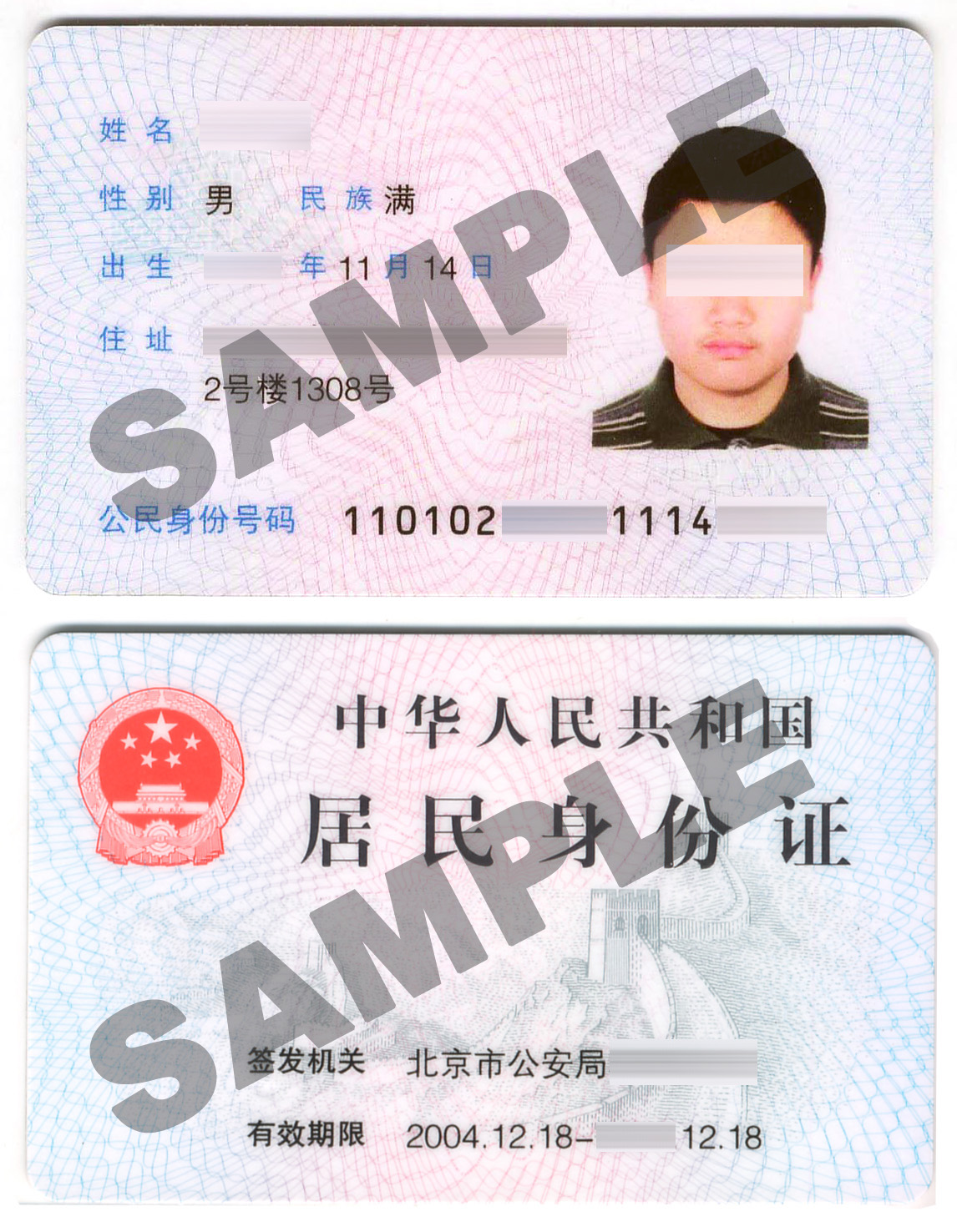
The identity card contains basic information regarding the individual, such as the following:
In addition, more detailed personal information can be obtained by viewing hukou information from the card database. Starting on January 1, 2013, Beijing has started trials to include fingerprints in the ID cards, making it more difficult to forge ID cards or for people to use the ID cards of others.
In 1984, discussion over the contents of the identity card became controversial regarding whether to include details such as "marital status" and "occupation"; considering the actual situation of the People's Republic of China at the time, these details ultimately were not included in the ID card.
The first-generation ID cards contained a black-and-white photograph portrait of the individual; following the introduction of the second-generation cards, all identification portraits are printed in colour. From 1 January 2013 a mandatory switch to the second-generation cards came into force; all first-generation cards became void and unusable. If used, first-generation cards are treated as expired ID cards, and will not be accepted. It is a criminal offense to accept first-generation ID cards if the person who accepts it knows that it is a first-generation card.
Hub AI
Resident Identity Card AI simulator
(@Resident Identity Card_simulator)
Resident Identity Card
The Resident Identity Card (Chinese: 居民身份证; pinyin: Jūmín Shēnfènzhèng) is an official identity document for personal identification in the People's Republic of China. According to the second chapter, tenth clause of the Resident Identity Card Law, residents are required to apply for resident identity cards from the local Public Security Bureau, sub-bureaus or local police precincts.
Prior to 1984, citizens within the People's Republic of China were not required to obtain or carry identification in public. On April 6, 1984, the State Council of the People's Republic of China passed the Identity Card Provisional Bill (中华人民共和国居民身份证试行条例), commencing the process of gradual introduction of personal identification, in the footsteps of many developed countries at the time. The first generation identification cards were single paged cards made of polyester film. Between 1984 and 1991, trials for the new identity card system took place in Beijing, Shanghai and Tianjin. Shan Xiurong (单秀荣), a Chinese Opera performer and soprano from Beijing, was the first person to receive a first-generation identity card in China.
On September 6, 1985, the Standing Committee of the 12th National People's Congress passed the Identity Card Bill of the People's Republic of China, which regulated that all citizens over the age of 16 apply for identification cards. At that point, the Ministry of Public Security of the People's Republic of China created a unified authority responsible for the issuing and management of the ID cards. From 2003, it is reported that a total of 1.14 billion ID cards have been created in China, for a total of 960,000,000 holders. However, as a result of technological development and certain techniques made available to the civilian population, the existing cards became relatively easier to counterfeit, opening the increasing threat of false identification.
On June 1, 2003, the National People's Congress passed the new Resident Identity Card Law, which expanded the scope of documents issued, and allowed soldiers in the People's Liberation Army and members of the People's Armed Police to apply for special identity cards. Individuals under the age of 16 were also permitted to voluntarily apply for an identification card. The law also established the use of newer, second-generation cards, which are machine-readable and more difficult to forge.
The identity card contains basic information regarding the individual, such as the following:
In addition, more detailed personal information can be obtained by viewing hukou information from the card database. Starting on January 1, 2013, Beijing has started trials to include fingerprints in the ID cards, making it more difficult to forge ID cards or for people to use the ID cards of others.
In 1984, discussion over the contents of the identity card became controversial regarding whether to include details such as "marital status" and "occupation"; considering the actual situation of the People's Republic of China at the time, these details ultimately were not included in the ID card.
The first-generation ID cards contained a black-and-white photograph portrait of the individual; following the introduction of the second-generation cards, all identification portraits are printed in colour. From 1 January 2013 a mandatory switch to the second-generation cards came into force; all first-generation cards became void and unusable. If used, first-generation cards are treated as expired ID cards, and will not be accepted. It is a criminal offense to accept first-generation ID cards if the person who accepts it knows that it is a first-generation card.