Hubbry Logo
search
logo
584967

Resident Identity Card

logo
Community Hub0 Subscribers
Read side by side
from Wikipedia
Resident Identity Card
居民身份证
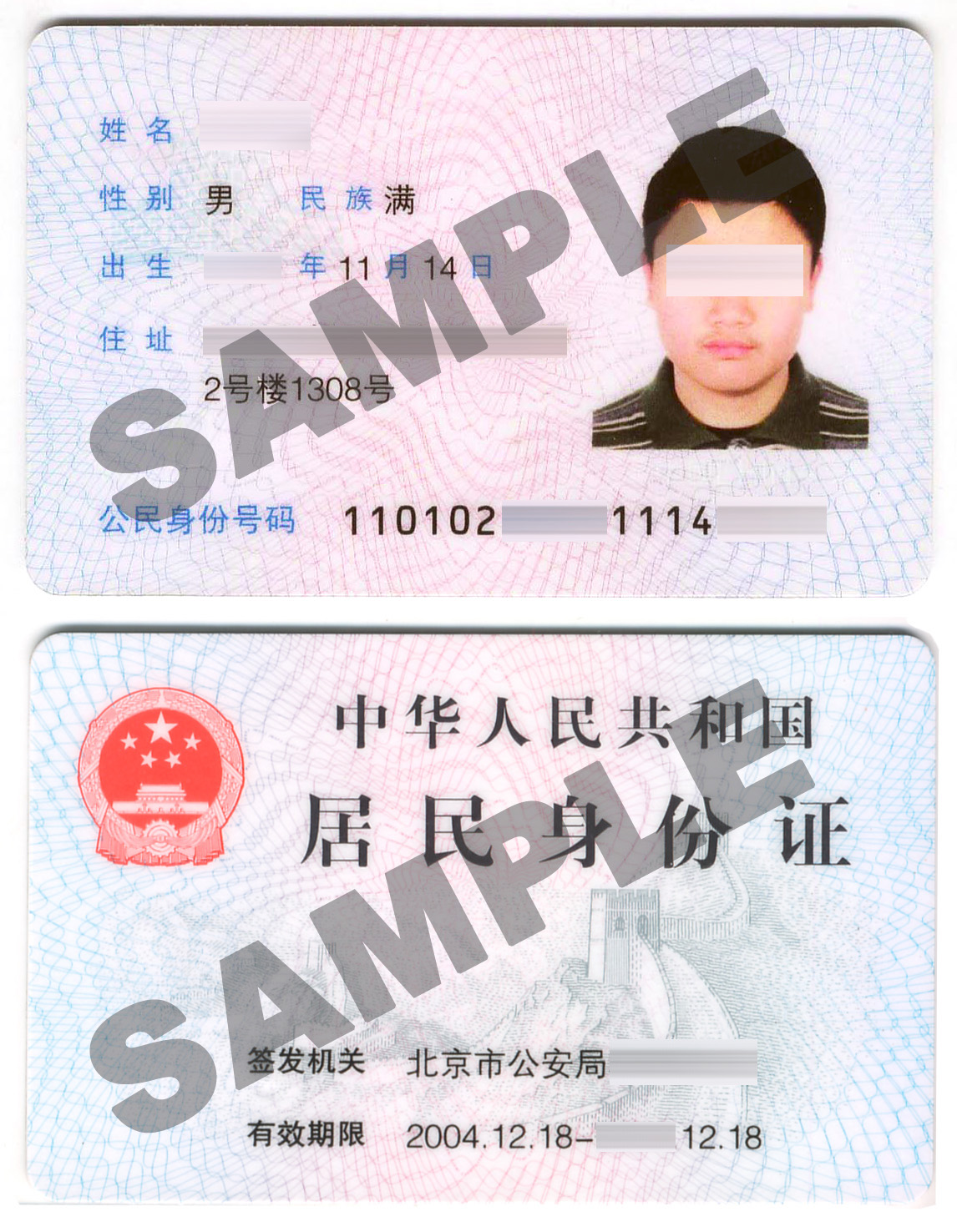
(above) and obverse (below) of a Resident Identity Card (Second-generation identification card)
TypeIdentity card
Issued by China
PurposeIdentification
Valid inPeople's Republic of China
EligibilityHukou registration required
CostRegistration fee: RMB20,
Replacement for lost or damaged cards: RMB40
Size85.60mm×54.00mm×1.00mm [1]

The Resident Identity Card (Chinese: 居民身份证; pinyin: Jūmín Shēnfènzhèng) is an official identity document for personal identification in the People's Republic of China. According to the second chapter, tenth clause of the Resident Identity Card Law, residents are required to apply for resident identity cards from the local Public Security Bureau, sub-bureaus or local police precincts.[2]

History

[edit]
First generation Resident Identity Card

Prior to 1984, citizens within the People's Republic of China were not required to obtain or carry identification in public.[3] On April 6, 1984, the State Council of the People's Republic of China passed the Identity Card Provisional Bill (中华人民共和国居民身份证试行条例), commencing the process of gradual introduction of personal identification, in the footsteps of many developed countries at the time. The first generation identification cards were single paged cards made of polyester film. Between 1984 and 1991, trials for the new identity card system took place in Beijing, Shanghai and Tianjin. Shan Xiurong (单秀荣), a Chinese Opera performer and soprano from Beijing, was the first person to receive a first-generation identity card in China.[4]

On September 6, 1985, the Standing Committee of the 12th National People's Congress passed the Identity Card Bill of the People's Republic of China, which regulated that all citizens over the age of 16 apply for identification cards.[5] At that point, the Ministry of Public Security of the People's Republic of China created a unified authority responsible for the issuing and management of the ID cards. From 2003, it is reported that a total of 1.14 billion ID cards have been created in China,[6] for a total of 960,000,000 holders. However, as a result of technological development and certain techniques made available to the civilian population, the existing cards became relatively easier to counterfeit, opening the increasing threat of false identification.

On June 1, 2003, the National People's Congress passed the new Resident Identity Card Law,[2] which expanded the scope of documents issued, and allowed soldiers in the People's Liberation Army and members of the People's Armed Police to apply for special identity cards. Individuals under the age of 16 were also permitted to voluntarily apply for an identification card. The law also established the use of newer, second-generation cards, which are machine-readable and more difficult to forge.

Contents

[edit]

The identity card contains basic information regarding the individual, such as the following:

Reverse side
  • Full name – in Chinese characters only. Non-Chinese ethnic names and foreign names are transliterated into Chinese. First-generation ID cards contained handwritten names for rare Chinese characters, whilst the second-generation cards exclusively used computer-printed text in a larger font compared to that of the first generation, and do not support rarer characters.
  • Gender – containing one character for either male () or female ().
  • Ethnicity – as officially listed by the People's Republic of China.
  • Date of birth – listed in the Gregorian calendar format, in YYYY年MM月DD日 Big-endian (ISO 8601) order.
  • Domicile – the individual's permanent residence as dictated by the Identity Card Bill of the People's Republic of China.
  • Identification number
  • Photo of the individual
Obverse side
  • Issuing authority (first-generation cards utilised a stamp; second-generation cards display text only)
  • The limits to validity of the document (for individuals under 16 years of age: five years; for individuals between 16 and 25 years of age: ten years; for individuals between 26 and 45 years of age: twenty years; for individuals over 46 years of age: long-term)
Sample of a second generation card, showing the personal information displayed on both sides.

In addition, more detailed personal information can be obtained by viewing hukou information from the card database. Starting on January 1, 2013, Beijing has started trials to include fingerprints in the ID cards, making it more difficult to forge ID cards or for people to use the ID cards of others.

In 1984, discussion over the contents of the identity card became controversial regarding whether to include details such as "marital status" and "occupation"; considering the actual situation of the People's Republic of China at the time, these details ultimately were not included in the ID card.

The first-generation ID cards contained a black-and-white photograph portrait of the individual; following the introduction of the second-generation cards, all identification portraits are printed in colour. From 1 January 2013 a mandatory switch to the second-generation cards came into force; all first-generation cards became void and unusable. If used, first-generation cards are treated as expired ID cards, and will not be accepted. It is a criminal offense to accept first-generation ID cards if the person who accepts it knows that it is a first-generation card.

The dimensions of the second-generation cards are 85.725 mm × 53.975 mm × 0.900 mm, and the identity photo is sized at 358 × 441 pixels (width by height), printed at a resolution of 350dpi on RGB using 24-bit True Color, prepared using JPEG compression techniques in line with the requirements of ISO DIS 10918-1. The final image appears as a 26 mm × 32 mm portrait box in the top-right hand corner.[7]

Additional features in ethnic minority areas

[edit]

Within the ethnic minority regions in China, identity cards possess corresponding text in the respective minority language for both first-generation and second-generation cards. For example, cards officially signed and issued in Guangxi all contain accompanying text in Zhuang, as well as Chinese characters. According to the fourth clause of the Resident Identity Card Law, "based on the de facto situation within the organs of self-government within autonomous ethnic regions, the content of the resident identity card can, alongside Chinese characters, be decided to include the text of the ethnic group exercising regional autonomy or choice of a local generic text".[8] This law permits resident identity cards within designated ethnic minority regions to have bilingual text, and depending on region, cards may contain accompanying text in Zhuang, Uyghur, Yi, Tibetan, Mongolian or Korean.

Ethnic minority residents represented by the local autonomous region can apply to have an additional ethnic minority language displayed on their identity cards, whilst Han Chinese and other ethnic residents' cards only have Chinese characters displayed. Ethnic minorities within their representative autonomous regions can have their personal name displayed in both their native language and Chinese characters; for example, within Xinjiang Uyghur Autonomous Region, a card belonging to a Uyghur may display the cardholder's name as "纳斯尔丁·阿凡提(نەسىرىدىن ئەپەندى)" (Effendi Nasreddin), however ethnic Kazakhs and Xibe people living in Xinjiang may only have their names written in Chinese. The following table shows the languages used on identity cards within minority regions:

Field Simplified Chinese
(Pinyin)
Zhuang Tibetan
(Wylie)
Mongol Uyghur
(ROM: ULY)
Nuosu
(Yi pinyin)
Korean
(McCune–Reischauer)
Name 姓名
(xìngmíng)
SINGQMINGZ རུས་མིང་།
(rus ming)
ᠣᠪᠣᠭ
ᠨᠡᠷ᠎ᠡ

(oboɣ ner-e)
نامى
(nami)
ꑫꂓ
(xyt hmi)
이름
(irŭm)
Gender 性别
(xìngbié)
SINGQBIED ཕོ་མོ།
(pho mo)
ᠴᠢᠨᠠᠷ ᠤᠨ
ᠢᠯᠭᠠᠯ

(činar-un ilɣal)
جىنسى
(jinsi)
ꌺꅪ
(sse hni)
성별
(sŏngbyŏl)
Ethnicity 民族
(mínzú)
MINZCUZ མི་རིགས།
(mi rigs)
ᠦᠨᠳᠦᠰᠦᠲᠡᠨ
(ündüsüten)
مىللىتى
(milliti)
ꊿꋅ
(co cux)
민족
(minjok)
Date of birth 出生
(chūshēng)
SENG སྐྱེས་དུས།
(skyes dus)
ᠲᠥᠷᠥᠭᠰᠡᠨ
ᠡᠳᠦᠷ

(törögsen edür)
تۇغۇلغان
(tughulghan)
ꒆꄮ
(yur te)
출생
(ch'ulsaeng)
Year-Month-Day 年月日
(nián yuè rì)
NIENZ NYIED HAUH ལོའི་ཟླ་ ཚེ་ས་ ཉིན།
(lo'i zla, tshe sa, nyin)
ᠣᠨ
ᠰᠠᠷ᠎ᠠ
ᠡᠳᠦᠷ

(on, sar-a, edür)
يىل ئاي كۈن
(yil, ay, kün)
ꈎ ꆪ ꑍ
(kut, help, nyit)
년 월 일
(nyŏn, wŏl, il)
Domicile 住址
(zhùzhǐ)
DIEGYOUQ སྡོད་གནས།
(sdod gnas)
ᠰᠠᠭᠤᠭ᠎ᠠ
ᠭᠠᠵᠠᠷ

(saɣuɣ-a ɣaǰar)
ئادرېسى
(adrési)
ꀀꅉ
(it dde)
주소
(chuso)
Resident Identity number 公民身份号码
(gōngmín shēnfèn hàomǎ)
GUNGHMINZ SINHFWN HAUMAJ སྤྱི་དམངས་ཐོབ་ཐང་ཨང་རྟགས།
(spyi dmangs thob thang ang rtags)
ᠢᠷᠭᠡᠨ ᠦ
ᠪᠡᠶ᠎ᠡ
ᠵᠢᠨ
ᠦᠨᠡᠮᠯᠡᠯ ᠦᠨ
ᠨᠣᠮᠧᠷ

(irgen-ü bey-e ǰin ünemlel-ün nomɛr)
كىملىك نومۇرى
(kimlik nomuri)
ꇬꂱꇭꀧꊫꌐꀕꂷ
(go mip gop bo zyp sat sat ma)
공민신분증번호
(kongmin sinbunchŭng pŏnho)
Issuing authority 签发机关
(qiānfā jīguān)
CIEMFAT GIHGVANH མཆན་སྤྲོད་ལས་ཁུངས།
(mchan sprod las khungs)
ᠭᠠᠷ ᠤᠨ
ᠦᠰᠦᠭ
ᠵᠢᠷᠤᠴᠤ
ᠣᠯᠭᠣᠨ
ᠥᠭᠬᠦᠭᠰᠡᠨ
ᠪᠡᠢᠭᠣᠯᠭ᠎ᠠ

(ɣar-un üsüg ǰiruču olɣon ögxügsen beigölɣ-a)
تارقاتقان ئورگان
(tarqatqan organ)
ꇭꀧꊫꌐꃑꅉ
(gop bo zyp sat fat dde)
발급기관
(palgŭp kigwan)
Validity 有效期限
(yǒuxiào qīxiàn)
MIZYAUQ GEIZHANH ནུས་ཐོན་ངུས་ཙོད།
(nus thon ngus tsod)
ᠬᠦᠴᠦᠨ
ᠪᠦᠬᠦᠢ
ᠬᠤᠭᠤᠴᠠᠭ᠎ᠠ

(xüčün büxüi xüɣüčaɣ-a)
كۈچكە ئىگە مۇددىتى
(küchke ige mudditi)
ꌬꉆꄮꈉ
(ssi hxit te kop)
유효기한
(yuhyo kihan)

Identity card number

[edit]
Obverse side of a second-generation ID card

From October 1, 1999, the PRC State Council approved the establishment of a citizen identification number system, and currently consists of an 18-digit code. This number has a function similar to that of the social security number in the United States. Each citizen has a unique number that remains unchanged for their entire lifetime.

1 1 0 1 0 2 Y Y Y Y M M D D 8 8 8 X
Address code Date of Birth code Order code Checksum
  • Address code refers to the resident's location, where administrative divisions (including cities, banners, and districts) have their own specific codes. (For example, the code for Xicheng District in Beijing is 110102.) Change of address does not modify this code, however, which means that the code therefore reflects one's birthplace or the location of one's first-time card issuance (in the case where people are born before the resident identity card system was introduced).
  • Date of Birth in the form YYYY-MM-DD.
  • Order code is the code used to disambiguate people with the same date of birth and address code. Men are assigned to odd numbers, women assigned to even numbers.
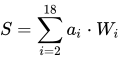
  • The Checksum is the final digit, which confirms the validity of the ID number from the first 17 digits, utilizing ISO 7064:1983, MOD 11-2. The checksum is obtained by:
  1. Marking the Identity card number right-to-left for the parity-check codes;
  2. Weight coefficient calculation ;
i 18 17 16 15 14 13 12 11 10 9 8 7 6 5 4 3 2 1
Wi 7 9 10 5 8 4 2 1 6 3 7 9 10 5 8 4 2 1
  1. Calculation of
Checksum derivation process
Checksum derivation process in Visual Basic
Dim a, w, s ,id
 msgbox "This procedure for checking the identity card number and or-bit",vbokonly+vbinformation,"identity check procedures"
 id=inputbox("Enter the ID number 15 or 18 before the identity card numbers of 17 or","ID","11010519491231002")
 if vartype(id) <> 0 then
'Test the legality of the importation of numbers
  l = 0
  do until l = 1
   l = 1
   p = ""
   if len(id) <> 17 then
     if len(id) <> 15 then
      l = 0
      p = "enter the median is not correct, please enter 15 or 17-digit."
     end if
   end if
   for i = 1 to len(id)
    a = mid(id, i, 1)
    if asc(a) < asc("0") or asc(a) > asc("9") then
     l = 0
     p = p & vbCrLf & vbCrLf & "Please enter the number, do not include the characters“" & a & "”。"
     exit for
    end if
   next
   if l = 0 then
    id = inputbox("illegal input" & vbCrLf  & vbCrLf & p, "input error", id)
   end if
  loop
'Will be number 15 or 17 places to number
  if len(id) = 15 then
   id = left(id, 6) & "19" & right(id, 9)
  end if
'Number 17 for the calculation of parity-check codes
  for i = 2 to 18
   a = mid(id, 19-i, 1)
   w = 2^(i-1) mod 11
   s = a * w + s
  next
  s = (12 - (s mod 11)) mod 11
  if s = 10 then s = "X"
'After checking the number of output
  inputbox "the identity card number of the parity-check codes for the“" & s & "”" & vbcrlf & vbcrlf & "by checking the ID card numbers are as follows:", "Check completed", id & s
 end if
Checksum derivation process in TypeScript
// Must input 17 bit string of RID from left to right
function calcChecksum(rid: string) {
    const workArr = rid.split('').reverse();
    let sum = 0;
    for (let j = 0; j < 17; j++) {
        sum += workArr[j] * Math.pow(2, j + 1) % 11;
    }
    return (12 - (sum % 11)) % 11;
}

// Test
alert(calcChecksum('63280119790817003')); // will alert 6
Checksum derivation process in Ruby
# accepts first 17 digits of the card number and calculates checksum
def calculate_checksum(card_id)
  sum = 0
  card_id.reverse.each_char.with_index do |ch, idx|
    w = (2**(idx + 1)) % 11
    sum += ch.to_i * w
  end
  (12 - sum % 11) % 11
end

puts checksum('34262219840209049') # first 17 digits
# => 10
puts checksum('63280119790817003')
# => 6
Checksum derivation process in Python
>>> id_checksum = lambda s:(1 - 2 * int(s, 13)) % 11
>>> id_checksum('63280119790817003')
6L
>>> id_checksum('34052419800101001')
10L # according to the standard, this means 'X'
Checksum derivation process in PHP
/**
 *身份证验证,传入身份证,返回true即为正确。 ID number validation, pass in ID number, return true if success.
 *只能传入字符串,传入参数必须加引号。 can only pass in strings, parameter should be surrounded by quote marks.
 **/
function check_id_number($id)
{
    if (strlen($id) != 18) {
        return false;
    }

    $temp = (str_split($id));
    $temp[17] == 'x'|| $temp[17] == 'X' ? $check = 10 : $check = $temp[17];
    array_pop($temp);
    $temp = array_reverse($temp);

    $sum = 0;
    foreach ($temp as $key => $value) {
        $w = pow(2, $key+1) % 11;
        $sum += $value * $w;
    }

    if ((12 - $sum % 11) % 11 != $check) {
        return false;
    }
    return true;
}
Checksum derivation process in R
> checkCode
function(ID) {
  stopifnot(length(grep('^[0-9]{17}$', ID)) != 0)
  code <- (12 - sum( (2^(17:1))%%11 * as.integer(strsplit(ID, split=NULL)[[1]]) )) %% 11
}
> print(checkCode('34262219840209049'))
[1] 10

Usage of identification

[edit]
Prior to purchasing tickets at a railway station, individuals must verify their identity by tapping their Resident Identity Card over an RFID reader.

The identity card is the only acceptable legal document used to obtain resident permits or driving licenses, open bank accounts, register for mobile phone numbers, apply for tertiary education and technical college for mainland Chinese citizens, and is one of the acceptable legal documents used to buy train tickets and pass through security checkpoints within domestic terminals at airports in mainland China. Documentation is also required for marriages, household registrations and legal cases.

Recently, there have been more services that require the display of Resident Identity Cards, such as at Internet cafes and certain stores.[9]

Police are required to inspect identification documents where:

  • Criminal suspects need to be identified;
  • To inspect those related to personnel involved in an incident;
  • In the occurrence of a serious security emergency, and there is a requirement to obtain the identity of a person at the scene;
  • If the law requires so during a case.

Anti-counterfeiting measures

[edit]
Hidden text of "JMSFZ" found within the texture of the second-generation identity cards.

First generation identity card

[edit]

Polyester plastic film, which utilizes an anti-counterfeit laser logo.

Second generation identity card

[edit]

Second-generation identity cards contain a non-contact IC chip card, a directional holographic "Great Wall" image, an anti-counterfeiting film made of green multi-layer polyester (PETG) composite material, optical variable optical storage containing the text "中国CHINA" situated on the card, and a microfilm string generating the letters "JMSFZ" (initials for the Pinyin of "Jumin Shenfenzheng"), and a "Great Wall" logo revealed by ultraviolet light.[7]

Security and criticism

[edit]

Unlike the biometric identity cards in EU countries which comply with ICAO standards, the second-generation ID card imposes older technologies similar to MIFARE used on public transportation systems, which, unlike its ICAO-compliant counterparts, lacks the proper encryption of personal data such as BAC control, thus making the information stored on the chip openly accessible to any ID card readers at a near enough distance. Also, because identity cards lack a different numbering scheme from the citizen's identity number for Chinese nationals, there's currently no way to deregister a lost ID card completely even when the loss of the identity card is reported to the police.[10] The above characteristics have made identity cards vulnerable to identification theft.[11]

See also

[edit]

References

[edit]
[edit]
Revisions and contributorsEdit on WikipediaRead on Wikipedia
from Grokipedia
The Resident Identity Card (Chinese: 居民身份证; pinyin: Jūmín shēnfènzhèng), commonly known as the ID card, is the principal compulsory identity document issued to all citizens of the People's Republic of China who have reached the age of 16, serving as the primary means of proving personal identity for purposes including domestic travel, financial services, employment, and access to government-administered benefits.[1][2] The card features a color photograph of the holder, along with printed details such as name, gender, ethnicity, date of birth, permanent address, and an 18-digit unique citizen identification number encoded according to the national standard GB 11643-1999, which incorporates birthplace information and a check digit for verification.[1][3] Introduced through regulations promulgated by the State Council on April 6, 1984, and implemented nationwide from 1987 onward, the first-generation cards were paper-based with basic laminates, but production and issuance faced logistical challenges leading to uneven adoption until the 1990s.[4] The second-generation card, rolled out starting in select regions in 2003 and mandated by the 2004 Resident Identity Cards Law effective January 1, 2004, shifted to a polycarbonate substrate with an embedded contactless RFID chip storing biometric and textual data, enabling electronic reading for improved security against forgery and facilitating integration with national databases for real-time identity checks.[1][5] Validity periods vary by age—five years for those under 16 (optional issuance), ten years for ages 16-25, 20 years for 26-45, and lifetime for those over 46—with mandatory replacement upon expiration or damage to ensure ongoing functionality in an increasingly digitized administrative system.[6]

History

Pre-Modern Precursors and Post-1949 Foundations

In imperial China, the baojia system served as an early precursor to formalized identity and registration mechanisms, organizing households into hierarchical groups for mutual surveillance, taxation, and conscription. Originating during the Song dynasty (960–1279 CE), it structured ten households into a jia (甲), ten jia into a pai (牌) or bao (保), with designated leaders held collectively accountable for local order and compliance with state directives.[7] This system, revived under the Qing dynasty and adapted in the Republican era (1912–1949) for rural policing and anti-communist efforts, emphasized community-based verification of residents' identities and movements to enforce fiscal and military obligations.[8] Local experiments, such as Shanghai's mandatory ID card policy introduced in 1946, extended these principles to urban personal documentation amid wartime displacement and modernization drives.[9] Following the establishment of the People's Republic of China in 1949, the imperatives of post-civil war reconstruction and population stabilization laid the groundwork for modern identity controls, building directly on household registration traditions. The chaos of the preceding conflict had displaced millions and strained administrative capacities, prompting the central government to prioritize demographic mapping through the 1953 national census, which enumerated over 594 million people. Early efforts relied on manual hukou (户口) booklets—household registration records tracing back to ancient precedents but systematized in provisional regulations by 1951—to track residency, allocate rations, and curb unregulated migration.[10] These served de facto as identity proofs in the planned economy, integrating with public security organs to monitor internal movements and prevent counter-revolutionary activities during the 1950s land reforms and subsequent campaigns. The hukou system's formalization in 1958 marked a pivotal post-1949 foundation, institutionalizing a dual urban-rural classification to manage rapid industrialization and urbanization amid a population swelling toward 1 billion. Designed to allocate resources and labor while restricting rural-to-urban flows—thereby averting urban overcrowding in cities like Shanghai and Beijing—hukou records became indispensable for verifying citizenship, employment, and social services, though they lacked portable personal cards and were prone to forgery in an era of limited mobility.[11] By the 1970s, as economic stagnation gave way to Deng Xiaoping's 1978 reforms, inefficiencies in these manual systems surfaced amid expanding commerce and travel; local experiments with rudimentary identity certificates emerged to supplement hukou, highlighting the need for a unified national mechanism to authenticate individuals in a populace exceeding 987 million by the 1982 census. This culminated in the drafting of resident identity card regulations in the early 1980s, motivated by fraud prevention and administrative streamlining in the reform era, with adoption by the National People's Congress Standing Committee on September 6, 1985.[12]

Introduction of the First Generation (1980s)

The first-generation Resident Identity Card was introduced in China as part of broader administrative reforms during the Deng Xiaoping era, which emphasized modernization and increased internal mobility following the launch of economic liberalization in 1978. On April 6, 1984, the State Council issued the Trial Regulations on Resident Identity Cards, mandating that Chinese citizens aged 16 and older apply for the card from public security organs, marking the formal inception of a nationwide identification system to replace fragmented local proofs like work unit letters.[13] Pilots commenced in select urban centers including Beijing, Shanghai, Tianjin, Wuhan, and Guangzhou to test issuance procedures and design.[13] The inaugural cards were distributed on August 30, 1984, in Beijing, where 380 individuals received them, with renowned soprano singer Shan Xiurong as the first recipient to facilitate her international travel documentation.[14] On September 6, 1985, the National People's Congress Standing Committee approved the Regulations on Resident Identity Cards, formalizing the system nationwide and stipulating contents such as the holder's name, gender, ethnicity, date of birth, address, and photograph on a paper document laminated in plastic for basic protection. Issuance began with handwritten entries and photographic lamination, transitioning to rudimentary printing, with validity periods of 10 or 20 years depending on age.[15] Rollout prioritized urban areas, expanding gradually to rural regions amid logistical constraints in population registration. Early implementation faced challenges including the cards' limited durability due to thin plastic lamination prone to wear and the absence of robust anti-counterfeiting measures, rendering them susceptible to forgery in an era of rising transient labor.[16] Regional pilots helped refine processes, such as verifying duplicates in birth dates for unique numbering, but counterfeit prevalence and material fragility persisted until design upgrades in subsequent years.[17] By the late 1980s, the system had begun standardizing identity verification, supporting reforms by enabling more reliable tracking of citizens outside traditional hukou-bound locales, though full national penetration required further decades.[18]

Transition to the Second Generation (2000s)

In 2004, China initiated the issuance of the second-generation Resident Identity Card to supersede the first-generation version, driven by the need to counter escalating identity fraud and incorporate advanced technology for enhanced security.[19] The upgrade featured a durable multi-layer polyester card with an embedded non-contact integrated circuit (IC) chip utilizing RFID technology, enabling contactless data retrieval of encoded personal information such as name, photograph, and identification number.[20][21] The rollout commenced with pilot programs in select urban areas like Huzhou, Shanghai, and Shenzhen in late 2003, expanding nationwide by 2005 through a phased replacement process managed by the Ministry of Public Security.[22] This effort prioritized technological modernization to integrate card data with centralized public security databases, facilitating real-time verification and reducing forgery risks.[23] Replacement continued incrementally, culminating in the expiration of first-generation cards on January 1, 2013, marking the effective completion of the transition.[24] The program extended issuance to rural populations, achieving broad coverage across China's 1.3 billion citizens by promoting uniform access to identification essential for economic participation and public services.[21] Government objectives emphasized fortifying national identification integrity against fraud while supporting market-oriented reforms by streamlining mobility and administrative processes.[19][25]

Digital Integration and Reforms (2010s–2025)

In the early 2010s, China initiated pilots for electronic identity verification tied to the resident identity card, requiring real-name registration for mobile numbers and online services to curb anonymous fraud.[26] By 2017, the WeChat platform launched an electronic ID pilot in Guangzhou, enabling users to verify identity via the app for services like hotel check-ins and ticket bookings, with plans for nationwide expansion.[27] These efforts built on the second-generation card's embedded chip, allowing contactless data reading for digital authentication in public services. During the 2020s, integrations expanded through major platforms, with WeChat and Alipay incorporating resident identity card verification for seamless online transactions and government e-services.[28] By 2024, a precursor digital ID system was trialed across over 80 applications, including public platforms and commercial apps, facilitating single sign-on without repeated biometric submissions.[29] Official data indicate these measures contributed to fraud reductions, with one Beijing study reporting a 10% drop in identity-related incidents following enhanced digital linkages.[28] Reforms from 2023 to 2025 emphasized biometric enhancements and national scalability, including facial recognition protocols for identity issuance and verification to support a population exceeding 1.4 billion.[30] On July 15, 2025, the National Network Identity Authentication system—known as the Cyberspace ID—was rolled out voluntarily nationwide, enabling users to authenticate online via a government app using real-name details and a one-time facial scan, thereby preventing platforms from retaining biometrics and aiming to minimize transaction fraud across digital ecosystems.[31] This system supports scalable verification for e-commerce, finance, and administrative tasks, with early enrollment surpassing six million users by late 2025.[32]

Eligibility, Issuance, and Administration

In the People's Republic of China, all citizens residing within the territory who have reached the age of 16 are legally required to apply for a Resident Identity Card, as stipulated in Article 2 of the Resident Identity Card Law promulgated in 2003 and effective from January 1, 2004.[33] This obligation applies uniformly to mainland Chinese citizens, with applications to be submitted to the public security organ at the location of their registered permanent residence (hukou) within three months of turning 16.[34] Citizens under 16 are not mandated to obtain their own card but may apply voluntarily, typically relying on a parent's or guardian's card for identification purposes until the age of majority.[35] The card serves as the primary official document for proving identity in civil, administrative, and certain legal contexts, underscoring its status as a foundational requirement for adult citizenship. While the law does not explicitly mandate carrying the card at all times, its absence during required verifications—such as for banking, travel, or employment—can hinder access to services and trigger scrutiny. Failure to apply or renew as required constitutes a violation under Article 17, subjecting the individual to an order for correction within a specified period; non-compliance incurs fines ranging from 50 to 200 RMB, though enforcement discretion varies by public security bureau and regional practices.[36] Validity periods for second-generation cards, introduced nationwide by 2013, are determined by the holder's age at issuance: 10 years for those aged 16–25, 20 years for those aged 26–45, and indefinite (lifetime) for those over 45, facilitating administrative efficiency by reducing renewal frequency for older citizens whose appearances remain relatively stable.[37] These durations, as provided under the Resident Identity Card Law, primarily account for changes in citizens' appearance with age—particularly rapid alterations in youth that render older photos unreliable for verification in contexts such as security checks or banking—updates to personal information like addresses via hukou changes, and the incorporation of enhanced security and anti-forgery measures through periodic reissuance, including new technologies like chips and machine-readable features.[37] The age-based design balances timely updates for accuracy and security with usability and reduced administrative costs; expired cards can restrict access to services like travel, so renewal is recommended up to 90 days prior to expiration. These durations reflect policy adjustments from earlier first-generation cards, which had uniform 15-year terms, and align with the 2013 mandate phasing out legacy cards to standardize electronic features and data security.[35]

Application and Renewal Procedures

Applications for the Resident Identity Card are submitted in person at public security bureaus or police stations corresponding to the applicant's hukou registration location within China; Chinese embassies and consulates abroad do not handle issuance, renewals, or any processing for Resident Identity Cards.[38] Applicants must complete a registration form, provide proof of identity such as an existing card or other documents issued by public security organs, undergo photography, and submit fingerprints; minors require guardian accompaniment.[1][37] Initial issuance for eligible citizens aged 16 and above is free, a policy implemented nationwide from April 1, 2018, to reduce barriers for first-time applicants. Renewal due to expiration, name changes, or information updates incurs a fee of 20 RMB per card, while replacement for loss or damage costs 40 RMB; temporary cards, if issued, cost 10 RMB. These standards, set by the National Development and Reform Commission and Ministry of Finance, apply uniformly across mainland China unless local exemptions apply for specific cases like poverty alleviation.[39][40] Since 2018, digital platforms have enabled pre-application steps, including online form submission and appointment booking via government apps or WeChat mini-programs, streamlining in-person visits by allowing preliminary data entry and queue reservation. Processing typically completes within 30 days in urban areas, extending to 60 days in remote regions, with reported averages dropping to around 15 days in major cities by the early 2020s due to integrated digital-hukou systems and expanded self-service kiosks.[41] Renewals must align with hukou updates, requiring reapplication if residence registration changes occur, though cards remain valid for 10 years for adults aged 20-45 or 20 years for those under 20 or over 45 until natural expiration. In migrant-dense urban areas, administrative backlogs have prompted deployments of mobile service vehicles since the early 2010s, enabling on-site fingerprinting and issuance for floating populations without returning to hukou origins, though full integration remains tied to local verification challenges.[1]

Role of Hukou System Integration

The resident identity card incorporates the holder's hukou-registered address as its permanent domicile field, distinct from any temporary residence, thereby embedding the household registration system's mobility controls directly into personal identification. This linkage determines eligibility for localized public services, including schooling for children, subsidized medical care, and social welfare benefits, which are predominantly allocated based on hukou status rather than actual habitation. Consequently, individuals with rural hukou who migrate to urban areas for employment must rely on their ID card's rural address, often resulting in exclusion from full urban entitlements despite contributing to city economies through labor.[42][11] In practice, this mechanism affects a vast population: as of 2023, China's migrant worker cohort numbered 297.53 million, the majority originating from rural hukou backgrounds and residing in cities without local registration, thereby facing systemic barriers to service integration that perpetuate economic vulnerabilities.[43] Hukou-linked ID verification thus sustains resource rationing, channeling migrants into informal sectors while reserving urban hukou privileges—tied to the card—for natives or approved transferees, a policy rooted in allocating finite infrastructure and fiscal capacities across uneven regional development.[44] Reforms initiated in 2014 under the State Council's urbanization plan relaxed hukou conversion criteria for skilled workers and residents of mid-sized cities (populations under 5 million), enabling some ID card holders to update their addresses and gain service access, which correlated with localized wage gains and economic expansion in eligible areas.[45][46] However, implementation has been uneven, with megacities like Beijing and Shanghai retaining stringent quotas, leaving persistent urban-rural divides evident in census data where rural hukou migrants comprise over 40% of urban labor forces yet access less than 20% of equivalent benefits.[47] Fundamentally, the ID card's hukou tether functions as a regulatory valve on population flows, curbing rapid urbanization that could overwhelm urban systems—as seen in pre-reform eras when unchecked inflows strained housing and sanitation—by incentivizing controlled migration tied to economic utility and local carrying capacity, thereby preserving regime stability amid demographic pressures.[10][42] This causal enforcement prioritizes sustainable resource distribution over free mobility, averting the infrastructural collapses observed in less regulated developing contexts, though critics from state-aligned analyses note it entrenches inequality by design.[48]

Design and Contents

Physical Specifications and Layout

The second-generation Resident Identity Card, introduced in 2004, adheres to the ID-1 standard dimensions of approximately 85.6 mm × 54 mm, matching the size of international credit cards for compatibility with standard readers and holders.[49] This compact form factor facilitates portability while ensuring sufficient space for essential visible information. The card is constructed from multi-layer polyester material, providing durability suitable for everyday use and resistance to physical wear over extended periods.[20] The front side prominently displays a laser-engraved photograph of the cardholder in the upper portion, typically in black and white for permanence and resistance to alteration. Below the photo, key personal details are printed in Chinese characters: the full name, gender (denoted as 男 for male or 女 for female), ethnicity (one of 56 recognized groups, such as 汉 for Han), date of birth in the format YYYY年MM月DD日, the 18-digit resident identity number, and the registered address. These elements are arranged vertically for efficient scanning and verification by authorities.[50] The reverse side includes administrative details such as the cardholder's signature, the issuing public security organ, the date of issuance, and the validity period, which for adults aged 20 and above is typically 10 or 20 years depending on age at issuance, supporting the card's long-term usability without frequent replacement.[50] This layout emphasizes quick visual confirmation of identity and legal status, with the absence of an expiry date for minors under 16 reflecting their indefinite validity until reaching eligibility for renewal. The overall design prioritizes legibility and tamper-evident features through engraving and material properties, enabling reliable manual inspection in verification scenarios.[20]

Data Encoded on the Card

The Resident Identity Card encodes core personal identification data, including the holder's Chinese name (in simplified characters), gender (denoted as male or female), ethnic group designation, date of birth, residential address (linked to hukou registration), 18-digit citizen identity number, digital photograph, issuing public security bureau, and validity period. These fields comply with the stipulations of the Law of the People's Republic of China on Resident Identity Cards, ensuring uniformity across issuances.[1][51] Second-generation cards, issued nationwide from 2004 onward, incorporate a contactless RFID chip compliant with the ISO/IEC 14443 Type B standard, which stores encrypted electronic versions of the above textual and photographic data for machine-readable verification.[52] The chip does not store financial information, transaction history, or other non-identification details, limiting its scope to authentication purposes. Biometric elements, including a digital facial image derived from the photograph and two fingerprints (typically index fingers), were integrated into the chip starting around 2013 to enhance anti-forgery measures and enable offline verification against printed data.[53][4] Ethnic group data follows national standardization for classification, with Han Chinese as the default majority designation and minorities listed per official registries; internal coding aligns with administrative protocols but is rendered in readable text on the card face. Address encoding references GB/T 2260 administrative division codes for precision in domicile linkage, though no separate financial or health records are included.[54] Per the 2011 amended law, electronic chip data readability is restricted to the specified fields and requires specialized readers approved by public security authorities, preventing unauthorized access or broad data extraction.[55] This design supports compulsory scenarios like banking or travel while maintaining central control over verification processes.[56]

Adaptations for Ethnic Minorities and Special Groups

In ethnic autonomous regions of China, resident identity cards incorporate bilingual elements to accommodate local minority languages alongside standard Chinese characters, as stipulated in Article 4 of the Law of the People's Republic of China on Resident Identity Cards.[1] This provision requires approval from the State Council for implementation where conditions permit, enabling cards to display personal details such as names, dates of birth, and addresses in scripts like Uyghur Arabic in the Xinjiang Uyghur Autonomous Region or Tibetan script in the Tibet Autonomous Region.[4] Similarly, Mongolian script appears on cards issued in Inner Mongolia, and Korean Hangul on those from Yanbian Korean Autonomous Prefecture, facilitating readability and cultural recognition for non-Han ethnic groups comprising about 8.9% of the population as of the 2020 census.[4] These adaptations reflect affirmative policies under China's ethnic regional autonomy system, where minority languages are used optionally to support administrative access in linguistically diverse areas, though standard Chinese remains mandatory for uniformity.[1] For instance, second-generation cards introduced in 2004 onward in regions like Xinjiang and Tibet routinely include such dual-script formatting, aiding verification in local contexts without altering core data fields.[4] For special groups such as disabled individuals, impoverished rural residents, and "five-guarantee" households (those receiving state aid for food, clothing, medical care, housing, and burial), adaptations include fee waivers for card issuance and replacement to reduce barriers to obtaining identification.[57] These exemptions, administered by public security organs, apply nationwide but are particularly relevant in minority areas with higher poverty rates, ensuring broader access without compromising card integrity or security features. No tactile or alternative-format modifications, such as braille, are standard on resident identity cards themselves; separate disability certificates handle such needs.[58]

Identity Number System

Structure and Encoding

The citizen identity number on the Resident Identity Card is an 18-digit alphanumeric code designed to uniquely identify each holder within China's population exceeding 1.4 billion as of 2023.[50] This format ensures no duplicates through a combination of geographic, temporal, and sequential elements, with assignment occurring at the time of first issuance without reuse or resets across generations.[59] The first six digits encode the administrative division of registration, following the national standard GB/T 2260-2007 for codes of the People's Republic of China's administrative divisions at provincial, prefectural, and county levels, typically ranging from 11xxxx to 65xxxx for mainland areas corresponding to over 3,000 valid codes.[60] For example, the code 110100 corresponds to Beijing municipality.[61] These digits reflect the hukou registration location rather than current residence, linking to the household registration system for administrative continuity.[50] Digits 7 through 14 represent the holder's date of birth in the YYYYMMDD format, using the Gregorian calendar to capture exact birth dates, including February 29 for individuals born on leap days, which occurs approximately every four years.[62] This fixed eight-digit structure accommodates births from 1800 onward, though practical use aligns with modern records post-1949.[59] The subsequent three digits (15-17) constitute a sequential order code (001-999, excluding 000), incremented within the specific administrative area and birth date to differentiate multiple individuals sharing the same registration locale and birthday; odd values are assigned to males and even to females, embedding gender information without additional fields.[59] This sequential method, initiated with the national ID system rollout in 1985 and standardized in the 18-digit format by 1999, prevents overlaps by exhausting the 001-999 range locally before broader adjustments, maintaining uniqueness amid high birth concentrations in populous regions.[19]

Checksum Algorithm and Validation

The identity number of the Resident Identity Card consists of 17 digits followed by a checksum character (a digit 0-9 or 'X' for 10), computed using a weighted sum modulo 11 based on the ISO/IEC 7064 MOD 11-2 procedure, which employs weights derived from powers of 2 modulo 11 to detect errors such as single-digit substitutions.[63] The weights for the first 17 digits, applied from left to right, are fixed as 7, 9, 10, 5, 8, 4, 2, 1, 6, 3, 7, 9, 10, 5, 8, 4, 2, reflecting $ w_i = 2^{18-i} \mod 11 $ for position $ i = 1 $ to 17.[64] To generate or validate the checksum, calculate the sum $ S = \sum_{i=1}^{17} a_i \cdot w_i $, where $ a_i $ are the digits. The checksum value is then $ (12 - (S \mod 11)) \mod 11 $; values 0-9 are digits, and 10 is represented as 'X'. For validation, compute this expected value from the first 17 digits and compare it to the provided 18th character (treating 'X' as 10); a match confirms the number's mathematical integrity, though it does not verify other aspects like date validity or administrative codes.[65][66] This algorithm is implemented in various software libraries and database systems for automated checks during data entry, registration, and processing, minimizing errors from manual transcription; for example, Python's stdnum module includes a dedicated function for Chinese resident identity card validation using this method. Empirical use in large-scale data handling, such as in leaked datasets, has shown it effectively filters invalid numbers, with analyses invalidating non-compliant entries at rates consistent with random error expectations.[67][66]

Compulsory Identification Scenarios

The Resident Identity Card serves as the primary document for compulsory identity verification in China across essential services, ensuring real-name registration to prevent anonymity in transactions and activities. This requirement stems from public security regulations and sector-specific laws mandating presentation of the card to access banking, domestic travel, telecommunications, accommodation, employment contracts, and real estate dealings, with non-presentation typically resulting in service denial. In railway travel, passengers must present the card for ticket purchases and boarding checks under the nationwide real-name system, fully enforced since December 31, 2010, covering high-speed and conventional lines to link tickets directly to individuals.[4] This applies to all domestic rail services, where identity mismatches at verification gates bar entry. Hotel and guesthouse check-ins, including traditional hotels and online-booked accommodations, require all guests to individually provide their own valid Resident Identity Cards for real-name registration, as stipulated in public security management provisions. It is strictly prohibited for one person to register for multiple occupants or for one to register while another does not; all occupants must register separately using their own IDs, with hotels obligated to upload the identity information of all guests to the公安旅馆业治安管理系统. Violations may result in penalties for the hotel, and guests may face inspections or denial of entry. Non-spousal cohabitation is not illegal but requires separate registration for each person. This practice is uniformly applied to record and report guest identities to local authorities, preventing unregistered stays.[68] Similarly, purchasing prepaid mobile SIM cards demands real-name registration via the card, mandated since September 1, 2010, by Ministry of Industry and Information Technology policies to tie phone numbers to verified users.[69] Financial institutions accept the Resident Identity Card or temporary identity cards to open personal bank settlement accounts or conduct transactions exceeding basic limits, per regulations from the People's Bank of China that recognize temporary cards as valid identity proof but require their use within the validity period, updating account information upon receipt of the formal card, with possible restrictions such as limiting to cash withdrawals; this is implemented by banks including Hangzhou Bank and Postal Savings Bank.[70][71] This aligns with anti-money laundering rules necessitating identity proof for account holders.[72] Formal employment similarly mandates it for labor contract signing and social insurance enrollment, as per the Labor Contract Law, while real estate purchases or registrations involve card submission to housing authorities for ownership verification and taxation. The 2017 Cybersecurity Law further reinforces these by requiring network operators to verify user identities using official documents like the card for services involving critical data.[73]

Linkages with Digital Services and Surveillance Systems

The Resident Identity Card serves as a foundational element in China's Skynet surveillance network, which by 2023 encompassed over 600 million cameras deployed nationwide for real-time public monitoring and identification. Facial recognition technology integrated with the system cross-references visual data against the national ID database, enabling authorities to overlay personal details from the card—such as name, photograph, and identity number—onto detected individuals within seconds. This linkage facilitates rapid suspect tracking and public safety operations, with the Ministry of Public Security reporting enhanced response times in criminal investigations through automated alerts when mismatched ID usage is detected.[74][75][76] Integration with the Social Credit System, formalized in a 2014 State Council planning outline, ties behavioral data to the unique 18-digit identity number on the card, allowing for automated scoring of compliance across financial, legal, and social domains. Local implementations, such as in Rongcheng, assign scores starting at 1,000 points linked directly to the national ID, aggregating inputs from government databases to enforce regulatory adherence and incentivize trustworthiness in governance interactions. This digital tether supports efficient resource allocation, with higher scores unlocking streamlined access to public services verified via ID-linked profiles.[77][78] The National Anti-Fraud Center app, launched by the Ministry of Public Security in the early 2020s, incorporates ID card verification for user authentication, enabling real-time checks against the central database to flag suspicious transactions and communications. State media outlets have attributed a reported 30% decline in telecom and online fraud cases to such app-enabled interventions, which prompt instant identity confirmation during high-risk activities like payments or account registrations.[79] In 2025, the voluntary national cyberspace ID system extended ID card linkages to online platforms, requiring real-name registration via facial scan and identity number for single sign-on services across apps and websites. Promoted by the Cyberspace Administration as a measure to curb fraud by minimizing anonymous interactions, it integrates with existing digital ecosystems to authenticate users against the Resident Identity Card database, thereby streamlining e-governance verifications while reducing impersonation risks in virtual transactions.[80][31]

Security Features and Anti-Counterfeiting

Evolution Across Generations

The first-generation Resident Identity Cards, implemented nationwide from September 1985 following the 1985 Identity Card Law, relied on rudimentary security features including lamination over printed photographs and text, rendering them susceptible to forgery through basic reproduction techniques.[19] These cards, often featuring black-and-white images and handwritten details for non-standard characters, faced heightened vulnerabilities in the 1990s as digital tools like early photo-editing software enabled widespread alterations and fakes, contributing to increased fraud incidents reported in urban areas.[19] To address these deficiencies, the Ministry of Public Security rolled out second-generation cards starting June 2004, transitioning to durable polycarbonate construction with embedded contactless RFID chips storing encrypted personal data, alongside optical security elements such as holograms, guilloché patterns, and microprinting.[81][15] This upgrade markedly improved forgery resistance by enabling machine-readable verification and tamper-evident features, with first-generation cards phased out by January 1, 2013, after which their use became invalid.[24] Post-2010 enhancements built on this foundation, incorporating fingerprint collection during issuance from 2013 onward in select regions like Beijing to bind biometric data to the chip, thereby complicating impersonation and duplicate issuance. These iterative security layers, driven by empirical observations of persistent threats, progressively reduced detected counterfeiting rates, as evidenced by public security campaigns noting substantial declines in fraudulent ID usage following the chip-enabled transition.[82]

Biometric and Chip-Based Protections

The second-generation Resident Identity Card employs a contactless integrated circuit (IC) chip adhering to the ISO/IEC 14443 Type B standard, which embeds personal data such as the holder's name, identity number, address, and digital photograph in an encrypted format to prevent unauthorized access and replication.[83][20] This chip-based storage mechanism supports electronic authentication via specialized readers, ensuring data integrity during verification processes without exposing raw information to casual scanning devices.[84] Biometric protections primarily rely on the encoded facial photograph, which enables matching against live captures for identity confirmation, though the card itself is classified as non-biometric under International Civil Aviation Organization (ICAO) definitions for machine-readable travel documents.[4] While fingerprints have been collected since 2013 for backend database enrollment in select regions like Beijing to combat forgery, standard chip storage does not include fingerprint minutiae templates or other raw biometric templates to minimize onboard data vulnerabilities.[19] Supplementary optical safeguards include ultraviolet (UV)-reactive inks and optically variable inks (OVI) that produce color-shifting effects and latent images visible only under specific lighting or angles, allowing border agents and inspectors to perform rapid visual authenticity assessments without electronic tools.[85] These features integrate with the chip's digital protections to form layered defenses, where physical alterations would disrupt both visual cues and electronic reads.[86]

Effectiveness and Empirical Outcomes

The Resident Identity Card system underpins China's real-name verification framework, which has correlated with declines in telecom and online fraud incidence. Official reports indicate that the number of such cases solved increased fivefold from 2016 to 2021, attributing this to enhanced traceability and anti-fraud measures tied to mandatory ID linkage.[87] This real-name approach restricts anonymous transactions, deterring perpetrators by increasing detection risks, though data from state sources warrant scrutiny for potential underreporting of persistent challenges.[88] By enabling unique identification for over 1.4 billion citizens, the system facilitates population management and administrative order, supporting census accuracy and resource allocation amid rapid urbanization.[18] In banking and finance, standardized ID checks have minimized fraudulent access to services, promoting economic stability by reducing verification discrepancies that plagued earlier decentralized methods.[89] Comparative analyses suggest that such centralization yields lower identity-dependent crime rates than in jurisdictions lacking nationwide mandatory systems, with China's reported homicide rate at about 0.5 per 100,000 in recent years versus 5-6 in the United States.[90] Economic analyses highlight net benefits through fraud deterrence, including streamlined compliance that averts losses in high-volume sectors, though precise annual savings figures remain opaque in public records.[91] The system's empirical track record underscores its utility in maintaining traceability for public order, contrasting with higher fraud vulnerabilities in less integrated ID regimes elsewhere.[92]

Controversies and Societal Impacts

Privacy and Mass Surveillance Debates

Critics, including human rights organizations such as Human Rights Watch, argue that the Resident Identity Card system facilitates extensive mass surveillance by integrating personal data with over 600 million CCTV cameras equipped with facial recognition technology, enabling real-time tracking and potential suppression of dissent.[76][93] This linkage allows authorities to cross-reference ID information with video footage, phone trajectories, and location data, raising concerns about erosion of individual privacy in everyday activities like travel and online behavior.[94] Such systems, while presented as tools for public security, are viewed by these groups as disproportionately enabling state control over political expression, particularly in regions like Xinjiang where predictive policing has been documented.[76] Chinese government officials counter that the ID card's role in surveillance infrastructure is essential for maintaining social stability in a population exceeding 1.4 billion, preventing chaos from crime, terrorism, and public health threats in a high-density, diverse society.[95] They emphasize that data fusion from ID-linked sources enhances governance efficiency, such as during the 2020 COVID-19 outbreak, where integration with health codes and QR scanning enabled rapid contact tracing that contained outbreaks more effectively than in many Western nations, with reported case detection and isolation rates surpassing global averages.[96][97] Official statements frame these measures as protective against data leaks and spam rather than invasive, arguing that voluntary digital extensions of the ID system safeguard users while curbing anonymous online harms.[95] Empirical assessments reveal trade-offs inherent to scaling identification in dense urban environments, where absolute privacy yields to causal necessities like epidemic control and crime reduction, evidenced by China's lower per-capita violent crime rates compared to less surveilled peers despite population pressures.[93] While isolated abuses in targeted enforcement exist, comprehensive data on widespread privacy violations tied directly to the ID card remain anecdotal rather than showing spikes in systemic misuse, contrasting with verifiable benefits in public order maintenance.[98] This balance underscores that in contexts of rapid urbanization and historical instability, ID-enabled monitoring realistically mitigates risks unattainable through decentralized alternatives, though ongoing scrutiny of source biases—such as Western NGOs' emphasis on rights over empirical outcomes—is warranted.[76][97]

Data Breaches and Black Market Exploitation

In July 2022, a hacker using the alias "China Dan" claimed to have breached the Shanghai National Police database, extracting personal data on up to one billion Chinese citizens, including names, addresses, national ID numbers, mobile numbers, and criminal records linked to resident identity cards.[99] [100] Samples provided to buyers and researchers verified the authenticity of portions of the dataset, which was offered for sale on dark web forums for approximately $200,000 in cryptocurrency, marking one of the largest known breaches of Chinese government-held identity data.[101] [102] The incident exposed systemic flaws in the centralized storage and access controls of police systems aggregating resident identity card information nationwide.[66] This breach fueled black market exploitation, with portions of the leaked data resold in smaller batches for use in fraud, scams, and forging documents tied to identity cards. Underground sales of stolen or duplicated ID data have persisted since the 2010s, often priced at 200-500 RMB per record or card, enabling activities like opening fraudulent bank accounts or evading verification systems.[103] [104] Post-2022, dark web marketplaces saw heightened trafficking of Chinese personal data, including ID-linked details, contributing to a thriving illicit economy for identity compromise.[105] [106] Chinese authorities responded by invoking the Personal Information Protection Law (PIPL), enacted in 2021, which requires data controllers to notify regulators and affected parties of breaches within specified timelines and implement remedial security measures.[107] [108] Enforcement actions intensified, with over 67,000 arrests for online fraud linked to data misuse reported in 2024, yet leaks continued due to vulnerabilities in centralized repositories.[105] For instance, in November 2023, an unsecured e-commerce platform exposed millions of citizen ID numbers publicly, underscoring ongoing risks in third-party handlers of identity data.[109] The resulting identity theft has driven financial losses, with credit card fraud rates reaching 0.83 incidents per 10,000 issued cards in state banks by 2023, often stemming from compromised ID details.[110] Embedded RFID chips in second- and third-generation resident identity cards provide mitigation through real-time authentication, reducing successful fraud in scenarios requiring physical or digital verification, though digital data sales bypass such checks for remote crimes.[111]

Balancing Security Benefits with Individual Rights

The Resident Identity Card system has demonstrably reduced identity-related fraud in high-volume transactions, with real-name verification requirements linked to banking and services deterring financial impersonation across China's 1.4 billion population.[112] Second-generation cards, incorporating optical and biometric elements since 2004, enable scalable verification that minimizes administrative inefficiencies, allowing seamless integration into employment, travel, and welfare distribution without the persistent forgery issues seen in less centralized systems.[113] Proponents emphasize these efficiencies as causal drivers of net societal gains, arguing that empirical reductions in document-based crimes—such as those tied to economic offenses—outweigh incremental privacy costs in a non-homogeneous state where unverified identities could amplify disorder.[92] Critics often invoke slippery-slope concerns over potential rights encroachments, yet available data indicates primarily targeted applications in rule-of-law enforcement rather than broad arbitrary monitoring, with legal frameworks like the 2021 Personal Information Protection Law imposing proportionality limits on data use.[113] In comparative terms, decentralized or voluntary ID alternatives in populous democracies have correlated with higher fraud persistence and service delivery failures, underscoring how centralized verification causally supports stability by curbing anonymity-enabled disruptions in diverse, large-scale governance.[28] While ideological critiques from Western sources frequently amplify abuse risks without quantifying alternatives' shortcomings, Chinese policy analyses highlight the system's role in containing unrest precursors like economic fraud, evidenced by sustained low incidences of identity-driven mass disruptions relative to population scale.[114] This trade-off reflects a pragmatic prioritization of collective security in a context demanding robust identity anchors, where privacy safeguards evolve through iterative laws but remain secondary to verifiable enforcement efficacy; decentralized models, by contrast, risk higher anarchy from unverifiable actors, as first-hand administrative data from integrated services affirms.[95]

References

User Avatar
No comments yet.