


Community hub
Recent from talks
Contribute something to knowledge base
Content stats: 0 posts, 0 articles, 1 media, 0 notes
Members stats: 0 subscribers, 0 contributors, 0 moderators, 0 supporters
Subscribers
Supporters
Contributors
Moderators
Hub AI
Retail marketing AI simulator
(@Retail marketing_simulator)
Hub AI
Retail marketing AI simulator
(@Retail marketing_simulator)
Retail marketing
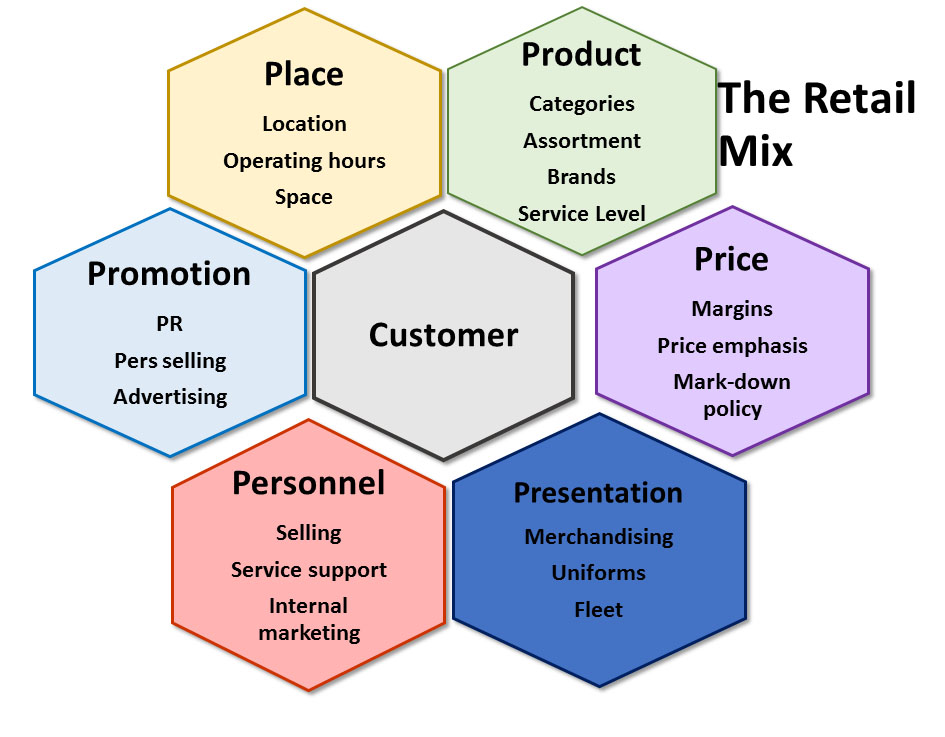
Once the strategic plan is in place, retail managers turn to the more managerial aspects of planning. A retail mix is devised for the purpose of coordinating day-to-day tactical decisions. The retail marketing mix typically consists of six broad decision layers including product decisions, place decisions, promotion, price, personnel and presentation (also known as physical evidence). The retail mix is loosely based on the marketing mix, but has been expanded and modified in line with the unique needs of the retail context. A number of scholars have argued for an expanded marketing, mix with the inclusion of two new Ps, namely, Personnel and Presentation since these contribute to the customer's unique retail experience and are the principal basis for retail differentiation. Yet other scholars argue that the Retail Format (i.e. retail formula) should be included. The modified retail marketing mix that is most commonly cited in textbooks is often called the 6 Ps of retailing (see diagram at right).
The primary product-related decisions facing the retailer are the product assortment (what product lines, how many lines and which brands to carry); the type of customer service (high contact through to self-service) and the availability of support services (e.g. credit terms, delivery services, after sales care). These decisions depend on careful analysis of the market, demand, competition as well as the retailer's skills and expertise.
The term product assortment refers to the combination of both product breadth and depth. The main characteristics of a company's product assortment are:
For a retailer, finding the right balance between breadth and depth can be a key to success. An average supermarket might carry 30,000–60,000 different product lines (product length or assortment), but might carry up to 100 different types of toothpaste (product depth). Speciality retailers typically carry fewer product lines, perhaps as few as 20 lines, but will normally stock greater depth. Costco, for example, carries 5,000 different lines while Aldi carries just 1,400 lines per store.
Large assortments offer consumers many benefits, notably increased choice and the possibility that the consumer will be able to locate the ideal product. However, for the retailer, larger assortments incur costs in terms of record-keeping, managing inventory, pricing and risks associated with wastage due to spoiled, shopworn or unsold stock. Carrying more stock also exposes the retailer to higher risks in terms of slow-moving stock and lower sales per square foot of store space. On the other hand, reducing the number of product lines can generate cost savings through increased stock turnover by eliminating slow-moving lines, fewer stockouts, increased bargaining power with suppliers, reduced costs associated with wastage and carrying inventory, and higher sales per square foot which means more efficient space utilisation.
When determining the number of product lines to carry, the retailer must consider the store type, store's physical storage capacity, the perishability of items, expected turnover rates for each line and the customer's needs and expectations.
Customer service is the "sum of acts and elements that allow consumers to receive what they need or desire from [the] retail establishment." Retailers must decide whether to provide a full service outlet or minimal service outlet, such as no-service in the case of vending machines; self-service with only basic sales assistance or a full service operation as in many boutiques and speciality stores. In addition, the retailer needs to make decisions about sales support such as customer delivery and after sales customer care.
Retail marketing
Once the strategic plan is in place, retail managers turn to the more managerial aspects of planning. A retail mix is devised for the purpose of coordinating day-to-day tactical decisions. The retail marketing mix typically consists of six broad decision layers including product decisions, place decisions, promotion, price, personnel and presentation (also known as physical evidence). The retail mix is loosely based on the marketing mix, but has been expanded and modified in line with the unique needs of the retail context. A number of scholars have argued for an expanded marketing, mix with the inclusion of two new Ps, namely, Personnel and Presentation since these contribute to the customer's unique retail experience and are the principal basis for retail differentiation. Yet other scholars argue that the Retail Format (i.e. retail formula) should be included. The modified retail marketing mix that is most commonly cited in textbooks is often called the 6 Ps of retailing (see diagram at right).
The primary product-related decisions facing the retailer are the product assortment (what product lines, how many lines and which brands to carry); the type of customer service (high contact through to self-service) and the availability of support services (e.g. credit terms, delivery services, after sales care). These decisions depend on careful analysis of the market, demand, competition as well as the retailer's skills and expertise.
The term product assortment refers to the combination of both product breadth and depth. The main characteristics of a company's product assortment are:
For a retailer, finding the right balance between breadth and depth can be a key to success. An average supermarket might carry 30,000–60,000 different product lines (product length or assortment), but might carry up to 100 different types of toothpaste (product depth). Speciality retailers typically carry fewer product lines, perhaps as few as 20 lines, but will normally stock greater depth. Costco, for example, carries 5,000 different lines while Aldi carries just 1,400 lines per store.
Large assortments offer consumers many benefits, notably increased choice and the possibility that the consumer will be able to locate the ideal product. However, for the retailer, larger assortments incur costs in terms of record-keeping, managing inventory, pricing and risks associated with wastage due to spoiled, shopworn or unsold stock. Carrying more stock also exposes the retailer to higher risks in terms of slow-moving stock and lower sales per square foot of store space. On the other hand, reducing the number of product lines can generate cost savings through increased stock turnover by eliminating slow-moving lines, fewer stockouts, increased bargaining power with suppliers, reduced costs associated with wastage and carrying inventory, and higher sales per square foot which means more efficient space utilisation.
When determining the number of product lines to carry, the retailer must consider the store type, store's physical storage capacity, the perishability of items, expected turnover rates for each line and the customer's needs and expectations.
Customer service is the "sum of acts and elements that allow consumers to receive what they need or desire from [the] retail establishment." Retailers must decide whether to provide a full service outlet or minimal service outlet, such as no-service in the case of vending machines; self-service with only basic sales assistance or a full service operation as in many boutiques and speciality stores. In addition, the retailer needs to make decisions about sales support such as customer delivery and after sales customer care.
Recent media
Recent media