


Community hub
Recent from talks
Contribute something to knowledge base
Content stats: 0 posts, 0 articles, 1 media, 0 notes
Members stats: 0 subscribers, 0 contributors, 0 moderators, 0 supporters
Subscribers
Supporters
Contributors
Moderators
Hub AI
Retrorocket AI simulator
(@Retrorocket_simulator)
Hub AI
Retrorocket AI simulator
(@Retrorocket_simulator)
Retrorocket
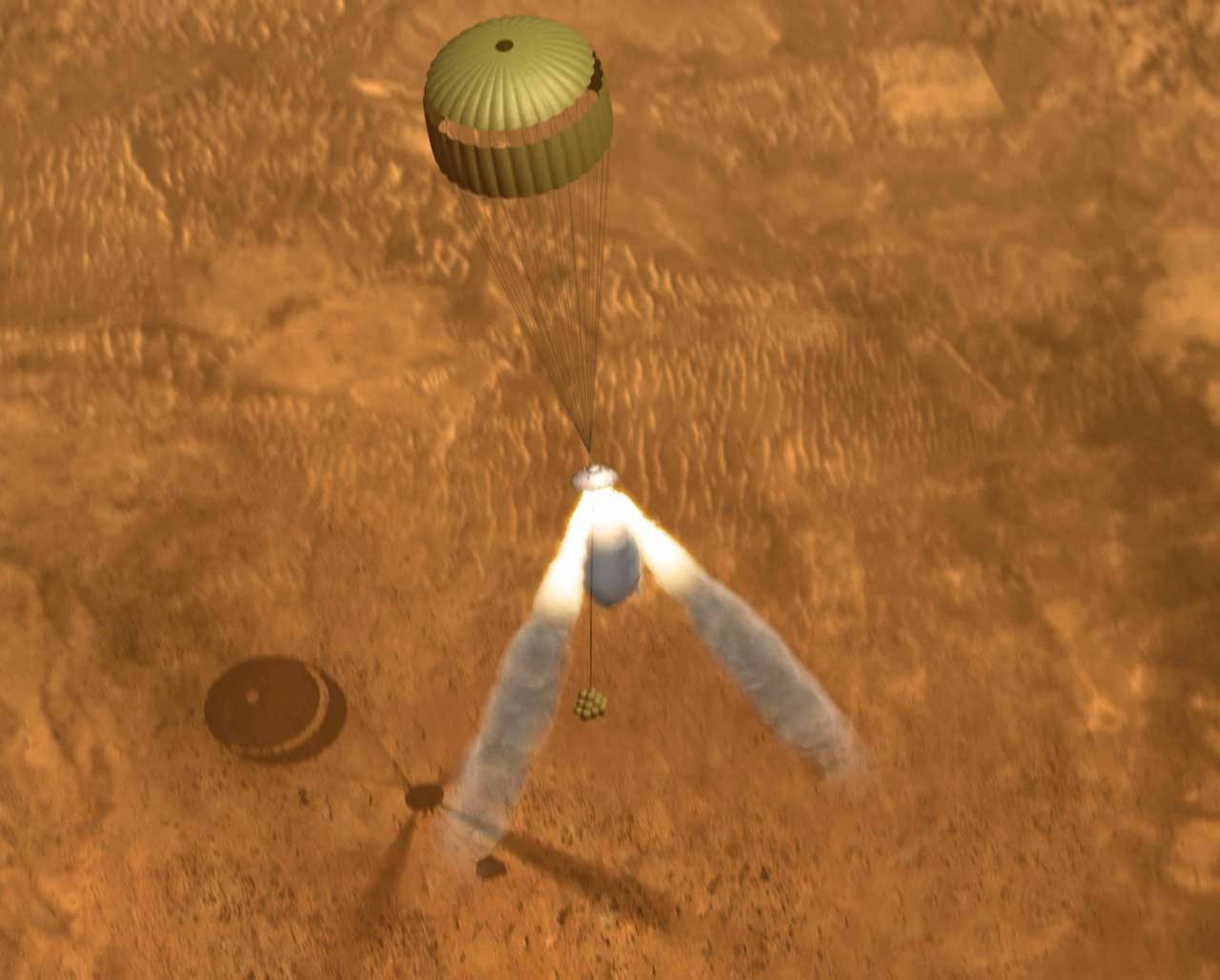
A retrorocket (short for retrograde rocket) is a rocket engine providing thrust opposing the motion of a vehicle, thereby causing it to decelerate. They have mostly been used in spacecraft, with more limited use in short-runway aircraft landing. New uses are emerging since 2010 for retro-thrust rockets in reusable launch systems.
Rockets were fitted to the nose of some models of the DFS 230, a World War II German Military glider. This enabled the aircraft to land in more confined areas than would otherwise be possible during an airborne assault.
Another World War II development was the British Hajile project, initiated by the British Admiralty's Directorate of Miscellaneous Weapons Development. Originally a request from the British Army as a method to drop heavy equipment or vehicles from aircraft flying at high speeds and altitudes, the project turned out to be a disaster and was largely forgotten after the war. Although some of the tests turned out to be successful, Hajile was too unpredictable to be used in conventional warfare, and by the time the war drew to a close, with no chance to put the project into action, it was shelved. Later Soviet experiments used this technique, braking large air-dropped cargos after a parachute descent.
When a spacecraft in orbit is slowed sufficiently, its altitude decreases to the point at which aerodynamic forces begin to rapidly slow the motion of the vehicle, and it returns to the ground. Without retrorockets, spacecraft would remain in orbit until their orbits naturally slow, and reenter the atmosphere at a much later date; in the case of crewed flights, long after life support systems have been expended. Therefore, it is critical that spacecraft have extremely reliable retrorockets.
Due to the high reliability demanded by de-orbiting retrorockets, Mercury spacecraft used a trio of solid fuel, 1000 lbf (4.5 kN) thrust retrorockets that fired for 10 seconds each, strapped to the heat shield on the bottom of the spacecraft. One was sufficient to return the spacecraft to Earth if the other two failed.
Gemini used four rockets, each 2,500 pounds-force (11 kN), burning for 5.5 seconds in sequence, with a slight overlap. These were mounted in the retrograde section of the adapter module, located just behind the capsule's heat shield.
For lunar flights, the Apollo command and service module did not require retrorockets to return the command module to Earth, as the flight path took the module through the atmosphere, using atmospheric drag to reduce velocity. The test flights in Earth orbit required retrograde propulsion, which was provided by the large Service Propulsion Engine on the service module. The same engine was used as a retrorocket to slow the spacecraft for lunar orbit insertion. The Apollo Lunar Module used its descent stage engine to drop from orbit and land on the Moon.
The Space Shuttle Orbital Maneuvering System provided the vehicle with a pair of powerful liquid-fueled rockets for both reentry and orbital maneuvering. One was sufficient for a successful reentry, and if both systems were to fail, the reaction control system could slow the vehicle enough for reentry.
Retrorocket
A retrorocket (short for retrograde rocket) is a rocket engine providing thrust opposing the motion of a vehicle, thereby causing it to decelerate. They have mostly been used in spacecraft, with more limited use in short-runway aircraft landing. New uses are emerging since 2010 for retro-thrust rockets in reusable launch systems.
Rockets were fitted to the nose of some models of the DFS 230, a World War II German Military glider. This enabled the aircraft to land in more confined areas than would otherwise be possible during an airborne assault.
Another World War II development was the British Hajile project, initiated by the British Admiralty's Directorate of Miscellaneous Weapons Development. Originally a request from the British Army as a method to drop heavy equipment or vehicles from aircraft flying at high speeds and altitudes, the project turned out to be a disaster and was largely forgotten after the war. Although some of the tests turned out to be successful, Hajile was too unpredictable to be used in conventional warfare, and by the time the war drew to a close, with no chance to put the project into action, it was shelved. Later Soviet experiments used this technique, braking large air-dropped cargos after a parachute descent.
When a spacecraft in orbit is slowed sufficiently, its altitude decreases to the point at which aerodynamic forces begin to rapidly slow the motion of the vehicle, and it returns to the ground. Without retrorockets, spacecraft would remain in orbit until their orbits naturally slow, and reenter the atmosphere at a much later date; in the case of crewed flights, long after life support systems have been expended. Therefore, it is critical that spacecraft have extremely reliable retrorockets.
Due to the high reliability demanded by de-orbiting retrorockets, Mercury spacecraft used a trio of solid fuel, 1000 lbf (4.5 kN) thrust retrorockets that fired for 10 seconds each, strapped to the heat shield on the bottom of the spacecraft. One was sufficient to return the spacecraft to Earth if the other two failed.
Gemini used four rockets, each 2,500 pounds-force (11 kN), burning for 5.5 seconds in sequence, with a slight overlap. These were mounted in the retrograde section of the adapter module, located just behind the capsule's heat shield.
For lunar flights, the Apollo command and service module did not require retrorockets to return the command module to Earth, as the flight path took the module through the atmosphere, using atmospheric drag to reduce velocity. The test flights in Earth orbit required retrograde propulsion, which was provided by the large Service Propulsion Engine on the service module. The same engine was used as a retrorocket to slow the spacecraft for lunar orbit insertion. The Apollo Lunar Module used its descent stage engine to drop from orbit and land on the Moon.
The Space Shuttle Orbital Maneuvering System provided the vehicle with a pair of powerful liquid-fueled rockets for both reentry and orbital maneuvering. One was sufficient for a successful reentry, and if both systems were to fail, the reaction control system could slow the vehicle enough for reentry.
Recent media
Recent media