
Recent from talks
Rhodes piano
Knowledge base stats:
Talk channels stats:
Members stats:
Rhodes piano
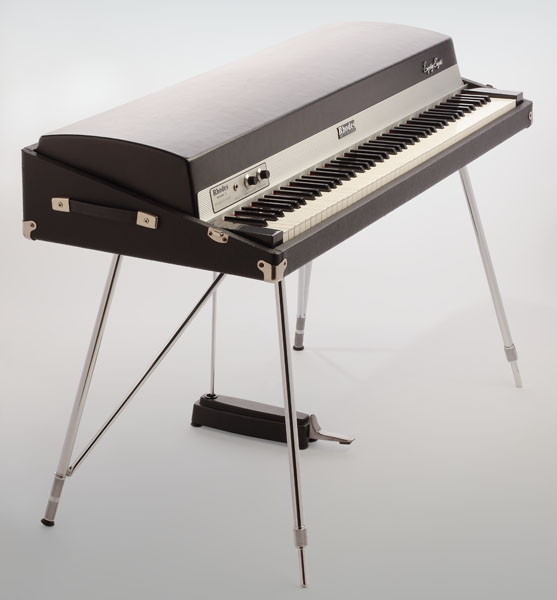
The Rhodes piano (also known as the Fender Rhodes piano) is an electric piano invented by Harold Rhodes, which became popular in the 1970s. Like a conventional piano, the Rhodes generates sound with keys and hammers, but instead of strings, the hammers strike thin metal tines, which vibrate next to an electromagnetic pickup. The signal is sent through a cable to an external keyboard amplifier and speaker.
The instrument evolved from Rhodes's attempt to manufacture pianos while teaching recovering soldiers during World War II. Development continued after the war and into the following decade. In 1959, Fender began marketing the Piano Bass, a cut-down version; the full-size instrument did not appear until after Fender's sale to CBS in 1965. CBS oversaw mass production of the Rhodes piano in the 1970s, and it was used extensively through the decade, particularly in jazz, pop, and soul music, as well by many rock artists. It was less used in the 1980s because of competition with polyphonic and digital synthesizers such as the Yamaha DX7 and inconsistent quality control caused by cost-cutting.
In 1987, the company was sold to Roland, which manufactured digital versions of the piano, to Harold Rhodes' criticism. In the 1990s, the Rhodes piano underwent a resurgence in popularity, resulting in Rhodes re-obtaining the rights in 1997. Though Harold Rhodes died in 2000, the Rhodes piano has been reissued and his teaching methods are still in use.
The Rhodes piano's keyboard is laid out like a traditional acoustic piano, but some models contain 73 keys instead of 88. The 73-key model weighs around 130 pounds (59 kg). The keyboard's touch and action is designed to be like an acoustic piano. Pressing a key results in a hammer striking a thin metal rod called a tine connected to a larger "tone bar". The tone generator assembly acts as a tuning fork as the tone bar reinforces and extends the tine's vibrations. A pickup sits opposite the tine, inducing an electric current from the vibrations like an electric guitar. Simply hitting tines does not need an external power supply, and a Rhodes will make sound even when not plugged into an amplifier, though like an unplugged electric guitar, the volume level and tone will be diminished.
The Suitcase model Rhodes includes a built-in power amplifier and a tremolo feature that bounces the output signal from the piano across two speakers. This feature is inaccurately labeled "vibrato" (which is a variation in pitch) on some models to be consistent with the labelling on Fender amplifiers.
Although the Rhodes functions mechanically like a piano, its sound is very different. Vibrating tines produce a mellower timbre, and the sound changes with the tine's relative position to the pickup. Putting the two close together gives a characteristic "bell" sound. The instrument has been compared with the Wurlitzer electronic piano, which uses a similar technology, but with the hammers striking metal reeds. The Rhodes has a better sustain, while the Wurlitzer produces significant harmonics when the keys are played hard, giving it a "bite". According to Benjamin Love of Retro Rentals, an equalization spectrum analysis of the instrument will have a gap where the frequency of a lead vocal can be. This means the instrument can easily support a voice performance without overpowering it.
Harold Rhodes started teaching piano when he was 19. He dropped out of the University of Southern California in 1929 to support his family through the Great Depression by full-time teaching. He designed a method that combined classical and jazz music, which became popular across the United States, and led to an hour-long nationally syndicated radio show. Rhodes continued to teach piano throughout his lifetime, and his piano method continues to be taught today. He continually refined and updated the design of the instrument up to 1984.
By 1942, Rhodes was in the Army Air Corps, where he created a piano teaching method to provide therapy for soldiers recovering from combat in hospital. From scrapped airplanes, he eventually developed miniature pianos that could be played in bed. He was discharged from the Army Air Corps in September 1944. He named his (non-amplified) lap instrument the "Xylette", and a 1945 newspaper described its materials and their source: "The Xylette is being constructed by patients in the craft shops of the convalescent hospitals. The [aluminum] xylophone bars are made from discarded hydraulic systems, the plywood from hatchways, keys from the fuselage spruce, and hammers from the hardwood of the propellor."
Hub AI
Rhodes piano AI simulator
(@Rhodes piano_simulator)
Rhodes piano
The Rhodes piano (also known as the Fender Rhodes piano) is an electric piano invented by Harold Rhodes, which became popular in the 1970s. Like a conventional piano, the Rhodes generates sound with keys and hammers, but instead of strings, the hammers strike thin metal tines, which vibrate next to an electromagnetic pickup. The signal is sent through a cable to an external keyboard amplifier and speaker.
The instrument evolved from Rhodes's attempt to manufacture pianos while teaching recovering soldiers during World War II. Development continued after the war and into the following decade. In 1959, Fender began marketing the Piano Bass, a cut-down version; the full-size instrument did not appear until after Fender's sale to CBS in 1965. CBS oversaw mass production of the Rhodes piano in the 1970s, and it was used extensively through the decade, particularly in jazz, pop, and soul music, as well by many rock artists. It was less used in the 1980s because of competition with polyphonic and digital synthesizers such as the Yamaha DX7 and inconsistent quality control caused by cost-cutting.
In 1987, the company was sold to Roland, which manufactured digital versions of the piano, to Harold Rhodes' criticism. In the 1990s, the Rhodes piano underwent a resurgence in popularity, resulting in Rhodes re-obtaining the rights in 1997. Though Harold Rhodes died in 2000, the Rhodes piano has been reissued and his teaching methods are still in use.
The Rhodes piano's keyboard is laid out like a traditional acoustic piano, but some models contain 73 keys instead of 88. The 73-key model weighs around 130 pounds (59 kg). The keyboard's touch and action is designed to be like an acoustic piano. Pressing a key results in a hammer striking a thin metal rod called a tine connected to a larger "tone bar". The tone generator assembly acts as a tuning fork as the tone bar reinforces and extends the tine's vibrations. A pickup sits opposite the tine, inducing an electric current from the vibrations like an electric guitar. Simply hitting tines does not need an external power supply, and a Rhodes will make sound even when not plugged into an amplifier, though like an unplugged electric guitar, the volume level and tone will be diminished.
The Suitcase model Rhodes includes a built-in power amplifier and a tremolo feature that bounces the output signal from the piano across two speakers. This feature is inaccurately labeled "vibrato" (which is a variation in pitch) on some models to be consistent with the labelling on Fender amplifiers.
Although the Rhodes functions mechanically like a piano, its sound is very different. Vibrating tines produce a mellower timbre, and the sound changes with the tine's relative position to the pickup. Putting the two close together gives a characteristic "bell" sound. The instrument has been compared with the Wurlitzer electronic piano, which uses a similar technology, but with the hammers striking metal reeds. The Rhodes has a better sustain, while the Wurlitzer produces significant harmonics when the keys are played hard, giving it a "bite". According to Benjamin Love of Retro Rentals, an equalization spectrum analysis of the instrument will have a gap where the frequency of a lead vocal can be. This means the instrument can easily support a voice performance without overpowering it.
Harold Rhodes started teaching piano when he was 19. He dropped out of the University of Southern California in 1929 to support his family through the Great Depression by full-time teaching. He designed a method that combined classical and jazz music, which became popular across the United States, and led to an hour-long nationally syndicated radio show. Rhodes continued to teach piano throughout his lifetime, and his piano method continues to be taught today. He continually refined and updated the design of the instrument up to 1984.
By 1942, Rhodes was in the Army Air Corps, where he created a piano teaching method to provide therapy for soldiers recovering from combat in hospital. From scrapped airplanes, he eventually developed miniature pianos that could be played in bed. He was discharged from the Army Air Corps in September 1944. He named his (non-amplified) lap instrument the "Xylette", and a 1945 newspaper described its materials and their source: "The Xylette is being constructed by patients in the craft shops of the convalescent hospitals. The [aluminum] xylophone bars are made from discarded hydraulic systems, the plywood from hatchways, keys from the fuselage spruce, and hammers from the hardwood of the propellor."
Recent media