



Community hub
Recent from talks
Contribute something to knowledge base
Content stats: 0 posts, 0 articles, 1 media, 0 notes
Members stats: 0 subscribers, 0 contributors, 0 moderators, 0 supporters
Subscribers
Supporters
Contributors
Moderators
Hub AI
Pink-headed duck AI simulator
(@Pink-headed duck_simulator)
Hub AI
Pink-headed duck AI simulator
(@Pink-headed duck_simulator)
Pink-headed duck
The pink-headed duck (Rhodonessa caryophyllacea) is an probable extinct species of large diving duck that was once found in parts of the Gangetic plains of India, Nepal, parts of Maharashtra, Bangladesh and in the riverine swamps of Myanmar but has been feared extinct since the 1950s. Numerous searches have failed to provide any proof of continued existence. It has been suggested that it may exist in the inaccessible swamp regions of northern Myanmar and some sight reports from that region have led to its status being declared as "Critically Endangered" rather than extinct. The genus placement has been disputed and while some have suggested that it is close to the red-crested pochard (Netta rufina), others have placed it in a separate genus of its own. It is unique in the pink colouration of the head combined with a dark body. A prominent wing patch and the long slender neck are features shared with the common Indian spot-billed duck. The eggs have also been held as particularly peculiar in being nearly spherical.
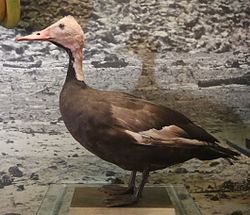
The male pink-headed duck is unmistakable when a good view is had. Both sexes are 41–43 cm and long-billed with long necks and peaked heads. The male has a pink bill, head and neck while the female has a pale pinkish head and neck with a paler bill. The black of the body extends as a narrow strip on the front of the neck. Wings have a leading white edge. In flight it would not contrast as much as the syntopic white-winged duck. Wing does not have the dark trailing edge of the red-crested pochard. Confusion with male red-crested pochards stems mainly from observations of swimming birds, as the latter species also has a conspicuous red head (although the color is actually very different from the pink-headed duck). Indian spot-billed ducks, on the other hand, can look similar to female pink-headed ducks when in flight and seen from a distance, and if seen from behind, they could be mistaken for males too. The upper side of the wing is distinguishing, with dark green secondaries (speculum) and prominent white tertiaries in the spot-billed duck and a pinkish-beige speculum, much lighter than its surroundings, in the pink-headed duck. If the upper part of the wings cannot be reliably seen, they are all but indistinguishable except to expert observers in good visibility conditions. Young birds had a nearly whitish head without a trace of pink and a mellow two note call wugh-ah has been attributed to the species.
Its breeding habitat is lowland marshes and pools in tall-grass jungle. The nest is built amongst grass. The eggs, six or seven in a clutch, are very spherical and creamy white. The eggs measure 1.71 to 1.82 inches long and 1.61 to 1.7 inches wide. They were believed to have been non-migratory and found singly or in pairs and very rarely in small groups. Pink-headed ducks are believed to have eaten water plants and molluscs. Like Netta species, they typically up-ended or dabbled for food and did not dive like a pochard.
Allan Octavian Hume and Stuart Baker noted that the stronghold of the species was north of the Ganges and west of the Brahmaputra, mainly in Maldah, Purnea, Madhubani and Purulia districts of present-day Bihar. It was said to be commoner in Singhbum. Hume collected a specimen in Manipur which he noted was very rare, hiding among dense reeds in Loktak Lake. Edward Blyth claimed that it was found in the Rakhine state of Burma. Brian Houghton Hodgson obtained specimens from Nepal. A few records were also noted from Delhi, Sindh and Punjab. The populations (possibly) undertook local seasonal movements, resulting in scattered historic records as far as Punjab, Maharashtra and Andhra Pradesh. Thus, resulting in rare sightings of the species in Maharashtra. Birds were also reported from the Oudh region some from very close to Lucknow. Specimens were shot at Najafgarh lake in the Delhi district. Jerdon obtained specimens of the bird from further south although he did not personally observe any in the wild until he visited Bengal.
The pink-headed duck was described by John Latham in 1790 under the genus Anas. In describing the species, it is possible that he made of use of a painting in the collection of Lady Impey, wife of Sir Elijah Impey who was Chief Justice of court in Calcutta from 1774 to 1783. Mary Impey maintained a menagerie in Calcutta and commissioned Indian artists such as Bhawani Das from Patna to illustrate animals in the collection. The Impeys moved to England, and after the death of her husband, she sold these paintings at auction in 1810. Some of them were acquired by the 13th Earl of Derby.
The genus Rhodonessa was originally created for this species alone. Jean Delacour and Ernst Mayr, in their 1945 revision of the family Anatidae considered it a somewhat abnormal member of the Anatini (or river-ducks) group because the hind toe is slightly lobed, display behaviour and the tendency to feed at the surface. The birds were observed in European aviaries and although they never bred, the males displayed often and this involved puffing the neck feathers, lowering the neck to rest on the back and then stretching up the neck while producing a wheezy whistle like a mallard. A study of its tracheal anatomy by Alfred Henry Garrod in 1875 suggested that it had a "slight fusiform dilatation" in the anterior syringeal region. The "bulba ossea" at the lower part of the male syrinx is peculiar in being swollen. The colour pattern has also been considered unique, lacking any of the metallic colours on the secondaries that are characteristic of the Anatini. The other unique feature being the somewhat large and nearly spherical shape of the eggs. All of these features supporting the retention of the species in a separate genus. Such mid-tracheal swellings were found only in Mergini and Aythyini and is extremely rare in the genus Anas. This tracheal bulla is rounded in Anas but angular with fenestrae in Netta and Aythya. Johnsgard considered Marmaronetta and Rhodonessa as intermediate in form. Based on the available morphological and behavioural evidence, especially the structure of the humerus and the structure of tracheal rings, Sidney Dillon Ripley suggested that it was undoubtedly in the Aythyini.
A study found that Rhodonessa was closely allied to the red-crested pochard (Netta rufina) suggesting that the two species be placed in the same genus. Rhodonessa was described prior to Netta which would then make Rhodonessa rufina the name of choice, however these changes have not been widely accepted. The pink colour is derived from a carotenoid pigment which is unusual among ducks and known only from a few other species such as the pink-eared duck which are not closely related.
This duck formerly occurred in eastern India, Nepal, Bangladesh and northern Myanmar, but is now probably extinct. It was always rare, and the last confirmed sighting, by C. M. Inglis, was from Bhagownie, Darbhangha District, in June 1935, with reports from India persisting until the early 1960s. These include reports from Monghyr and from near Shimla. Sidney Dillon Ripley considered it likely extinct in 1950.
Pink-headed duck
The pink-headed duck (Rhodonessa caryophyllacea) is an probable extinct species of large diving duck that was once found in parts of the Gangetic plains of India, Nepal, parts of Maharashtra, Bangladesh and in the riverine swamps of Myanmar but has been feared extinct since the 1950s. Numerous searches have failed to provide any proof of continued existence. It has been suggested that it may exist in the inaccessible swamp regions of northern Myanmar and some sight reports from that region have led to its status being declared as "Critically Endangered" rather than extinct. The genus placement has been disputed and while some have suggested that it is close to the red-crested pochard (Netta rufina), others have placed it in a separate genus of its own. It is unique in the pink colouration of the head combined with a dark body. A prominent wing patch and the long slender neck are features shared with the common Indian spot-billed duck. The eggs have also been held as particularly peculiar in being nearly spherical.
The male pink-headed duck is unmistakable when a good view is had. Both sexes are 41–43 cm and long-billed with long necks and peaked heads. The male has a pink bill, head and neck while the female has a pale pinkish head and neck with a paler bill. The black of the body extends as a narrow strip on the front of the neck. Wings have a leading white edge. In flight it would not contrast as much as the syntopic white-winged duck. Wing does not have the dark trailing edge of the red-crested pochard. Confusion with male red-crested pochards stems mainly from observations of swimming birds, as the latter species also has a conspicuous red head (although the color is actually very different from the pink-headed duck). Indian spot-billed ducks, on the other hand, can look similar to female pink-headed ducks when in flight and seen from a distance, and if seen from behind, they could be mistaken for males too. The upper side of the wing is distinguishing, with dark green secondaries (speculum) and prominent white tertiaries in the spot-billed duck and a pinkish-beige speculum, much lighter than its surroundings, in the pink-headed duck. If the upper part of the wings cannot be reliably seen, they are all but indistinguishable except to expert observers in good visibility conditions. Young birds had a nearly whitish head without a trace of pink and a mellow two note call wugh-ah has been attributed to the species.
Its breeding habitat is lowland marshes and pools in tall-grass jungle. The nest is built amongst grass. The eggs, six or seven in a clutch, are very spherical and creamy white. The eggs measure 1.71 to 1.82 inches long and 1.61 to 1.7 inches wide. They were believed to have been non-migratory and found singly or in pairs and very rarely in small groups. Pink-headed ducks are believed to have eaten water plants and molluscs. Like Netta species, they typically up-ended or dabbled for food and did not dive like a pochard.
Allan Octavian Hume and Stuart Baker noted that the stronghold of the species was north of the Ganges and west of the Brahmaputra, mainly in Maldah, Purnea, Madhubani and Purulia districts of present-day Bihar. It was said to be commoner in Singhbum. Hume collected a specimen in Manipur which he noted was very rare, hiding among dense reeds in Loktak Lake. Edward Blyth claimed that it was found in the Rakhine state of Burma. Brian Houghton Hodgson obtained specimens from Nepal. A few records were also noted from Delhi, Sindh and Punjab. The populations (possibly) undertook local seasonal movements, resulting in scattered historic records as far as Punjab, Maharashtra and Andhra Pradesh. Thus, resulting in rare sightings of the species in Maharashtra. Birds were also reported from the Oudh region some from very close to Lucknow. Specimens were shot at Najafgarh lake in the Delhi district. Jerdon obtained specimens of the bird from further south although he did not personally observe any in the wild until he visited Bengal.
The pink-headed duck was described by John Latham in 1790 under the genus Anas. In describing the species, it is possible that he made of use of a painting in the collection of Lady Impey, wife of Sir Elijah Impey who was Chief Justice of court in Calcutta from 1774 to 1783. Mary Impey maintained a menagerie in Calcutta and commissioned Indian artists such as Bhawani Das from Patna to illustrate animals in the collection. The Impeys moved to England, and after the death of her husband, she sold these paintings at auction in 1810. Some of them were acquired by the 13th Earl of Derby.
The genus Rhodonessa was originally created for this species alone. Jean Delacour and Ernst Mayr, in their 1945 revision of the family Anatidae considered it a somewhat abnormal member of the Anatini (or river-ducks) group because the hind toe is slightly lobed, display behaviour and the tendency to feed at the surface. The birds were observed in European aviaries and although they never bred, the males displayed often and this involved puffing the neck feathers, lowering the neck to rest on the back and then stretching up the neck while producing a wheezy whistle like a mallard. A study of its tracheal anatomy by Alfred Henry Garrod in 1875 suggested that it had a "slight fusiform dilatation" in the anterior syringeal region. The "bulba ossea" at the lower part of the male syrinx is peculiar in being swollen. The colour pattern has also been considered unique, lacking any of the metallic colours on the secondaries that are characteristic of the Anatini. The other unique feature being the somewhat large and nearly spherical shape of the eggs. All of these features supporting the retention of the species in a separate genus. Such mid-tracheal swellings were found only in Mergini and Aythyini and is extremely rare in the genus Anas. This tracheal bulla is rounded in Anas but angular with fenestrae in Netta and Aythya. Johnsgard considered Marmaronetta and Rhodonessa as intermediate in form. Based on the available morphological and behavioural evidence, especially the structure of the humerus and the structure of tracheal rings, Sidney Dillon Ripley suggested that it was undoubtedly in the Aythyini.
A study found that Rhodonessa was closely allied to the red-crested pochard (Netta rufina) suggesting that the two species be placed in the same genus. Rhodonessa was described prior to Netta which would then make Rhodonessa rufina the name of choice, however these changes have not been widely accepted. The pink colour is derived from a carotenoid pigment which is unusual among ducks and known only from a few other species such as the pink-eared duck which are not closely related.
This duck formerly occurred in eastern India, Nepal, Bangladesh and northern Myanmar, but is now probably extinct. It was always rare, and the last confirmed sighting, by C. M. Inglis, was from Bhagownie, Darbhangha District, in June 1935, with reports from India persisting until the early 1960s. These include reports from Monghyr and from near Shimla. Sidney Dillon Ripley considered it likely extinct in 1950.
Recent media
Recent media