
_Barnegat_Inlet,_New_Jersey,_USA.jpg/250px-Drake_Greater_scaup_(Aythya_marila)_Barnegat_Inlet,_New_Jersey,_USA.jpg)


_Barnegat_Inlet,_New_Jersey,_USA.jpg/2000px-Drake_Greater_scaup_(Aythya_marila)_Barnegat_Inlet,_New_Jersey,_USA.jpg)
Community hub
Recent from talks
Contribute something
Nothing was collected or created yet.
Aythya
View on Wikipedia
| Aythya | |
|---|---|
_Barnegat_Inlet,_New_Jersey,_USA.jpg)
| |
| Greater scaup (Aythya marila), the type species of Aythya | |
Scientific classification 
| |
| Kingdom: | Animalia |
| Phylum: | Chordata |
| Class: | Aves |
| Order: | Anseriformes |
| Family: | Anatidae |
| Tribe: | Aythyini |
| Genus: | Aythya F. Boie, 1822 |
| Type species | |
| Anas marila[1] Linnaeus, 1761
| |
| Species | |
|
12 species, see text | |
Aythya is a genus of diving ducks, with twelve species currently accepted.[2] The genus was described in 1822 by the German zoologist Friedrich Boie, with the type species being greater scaup.[3][4] The name Aythya comes from the Ancient Greek word αἴθυιᾰ (aithuia), which referred to an unknown diving-bird.[5][6]
_(53667828962).jpg)
The species are plump, compact, medium-sized ducks ranging from 37–61 cm long, 60–84 cm wingspan, and weighing 410–1600 g, with canvasback the largest, and ring-necked duck and ferruginous duck marginally the smallest. The body plumage is variably white, grey, red-brown, or black, often with a finely vermiculated pattern; in several species, the flanks are white or pale grey, the back darker grey to black, and the breast and tail black. The heads are strongly coloured in the males, orange-red in some species, and black with a green to purple sheen (structural colour) in good light; the sheen colour varies with both species and angle of light incidence – in for example greater scaup, the head has a green sheen in direct light, but a purple sheen when backlit. In females, the heads are browner, sometimes with white patterning on the face. The eye colour is also variable in males, from white in ferruginous duck (leading to its archaic name of "white-eyed pochard"), through yellow in most species, to deep red in common pochard and canvasback; in females, the eye is brown in all species. The bills are short, fairly broad, and pale blue-grey to black, usually with a small black 'nail' at the tip; the pattern of blue-grey and black is important in species identification. In flight, the wings are dark grey to black, with a white to pale grey wingbar along the primary and secondary feathers; the pattern of the wingbar (whether all-white, or all-grey, or white on the secondaries and grey on the primaries) is an important identification feature. The webbed feet, used for propulsion in both swimming and diving, are 5–7 cm long, large for the size of the birds, and dark grey to blackish in all the species.[7][8]
The species occur throughout Asia, Europe, North America, Australia, New Zealand, and Madagascar, and also in the northern half of Africa primarily in winter. Small numbers also reach the far north of South America in winter. In the breeding season, they are restricted to well-vegetated freshwater lakes, while in the winter they use both freshwater lakes and sheltered saltwater bays and inlets.[7]
Aythya species
[edit]The genus contains 12 species; all are monotypic except for A. marila, which has two subspecies in the Old and New Worlds, respectively.[2]
| Male | Female | Scientific name | Common name | Distribution | Conservation status |
|---|---|---|---|---|---|
_-_Aythya_valisineria,_Oakley_Street,_Cambridge,_Maryland.jpg) |
 |
A. valisineria | Canvasback | North America | least concern |
 |
 |
A. ferina | Common pochard | Northern Europe into Asia | vulnerable |
 |
 |
A. americana | Redhead | North America, from northern Canada to the lower United States | least concern |
 |
 |
A. collaris | Ring-necked duck | North America, from Alaska and northern Canada to the central United States, wintering south to the Caribbean; occasional visitor to Western Europe | least concern |
 |
 |
A. australis | Hardhead | Australia; occasional visitor to New Guinea, New Zealand, and Vanuatu in the Pacific | least concern |
 |
 |
A. baeri | Baer's pochard | Southeastern Russia and northeastern China, migrating in winter to southern China, Vietnam, Japan, and India | critically endangered |
 |
_(49177728373).jpg) |
A. nyroca | Ferruginous duck | From the Iberian Peninsula and the Maghreb east to western Mongolia, south to Arabia | near threatened |
 |
 |
A. innotata | Madagascar pochard | Madagascar | critically endangered |
 |
_with_chicks.jpg) |
A. novaeseelandiae | New Zealand scaup | New Zealand | least concern |
_01.jpg) |
_01.jpg) |
A. fuligula | Tufted duck | Throughout temperate and northern Eurasia; occasional visitor to the United States and Canada | least concern |
 |
 |
A. marila | Greater scaup | Iceland, Northern Europe, Northern Asia except the Far East (A. m. marila); far northeastern Asia, Alaska, northern Canada (A. m. nearctica) | least concern |
.jpg) |
 |
A. affinis | Lesser scaup | Alaska through western Canada to western Montana, wintering east to the Atlantic Coast and south to Central America; occasional visitor to Western Europe | least concern |
Hybrids
[edit]
The species in the genus are all closely related, and are more prone to hybridisation than most other bird genera.[8][9] Hybrids regularly seen in Europe include tufted duck × common pochard, tufted duck × ring-necked duck, greater scaup × tufted duck, and common pochard × ferruginous duck;[8] while in North America, ring-necked duck × greater scaup, greater scaup × tufted duck, and canvasback × redhead are frequent.[10] These hybrids can often resemble, and be mistaken for, other species in the genus; for example tufted duck × common pochard hybrids are easily mistaken for lesser scaup.[8] Usually only male hybrids are evident; female hybrids are less obvious and even more difficult to identify.[8][10]
Diet
[edit]The diet, mostly obtained by diving to depths of 0.5–6 m (exceptionally 10 m), but also at times from the surface without diving, consists of a mixture of plant material (including seeds, leaves and roots of water plants) and bottom-dwelling invertebrates (including worms, molluscs, insects). In urban situations, several species have learnt to take bread or birdseed fed to ducks by people.[7][11]
Breeding
[edit]The nests are hidden in dense waterside vegetation, for preference on islets which give greater security from land predators. Incubation of the [2–]6–10[–18] eggs takes 3–4 weeks, and is done entirely by the female. The ducklings fledge at around 6–7 weeks old, and are cared for primarily by the female, though the male may assist with guarding the ducklings.[7][11] 'Dump nesting', where more than one female lays eggs in a nest, is common, and likely accounts for nests containing more than ten eggs.[11]
Prehistory
[edit]Aythya shihuibas was described from the Late Miocene of China, but probably belongs outside crown group Aythya.[12] Zelenkov (2016) transferred the species Anas denesi Kessler (2013), known from the late Miocene of Hungary, to the genus Aythya.[13] An undescribed prehistoric species is known only from Early Pleistocene fossil remains found at Dursunlu, Turkey;[14] it might however be referrable to a paleosubspecies of an extant species considering its age (see also Greater scaup). Subfossils have also been found on Réunion; this Réunion pochard awaits formal description, and may prove to have been a population of the Madagascar pochard.[15]
The Miocene "Aythya" arvernensis is now placed in Mionetta,[verification needed] while "Aythya" chauvirae seems to contain the remains of two species, at least one of which does not seem to be a diving duck.[16]
See also
[edit]Gallery
[edit]-
 Canvasback (Aythya valisineria)
 -
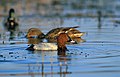 Common pochard (Aythya ferina)
 -
 Redhead (Aythya americana)
 -
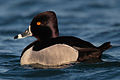 Ring-necked duck (Aythya collaris)
 -
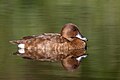 Female Hardhead (Aythya australis)
 -
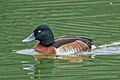 Baer's pochard (Aythya baeri)
 -
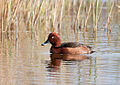 Ferruginous duck (Aythya nyroca)
 -
 Madagascar pochard (Aythya innotata)
 -
 New Zealand scaup (Aythya novaeseelandiae)
 -
 Tufted duck (Aythya fuligula)
 -
 Greater scaup (Aythya marila)
 -
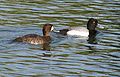 Lesser scaup (Aythya affinis)

.jpg)
.jpg)


References
[edit]- ^ "Anatidae". aviansystematics.org. The Trust for Avian Systematics. Retrieved 5 August 2023.
- ^ a b Gill, Frank; Donsker, David; Rasmussen, Pamela, eds. (January 2024). "Screamers, ducks, geese & swans". IOC World Bird List Version 14.1. International Ornithologists' Union. Retrieved 18 August 2024.
- ^ Boie, Friedrich (1822). Tagebuch gehalten auf einer Reise durch Norwegen im Jahre 1817 (in German). Schleswig. pp. 308, 351.
- ^ Mayr, Ernst; Cottrell, G. William, eds. (1979). Check-List of Birds of the World. Vol. 1 (2nd ed.). Cambridge, Massachusetts: Museum of Comparative Zoology. p. 482.
- ^ Jobling, James A. (2010). The Helm Dictionary of Scientific Bird Names. London: Christopher Helm. p. 64. ISBN 978-1-4081-2501-4.
- ^ "Henry George Liddell, Robert Scott, A Greek-English Lexicon, αἴθυια". www.perseus.tufts.edu.
- ^ a b c d Carboneras, C. (1992). "Family Anatidae (Ducks, Geese and Swans)". In del Hoyo, J.; Elliott, A.; Sargatal, J. (eds.). Handbook of the Birds of the World. Vol. 1: Ostrich to Ducks. Barcelona, Spain: Lynx Edicions. pp. 614–619. ISBN 84-87334-10-5.
- ^ a b c d e Svensson, L., Mullarney, K., & Zetterström, D. (2022) Collins Bird Guide, ed. 3. ISBN 978-0-00-854746-2, pages 30-35
- ^ Lehmhus, Jörn (2012). "Beitrag zur Identifikation von Entenhybriden der Gattung Aythya". AVES Braunschweig. 3: 33–40.
- ^ a b Sibley, David Allen (2014). The Sibley Guide to Birds. New York: Knopf. ISBN 978-0-307-95790-0.
- ^ a b c Cramp, Stanley, ed. (1977). Handbook of the Birds of Europe the Middle East and North Africa. The Birds of the Western Palearctic. Vol. I: Ostrich to Ducks. Oxford: Oxford University Press. pp. 561–593. ISBN 978-0-19-857358-6.
- ^ Stidham, Thomas (2015). "Re-description and phylogenetic assessment of the Late Miocene ducks Aythya shihuibas and Anas sp. (Aves: Anseriformes) from Lufeng, Yunnan, China". Vertebrata PalAsiatica. 53 (4): 335–349.
- ^ Nikita V. Zelenkov (2016). "РЕВИЗИЯ НЕВОРОБЬИНЫХ ПТИЦ ПОЛГАРДИ (ВЕНГРИЯ, ВЕРХНИЙ МИОЦЕН). 1. Anseriformes". Paleontological Journal. 50 (5).
- ^ Louchart, Antoine; Mourer-Chauviré, Cécile; Guleç, Erksin; Howell, Francis Clark & White, Tim D. (1998): L'avifaune de Dursunlu, Turquie, Pléistocène inférieur: climat, environnement et biogéographie. C. R. Acad. Sci. Paris IIA 327(5): 341–346. [French with English abridged version] doi:10.1016/S1251-8050(98)80053-0 (HTML abstract)
- ^ Hume, Julian, ed. (1970). "A Synopsis of the Pre-human Avifauna of the Mascarene Islands" (PDF). Paleornithological Research 2013: 195–238. Retrieved 8 February 2023.
- ^ Worthy, Trevor; Tennyson, A.J.D.; Jones, C.; McNamara, J.A. & Douglas, B.J. (2007): Miocene waterfowl and other birds from central Otago, New Zealand. J. Syst. Palaeontol. 5(1): 1–39. doi:10.1017/S1477201906001957 (HTML abstract)
Genera of waterfowl and their extinct allies | |||||||||||||||||||||||||||||||||||||||
|---|---|---|---|---|---|---|---|---|---|---|---|---|---|---|---|---|---|---|---|---|---|---|---|---|---|---|---|---|---|---|---|---|---|---|---|---|---|---|---|
| |||||||||||||||||||||||||||||||||||||||
| |||||||||||||||||||||||||||||||||||||||


Aythya
View on GrokipediaTaxonomy and Phylogeny
Etymology
The genus name Aythya derives from the Ancient Greek term aithuia (αἴθυια), which denoted an unidentified seabird, possibly a diving bird such as an auk or similar marine species, as referenced in the writings of Aristotle and other classical authors like Hesychius.[10] This linguistic root reflects early observations of diving waterfowl, aligning the name with the ecological niche of the species within the genus.[11] The genus Aythya was formally established in 1822 by the German zoologist Friedrich Boie in the journal Isis, where he classified several diving ducks previously placed in other genera.[12] Boie designated the greater scaup (Aythya marila) as the type species, serving as the nomenclatural reference for the group.[10] This establishment occurred within the framework of binomial nomenclature, pioneered by Carl Linnaeus in the 18th century, which standardized scientific naming for species and allowed for the reorganization of avian taxa into more precise genera based on shared morphological and behavioral traits.[12] Boie's contribution thus marked a key step in refining the classification of Anatidae, emphasizing diving adaptations among its members.[13]Classification
Aythya is a genus of diving ducks placed within the family Anatidae, subfamily Anatinae, and tribe Aythyini. This tribe encompasses the diving ducks, characterized by their adaptations for underwater foraging, distinguishing them from dabbling ducks in the tribe Anatini. Phylogenetic studies based on molecular data, including mitochondrial genes such as cytochrome b (Cyt b), NADH dehydrogenase 2 (ND2), and cytochrome c oxidase subunit I (COI), have confirmed the monophyly of Aythya, supporting its status as a distinct clade within Aythyini. These analyses reveal close relationships with other diving duck genera, notably Marmaronetta (marbled teal) and Netta (red-crested pochard and southern pochard), forming a sister group that diverged during the late Miocene to early Pliocene. Divergence time estimates for the Aythya lineage, derived from Bayesian analyses of concatenated mitochondrial sequences calibrated against fossil records, place its origin around 5-7 million years ago, coinciding with Plio-Pleistocene climate shifts that promoted rapid diversification in Anatidae. Taxonomic reclassifications within Aythya have refined its composition based on morphological and genetic evidence. For instance, the Madagascar pochard, originally described as Nyroca innotata in 1894, was transferred to Aythya to reflect its phylogenetic affinity with other diving ducks in the genus.[14] This adjustment aligns with broader revisions in anseriform taxonomy that emphasize monophyletic groupings supported by DNA sequence data.Species
The genus Aythya comprises 12 extant species of diving ducks, distributed across North America, Eurasia, Africa, Australasia, and oceanic islands, with most species exhibiting migratory behavior between breeding and wintering grounds.[1] These species are characterized by their diving foraging habits and rounded heads, though each has distinct morphological features such as bill shape or head adornments that aid identification. Conservation statuses vary, with several facing threats from habitat loss and hunting, leading to listings on the IUCN Red List from Least Concern to Critically Endangered.| Common Name | Scientific Name | Brief Distinguishing Traits | Distribution and Status |
|---|---|---|---|
| Canvasback | Aythya valisineria | Long, sloping bill adapted for uprooting aquatic plants; males have reddish head and black bill. | Breeds in North America (prairie potholes); winters in southern U.S. and Mexico; Least Concern. |
| Redhead | Aythya americana | Rounded head with bright reddish-brown plumage in males; grayish bill with blue-gray base. | Endemic breeder in North America (prairie wetlands); winters in southern U.S., Mexico, and Central America; Least Concern.[15] |
| Ring-necked Duck | Aythya collaris | Distinct white ring on bill and subtle chestnut neck band in males; peaked crown. | Breeds in northern North America (boreal forests); migrates to southern U.S. and Caribbean; Least Concern.[3] |
| Lesser Scaup | Aythya affinis | Small size with iridescent purple head gloss in males; black-tipped gray bill. | Widespread breeder in North America (prairies and tundra); winters in southern U.S., Mexico, and South America; Least Concern.[5] |
| Greater Scaup | Aythya marila | Larger body with green head gloss in males; broader bill than lesser scaup. | Circumpolar breeder in northern Eurasia and North America; winters in temperate coastal and inland waters; Least Concern globally, but declining in Europe.[6] |
| Common Pochard | Aythya ferina | Reddish head and black bill in males; sloping forehead. | Breeds across Eurasia (temperate wetlands); winters in southern Europe, Africa, and South Asia; Vulnerable due to population declines.[16] |
| Tufted Duck | Aythya fuligula | Long, drooping crest on male's black head; white flank stripe. | Breeds in Eurasia (lakes and rivers); winters in southern Europe, Africa, and Asia; Least Concern.[17] |
| Ferruginous Duck | Aythya nyroca | Chestnut body plumage; white eye and dark cap in both sexes. | Breeds in Europe, Asia, and Africa (shallow marshes); migratory to sub-Saharan Africa and India; Near Threatened from wetland drainage. |
| Baer's Pochard | Aythya baeri | Glossy green-black head in males; white tertials visible in flight. | Breeds in eastern Asia (Russia, China); winters in southern Asia; Critically Endangered with severe declines. |
| Madagascar Pochard | Aythya innotata | Grayish body with white undertail; males have darker head. | Endemic to Madagascar (highland lakes); long presumed extinct until rediscovered in 2006 with a small population at Lake Sofia; Critically Endangered.[18] |
| New Zealand Scaup | Aythya novaeseelandiae | Similar to greater scaup but smaller; no crest. | Endemic resident breeder in New Zealand (lakes and rivers); Least Concern. |
| Hardhead (White-eyed Duck) | Aythya australis | White eye-ring prominent in both sexes; slate-gray body. | Resident in Australia and New Zealand (inland wetlands); Least Concern. |
Fossil Record
The fossil record of the genus Aythya extends back to the Miocene, indicating an early divergence within the Anatidae family. The earliest described species is Aythya shihuibas, known from a proximal left humerus collected from the Shihuiba Formation in Lufeng, Yunnan Province, China, dated to the Late Miocene approximately 6.2–6.9 million years ago. This specimen exhibits a highly pneumatic ventral pneumotricipital fossa with bony struts, a primitive feature distinguishing it from most extant Aythya species, and phylogenetic analyses place it as a stem-group taxon outside the crown clade of modern diving ducks in the tribe Aythyini.[19] Additional extinct species from the Miocene and Pliocene further document the genus's emergence in Eurasia. Aythya denesi, described from humeral fragments at the Late Miocene site of Polgárdi, Hungary, represents an evolutionarily advanced form with proximal humerus morphology closely resembling living Aythya species, though it differs in subtle proportional details. Similarly, Aythya molesta, originally classified under Anas but reassigned based on its diving duck characteristics, is known from the Late Miocene to Early Pliocene of localities in the Czechoslovakian region, including the Šarka Formation, highlighting early diversification in Central Europe. These fossils suggest the genus originated in Eurasia before spreading, with key sites spanning from China to France (e.g., the Middle Miocene Sansan locality, where tentative Aythya material like A. chauvirae has been reported, though its generic assignment remains debated).[20] By the Pleistocene, Aythya was widespread, with abundant remains of extant species in both Eurasia and North America attesting to its established role in aquatic ecosystems. In North America, fossils of species such as the lesser scaup (A. affinis) and ring-necked duck (A. collaris) occur at sites like the Late Pleistocene deposits of Hackberry Creek, Kansas, and the Ichetucknee River, Florida, often in association with other waterfowl. Eurasian Pleistocene records, including an undescribed form from Dursunlu, Turkey, reinforce this pattern. Evolutionarily, Aythya adapted from surface-feeding ancestors in the Anatidae (tribe Anatini) to specialized diving, developing heavier bodies, modified bills, and enhanced underwater foraging capabilities that distinguish the Aythyini tribe.[21][22]Description
Morphology
Aythya ducks are medium-sized diving birds characterized by a compact, plump body structure that supports their aquatic lifestyle. Species in the genus range from 37 to 61 cm in total length and 410 to 1600 g in body weight, with significant variation across taxa; for instance, the canvasback (Aythya valisineria) is the largest, reaching up to 56 cm in length and 1600 g, while the ferruginous duck (A. nyroca) is among the smaller at 38–42 cm and 464–730 g.[2][23] This size range reflects adaptations for efficient diving and foraging in freshwater and coastal environments, with males generally larger than females in most species.[24] A key morphological feature is the broad, flattened bill, which is lined with fine, comb-like lamellae along the edges, enabling filter-feeding on submerged aquatic plants, seeds, and invertebrates by straining food particles from water and sediment.[25] The legs are robust and positioned rearward on the body—often appearing near the tail base—which enhances propulsive power during underwater paddling and diving, though it renders them awkward on land.[26] Their plumage consists of dense contour feathers overlying insulating down, which helps regulate buoyancy by allowing compression to expel trapped air prior to submersion, thereby reducing drag and facilitating deeper dives.[26] Skeletally, Aythya exhibit adaptations suited to dual demands of diving and flight, including a robust humerus with intermediate stiffness and yield strength that balances the stresses of underwater propulsion and aerial locomotion.[27] The tibia and other limb bones are particularly strong and stiff, providing structural support against the compressive forces encountered during foot-propelled dives to depths of several meters.[28] These skeletal reinforcements, combined with higher bone mineral density in diving-specialized species like the tufted duck (A. fuligula), underscore their evolutionary tuning for sustained aquatic foraging.[27]Plumage and Sexual Dimorphism
Aythya ducks exhibit pronounced sexual dimorphism in plumage, with males typically displaying vibrant, contrasting patterns during the breeding season to attract mates, while females possess subdued, cryptic coloration for camouflage during nesting. Males in alternate (breeding) plumage often feature iridescent heads with glossy green, purple, or reddish hues, black breasts and tails, and pale flanks or sides that provide stark contrast; for instance, the redhead (Aythya americana) male has a distinctive cinnamon-red head and neck, gray vermiculated sides, and white undertail coverts.[29] In contrast, females across the genus are generally dull brown or gray-brown overall, with mottled patterns on the upperparts and paler underparts, enabling better concealment in wetland environments; the lesser scaup (Aythya affinis) female, for example, shows a dark crown, white face patch, and finely vermiculated gray-brown body.[30] During the post-breeding period, male Aythya undergo an eclipse plumage phase, molting into a duller, female-like appearance that reduces conspicuousness while they are flightless and vulnerable. In this basic plumage, males lose their bright head gloss and bold contrasts, adopting mottled brown or gray tones similar to females, as seen in the ring-necked duck (Aythya collaris), where eclipse males have a dark brown head, finely vermiculated gray body, and subdued white on the flanks.[31] This seasonal shift serves an adaptive role, minimizing predation risk during the energetically costly molting period when flight feathers are replaced.[32] Species within Aythya show notable variations in plumage details, particularly in flank and body coloration, which aid in identification. The canvasback (Aythya valisineria) male stands out with its extensive white flanks and back contrasting sharply against a chestnut head and black breast, creating a sleek, two-toned appearance.[33] Conversely, the greater scaup (Aythya marila) male has white sides but a more uniformly black rear and iridescent green-black head, with gray vermiculated upperparts providing subtler patterning than the canvasback's bold white.[34] These differences, combined with bill shape and size, distinguish closely related species in the field. Molting in Aythya follows a biannual cycle of pre-basic and pre-alternate molts, synchronized with seasonal demands. The pre-basic molt occurs after breeding, primarily in summer for males (June–August) and spring for females (April–May), leading to the dull basic plumage and including a flightless remigial (wing) molt lasting 3–4 weeks that confines birds to water.[30] The pre-alternate molt follows in late winter or early spring, restoring breeding plumage; for example, in the tufted duck (Aythya fuligula), males regain their glossy black head and white sides by March–April.[35] This cycle ensures males are at peak coloration for courtship while females maintain camouflage year-round.[36]Distribution and Habitat
Geographic Range
The genus Aythya encompasses diving ducks with predominantly Holarctic breeding distributions, spanning North America from Alaska and central Canada southward to the northern United States, including key areas like the Prairie Pothole Region, boreal forests, and parklands.[37] In Europe and Asia, breeding occurs across the Palearctic from Iceland and the British Isles eastward to Siberia, Kamchatka, and northern China, often in temperate wetlands south of the tundra.[38] Southern extensions of breeding ranges include the Australian endemic hardhead (A. australis), which inhabits southeastern Australia, Tasmania, and occasionally New Guinea; the New Zealand scaup (A. novaeseelandiae), confined to freshwater bodies across New Zealand; and the critically endangered Madagascar pochard (A. innotata), restricted to Lake Sofia in northern Madagascar.[39][40] Winter ranges for most Aythya species shift southward, reflecting their migratory nature, with concentrations in southern North America (e.g., Gulf Coast, California, Mexico, and Central America for North American breeders like the lesser scaup A. affinis and canvasback A. valisineria), South America (occasional vagrants from northern populations), Africa (northern and sub-Saharan regions for Palearctic species), and southern Asia (including the Indian subcontinent, Southeast Asia, and Japan for species like the common pochard A. ferina and ferruginous duck A. nyroca).[37][41][42] Overlap between breeding and wintering areas occurs in some resident or partial migrant populations, such as the tufted duck (A. fuligula) in milder parts of Europe and the hardhead in Australia.[24][39] Migration patterns vary by species but generally involve long-distance movements, with many undertaking journeys exceeding 3,000 km between Holarctic breeding grounds and southern wintering sites. For instance, the ring-necked duck (A. collaris) averages about 3,400 km during spring migration, often following major North American flyways such as the Mississippi Flyway, where flocks travel from boreal breeding areas in Canada and Alaska to wintering grounds in the southern United States, Mexico, and the Caribbean.[43] Similarly, lesser scaup and canvasbacks utilize the Mississippi and Central Flyways for southward fall migrations starting in September–October, with stopovers at large wetlands, while Palearctic species like the common pochard migrate along routes through the Mediterranean, Black Sea, and Caspian regions to African and Asian wintering areas.[42] These movements are typically nocturnal and in loose flocks, influenced by weather and food availability.[44]Habitat Preferences
Aythya ducks, a genus of diving ducks, primarily inhabit freshwater and brackish wetlands across their range, favoring environments that support their diving foraging and nesting behaviors. These birds are adapted to a variety of aquatic systems, including lakes, ponds, marshes, and riverine habitats, where water clarity and vegetation density influence site selection.[45] During the breeding season, Aythya species seek out shallow freshwater lakes and marshes with abundant emergent vegetation, such as cattails, bulrushes, and reeds, which provide essential cover for nesting. Preferred breeding sites include prairie potholes in North America, boreal wetlands, and tundra pools in Arctic regions, where water depths typically range from less than 1.5 meters to support accessible diving and nest concealment on islands or floating mats. For instance, the redhead (Aythya americana) and lesser scaup (Aythya affinis) nest in seasonal wetlands with dense submergent plants like pondweeds, while the ferruginous duck (Aythya nyroca) favors structured, vegetated shallows in Eurasian marshes.[46][37][47][41] In winter, Aythya ducks shift to deeper waters, including coastal bays, estuaries, reservoirs, and large lakes, where they tolerate brackish and saline conditions. These sites, such as the Chesapeake Bay for canvasbacks (Aythya valisineria) or southern European estuaries for tufted ducks (Aythya fuligula), offer open expanses for communal roosting and diving. Greater scaup (Aythya marila) commonly winter along Pacific and Atlantic coasts in North America, utilizing harbors and river deltas with mixed freshwater-brackish influences.[2][24][45][48] Microhabitat requirements for Aythya emphasize water depths of 0.5 to 6 meters, enabling efficient diving while remaining proximate to food sources like aquatic plants and invertebrates. Vegetation plays a critical role, with emergent stands providing protection and submergent species ensuring nutrient-rich foraging zones; for example, Baer's pochard (Aythya baeri) requires lakes with rich aquatic flora, including artificial fishponds. These preferences overlap with the genus's broad geographic distribution in the Northern Hemisphere.[2][24][9]Ecology and Behavior
Diet and Foraging
Aythya ducks are omnivorous, with a diet dominated by aquatic vegetation that provides the bulk of their nutritional intake. Key plant foods include tubers, rhizomes, seeds, and vegetative parts of species such as sago pondweed (Potamogeton pectinatus), wild celery (Vallisneria americana), muskgrasses (Chara spp.), and various pondweeds (Potamogeton spp.). In species like the canvasback (Aythya valisineria), the diet is primarily plant material, often exceeding 97% in winter, emphasizing the genus's primarily herbivorous nature.[49][50] Invertebrates supplement this plant-based diet, offering essential proteins and comprising 20–50% of intake in many cases, particularly when plant resources are scarce or during periods of high nutritional demand. Common animal foods include mollusks (e.g., snails, clams, zebra mussels Dreissena polymorpha), crustaceans (e.g., amphipods, crayfish), and insects (e.g., chironomid midge larvae, caddisflies). For example, in the lesser scaup (Aythya affinis), the diet is primarily aquatic invertebrates in breeding areas, with amphipods and midges being predominant. These items are obtained through underwater foraging, as Aythya species lack the specialized bills of surface-feeding ducks for efficient grazing.[51][52] Foraging in Aythya occurs exclusively in aquatic environments, employing a range of techniques adapted to water depth and prey location. In shallows (less than 0.5 m), individuals use head-down dabbling or tip-up postures to access surface vegetation and invertebrates, similar to dabbling ducks. For deeper resources, they execute full-body dives propelled by bilateral foot kicks, submerging for 10–25 seconds and reaching depths of 0.5–6 m, with typical dives around 1–3 m. Species like the ring-necked duck (Aythya collaris) favor shallow dives under 1.5 m, while canvasbacks may exceed 9 m in nutrient-rich beds. Dive efficiency varies by species and habitat, with oblique angles in some like the lesser scaup aiding benthic probing.[49][53][51] Dietary preferences within the genus shift seasonally in response to energetic needs, prey availability, and habitat conditions. During breeding, adults often prioritize high-energy plant foods like tubers for sustained foraging, while laying females and ducklings increase invertebrate consumption (up to 87–92% in young) for protein to support reproduction and growth. In winter and migration, diets lean more heavily toward available plants (e.g., shoalgrass rhizomes >70% for redheads Aythya americana in coastal areas) or localized invertebrates like clams when vegetation is limited. These adaptations allow Aythya species to exploit diverse wetlands effectively.[52][51][49]Breeding and Reproduction
Aythya species typically form monogamous pairs that last for a single breeding season, with pair bonds forming during winter or spring migration and persisting through incubation or early brood-rearing before dissolving.[54][55] Courtship involves elaborate displays performed primarily by males on the water, including head-pumping or head-throwing motions where the male rapidly raises and lowers its head while calling, as well as wing-flapping, bill-dipping, and preening behind the wing to attract females.[36][55] These displays often occur in groups and peak in late winter to early spring, with females inciting males through head-turning or leading flights; pairing chronology varies by species, starting earliest in redheads (Aythya americana) and latest in lesser scaup (Aythya affinis).[55] Nesting occurs in spring, primarily from April to June depending on latitude, with females selecting sites in dense emergent vegetation such as cattails or bulrushes near or over shallow water, often 3–11 yards from open water to provide concealment and predator protection.[54][56] The nest is a shallow depression lined with grasses, down, and feathers, and clutch sizes generally range from 8 to 12 eggs, though they average 7–11 across species like the canvasback (Aythya valisineria) and ring-necked duck (Aythya collaris), with females laying one egg per day.[54][57] Incubation is performed solely by the female and lasts 22–28 days, beginning shortly before the clutch is complete; during this period, the male typically abandons the pair and joins male flocks.[54][56][57] Aythya ducklings are precocial, hatching covered in down and able to walk and swim shortly after emerging, at which point the female leads them from the nest to water within 24 hours for foraging and protection.[57][54] Maternal care continues for 2–5 weeks as the female broods and defends the brood, after which she abandons them; fledging occurs at 45–75 days post-hatching, varying by species, enabling independent flight and dispersal.[57][56][54]Social Interactions and Hybrids
Aythya species exhibit highly social behaviors outside the breeding season, forming large flocks or rafts that provide safety from predators through collective vigilance and dilution effects. During migration and winter, these diving ducks aggregate in groups ranging from dozens to thousands, as observed in lesser scaup (Aythya affinis) rafts exceeding 10,000 individuals on wintering grounds.[54] Such flocking ceases shortly after arrival on breeding grounds, where pairs disperse and intraspecific aggression remains low, allowing close associations without rigid territoriality.[54] Communication among Aythya ducks relies on subtle vocalizations and displays, particularly during courtship and pair formation. Males produce a variety of sounds, including soft grunts, coos, whistles, and catlike meows, to attract females and maintain flock cohesion, while females are generally quieter but may emit low quacks or inciting calls.[54] For instance, canvasback (Aythya valisineria) males use cooing grunts during water-based courtship, and greater scaup (Aythya marila) incorporate whistled "coughing" notes in head-throw displays.[58][54] These vocalizations, audible over distances, facilitate social interactions in dense flocks and support the formation of breeding pairs, as referenced in studies of their reproductive behaviors. Hybridization occurs among Aythya species with overlapping ranges, driven by similar courtship displays and forced interspecific copulations, resulting in fertile offspring that promote gene flow; however, wild hybrids are rare in North America. Notable examples include redhead (Aythya americana) × canvasback crosses, often termed "redheads" due to brood parasitism dynamics.[59][60] Another reported hybrid is lesser scaup (Aythya affinis) × ring-necked duck (Aythya collaris), observed in natural settings where fertile hybrids backcross, leading to mitochondrial and nuclear gene introgression between species.[61][59] This interspecific gene flow, facilitated by the fertility of hybrids, underscores the porous reproductive barriers within the genus despite morphological distinctions.[62]Conservation
Status by Species
The genus Aythya comprises 12 species of diving ducks, with the majority classified as Least Concern on the IUCN Red List due to their widespread distributions and relatively stable or large populations. For instance, the common pochard (Aythya ferina) is classified as Vulnerable, with a global population estimated at 760,000–790,000 mature individuals (as of 2021), showing a decreasing trend in Europe from ongoing declines observed in breeding surveys between 2020 and 2024.[38] Similarly, the tufted duck (Aythya fuligula) and greater scaup (Aythya marila) are Least Concern, with populations exceeding 1 million mature individuals each and stable trends in North American and Eurasian surveys through 2025.[17] Two species stand out as critically endangered, highlighting acute conservation concerns within the genus. The Madagascar pochard (Aythya innotata) remains Critically Endangered, with a wild population of 33–47 mature individuals as of 2024 assessments, representing a modest increase from 25 individuals in 2008 but still fewer than 100 overall amid limited habitat at Lake Sofia.[40] Baer's pochard (Aythya baeri) is likewise Critically Endangered, though recent winter surveys in China during 2024–2025 recorded 2,555 individuals, a significant rise from approximately 1,000 in 2012, indicating potential stabilization efforts are yielding results despite ongoing declines in breeding areas.[63][64] Population trends across Aythya species from 2020–2025 reflect a mix of stability and recovery in managed regions. North American species, such as the canvasback (Aythya valisineria), have shown resilience, with breeding estimates reaching approximately 690,000 individuals in 2025, similar to 2024 levels and attributable to adaptive harvest regulations implemented since the 1990s that have supported recovery from historical lows below 500,000 in the 1970s.[65] In contrast, the ferruginous duck (Aythya nyroca), classified as Near Threatened globally, maintains populations around 180,000–238,000 individuals based on recent estimates, though localized declines persist in fragmented habitats.[41]| Species | IUCN Status | Estimated Global Population (Mature Individuals) | Trend (2020–2025) |
|---|---|---|---|
| Common pochard (A. ferina) | Vulnerable | 760,000–790,000 | Decreasing |
| Canvasback (A. valisineria) | Least Concern | ~690,000 | Stable/Recovering |
| Madagascar pochard (A. innotata) | Critically Endangered | 33–47 | Increasing (modest) |
| Baer's pochard (A. baeri) | Critically Endangered | ~2,500 (recent survey) | Increasing |