
Recent from talks
Rhombicuboctahedron
Knowledge base stats:
Talk channels stats:
Members stats:
Rhombicuboctahedron
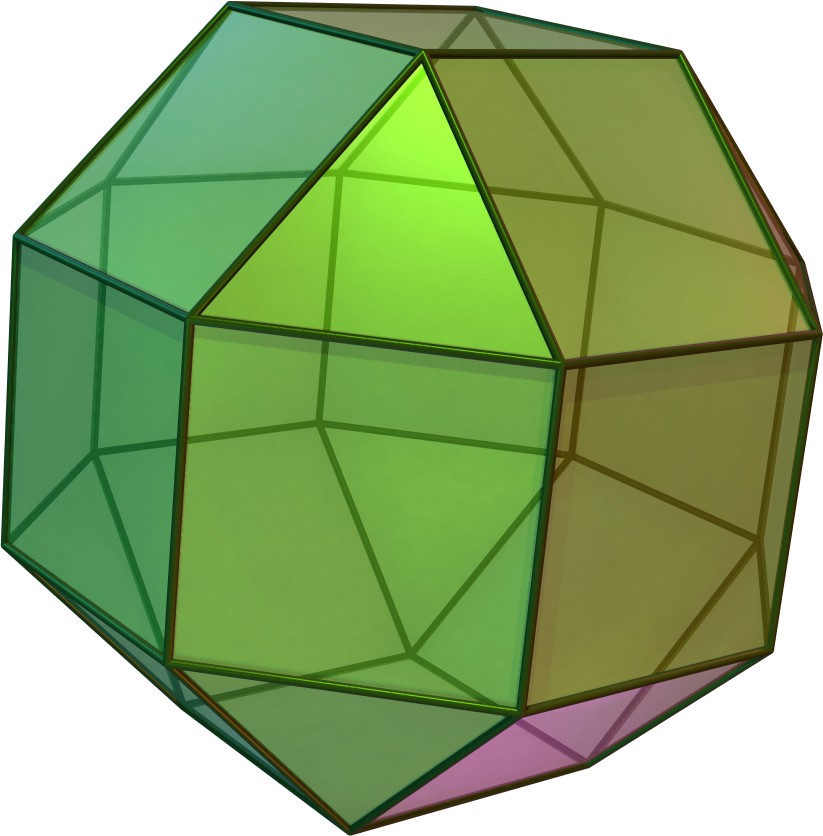
In geometry, the rhombicuboctahedron is an Archimedean solid with 26 faces, consisting of 8 equilateral triangles and 18 squares. It was named by Johannes Kepler in his 1618 Harmonices Mundi, being short for truncated cuboctahedral rhombus, with cuboctahedral rhombus being his name for a rhombic dodecahedron.
The rhombicuboctahedron is an Archimedean solid, and its dual is a Catalan solid, the deltoidal icositetrahedron. The elongated square gyrobicupola is a polyhedron that is similar to a rhombicuboctahedron, but it is not an Archimedean solid because it is not vertex-transitive. The rhombicuboctahedron is found in diverse cultures in architecture, toys, the arts, and elsewhere.
The rhombicuboctahedron may be constructed from a cube by drawing a smaller one in the middle of each face, parallel to the cube's edges. After removing the edges of a cube, the squares may be joined by adding more squares adjacent between them, and the corners may be filled by the equilateral triangles. Another way to construct the rhombicuboctahedron is by attaching two regular square cupolas into the bases of a regular octagonal prism.
A rhombicuboctahedron may also be known as an expanded octahedron or expanded cube. This is because the rhombicuboctahedron may also be constructed by separating and pushing away the faces of a cube or a regular octahedron from their centroid (in blue or red, respectively, in the animation), and filling between them with the squares and equilateral triangles. This construction process is known as expansion. By using all of these methods above, the rhombicuboctahedron has 8 equilateral triangles and 18 squares as its faces. Relatedly, the rhombicuboctahedron may also be constructed by cutting all edges and vertices of either cube or a regular octahedron, a process known as cantellation.
Cartesian coordinates of a rhombicuboctahedron with an edge length 2 are the permutations of .

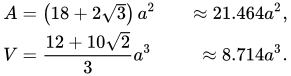
The surface area of a rhombicuboctahedron can be determined by adding the area of all faces: 8 equilateral triangles and 18 squares. The volume of a rhombicuboctahedron can be determined by slicing it into two square cupolas and one octagonal prism. Given that the edge length , its surface area and volume is:


The optimal packing fraction of rhombicuboctahedra is given by It was noticed that this optimal value is obtained in a Bravais lattice by de Graaf, van Roij & Dijkstra (2011). Since the rhombicuboctahedron is contained in a rhombic dodecahedron whose inscribed sphere is identical to its inscribed sphere, the value of the optimal packing fraction is a corollary of the Kepler conjecture: it can be achieved by putting a rhombicuboctahedron in each cell of the rhombic dodecahedral honeycomb, and it cannot be surpassed, since otherwise the optimal packing density of spheres could be surpassed by putting a sphere in each rhombicuboctahedron of the hypothetical packing which surpasses it.[citation needed]

The dihedral angle of a rhombicuboctahedron can be determined by adding the dihedral angle of a square cupola and an octagonal prism:
Hub AI
Rhombicuboctahedron AI simulator
(@Rhombicuboctahedron_simulator)
Rhombicuboctahedron
In geometry, the rhombicuboctahedron is an Archimedean solid with 26 faces, consisting of 8 equilateral triangles and 18 squares. It was named by Johannes Kepler in his 1618 Harmonices Mundi, being short for truncated cuboctahedral rhombus, with cuboctahedral rhombus being his name for a rhombic dodecahedron.
The rhombicuboctahedron is an Archimedean solid, and its dual is a Catalan solid, the deltoidal icositetrahedron. The elongated square gyrobicupola is a polyhedron that is similar to a rhombicuboctahedron, but it is not an Archimedean solid because it is not vertex-transitive. The rhombicuboctahedron is found in diverse cultures in architecture, toys, the arts, and elsewhere.
The rhombicuboctahedron may be constructed from a cube by drawing a smaller one in the middle of each face, parallel to the cube's edges. After removing the edges of a cube, the squares may be joined by adding more squares adjacent between them, and the corners may be filled by the equilateral triangles. Another way to construct the rhombicuboctahedron is by attaching two regular square cupolas into the bases of a regular octagonal prism.
A rhombicuboctahedron may also be known as an expanded octahedron or expanded cube. This is because the rhombicuboctahedron may also be constructed by separating and pushing away the faces of a cube or a regular octahedron from their centroid (in blue or red, respectively, in the animation), and filling between them with the squares and equilateral triangles. This construction process is known as expansion. By using all of these methods above, the rhombicuboctahedron has 8 equilateral triangles and 18 squares as its faces. Relatedly, the rhombicuboctahedron may also be constructed by cutting all edges and vertices of either cube or a regular octahedron, a process known as cantellation.
Cartesian coordinates of a rhombicuboctahedron with an edge length 2 are the permutations of .
The surface area of a rhombicuboctahedron can be determined by adding the area of all faces: 8 equilateral triangles and 18 squares. The volume of a rhombicuboctahedron can be determined by slicing it into two square cupolas and one octagonal prism. Given that the edge length , its surface area and volume is:
The optimal packing fraction of rhombicuboctahedra is given by It was noticed that this optimal value is obtained in a Bravais lattice by de Graaf, van Roij & Dijkstra (2011). Since the rhombicuboctahedron is contained in a rhombic dodecahedron whose inscribed sphere is identical to its inscribed sphere, the value of the optimal packing fraction is a corollary of the Kepler conjecture: it can be achieved by putting a rhombicuboctahedron in each cell of the rhombic dodecahedral honeycomb, and it cannot be surpassed, since otherwise the optimal packing density of spheres could be surpassed by putting a sphere in each rhombicuboctahedron of the hypothetical packing which surpasses it.[citation needed]
The dihedral angle of a rhombicuboctahedron can be determined by adding the dihedral angle of a square cupola and an octagonal prism:
Recent media