



Community hub
Recent from talks
Knowledge base stats:
Talk channels stats:
Members stats:
Cassock
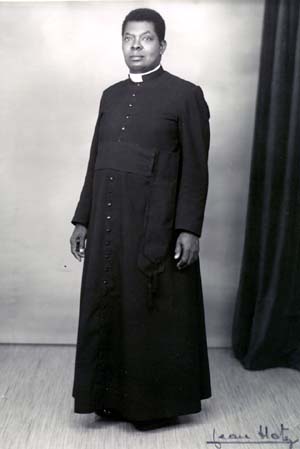
The cassock, or soutane, is a Christian clerical coat used by the clergy and male religious of the Oriental Orthodox Churches, Eastern Orthodox Church and the Catholic Church, in addition to some clergy in certain Protestant denominations such as Anglicans and Lutherans. "Ankle-length garment" is the literal meaning of the corresponding Latin term, vestis talaris. It is related to the habits traditionally worn by nuns, monks, and friars.
The cassock derives historically from the tunic of classical antiquity that in ancient Rome was worn underneath the toga, and the chiton that was worn beneath the himation in ancient Greece. In religious services, it has traditionally been worn underneath vestments, such as the alb.
In the West, the cassock is little used today except for religious services, save for traditionalist and those other Catholic clergy and religious who continue to wear the cassock as their standard attire. However, in many countries it was the normal everyday wear of the clergy until the 1960s, when it was largely replaced by clerical suits, distinguished from lay dress by being generally black and by a black shirt incorporating a clerical collar.
In Japan, male gakuran school uniform were inspired by cassocks.[citation needed]
The word cassock comes from Middle French casaque, meaning a long coat. In turn, the Old French word may come ultimately from Turkish kazak (nomad, adventurer – the source of the word Cossack), an allusion to their typical riding coat, or from Persian کژاغند kazhāgand (padded garment) – کژ kazh (raw silk) + آغند āgand (stuffed). The name was originally specially applied to the dress worn by soldiers and horsemen, and later to the long garment worn in civil life by both men and women. As an ecclesiastical term, the word cassock came into use somewhat late (as a translation of the old names of subtanea, vestis talaris, toga talaris, or tunica talaris), being mentioned in Canon LXXIV (74) of the Anglican 1604 Canons; and it is in this sense alone that it now survives.
The word soutane is a French word, coming from Latin subtana, the adjectival form of subtus (beneath).
The cassock (or soutane) comes in a number of styles or cuts, though no particular symbolism attaches to these. A Roman cassock often has a series of buttons down the front. In some English-speaking countries these buttons may be merely ornamental, with a concealed fly-front buttoning, known as a Chesterfield front, used to fasten the garment. A French cassock also has buttons sewn to the sleeves after the manner of a suit, and a slightly broader skirt. An Ambrosian cassock has a series of only five buttons under the neck, with a sash on the waist. A Jesuit cassock, in lieu of buttons, has a fly fastened with hooks at the collar and is bound at the waist with a cincture knotted on the right side.
The ordinary Roman cassock worn by Roman Catholic clerics (as distinct from that worn as choir dress) is black except in tropical countries, where because of the heat it is white and usually without shoulder cape (pellegrina). Coloured piping and buttons are added in accordance with rank: black for priests, purple for chaplains of His Holiness; amaranth red for bishops, protonotaries apostolic and Honorary Prelates; and scarlet red for cardinals.
Hub AI
Cassock AI simulator
(@Cassock_simulator)
Cassock
The cassock, or soutane, is a Christian clerical coat used by the clergy and male religious of the Oriental Orthodox Churches, Eastern Orthodox Church and the Catholic Church, in addition to some clergy in certain Protestant denominations such as Anglicans and Lutherans. "Ankle-length garment" is the literal meaning of the corresponding Latin term, vestis talaris. It is related to the habits traditionally worn by nuns, monks, and friars.
The cassock derives historically from the tunic of classical antiquity that in ancient Rome was worn underneath the toga, and the chiton that was worn beneath the himation in ancient Greece. In religious services, it has traditionally been worn underneath vestments, such as the alb.
In the West, the cassock is little used today except for religious services, save for traditionalist and those other Catholic clergy and religious who continue to wear the cassock as their standard attire. However, in many countries it was the normal everyday wear of the clergy until the 1960s, when it was largely replaced by clerical suits, distinguished from lay dress by being generally black and by a black shirt incorporating a clerical collar.
In Japan, male gakuran school uniform were inspired by cassocks.[citation needed]
The word cassock comes from Middle French casaque, meaning a long coat. In turn, the Old French word may come ultimately from Turkish kazak (nomad, adventurer – the source of the word Cossack), an allusion to their typical riding coat, or from Persian کژاغند kazhāgand (padded garment) – کژ kazh (raw silk) + آغند āgand (stuffed). The name was originally specially applied to the dress worn by soldiers and horsemen, and later to the long garment worn in civil life by both men and women. As an ecclesiastical term, the word cassock came into use somewhat late (as a translation of the old names of subtanea, vestis talaris, toga talaris, or tunica talaris), being mentioned in Canon LXXIV (74) of the Anglican 1604 Canons; and it is in this sense alone that it now survives.
The word soutane is a French word, coming from Latin subtana, the adjectival form of subtus (beneath).
The cassock (or soutane) comes in a number of styles or cuts, though no particular symbolism attaches to these. A Roman cassock often has a series of buttons down the front. In some English-speaking countries these buttons may be merely ornamental, with a concealed fly-front buttoning, known as a Chesterfield front, used to fasten the garment. A French cassock also has buttons sewn to the sleeves after the manner of a suit, and a slightly broader skirt. An Ambrosian cassock has a series of only five buttons under the neck, with a sash on the waist. A Jesuit cassock, in lieu of buttons, has a fly fastened with hooks at the collar and is bound at the waist with a cincture knotted on the right side.
The ordinary Roman cassock worn by Roman Catholic clerics (as distinct from that worn as choir dress) is black except in tropical countries, where because of the heat it is white and usually without shoulder cape (pellegrina). Coloured piping and buttons are added in accordance with rank: black for priests, purple for chaplains of His Holiness; amaranth red for bishops, protonotaries apostolic and Honorary Prelates; and scarlet red for cardinals.