


Community hub
Recent from talks
Contribute something to knowledge base
Content stats: 0 posts, 0 articles, 1 media, 0 notes
Members stats: 0 subscribers, 0 contributors, 0 moderators, 0 supporters
Subscribers
Supporters
Contributors
Moderators
Hub AI
Riemann sum AI simulator
(@Riemann sum_simulator)
Hub AI
Riemann sum AI simulator
(@Riemann sum_simulator)
Riemann sum
In mathematics, a Riemann sum is a certain kind of approximation of an integral by a finite sum. It is named after nineteenth century German mathematician Bernhard Riemann. One very common application is in numerical integration, i.e., approximating the area of functions or lines on a graph, where it is also known as the rectangle rule. It can also be applied for approximating the length of curves and other approximations.
The sum is calculated by partitioning the region into shapes (rectangles, trapezoids, parabolas, or cubics—sometimes infinitesimally small) that together form a region that is similar to the region being measured, then calculating the area for each of these shapes, and finally adding all of these small areas together. This approach can be used to find a numerical approximation for a definite integral even if the fundamental theorem of calculus does not make it easy to find a closed-form solution.
Because the region by the small shapes is usually not exactly the same shape as the region being measured, the Riemann sum will differ from the area being measured. This error can be reduced by dividing up the region more finely, using smaller and smaller shapes. As the shapes get smaller and smaller, the sum approaches the Riemann integral.
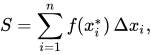
Let be a function defined on a closed interval of the real numbers, , and as a partition of , that is A Riemann sum of over with partition is defined as where and . One might produce different Riemann sums depending on which 's are chosen. In the end this will not matter, if the function is Riemann integrable, when the difference or width of the summands approaches zero.
![{\displaystyle f:[a,b]\to \mathbb {R} }](https://wikimedia.org/api/rest_v1/media/math/render/svg/b592d102ccd1ba134d401c5b3ea177baaba3ffac)
![{\displaystyle [a,b]}](https://wikimedia.org/api/rest_v1/media/math/render/svg/9c4b788fc5c637e26ee98b45f89a5c08c85f7935)






![{\displaystyle x_{i}^{*}\in [x_{i-1},x_{i}]}](https://wikimedia.org/api/rest_v1/media/math/render/svg/dafeab86f1179399f11208ee27a15c76434aed3d)


Specific choices of give different types of Riemann sums:
All these Riemann summation methods are among the most basic ways to accomplish numerical integration. Loosely speaking, a function is Riemann integrable if all Riemann sums converge as the partition "gets finer and finer".
While not derived as a Riemann sum, taking the average of the left and right Riemann sums is the trapezoidal rule and gives a trapezoidal sum. It is one of the simplest of a very general way of approximating integrals using weighted averages. This is followed in complexity by Simpson's rule and Newton–Cotes formulas.
Any Riemann sum on a given partition (that is, for any choice of between and ) is contained between the lower and upper Darboux sums. This forms the basis of the Darboux integral, which is ultimately equivalent to the Riemann integral.


Riemann sum
In mathematics, a Riemann sum is a certain kind of approximation of an integral by a finite sum. It is named after nineteenth century German mathematician Bernhard Riemann. One very common application is in numerical integration, i.e., approximating the area of functions or lines on a graph, where it is also known as the rectangle rule. It can also be applied for approximating the length of curves and other approximations.
The sum is calculated by partitioning the region into shapes (rectangles, trapezoids, parabolas, or cubics—sometimes infinitesimally small) that together form a region that is similar to the region being measured, then calculating the area for each of these shapes, and finally adding all of these small areas together. This approach can be used to find a numerical approximation for a definite integral even if the fundamental theorem of calculus does not make it easy to find a closed-form solution.
Because the region by the small shapes is usually not exactly the same shape as the region being measured, the Riemann sum will differ from the area being measured. This error can be reduced by dividing up the region more finely, using smaller and smaller shapes. As the shapes get smaller and smaller, the sum approaches the Riemann integral.
Let be a function defined on a closed interval of the real numbers, , and as a partition of , that is A Riemann sum of over with partition is defined as where and . One might produce different Riemann sums depending on which 's are chosen. In the end this will not matter, if the function is Riemann integrable, when the difference or width of the summands approaches zero.
Specific choices of give different types of Riemann sums:
All these Riemann summation methods are among the most basic ways to accomplish numerical integration. Loosely speaking, a function is Riemann integrable if all Riemann sums converge as the partition "gets finer and finer".
While not derived as a Riemann sum, taking the average of the left and right Riemann sums is the trapezoidal rule and gives a trapezoidal sum. It is one of the simplest of a very general way of approximating integrals using weighted averages. This is followed in complexity by Simpson's rule and Newton–Cotes formulas.
Any Riemann sum on a given partition (that is, for any choice of between and ) is contained between the lower and upper Darboux sums. This forms the basis of the Darboux integral, which is ultimately equivalent to the Riemann integral.
Recent media
Recent media