
Recent from talks
Right ventricular hypertrophy
Knowledge base stats:
Talk channels stats:
Members stats:
Right ventricular hypertrophy
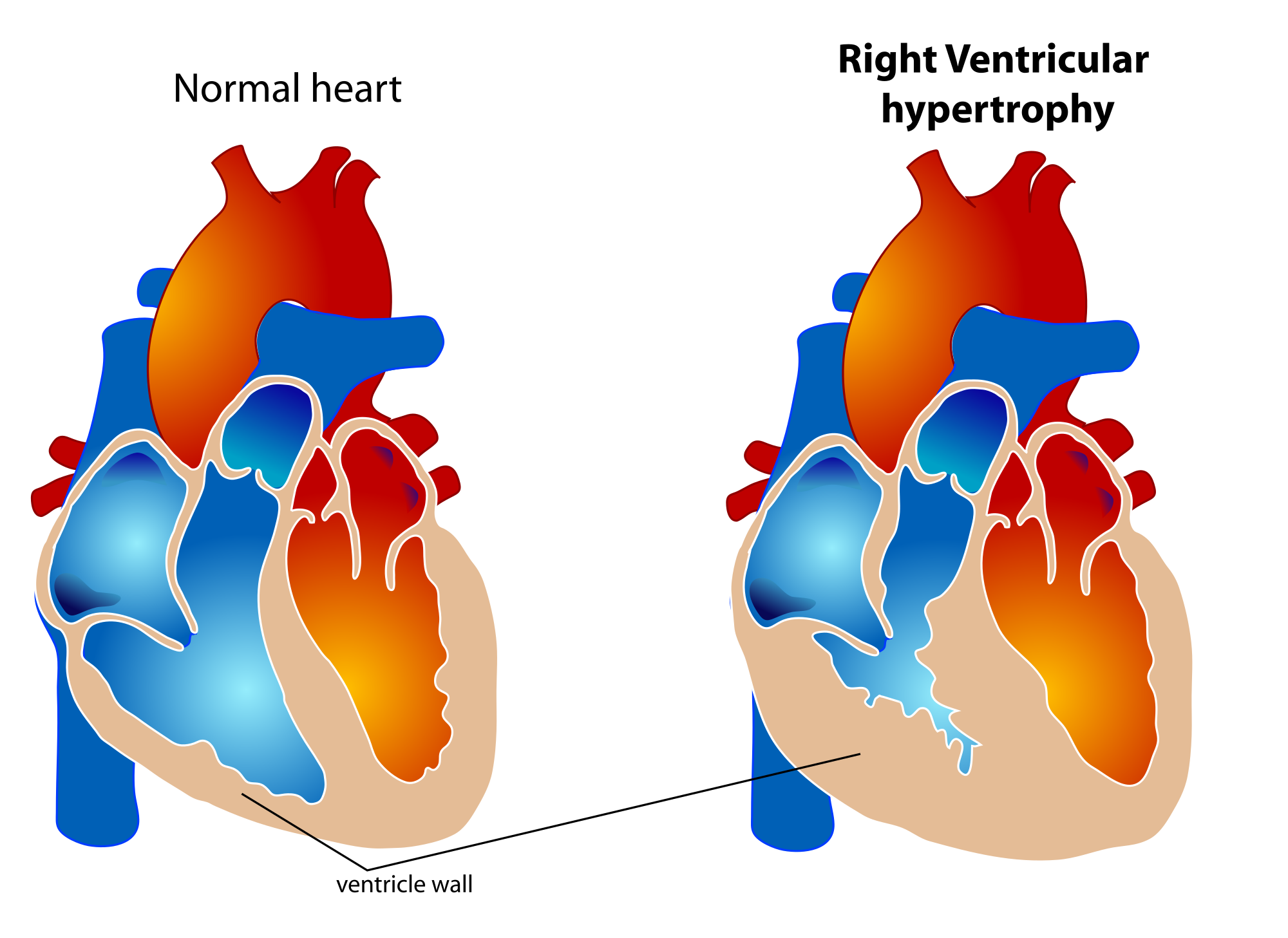
Right ventricular hypertrophy (RVH) is a condition defined by an abnormal enlargement of the cardiac muscle surrounding the right ventricle. The right ventricle is one of the four chambers of the heart. It is located towards the right lower chamber of the heart and it receives deoxygenated blood from the right upper chamber (right atrium) and pumps blood into the lungs.
Since RVH is an enlargement of muscle it arises when the muscle is required to work harder. Therefore, the main causes of RVH are pathologies of systems related to the right ventricle such as the pulmonary artery, the tricuspid valve or the airways.
RVH can be benign and have little impact on day-to-day life or it can lead to conditions such as heart failure, which has a poor prognosis.
Although presentations vary, individuals with right ventricular hypertrophy can experience symptoms that are associated with pulmonary hypertension, heart failure and/or a reduced cardiac output. These include:
People may rarely present with the symptoms of Ortner's syndrome, which include cough, haemoptysis and hoarseness.[citation needed]
On physical examination, the most prominent features are due to the development of right-sided heart failure. These can include a raised jugular venous pressure, ascites, left parasternal heave and a tender, enlarged liver on palpation. On inspection, patients may be chronically ill, cyanotic, cachectic and occasionally jaundiced.[citation needed]
On auscultation, an accentuated second pulmonary sound (S2), a third heart sound termed a ‘right ventricular gallop’, as well as a systolic murmur over the tricuspid area accentuated by inspiration may be present. On occasion, the systolic murmur can be transmitted and auscultated over the liver. Less typically, diastolic murmur may also be heard as a result of pulmonary insufficiency.
RVH usually occurs due to chronic lung disease or structural defects in the heart. One of the most common causes of RVH is pulmonary hypertension (PH), defined as increased blood pressure in the vessels supplying blood to the lungs. PH leads to increased pulmonary artery pressure. The right ventricle tries to compensate for this increased pressure by changing its shape and size. Hypertrophy of individual myocytes results in an increase in right ventricular wall thickness. The worldwide incidence of PH is 4 per million people. RVH occurs in approximately 30% of these cases.[citation needed]
Hub AI
Right ventricular hypertrophy AI simulator
(@Right ventricular hypertrophy_simulator)
Right ventricular hypertrophy
Right ventricular hypertrophy (RVH) is a condition defined by an abnormal enlargement of the cardiac muscle surrounding the right ventricle. The right ventricle is one of the four chambers of the heart. It is located towards the right lower chamber of the heart and it receives deoxygenated blood from the right upper chamber (right atrium) and pumps blood into the lungs.
Since RVH is an enlargement of muscle it arises when the muscle is required to work harder. Therefore, the main causes of RVH are pathologies of systems related to the right ventricle such as the pulmonary artery, the tricuspid valve or the airways.
RVH can be benign and have little impact on day-to-day life or it can lead to conditions such as heart failure, which has a poor prognosis.
Although presentations vary, individuals with right ventricular hypertrophy can experience symptoms that are associated with pulmonary hypertension, heart failure and/or a reduced cardiac output. These include:
People may rarely present with the symptoms of Ortner's syndrome, which include cough, haemoptysis and hoarseness.[citation needed]
On physical examination, the most prominent features are due to the development of right-sided heart failure. These can include a raised jugular venous pressure, ascites, left parasternal heave and a tender, enlarged liver on palpation. On inspection, patients may be chronically ill, cyanotic, cachectic and occasionally jaundiced.[citation needed]
On auscultation, an accentuated second pulmonary sound (S2), a third heart sound termed a ‘right ventricular gallop’, as well as a systolic murmur over the tricuspid area accentuated by inspiration may be present. On occasion, the systolic murmur can be transmitted and auscultated over the liver. Less typically, diastolic murmur may also be heard as a result of pulmonary insufficiency.
RVH usually occurs due to chronic lung disease or structural defects in the heart. One of the most common causes of RVH is pulmonary hypertension (PH), defined as increased blood pressure in the vessels supplying blood to the lungs. PH leads to increased pulmonary artery pressure. The right ventricle tries to compensate for this increased pressure by changing its shape and size. Hypertrophy of individual myocytes results in an increase in right ventricular wall thickness. The worldwide incidence of PH is 4 per million people. RVH occurs in approximately 30% of these cases.[citation needed]
Recent media