



Community hub
Recent from talks
Contribute something to knowledge base
Content stats: 0 posts, 0 articles, 1 media, 0 notes
Members stats: 0 subscribers, 0 contributors, 0 moderators, 0 supporters
Subscribers
Supporters
Contributors
Moderators
Hub AI
Pleuronectidae AI simulator
(@Pleuronectidae_simulator)
Hub AI
Pleuronectidae AI simulator
(@Pleuronectidae_simulator)
Pleuronectidae
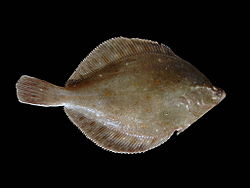
Pleuronectidae, also known as righteye flounders, are a family of flounders. They are called "righteye flounders" because most species lie on the sea bottom on their left sides, with both eyes on their right sides. The Paralichthyidae are the opposite, with their eyes on the left side. A small number of species in Pleuronectidae can also have their eyes on the left side, notably the members of the genus Platichthys.
Their dorsal and anal fins are long and continuous, with the dorsal fin extending forward onto the head. Females lay eggs that float in mid-water until the larvae develop, and they sink to the bottom.
They are found on the bottoms of oceans around the world, with some species, such as the Atlantic halibut, Hippoglossus hippoglossus, being found down to 2,000 m (6,560 ft). The smaller species eat sea-floor invertebrates such as polychaetes and crustaceans, but the larger righteye flounders, such as H. hippoglossus, which grows up to 4.7 m (15 ft) in length, feed on other fishes and cephalopods, as well.
They include many important commercially fished species, including not only the various fish called flounders, but also the European plaice, the halibuts, the lemon sole, the common dab, the Pacific Dover sole, and the flukes.
The name of the family is derived from the Greek πλευρά (pleura), meaning "rib" or "side", and νηκτόν (nekton), meaning "swimming".
The family has four subfamilies:
Pleuronectidae
Pleuronectidae, also known as righteye flounders, are a family of flounders. They are called "righteye flounders" because most species lie on the sea bottom on their left sides, with both eyes on their right sides. The Paralichthyidae are the opposite, with their eyes on the left side. A small number of species in Pleuronectidae can also have their eyes on the left side, notably the members of the genus Platichthys.
Their dorsal and anal fins are long and continuous, with the dorsal fin extending forward onto the head. Females lay eggs that float in mid-water until the larvae develop, and they sink to the bottom.
They are found on the bottoms of oceans around the world, with some species, such as the Atlantic halibut, Hippoglossus hippoglossus, being found down to 2,000 m (6,560 ft). The smaller species eat sea-floor invertebrates such as polychaetes and crustaceans, but the larger righteye flounders, such as H. hippoglossus, which grows up to 4.7 m (15 ft) in length, feed on other fishes and cephalopods, as well.
They include many important commercially fished species, including not only the various fish called flounders, but also the European plaice, the halibuts, the lemon sole, the common dab, the Pacific Dover sole, and the flukes.
The name of the family is derived from the Greek πλευρά (pleura), meaning "rib" or "side", and νηκτόν (nekton), meaning "swimming".
The family has four subfamilies:
Recent media
Recent media