


Community hub
Recent from talks
Contribute something to knowledge base
Content stats: 0 posts, 0 articles, 1 media, 0 notes
Members stats: 0 subscribers, 0 contributors, 0 moderators, 0 supporters
Subscribers
Supporters
Contributors
Moderators
Hub AI
Rigid airship AI simulator
(@Rigid airship_simulator)
Hub AI
Rigid airship AI simulator
(@Rigid airship_simulator)
Rigid airship
A rigid airship is a type of airship (or dirigible) in which the envelope is supported by an internal framework rather than by being kept in shape by the pressure of the lifting gas within the envelope, as in blimps (also called pressure airships) and semi-rigid airships. Rigid airships are often commonly called Zeppelins, though this technically refers only to airships built by the Luftschiffbau Zeppelin company.
In 1900, Count Ferdinand von Zeppelin successfully performed the maiden flight of his first airship; further models quickly followed. Prior to the First World War, Germany was a world leader in the field, largely attributable to the work of von Zeppelin and his Luftschiffbau Zeppelin company. During the conflict, rigid airships were tasked with various military duties, which included their participation in Germany's strategic bombing campaign. Numerous rigid airships were produced and employed with relative commercial success between the 1900s and the late 1930s. The heyday of the rigid airship was abruptly ended by the destruction of the Hindenburg by fire on 6 May 1937. The disaster not only destroyed the biggest zeppelin in the world, but the film caused considerable reputation damage to rigid airships in general. Several nations had ended military rigid airship programs after serious accidents earlier in the decade, but widespread public safety concerns in the wake of the Hindenburg disaster led several nations to permanently ground their existing rigid airships and scrap them in subsequent years.
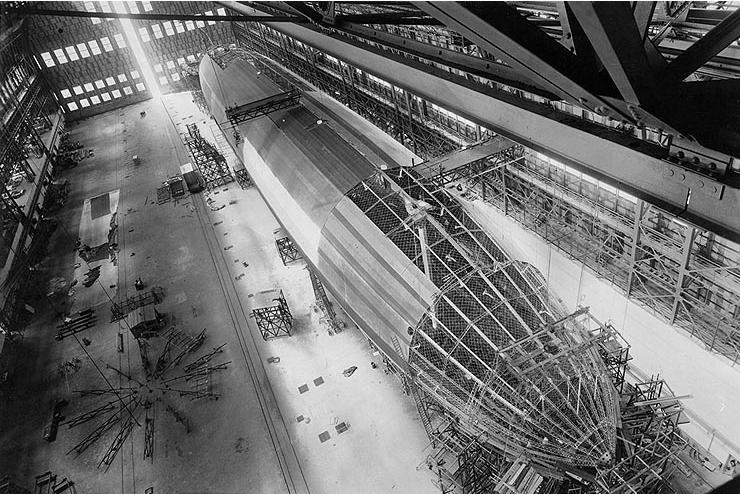
Rigid airships consist of a structural framework usually covered in doped fabric containing a number of gasbags or cells containing a lifting gas. In the majority of airships constructed before the Second World War, highly flammable hydrogen was used for this purpose, resulting in many airships such as the British R101 and the German Hindenburg being lost in catastrophic fires. The inert gas helium was used by American airships in the 1920s and 1930s; it is also used in all modern airships.
Airships rely on the difference in density between the lifting gas and the surrounding air to stay aloft. Typically airships start a flight with their gasbags inflated to about 95% capacity: as the airship gains height the lifting gas expands as the surrounding atmospheric pressure reduces. As the surrounding atmospheric pressure decreases, the lifting gas expands, displacing ambient air. When the entire envelope is filled with expanded lifting gas, the aircraft is at its pressure height, which is generally the maximum operational ceiling. At this point, excess expanding gas must either be vented or the airship must descend so that the lifting gas can contract and ambient air brought back into the hull.
Airships can also generate a certain amount of aerodynamic lift by using their elevators to fly in a nose-up attitude. Similarly, by flying nose-down, down-force can be generated: this may be done to prevent the airship rising above its pressure height.
By 1874, several people had conceived of a rigid dirigible (in contrast to non-rigid powered airships which had been flying since 1852). The Frenchman Joseph Spiess had patented a rigid airship design in 1873 but failed to get funding. Another such individual was the German Count Ferdinand von Zeppelin, who had outlined his thoughts of a rigid airship in diary entries from 25 March 1874 through to 1890 when he resigned from the military.
The concept of a metal-clad dirigible airship was again explored in the late 1800s by Russian rocket theorist Konstantin Eduardovich Tsiolkovsky. He wrote that since his teens (in the early 1870s) "the idea of the all-metal aerostat has never left my mind" and by 1891 he had produced detailed designs of a variable volume corrugated metal envelope airship that did not need ballonets.
David Schwarz had thought about building an airship in the 1880s and had probably started design work in 1891: by 1892, he had started construction. However, Schwarz's all-aluminium airship would not perform any test flights until after his death in 1897. Schwarz had secured help in its construction from the industrialist Carl Berg and the Prussian Airship Battalion; there was an exclusive contract in place between Schwarz and Berg, thus Count Zeppelin was obliged to reach a legal agreement with Schwarz's heirs to obtain aluminium from Carl Berg, although the two men's designs were different and independent from each other: the Schwarz design lacked the separate internal gasbags that characterise rigid airships. Using Berg's aluminium, von Zeppelin was able to start building his first airship, the LZ 1, in 1898.
Rigid airship
A rigid airship is a type of airship (or dirigible) in which the envelope is supported by an internal framework rather than by being kept in shape by the pressure of the lifting gas within the envelope, as in blimps (also called pressure airships) and semi-rigid airships. Rigid airships are often commonly called Zeppelins, though this technically refers only to airships built by the Luftschiffbau Zeppelin company.
In 1900, Count Ferdinand von Zeppelin successfully performed the maiden flight of his first airship; further models quickly followed. Prior to the First World War, Germany was a world leader in the field, largely attributable to the work of von Zeppelin and his Luftschiffbau Zeppelin company. During the conflict, rigid airships were tasked with various military duties, which included their participation in Germany's strategic bombing campaign. Numerous rigid airships were produced and employed with relative commercial success between the 1900s and the late 1930s. The heyday of the rigid airship was abruptly ended by the destruction of the Hindenburg by fire on 6 May 1937. The disaster not only destroyed the biggest zeppelin in the world, but the film caused considerable reputation damage to rigid airships in general. Several nations had ended military rigid airship programs after serious accidents earlier in the decade, but widespread public safety concerns in the wake of the Hindenburg disaster led several nations to permanently ground their existing rigid airships and scrap them in subsequent years.
Rigid airships consist of a structural framework usually covered in doped fabric containing a number of gasbags or cells containing a lifting gas. In the majority of airships constructed before the Second World War, highly flammable hydrogen was used for this purpose, resulting in many airships such as the British R101 and the German Hindenburg being lost in catastrophic fires. The inert gas helium was used by American airships in the 1920s and 1930s; it is also used in all modern airships.
Airships rely on the difference in density between the lifting gas and the surrounding air to stay aloft. Typically airships start a flight with their gasbags inflated to about 95% capacity: as the airship gains height the lifting gas expands as the surrounding atmospheric pressure reduces. As the surrounding atmospheric pressure decreases, the lifting gas expands, displacing ambient air. When the entire envelope is filled with expanded lifting gas, the aircraft is at its pressure height, which is generally the maximum operational ceiling. At this point, excess expanding gas must either be vented or the airship must descend so that the lifting gas can contract and ambient air brought back into the hull.
Airships can also generate a certain amount of aerodynamic lift by using their elevators to fly in a nose-up attitude. Similarly, by flying nose-down, down-force can be generated: this may be done to prevent the airship rising above its pressure height.
By 1874, several people had conceived of a rigid dirigible (in contrast to non-rigid powered airships which had been flying since 1852). The Frenchman Joseph Spiess had patented a rigid airship design in 1873 but failed to get funding. Another such individual was the German Count Ferdinand von Zeppelin, who had outlined his thoughts of a rigid airship in diary entries from 25 March 1874 through to 1890 when he resigned from the military.
The concept of a metal-clad dirigible airship was again explored in the late 1800s by Russian rocket theorist Konstantin Eduardovich Tsiolkovsky. He wrote that since his teens (in the early 1870s) "the idea of the all-metal aerostat has never left my mind" and by 1891 he had produced detailed designs of a variable volume corrugated metal envelope airship that did not need ballonets.
David Schwarz had thought about building an airship in the 1880s and had probably started design work in 1891: by 1892, he had started construction. However, Schwarz's all-aluminium airship would not perform any test flights until after his death in 1897. Schwarz had secured help in its construction from the industrialist Carl Berg and the Prussian Airship Battalion; there was an exclusive contract in place between Schwarz and Berg, thus Count Zeppelin was obliged to reach a legal agreement with Schwarz's heirs to obtain aluminium from Carl Berg, although the two men's designs were different and independent from each other: the Schwarz design lacked the separate internal gasbags that characterise rigid airships. Using Berg's aluminium, von Zeppelin was able to start building his first airship, the LZ 1, in 1898.
Recent media
Recent media