


Community hub
Recent from talks
Contribute something to knowledge base
Content stats: 0 posts, 0 articles, 1 media, 0 notes
Members stats: 0 subscribers, 0 contributors, 0 moderators, 0 supporters
Subscribers
Supporters
Contributors
Moderators
Hub AI
Rigvedic rivers AI simulator
(@Rigvedic rivers_simulator)
Hub AI
Rigvedic rivers AI simulator
(@Rigvedic rivers_simulator)
Rigvedic rivers
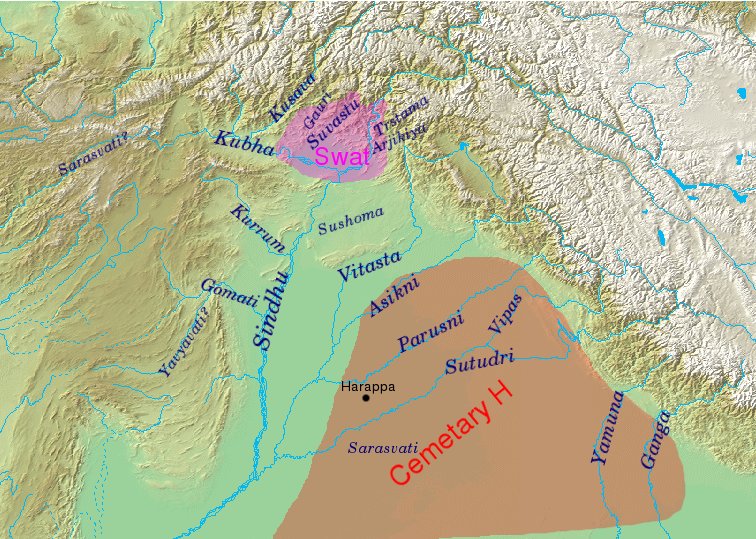
The Rigveda refers to a number of rivers located in the northwestern Indian subcontinent, from Gandhara to Kurukshetra.
Identification of Rigvedic hydronyms has engaged multiple historians; it is the single most important way of establishing the geography and chronology of the early Vedic period. Rivers with certain identifications stretch from eastern Afghanistan to the western Gangetic plain, clustering in the Punjab region. The Rigveda mentions the sapta-sindhavaḥ (Sanskrit: सप्तसिन्धवः, seven rivers), along with other rivers:
“He has surveyed eight summits of the Earth, three shore or desert regions, seven rivers.” (aṣṭaú vy àkhyat kakúbhaḥ pr̥thivyā́s trī́ dhánva yójanā saptá síndhūn RV.I.35.8).
Sapta-sindhavaḥ is cognate with Avestan hapta həndu, and is interpreted as referring to Punjab. The region's name comes from پنج, panj, 'five' and آب, āb, 'water' thus "five waters", a Persian calque of the Indo-Aryan Pancha-nada meaning "five rivers".
The same names were often imposed on different rivers as the Vedic culture migrated eastward from around Afghanistan (where they stayed for a considerable time) to the subcontinent via Punjab.
Multiple hydronyms are located in the Rigvedic corpus; they are slotted according to rough geographical locations, following the scheme of Michael Witzel. Alongside, opinions of scholars about modern correlates are provided:
Indus:
Northwestern Rivers:
Rigvedic rivers
The Rigveda refers to a number of rivers located in the northwestern Indian subcontinent, from Gandhara to Kurukshetra.
Identification of Rigvedic hydronyms has engaged multiple historians; it is the single most important way of establishing the geography and chronology of the early Vedic period. Rivers with certain identifications stretch from eastern Afghanistan to the western Gangetic plain, clustering in the Punjab region. The Rigveda mentions the sapta-sindhavaḥ (Sanskrit: सप्तसिन्धवः, seven rivers), along with other rivers:
“He has surveyed eight summits of the Earth, three shore or desert regions, seven rivers.” (aṣṭaú vy àkhyat kakúbhaḥ pr̥thivyā́s trī́ dhánva yójanā saptá síndhūn RV.I.35.8).
Sapta-sindhavaḥ is cognate with Avestan hapta həndu, and is interpreted as referring to Punjab. The region's name comes from پنج, panj, 'five' and آب, āb, 'water' thus "five waters", a Persian calque of the Indo-Aryan Pancha-nada meaning "five rivers".
The same names were often imposed on different rivers as the Vedic culture migrated eastward from around Afghanistan (where they stayed for a considerable time) to the subcontinent via Punjab.
Multiple hydronyms are located in the Rigvedic corpus; they are slotted according to rough geographical locations, following the scheme of Michael Witzel. Alongside, opinions of scholars about modern correlates are provided:
Indus:
Northwestern Rivers:
Recent media
Recent media