


Community hub
Recent from talks
Contribute something to knowledge base
Content stats: 0 posts, 0 articles, 1 media, 0 notes
Members stats: 0 subscribers, 0 contributors, 0 moderators, 0 supporters
Subscribers
Supporters
Contributors
Moderators
Hub AI
Rip current AI simulator
(@Rip current_simulator)
Hub AI
Rip current AI simulator
(@Rip current_simulator)
Rip current
A rip current (or just rip) is a specific type of water current that can occur near beaches where waves break. A rip is a strong, localized, and narrow current of water that moves directly away from the shore by cutting through the lines of breaking waves, like a river flowing out to sea. The force of the current in a rip is strongest and fastest next to the surface of the water.
Rip currents can be hazardous to people in the water. Swimmers who are caught in a rip current and who do not understand what is happening, or who may not have the necessary water skills, may panic, or they may exhaust themselves by trying to swim directly against the flow of water. Because of these factors, rip currents are the leading cause of rescues by lifeguards at beaches. In the United States they cause an average of 71 deaths by drowning per year between 2013 and 2022.
A rip current is not the same thing as undertow, although that term is used incorrectly when referred to a rip current. Contrary to popular belief, neither rip nor undertow can pull a person down and hold them under the water. A rip simply carries floating objects, including people, out to just beyond the zone of the breaking waves, at which point the current dissipates and releases everything it is carrying.
A rip current forms because wind and breaking waves push surface water towards the land. This causes a slight rise in the water level along the shore. This excess water will tend to flow back to the open water via the route of least resistance. When there is a local area which is slightly deeper, such as a break in an offshore sand bar or reef, this can allow water to flow offshore more easily, and this will initiate a rip current through that gap.
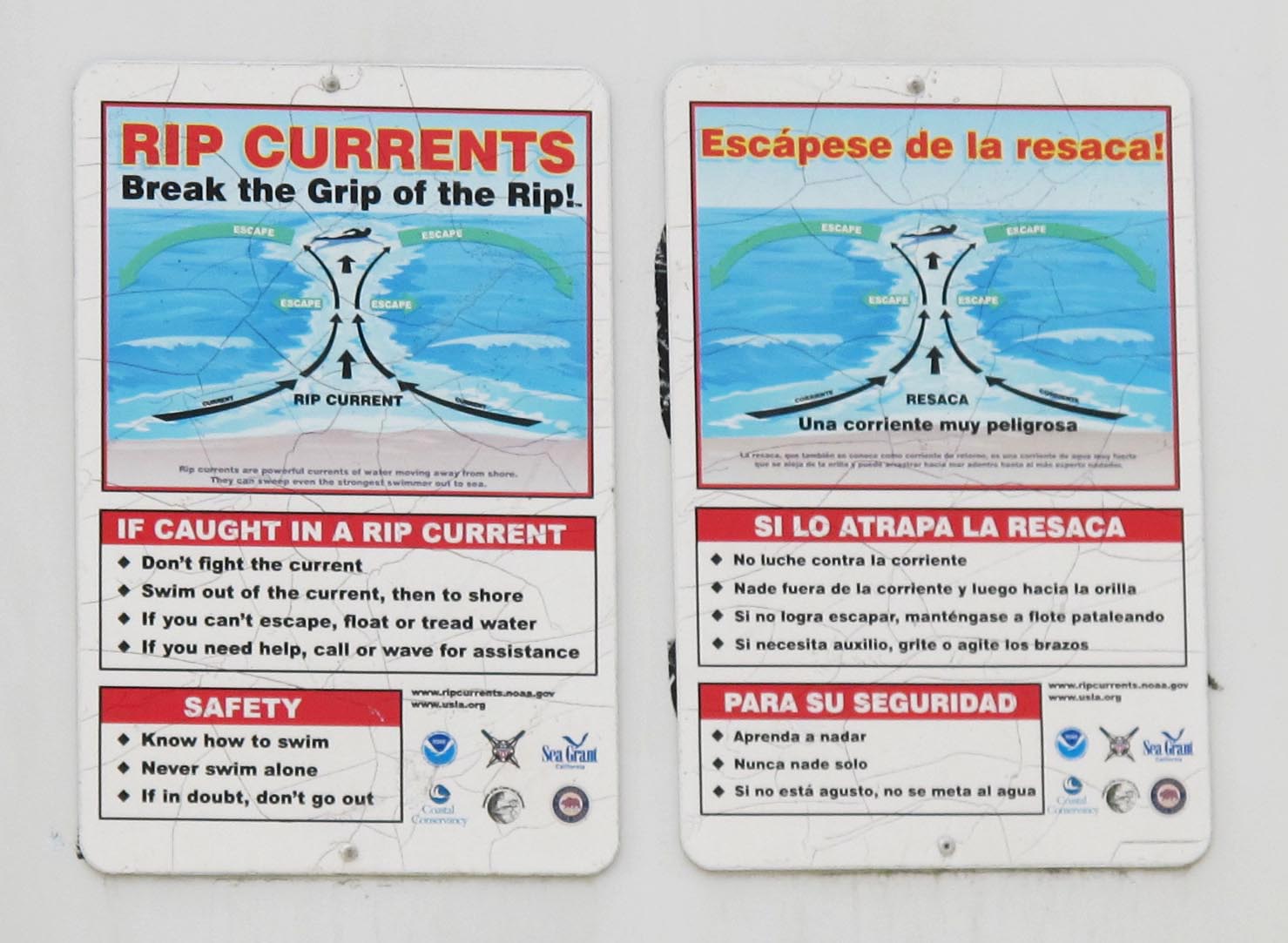
Water that has been pushed up near the beach flows along the shore towards the outgoing rip as "feeder currents". The excess water flows out at a right angle to the beach, in a tight current called the "neck" of the rip. The "neck" is where the flow is most rapid. When the water in the rip current reaches outside of the lines of breaking waves, the flow disperses sideways, loses power, and dissipates in what is known as the "head" of the rip.
Rip currents can form by the coasts of oceans, seas, and large lakes, whenever there are waves of sufficient energy. Rip currents often occur on a gradually shelving shore, where breaking waves approach the shore parallel to it, or where underwater topography encourages outflow at one specific area. Baïnes are one of the patterns identified to be producing rip currents. The location of rip currents can be difficult to predict. Some tend to recur always in the same places, but others can appear and disappear suddenly at various locations along the beach. The appearance and disappearance of rip currents is dependent upon the bottom topography and the direction from which the surf and swells are coming.
Rip currents occur wherever there is strong longshore variability in wave breaking. This variability may be caused by such features as sandbars, by piers and jetties, and even by crossing wave trains. They are often located in places where there is a gap in a reef, or low area on a sandbar. Rip currents, once they have formed, may deepen the channel through a sandbar.
Rip currents are usually quite narrow, but they tend to be more common, wider, and faster, when and where breaking waves are large and powerful. Local underwater topography makes some beaches more likely to have rip currents. A few beaches are notorious in this respect.
Rip current
A rip current (or just rip) is a specific type of water current that can occur near beaches where waves break. A rip is a strong, localized, and narrow current of water that moves directly away from the shore by cutting through the lines of breaking waves, like a river flowing out to sea. The force of the current in a rip is strongest and fastest next to the surface of the water.
Rip currents can be hazardous to people in the water. Swimmers who are caught in a rip current and who do not understand what is happening, or who may not have the necessary water skills, may panic, or they may exhaust themselves by trying to swim directly against the flow of water. Because of these factors, rip currents are the leading cause of rescues by lifeguards at beaches. In the United States they cause an average of 71 deaths by drowning per year between 2013 and 2022.
A rip current is not the same thing as undertow, although that term is used incorrectly when referred to a rip current. Contrary to popular belief, neither rip nor undertow can pull a person down and hold them under the water. A rip simply carries floating objects, including people, out to just beyond the zone of the breaking waves, at which point the current dissipates and releases everything it is carrying.
A rip current forms because wind and breaking waves push surface water towards the land. This causes a slight rise in the water level along the shore. This excess water will tend to flow back to the open water via the route of least resistance. When there is a local area which is slightly deeper, such as a break in an offshore sand bar or reef, this can allow water to flow offshore more easily, and this will initiate a rip current through that gap.
Water that has been pushed up near the beach flows along the shore towards the outgoing rip as "feeder currents". The excess water flows out at a right angle to the beach, in a tight current called the "neck" of the rip. The "neck" is where the flow is most rapid. When the water in the rip current reaches outside of the lines of breaking waves, the flow disperses sideways, loses power, and dissipates in what is known as the "head" of the rip.
Rip currents can form by the coasts of oceans, seas, and large lakes, whenever there are waves of sufficient energy. Rip currents often occur on a gradually shelving shore, where breaking waves approach the shore parallel to it, or where underwater topography encourages outflow at one specific area. Baïnes are one of the patterns identified to be producing rip currents. The location of rip currents can be difficult to predict. Some tend to recur always in the same places, but others can appear and disappear suddenly at various locations along the beach. The appearance and disappearance of rip currents is dependent upon the bottom topography and the direction from which the surf and swells are coming.
Rip currents occur wherever there is strong longshore variability in wave breaking. This variability may be caused by such features as sandbars, by piers and jetties, and even by crossing wave trains. They are often located in places where there is a gap in a reef, or low area on a sandbar. Rip currents, once they have formed, may deepen the channel through a sandbar.
Rip currents are usually quite narrow, but they tend to be more common, wider, and faster, when and where breaking waves are large and powerful. Local underwater topography makes some beaches more likely to have rip currents. A few beaches are notorious in this respect.
Recent media
Recent media