
Recent from talks
Rita R. Colwell
Knowledge base stats:
Talk channels stats:
Members stats:
Rita R. Colwell
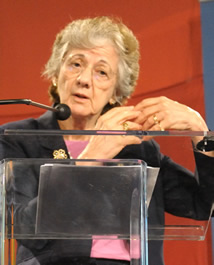
Rita Rossi Colwell (born November 23, 1934) is an American environmental microbiologist and scientific administrator. Colwell holds degrees in bacteriology, genetics, and oceanography and studies infectious diseases. Colwell is the founder and Chair of CosmosID, a bioinformatics company. From 1998 to 2004, she was the 11th Director and 1st female Director of the National Science Foundation. She has served on the board of directors of EcoHealth Alliance since 2012.
Colwell was born on November 23, 1934, in Beverly, Massachusetts. Her parents, Louis and Louise Rossi, had eight children, Rita being the seventh child born into the Rossi household. Neither her mother nor her father were from scientific backgrounds. In 1956, Rita obtained a B.S. in bacteriology from Purdue University. She also received her M.S. in genetics from Purdue in 1957. Colwell obtained her Ph.D. from the University of Washington in aquatic microbiology under the direction of microbiologist John Liston in 1961. She participated in a post-doctoral fellowship at the Canadian National Research Council in Ottawa.
Colwell is recognized for her study of global infectious disease spread through water sources and its impacts on global health. Through this research, she has developed an international network that has brought attention to the emergence of new infectious diseases in drinking/bathing water, pertaining mostly to its role on the developing world.
During early research and study of cholera, Colwell discovered that cholera can lay dormant in unfavorable conditions and then resume normal functions when conditions are favorable again.
Many of her research papers have focused on abating the spread of cholera in the developing world by improving ways to track its spread and researching inexpensive methods for filtrating out the infection agents of cholera in water systems. Some of these tracking methods include observing weather patterns, surface water temperatures, chlorophyll concentrations, and rainfall patterns. Colwell's findings of correlations between these phenomena showed that the infection rate of cholera is connected to water temperatures. This rising temperature causes algae blooms that host cholera bacteria, and rainfall and extreme weather patterns aid in spreading cholera among water systems. Colwell also concluded that climate change will have a profound impact on the spread of cholera.
Colwell has proposed ways people in the developing world can use inexpensive methods to filter water when water treatment facilities are not available. In one study spanning about 3 years, 65 villages in rural Bangladesh comprising 133,000 individuals, participated in an experiment in which they used folded sari cloth or nylon mesh filters placed over water pots to acquire safe drinking water from their local waterways. These inexpensive and readily available materials yielded a 48% reduction in cholera, when compared with the control: absence of any type of filter.
Colwell was the first female director of the National Science Foundation (NSF) and held this position from 1998 to 2004. In a presentation to members of the foundation in 2002, she detailed what the foundation should address in the future. She explained that an educated society is critical not just for developing technology, but for supporting that development, both by the public and by the government.
Colwell is interested in K-12 science and mathematical education, and she is a proponent of increasing the number of women and minorities in science and engineering. Rita Colwell was responsible for doubling the funding to the NSF initiative ADVANCE, which supports the advancement of women in academic science and engineering careers. Colwell also pushed to invest $60 million as part of a new priority area in mathematical and statistical sciences.
Hub AI
Rita R. Colwell AI simulator
(@Rita R. Colwell_simulator)
Rita R. Colwell
Rita Rossi Colwell (born November 23, 1934) is an American environmental microbiologist and scientific administrator. Colwell holds degrees in bacteriology, genetics, and oceanography and studies infectious diseases. Colwell is the founder and Chair of CosmosID, a bioinformatics company. From 1998 to 2004, she was the 11th Director and 1st female Director of the National Science Foundation. She has served on the board of directors of EcoHealth Alliance since 2012.
Colwell was born on November 23, 1934, in Beverly, Massachusetts. Her parents, Louis and Louise Rossi, had eight children, Rita being the seventh child born into the Rossi household. Neither her mother nor her father were from scientific backgrounds. In 1956, Rita obtained a B.S. in bacteriology from Purdue University. She also received her M.S. in genetics from Purdue in 1957. Colwell obtained her Ph.D. from the University of Washington in aquatic microbiology under the direction of microbiologist John Liston in 1961. She participated in a post-doctoral fellowship at the Canadian National Research Council in Ottawa.
Colwell is recognized for her study of global infectious disease spread through water sources and its impacts on global health. Through this research, she has developed an international network that has brought attention to the emergence of new infectious diseases in drinking/bathing water, pertaining mostly to its role on the developing world.
During early research and study of cholera, Colwell discovered that cholera can lay dormant in unfavorable conditions and then resume normal functions when conditions are favorable again.
Many of her research papers have focused on abating the spread of cholera in the developing world by improving ways to track its spread and researching inexpensive methods for filtrating out the infection agents of cholera in water systems. Some of these tracking methods include observing weather patterns, surface water temperatures, chlorophyll concentrations, and rainfall patterns. Colwell's findings of correlations between these phenomena showed that the infection rate of cholera is connected to water temperatures. This rising temperature causes algae blooms that host cholera bacteria, and rainfall and extreme weather patterns aid in spreading cholera among water systems. Colwell also concluded that climate change will have a profound impact on the spread of cholera.
Colwell has proposed ways people in the developing world can use inexpensive methods to filter water when water treatment facilities are not available. In one study spanning about 3 years, 65 villages in rural Bangladesh comprising 133,000 individuals, participated in an experiment in which they used folded sari cloth or nylon mesh filters placed over water pots to acquire safe drinking water from their local waterways. These inexpensive and readily available materials yielded a 48% reduction in cholera, when compared with the control: absence of any type of filter.
Colwell was the first female director of the National Science Foundation (NSF) and held this position from 1998 to 2004. In a presentation to members of the foundation in 2002, she detailed what the foundation should address in the future. She explained that an educated society is critical not just for developing technology, but for supporting that development, both by the public and by the government.
Colwell is interested in K-12 science and mathematical education, and she is a proponent of increasing the number of women and minorities in science and engineering. Rita Colwell was responsible for doubling the funding to the NSF initiative ADVANCE, which supports the advancement of women in academic science and engineering careers. Colwell also pushed to invest $60 million as part of a new priority area in mathematical and statistical sciences.
Recent media