



Community hub
Recent from talks
Contribute something to knowledge base
Content stats: 0 posts, 0 articles, 1 media, 0 notes
Members stats: 0 subscribers, 0 contributors, 0 moderators, 0 supporters
Subscribers
Supporters
Contributors
Moderators
Hub AI
Riverside Drive (Manhattan) AI simulator
(@Riverside Drive (Manhattan)_simulator)
Hub AI
Riverside Drive (Manhattan) AI simulator
(@Riverside Drive (Manhattan)_simulator)
Riverside Drive (Manhattan)
Riverside Drive is a north–south avenue in the New York City borough of Manhattan. The road runs on the west side of Upper Manhattan, generally paralleling the Hudson River and Riverside Park between 72nd Street and the vicinity of the George Washington Bridge at 181st Street. North of 96th Street, Riverside Drive is a wide divided roadway. At several locations, a serpentine service road diverges from the main road, providing access to the residential buildings. Several viaducts connect the various segments of Riverside Drive, including the 2,047-foot (624 m) Manhattan Valley Viaduct between Tiemann Place and 135th Street. A disconnected section of Riverside Drive exists in Inwood, Manhattan. The New York City Landmarks Preservation Commission has designated the original section of Riverside Drive, between 72nd and 125th streets, as part of a scenic landmark that also includes Riverside Park.
Riverside Drive was proposed as part of Riverside Park, which was established by land condemnation in 1872. Originally known as Riverside Avenue, the road opened in 1880 and originally ran between 72nd Street and the current site of Grant's Tomb. The park and avenue were originally designed by architects and horticulturalists such as Calvert Vaux and Samuel Parsons. Riverside Drive was extended north to 155th Street in the 1900s, and a viaduct carrying Riverside Drive West between 155th and 161st streets was built in the 1920s. Traffic flow on Riverside Drive was modified several times throughout the years, and the viaducts have been renovated as well. A southern extension, known as Riverside Boulevard, was built starting in the 1990s when the Riverside South complex was developed.
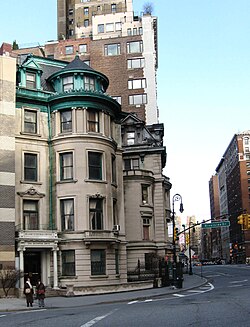
Between 72nd and 125th streets, nearly every block of Riverside Drive is part of a New York City historic district, and the buildings on these blocks date from before World War II. The eastern side of Riverside Drive originally included luxuriously finished row-houses interspersed with free-standing mansions, though few of the mansions remain. Some remaining mansions are the Schinasi Mansion on 107th and the Isaac L. Rice Mansion on 89th. Many of Riverside Drive's apartment buildings date from between the 1900s and the 1930s, with curving facades along the avenue; some of these buildings are designated as city landmarks. Along Riverside Drive, there are also numerous monuments such as Grant's Tomb and the Soldiers' and Sailors' Monument, in addition to other structures such as Riverside Church. Riverside Drive has received commentary for its landscape features and architecture, and it has been depicted in works of popular media.
Starting at 72nd Street, Riverside Drive passes through the Manhattan neighborhoods of the Upper West Side, Morningside Heights, Manhattanville, Hamilton Heights, and Washington Heights. Commercial vehicles are banned from parts of Riverside Drive.
Unlike other avenues in Manhattan, Riverside Drive is curved because its original designer, Frederick Law Olmsted, did not like sharp corners. A narrow service road diverges from Riverside Drive at several points, creating traffic islands. For a short stretch near 122nd Street, the avenue splits into two roadways, one each to the west and east of Grant's Tomb; the western roadway carries southbound traffic, while the eastern roadway carries northbound traffic. There are several viaducts along the route of Riverside Drive, including at 96th Street on the Upper West Side; between Tiemann Place and 135th Street in Manhattanville; and between 155th and 161st streets in Hamilton Heights. The street atop the viaduct in Hamilton Heights is officially named Riverside Drive West, while the original Riverside Drive curves inland.
North of 181st Street, Riverside Drive merges with the northbound lanes of the Henry Hudson Parkway; as such, there is a gap in the road between 181st Street and Dyckman Street. A disconnected section of Riverside Drive begins at the Henry Hudson Parkway's Dyckman Street exit in Inwood, ending at Broadway. South of 72nd Street, Riverside Drive continues as Riverside Boulevard, which extends south to 59th Street.
A small bridge carries Riverside Drive over 96th Street. The bridge, also known as the Riverside Bridge, was designed by Carrère and Hastings. When this overpass was built, it was described as a viaduct with buttresses and stone terraces leading down to Riverside Park and the Hudson River. Semicircular shelters were also built next to the viaduct on either side of 96th Street. Although the overpass is clad with stone, its superstructure is made of steel. As built, it had four elaborate electric lampposts, each measuring 15 feet (4.6 m) high.
Between Tiemann Place and 135th Street is the Manhattan Valley Viaduct, which carries Riverside Drive above 12th Avenue. Built in 1901, it is variously called the 125th Street Viaduct or Riverside Drive Viaduct. Murray Roe designed the Manhattan Valley Viaduct, while Francis Stuart Williamson was the chief engineer. Despite the structure's utilitarian role as a highway, it was also a strong symbol of civic pride, inspired by America's late 19th-century City Beautiful movement. The viaduct's original roadway, wide pedestrian walks and overall design was highly ornamented. The surrounding area is part of the Manhattanville valley, which contains a fault.
Riverside Drive (Manhattan)
Riverside Drive is a north–south avenue in the New York City borough of Manhattan. The road runs on the west side of Upper Manhattan, generally paralleling the Hudson River and Riverside Park between 72nd Street and the vicinity of the George Washington Bridge at 181st Street. North of 96th Street, Riverside Drive is a wide divided roadway. At several locations, a serpentine service road diverges from the main road, providing access to the residential buildings. Several viaducts connect the various segments of Riverside Drive, including the 2,047-foot (624 m) Manhattan Valley Viaduct between Tiemann Place and 135th Street. A disconnected section of Riverside Drive exists in Inwood, Manhattan. The New York City Landmarks Preservation Commission has designated the original section of Riverside Drive, between 72nd and 125th streets, as part of a scenic landmark that also includes Riverside Park.
Riverside Drive was proposed as part of Riverside Park, which was established by land condemnation in 1872. Originally known as Riverside Avenue, the road opened in 1880 and originally ran between 72nd Street and the current site of Grant's Tomb. The park and avenue were originally designed by architects and horticulturalists such as Calvert Vaux and Samuel Parsons. Riverside Drive was extended north to 155th Street in the 1900s, and a viaduct carrying Riverside Drive West between 155th and 161st streets was built in the 1920s. Traffic flow on Riverside Drive was modified several times throughout the years, and the viaducts have been renovated as well. A southern extension, known as Riverside Boulevard, was built starting in the 1990s when the Riverside South complex was developed.
Between 72nd and 125th streets, nearly every block of Riverside Drive is part of a New York City historic district, and the buildings on these blocks date from before World War II. The eastern side of Riverside Drive originally included luxuriously finished row-houses interspersed with free-standing mansions, though few of the mansions remain. Some remaining mansions are the Schinasi Mansion on 107th and the Isaac L. Rice Mansion on 89th. Many of Riverside Drive's apartment buildings date from between the 1900s and the 1930s, with curving facades along the avenue; some of these buildings are designated as city landmarks. Along Riverside Drive, there are also numerous monuments such as Grant's Tomb and the Soldiers' and Sailors' Monument, in addition to other structures such as Riverside Church. Riverside Drive has received commentary for its landscape features and architecture, and it has been depicted in works of popular media.
Starting at 72nd Street, Riverside Drive passes through the Manhattan neighborhoods of the Upper West Side, Morningside Heights, Manhattanville, Hamilton Heights, and Washington Heights. Commercial vehicles are banned from parts of Riverside Drive.
Unlike other avenues in Manhattan, Riverside Drive is curved because its original designer, Frederick Law Olmsted, did not like sharp corners. A narrow service road diverges from Riverside Drive at several points, creating traffic islands. For a short stretch near 122nd Street, the avenue splits into two roadways, one each to the west and east of Grant's Tomb; the western roadway carries southbound traffic, while the eastern roadway carries northbound traffic. There are several viaducts along the route of Riverside Drive, including at 96th Street on the Upper West Side; between Tiemann Place and 135th Street in Manhattanville; and between 155th and 161st streets in Hamilton Heights. The street atop the viaduct in Hamilton Heights is officially named Riverside Drive West, while the original Riverside Drive curves inland.
North of 181st Street, Riverside Drive merges with the northbound lanes of the Henry Hudson Parkway; as such, there is a gap in the road between 181st Street and Dyckman Street. A disconnected section of Riverside Drive begins at the Henry Hudson Parkway's Dyckman Street exit in Inwood, ending at Broadway. South of 72nd Street, Riverside Drive continues as Riverside Boulevard, which extends south to 59th Street.
A small bridge carries Riverside Drive over 96th Street. The bridge, also known as the Riverside Bridge, was designed by Carrère and Hastings. When this overpass was built, it was described as a viaduct with buttresses and stone terraces leading down to Riverside Park and the Hudson River. Semicircular shelters were also built next to the viaduct on either side of 96th Street. Although the overpass is clad with stone, its superstructure is made of steel. As built, it had four elaborate electric lampposts, each measuring 15 feet (4.6 m) high.
Between Tiemann Place and 135th Street is the Manhattan Valley Viaduct, which carries Riverside Drive above 12th Avenue. Built in 1901, it is variously called the 125th Street Viaduct or Riverside Drive Viaduct. Murray Roe designed the Manhattan Valley Viaduct, while Francis Stuart Williamson was the chief engineer. Despite the structure's utilitarian role as a highway, it was also a strong symbol of civic pride, inspired by America's late 19th-century City Beautiful movement. The viaduct's original roadway, wide pedestrian walks and overall design was highly ornamented. The surrounding area is part of the Manhattanville valley, which contains a fault.
Recent media
Recent media