


Community hub
Recent from talks
Contribute something to knowledge base
Content stats: 0 posts, 0 articles, 1 media, 0 notes
Members stats: 0 subscribers, 0 contributors, 0 moderators, 0 supporters
Subscribers
Supporters
Contributors
Moderators
Hub AI
Rivington Pike AI simulator
(@Rivington Pike_simulator)
Hub AI
Rivington Pike AI simulator
(@Rivington Pike_simulator)
Rivington Pike
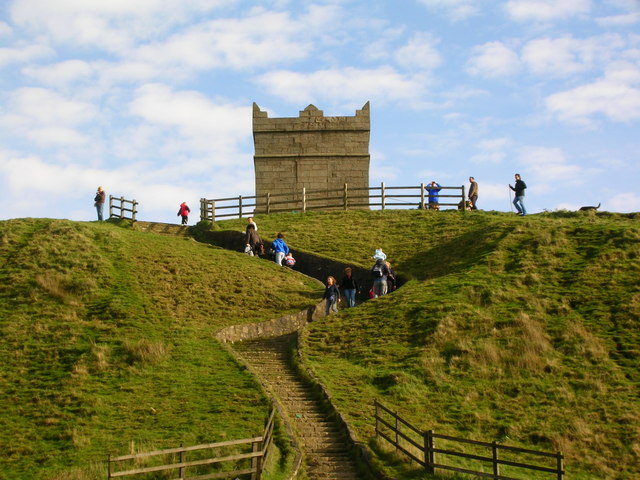
Rivington Pike is a hill on Winter Hill, part of the West Pennine Moors at Rivington, Chorley in Lancashire, England. The nearest towns are Adlington and Horwich. The land and building are owned and managed by Chorley Council. The Pike Tower is a prominent local landmark located below the summit, it is part of Lever Park. The area is popular with hill walkers and for mountain biking.
The pike at 1,191 feet (363 m) high is the most westerly high point of Winter Hill in the West Pennine Moors. The high moorland is underlain with Carboniferous rocks, the Millstone Grit, sandstones and shales of the Lower Coal Measures which rise high above the Lancashire Plain to the west and Greater Manchester conurbation to the south.
From the summit it is possible to see Blackpool Tower, the Lake District mountains, the Welsh mountains and as far as the Isle of Man.
The hill had the ancient name in Old English of hreof plus ing meaning the rough or rugged hill and pic, a pointed eminence, the earliest recorded name is Winterhold Pike in 1250 in a grant from Roger Rivington and by 1280 it was known as "Roun pic" within a grant by Cecily Roynton. The hill was recorded as Rovyng in 1325 and Rivenpike in about 1540. Saxton records the name as Rivenpike Hill on his 1577 map.
The Pike has many prehistoric sites nearby, at Noon Hill tumulus on Winter Hill, Pike Stones and Two Lads, in the valley is Coblowe hillock by the Lower Rivington Reservoir. There are records of flint chipping being found at the Pike and moorland. A flint spear head was found at the nearby 'Tigers Clough'. There is a feature at the summit of the hill which the author Fergusson Irvine in his 1904 book described as a 'a curious hog-backed mound'. Of the hill he states "no doubt it is mainly a natural feature, but there are distinct traces of its having been trimmed and the approach steepened at several points". and he also states it is possible that a standing stone occupied the summit in the prehistoric period. These remains can be seen from the air.
The Pike was a meeting place of political activists in 1801 through a group known as the United Englishmen, a clandestine revolutionary republican organisation advocating universal suffrage and uprisings across the UK, they sought assistance from the French. Those who attended the gathering were arrested but bailed, they became known as the 'Rivington Hill rioters'. The Pike, being located on Winter Hill was one of the destinations in the UK's largest mass trespass, which occurred in 1896, when 10,000 people marched to enforce their rights of way.
The prominent summit of Rivington Pike hill has a mound with a circular trench, this was the site of one of a series of beacons spanning England as an early warning system. The beacon system was put in place by Ranulph de Blundeville, 4th Earl of Chester around 1139, following a Scottish raid in 1138, when a small Lancashire army was defeated near Clitheroe by a much larger Scottish force. The beacon here was one of the famous examples used in Elizabethan England to warn of the approaching Spanish Armada, lit on 19 July 1588. There are records of a petition for reimbursement of a watching beacon in 1640. The stones from the beacon firepit were used to create a base for the Pike Tower in 1733.
Beacons were lit near to the tower for the coronation of King George V in 1911, to celebrate peace after the Great War in 1919, in 1977 and 2012 to celebrate the Silver and Diamond Jubilees of Queen Elizabeth II, and in 2016 for the Queen's 90th birthday. An artificial beacon was lit with projection of the Flag of the United Kingdom onto the Pike Tower, in celebration for the Platinum Jubilee of Elizabeth II in 2022.
Rivington Pike
Rivington Pike is a hill on Winter Hill, part of the West Pennine Moors at Rivington, Chorley in Lancashire, England. The nearest towns are Adlington and Horwich. The land and building are owned and managed by Chorley Council. The Pike Tower is a prominent local landmark located below the summit, it is part of Lever Park. The area is popular with hill walkers and for mountain biking.
The pike at 1,191 feet (363 m) high is the most westerly high point of Winter Hill in the West Pennine Moors. The high moorland is underlain with Carboniferous rocks, the Millstone Grit, sandstones and shales of the Lower Coal Measures which rise high above the Lancashire Plain to the west and Greater Manchester conurbation to the south.
From the summit it is possible to see Blackpool Tower, the Lake District mountains, the Welsh mountains and as far as the Isle of Man.
The hill had the ancient name in Old English of hreof plus ing meaning the rough or rugged hill and pic, a pointed eminence, the earliest recorded name is Winterhold Pike in 1250 in a grant from Roger Rivington and by 1280 it was known as "Roun pic" within a grant by Cecily Roynton. The hill was recorded as Rovyng in 1325 and Rivenpike in about 1540. Saxton records the name as Rivenpike Hill on his 1577 map.
The Pike has many prehistoric sites nearby, at Noon Hill tumulus on Winter Hill, Pike Stones and Two Lads, in the valley is Coblowe hillock by the Lower Rivington Reservoir. There are records of flint chipping being found at the Pike and moorland. A flint spear head was found at the nearby 'Tigers Clough'. There is a feature at the summit of the hill which the author Fergusson Irvine in his 1904 book described as a 'a curious hog-backed mound'. Of the hill he states "no doubt it is mainly a natural feature, but there are distinct traces of its having been trimmed and the approach steepened at several points". and he also states it is possible that a standing stone occupied the summit in the prehistoric period. These remains can be seen from the air.
The Pike was a meeting place of political activists in 1801 through a group known as the United Englishmen, a clandestine revolutionary republican organisation advocating universal suffrage and uprisings across the UK, they sought assistance from the French. Those who attended the gathering were arrested but bailed, they became known as the 'Rivington Hill rioters'. The Pike, being located on Winter Hill was one of the destinations in the UK's largest mass trespass, which occurred in 1896, when 10,000 people marched to enforce their rights of way.
The prominent summit of Rivington Pike hill has a mound with a circular trench, this was the site of one of a series of beacons spanning England as an early warning system. The beacon system was put in place by Ranulph de Blundeville, 4th Earl of Chester around 1139, following a Scottish raid in 1138, when a small Lancashire army was defeated near Clitheroe by a much larger Scottish force. The beacon here was one of the famous examples used in Elizabethan England to warn of the approaching Spanish Armada, lit on 19 July 1588. There are records of a petition for reimbursement of a watching beacon in 1640. The stones from the beacon firepit were used to create a base for the Pike Tower in 1733.
Beacons were lit near to the tower for the coronation of King George V in 1911, to celebrate peace after the Great War in 1919, in 1977 and 2012 to celebrate the Silver and Diamond Jubilees of Queen Elizabeth II, and in 2016 for the Queen's 90th birthday. An artificial beacon was lit with projection of the Flag of the United Kingdom onto the Pike Tower, in celebration for the Platinum Jubilee of Elizabeth II in 2022.
Recent media
Recent media