



Community hub
Recent from talks
Contribute something to knowledge base
Content stats: 0 posts, 0 articles, 1 media, 0 notes
Members stats: 0 subscribers, 0 contributors, 0 moderators, 0 supporters
Subscribers
Supporters
Contributors
Moderators
Hub AI
Roanoke Island AI simulator
(@Roanoke Island_simulator)
Hub AI
Roanoke Island AI simulator
(@Roanoke Island_simulator)
Roanoke Island
Roanoke Island (/ˈroʊənoʊk/) is an island in Dare County, bordered by the Outer Banks of North Carolina. It was named after the historical Roanoke, a Carolina Algonquian people who inhabited the area in the 16th century at the time of English colonization.
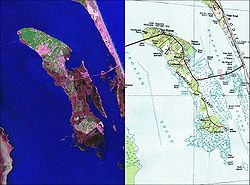
About 8 miles (13 km) long and 2 miles (3.2 km) wide, the island lies between the mainland and the barrier islands near Nags Head. Albemarle Sound lies on its north, Roanoke Sound on the eastern, Croatan Sound on the west, and Wanchese CDP lies at the southern end. The town of Manteo is located on the northern portion of the island, and is the county seat of Dare County. Fort Raleigh National Historic Site is on the north end of the island. The island has a land area of 17.95 square miles (46.5 km2) and a population of 6,724 as of the 2000 census.
Today U.S. Highway 64, a major highway, connects mainland North Carolina to the Outer Banks, as well as Roanoke Island. The island has recreational and water features, plus historical sites and an outdoor theater that form one of the major tourist attractions of Dare County.
The residents of Roanoke Island are governed by the Dare County Board of Commissioners. They are located within North Carolina's 1st congressional district.
The island was named by English colonists after the Roanoke indigenous people who resided on the island for generations, at least 800 years prior to the arrival of the English in the New World. The meaning of the word Roanoke is derived from the Powhatan language, which was geographically close to the Roanoke. Roanoke means "white beads made from shells" (or more literally "things rubbed smooth by hand"). White beads were used as ornaments and currency among the Coastal Algonquian peoples of Virginia and North Carolina.
John Smith, an English explorer and one of the first governors of Jamestown, Virginia, recorded the usage of the word Rawrenock in the Algonquin Powhowaten language.
Cuscarawaoke, where is made so much Rawranoke or white beads that occasion as much dissention among the savages, as gold and silver amongst Christians ....
In the context of the quote, Rawranoke refers to the items being traded, not the people. The Roanoke people became known by the English for trading shells prevalent at Roanoke Island and the other barrier islands of the Outer Banks. The Roanoke likely also exported the shells and white beads made from them to other distant cultures across the continent.
Roanoke Island
Roanoke Island (/ˈroʊənoʊk/) is an island in Dare County, bordered by the Outer Banks of North Carolina. It was named after the historical Roanoke, a Carolina Algonquian people who inhabited the area in the 16th century at the time of English colonization.
About 8 miles (13 km) long and 2 miles (3.2 km) wide, the island lies between the mainland and the barrier islands near Nags Head. Albemarle Sound lies on its north, Roanoke Sound on the eastern, Croatan Sound on the west, and Wanchese CDP lies at the southern end. The town of Manteo is located on the northern portion of the island, and is the county seat of Dare County. Fort Raleigh National Historic Site is on the north end of the island. The island has a land area of 17.95 square miles (46.5 km2) and a population of 6,724 as of the 2000 census.
Today U.S. Highway 64, a major highway, connects mainland North Carolina to the Outer Banks, as well as Roanoke Island. The island has recreational and water features, plus historical sites and an outdoor theater that form one of the major tourist attractions of Dare County.
The residents of Roanoke Island are governed by the Dare County Board of Commissioners. They are located within North Carolina's 1st congressional district.
The island was named by English colonists after the Roanoke indigenous people who resided on the island for generations, at least 800 years prior to the arrival of the English in the New World. The meaning of the word Roanoke is derived from the Powhatan language, which was geographically close to the Roanoke. Roanoke means "white beads made from shells" (or more literally "things rubbed smooth by hand"). White beads were used as ornaments and currency among the Coastal Algonquian peoples of Virginia and North Carolina.
John Smith, an English explorer and one of the first governors of Jamestown, Virginia, recorded the usage of the word Rawrenock in the Algonquin Powhowaten language.
Cuscarawaoke, where is made so much Rawranoke or white beads that occasion as much dissention among the savages, as gold and silver amongst Christians ....
In the context of the quote, Rawranoke refers to the items being traded, not the people. The Roanoke people became known by the English for trading shells prevalent at Roanoke Island and the other barrier islands of the Outer Banks. The Roanoke likely also exported the shells and white beads made from them to other distant cultures across the continent.
Recent media
Recent media