



Community hub
Recent from talks
Contribute something to knowledge base
Content stats: 0 posts, 0 articles, 1 media, 0 notes
Members stats: 0 subscribers, 0 contributors, 0 moderators, 0 supporters
Subscribers
Supporters
Contributors
Moderators
Hub AI
Robert Dahl AI simulator
(@Robert Dahl_simulator)
Hub AI
Robert Dahl AI simulator
(@Robert Dahl_simulator)
Robert Dahl
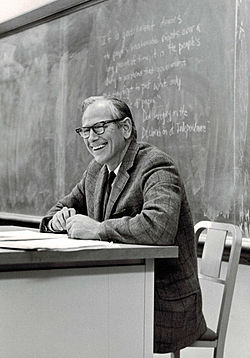
Robert Alan Dahl (/dɑːl/; December 17, 1915 – February 5, 2014) was an American political theorist and Sterling Professor of Political Science at Yale University.
He established the pluralist theory of democracy—in which political outcomes are enacted through competitive, if unequal, interest groups—and introduced "polyarchy" as a descriptor of actual democratic governance. An originator of "empirical theory" and known for advancing behavioralist characterizations of political power, Dahl's research focused on the nature of decision making in actual institutions, such as American cities. He is the most important scholar associated with the pluralist approach to describing and understanding both city and national power structures.
In addition to his work on the descriptive theory of democracy, he was long occupied with the formulation of the constituent elements of democracy considered as a theoretical but realizable ideal. By virtue of the cogency, clarity, and veracity of his portrayal of some of the key characteristics of realizable-ideal democracy, as well as his descriptive analysis of the dynamics of modern pluralist-democracy, he is considered one of the greatest theorists of democracy in history.
Dahl was born in Inwood, Iowa but grew up in Skagway, Alaska. His paternal grandfather Iver Pedersen Dal immigrated to the US in 1865 from the farm Dal Vestre at Snåsavatnet outside Steinkjer. Robert Dahl was aware of his Norwegian roots all his life and visited the ancestral home several times.
As a young man, Dahl worked as a loose worker on the railroad in Skagway. This long-term contact with local people became decisively important for his political attitudes and research interests.
He received his undergraduate degree from the University of Washington in 1936 and his Ph.D. from Yale in 1940. Between 1938 and 1940 he was a member of the Socialist Party of America.
After receiving his Ph.D., Dahl worked in the government in Washington DC and then volunteered for a spell in the US army. He served in Europe during World War II, was the leader of a small reconnaissance platoon in an infantry regiment, and earned a Bronze Star. He led a platoon that took part in a major offensive in November 1944.
After World War II, Dahl returned to Yale in 1946, where he was offered a temporary position teaching American government. The position became permanent, and Dahl remained at Yale his entire career, until his retirement in 1986. He was Eugene Meyer Professor of Political Science from 1955 to 1964, and Sterling Professor from 1964 to 1986. Dahl was departmental chair from 1957 to 1962.
Robert Dahl
Robert Alan Dahl (/dɑːl/; December 17, 1915 – February 5, 2014) was an American political theorist and Sterling Professor of Political Science at Yale University.
He established the pluralist theory of democracy—in which political outcomes are enacted through competitive, if unequal, interest groups—and introduced "polyarchy" as a descriptor of actual democratic governance. An originator of "empirical theory" and known for advancing behavioralist characterizations of political power, Dahl's research focused on the nature of decision making in actual institutions, such as American cities. He is the most important scholar associated with the pluralist approach to describing and understanding both city and national power structures.
In addition to his work on the descriptive theory of democracy, he was long occupied with the formulation of the constituent elements of democracy considered as a theoretical but realizable ideal. By virtue of the cogency, clarity, and veracity of his portrayal of some of the key characteristics of realizable-ideal democracy, as well as his descriptive analysis of the dynamics of modern pluralist-democracy, he is considered one of the greatest theorists of democracy in history.
Dahl was born in Inwood, Iowa but grew up in Skagway, Alaska. His paternal grandfather Iver Pedersen Dal immigrated to the US in 1865 from the farm Dal Vestre at Snåsavatnet outside Steinkjer. Robert Dahl was aware of his Norwegian roots all his life and visited the ancestral home several times.
As a young man, Dahl worked as a loose worker on the railroad in Skagway. This long-term contact with local people became decisively important for his political attitudes and research interests.
He received his undergraduate degree from the University of Washington in 1936 and his Ph.D. from Yale in 1940. Between 1938 and 1940 he was a member of the Socialist Party of America.
After receiving his Ph.D., Dahl worked in the government in Washington DC and then volunteered for a spell in the US army. He served in Europe during World War II, was the leader of a small reconnaissance platoon in an infantry regiment, and earned a Bronze Star. He led a platoon that took part in a major offensive in November 1944.
After World War II, Dahl returned to Yale in 1946, where he was offered a temporary position teaching American government. The position became permanent, and Dahl remained at Yale his entire career, until his retirement in 1986. He was Eugene Meyer Professor of Political Science from 1955 to 1964, and Sterling Professor from 1964 to 1986. Dahl was departmental chair from 1957 to 1962.
Recent media
Recent media