



Community hub
Recent from talks
Contribute something to knowledge base
Content stats: 0 posts, 0 articles, 1 media, 0 notes
Members stats: 0 subscribers, 0 contributors, 0 moderators, 0 supporters
Subscribers
Supporters
Contributors
Moderators
Hub AI
Robert Emmet AI simulator
(@Robert Emmet_simulator)
Hub AI
Robert Emmet AI simulator
(@Robert Emmet_simulator)
Robert Emmet
Robert Emmet (4 March 1778 – 20 September 1803) was an Irish Republican, orator and rebel leader. Following the suppression of the United Irish uprising in 1798, he sought to organise a renewed attempt in Ireland to overthrow the British Crown and Protestant Ascendancy in Ireland, and to break the recently enforced union with Great Britain. Emmet entertained, but ultimately abandoned, hopes of immediate French assistance and of coordination with radical militants in Great Britain. In Ireland, many of the surviving veterans of '98 hesitated to lend their support, and his rising in Dublin in 1803 proved abortive.
Emmet’s Proclamation of the Provisional Government to the People of Ireland, his Speech from the Dock, and his "sacrificial" end on the gallows inspired later generations of Irish republicans. His memory was invoked by Patrick Pearse who in 1916 was again to proclaim a provisional government in Dublin.
Emmet was born at 109 St. Stephen's Green, in Dublin on 4 March 1778. He was the youngest son of Dr Robert Emmet (1729–1802), physician to the Lord Lieutenant, and his wife, Elizabeth Mason (1739–1803). The Emmets were financially comfortable, members of the Protestant Ascendancy with a house at St Stephen's Green and a country residence near Milltown.
Dr Emmet supported the cause of American independence and was a well-known figure on the fringes of the Irish patriot movement. Theobald Wolfe Tone, a friend of Emmet's elder brother, Thomas Addis Emmet, and an advocate of more radical reform, including Catholic Emancipation, was a visitor to the house. So too, as a friend of his father, was Dr William Drennan, the original proposer of the "benevolent conspiracy--a plot for the people" that was to call itself, at Tone's suggestion, the Society of United Irishmen.
Robert Emmet was educated first at Oswald's School in Dapping Court, near Golden Lane, and then at the English grammar school of Samuel Whyte at 75 Grafton Street. One of his schoolmates was the poet, lyricist and squib writer Thomas Moore; Arthur Wellesley, the future Duke of Wellington, had been a pupil a few years earlier. After this he was tutored by the Rev Mr Lewis of Camden Street.
Emmet entered Trinity College Dublin in October 1793 as a precocious fifteen-year-old and excelled as a student of history and chemistry. In December 1797, he joined Thomas Moore in the College Historical Society. His brother Thomas and Wolfe Tone, preceding him in the society, maintained its lively tradition (stretching back to Edmund Burke) of defying the College's injunction against discussing questions of "modern politics".
Moore recalled that men "of advanced standing and reputation for oratory, came to attend our debates, expressly for the purpose of answering [Robert] Emmet". His eloquence was unmatched. In the preface to his Irish Melodies (1837), he recounts Emmet "ardently" taking the side of Democracy in the debate "Whether an Aristocracy or a Democracy is most favourable to the advancement of science and literature?". In "another of his remarkable speeches", he recalls Emmet saying, "When a people, advancing rapidly in knowledge and power, perceive at last how far their government is lagging behind them, what then, I ask, is to be done in such a case? What, but to pull the government up to the people?"
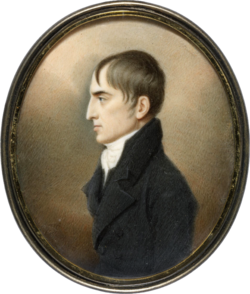
Robert Emmet is described by his contemporaries as slight in person; his features were regular, his forehead high, his eyes bright and full of expression, his nose sharp, thin, and straight, the lower part of his face slightly pock-marked, his complexion sallow.
Robert Emmet
Robert Emmet (4 March 1778 – 20 September 1803) was an Irish Republican, orator and rebel leader. Following the suppression of the United Irish uprising in 1798, he sought to organise a renewed attempt in Ireland to overthrow the British Crown and Protestant Ascendancy in Ireland, and to break the recently enforced union with Great Britain. Emmet entertained, but ultimately abandoned, hopes of immediate French assistance and of coordination with radical militants in Great Britain. In Ireland, many of the surviving veterans of '98 hesitated to lend their support, and his rising in Dublin in 1803 proved abortive.
Emmet’s Proclamation of the Provisional Government to the People of Ireland, his Speech from the Dock, and his "sacrificial" end on the gallows inspired later generations of Irish republicans. His memory was invoked by Patrick Pearse who in 1916 was again to proclaim a provisional government in Dublin.
Emmet was born at 109 St. Stephen's Green, in Dublin on 4 March 1778. He was the youngest son of Dr Robert Emmet (1729–1802), physician to the Lord Lieutenant, and his wife, Elizabeth Mason (1739–1803). The Emmets were financially comfortable, members of the Protestant Ascendancy with a house at St Stephen's Green and a country residence near Milltown.
Dr Emmet supported the cause of American independence and was a well-known figure on the fringes of the Irish patriot movement. Theobald Wolfe Tone, a friend of Emmet's elder brother, Thomas Addis Emmet, and an advocate of more radical reform, including Catholic Emancipation, was a visitor to the house. So too, as a friend of his father, was Dr William Drennan, the original proposer of the "benevolent conspiracy--a plot for the people" that was to call itself, at Tone's suggestion, the Society of United Irishmen.
Robert Emmet was educated first at Oswald's School in Dapping Court, near Golden Lane, and then at the English grammar school of Samuel Whyte at 75 Grafton Street. One of his schoolmates was the poet, lyricist and squib writer Thomas Moore; Arthur Wellesley, the future Duke of Wellington, had been a pupil a few years earlier. After this he was tutored by the Rev Mr Lewis of Camden Street.
Emmet entered Trinity College Dublin in October 1793 as a precocious fifteen-year-old and excelled as a student of history and chemistry. In December 1797, he joined Thomas Moore in the College Historical Society. His brother Thomas and Wolfe Tone, preceding him in the society, maintained its lively tradition (stretching back to Edmund Burke) of defying the College's injunction against discussing questions of "modern politics".
Moore recalled that men "of advanced standing and reputation for oratory, came to attend our debates, expressly for the purpose of answering [Robert] Emmet". His eloquence was unmatched. In the preface to his Irish Melodies (1837), he recounts Emmet "ardently" taking the side of Democracy in the debate "Whether an Aristocracy or a Democracy is most favourable to the advancement of science and literature?". In "another of his remarkable speeches", he recalls Emmet saying, "When a people, advancing rapidly in knowledge and power, perceive at last how far their government is lagging behind them, what then, I ask, is to be done in such a case? What, but to pull the government up to the people?"
Robert Emmet is described by his contemporaries as slight in person; his features were regular, his forehead high, his eyes bright and full of expression, his nose sharp, thin, and straight, the lower part of his face slightly pock-marked, his complexion sallow.
Recent media
Recent media