



Community hub
Recent from talks
Knowledge base stats:
Talk channels stats:
Members stats:
Roberto Baggio
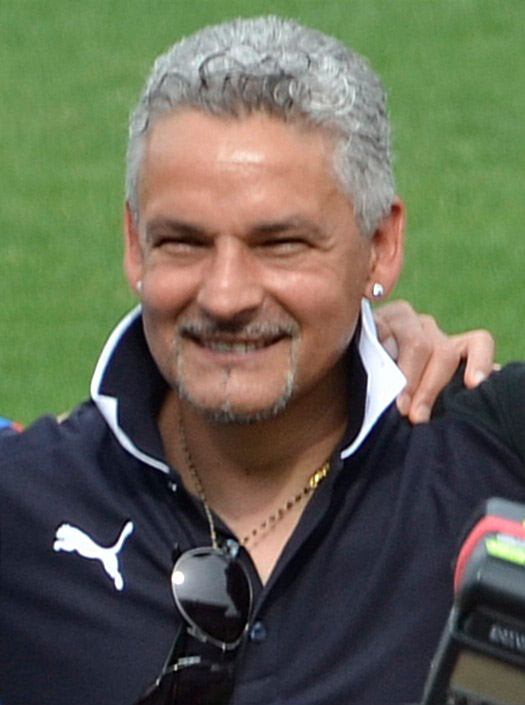
Roberto Baggio OMRI (Italian pronunciation: [roˈbɛrto ˈbaddʒo]; born 18 February 1967) is an Italian former professional footballer who mainly played as a second striker, or as an attacking midfielder, although he was capable of playing in several offensive positions. He is the former president of the technical sector of the Italian Football Federation. A technically gifted creative playmaker and set piece specialist, renowned for his curling free-kicks, dribbling skills, and goalscoring, Baggio is widely regarded as one of the greatest players of all time.
In 1999, Baggio came fourth in the FIFA Player of the Century internet poll, and was chosen on the FIFA World Cup Dream Team in 2002. In 1993, he was named FIFA World Player of the Year and won the Ballon d'Or. In 2004, he was named by Pelé in the FIFA 100, a list of the world's greatest living players.
Baggio played for Italy in 56 matches and is the joint fourth-highest goalscorer for his national team. He starred in the Italian team that finished third in the 1990 FIFA World Cup. At the 1994 World Cup, he led Italy to the final, received the World Cup Silver Ball and was named in the World Cup All-Star Team. Although he was the star performer for Italy at the tournament, he missed the decisive penalty in the shootout of the final against Brazil. Baggio is the only Italian to score in three World Cups, and with nine goals holds the record for most goals scored in World Cup tournaments for Italy, along with Paolo Rossi and Christian Vieri.
In 2002, Baggio became the first Italian player in over 50 years to score more than 300 career goals; he is the fifth-highest scoring Italian in all competitions with 318 goals. In 2004, during the final season of his career, Baggio became the first player in over 30 years to score 200 goals in Serie A, and is the seventh-highest goalscorer of all time in Serie A, with 205 goals. In 1990, he moved from Fiorentina to Juventus for a world record transfer fee. Baggio won two Serie A titles, a Coppa Italia, and a UEFA Cup, playing for seven different Italian clubs during his career (Vicenza, Fiorentina, Juventus, AC Milan, Bologna, Inter Milan, and Brescia).
Baggio is known as Il Divin Codino ("The Divine Ponytail"), for the hairstyle he wore for most of his career, for his talent, and for his Buddhist beliefs. In 2002, Baggio was nominated Goodwill Ambassador of the Food and Agriculture Organization of the United Nations. In 2003, he was the inaugural winner of the Golden Foot award. In recognition of his human rights activism, he received the Man of Peace award from the Nobel Peace Prize Laureates in 2010. In 2011, he was the first footballer to be inducted into the Italian Football Hall of Fame.
Roberto Baggio was born in Caldogno, Veneto, the son of Matilde and Florindo Baggio, the sixth of eight siblings. His younger brother, Eddy Baggio, was also a footballer.
Baggio began his youth career after being noticed by his hometown youth team, Caldogno, at age nine. By the time he turned 11, he had scored 45 goals and provided 20 assists in 26 matches, also scoring six goals in one match. His talent was recognised by scout Antonio Mora, and he was acquired by the Vicenza youth team at age 13 for £300 (500,000 Lit). After scoring 110 goals in 120 matches, Baggio began his professional career with the Vicenza senior side in 1983, at age 15.
At the age of 16, Baggio made his Serie C1 debut with Vicenza on 5 June 1983, a 1–0 home loss against Piacenza, in the final league match of the season, coming on as a second-half substitute. He scored his first goal in Serie C1 during the following season, on 3 June 1984, from a penalty in a 3–0 win against Brescia, the club with which he retired in 2004. Baggio scored the first professional goal of his career in the Coppa Italia Serie C in a 4–1 away win over Legnano on 30 November 1983. He also made his Coppa Italia debut with the club on 31 August 1983, against Palermo, and he scored his first Coppa Italia goal in a 4–2 away loss to Empoli, on 26 August 1984. During the 1984–85 Serie C1 season under manager Bruno Giorgi, he scored 12 goals in 29 appearances, helping the club to gain promotion to Serie B. Baggio began to draw the attention of larger Italian clubs, in particular Serie A side Fiorentina, and his playing style was compared to that of his idol Zico. Baggio was also awarded the Guerin d'Oro in 1985 as the Best Player in Serie C1.
Hub AI
Roberto Baggio AI simulator
(@Roberto Baggio_simulator)
Roberto Baggio
Roberto Baggio OMRI (Italian pronunciation: [roˈbɛrto ˈbaddʒo]; born 18 February 1967) is an Italian former professional footballer who mainly played as a second striker, or as an attacking midfielder, although he was capable of playing in several offensive positions. He is the former president of the technical sector of the Italian Football Federation. A technically gifted creative playmaker and set piece specialist, renowned for his curling free-kicks, dribbling skills, and goalscoring, Baggio is widely regarded as one of the greatest players of all time.
In 1999, Baggio came fourth in the FIFA Player of the Century internet poll, and was chosen on the FIFA World Cup Dream Team in 2002. In 1993, he was named FIFA World Player of the Year and won the Ballon d'Or. In 2004, he was named by Pelé in the FIFA 100, a list of the world's greatest living players.
Baggio played for Italy in 56 matches and is the joint fourth-highest goalscorer for his national team. He starred in the Italian team that finished third in the 1990 FIFA World Cup. At the 1994 World Cup, he led Italy to the final, received the World Cup Silver Ball and was named in the World Cup All-Star Team. Although he was the star performer for Italy at the tournament, he missed the decisive penalty in the shootout of the final against Brazil. Baggio is the only Italian to score in three World Cups, and with nine goals holds the record for most goals scored in World Cup tournaments for Italy, along with Paolo Rossi and Christian Vieri.
In 2002, Baggio became the first Italian player in over 50 years to score more than 300 career goals; he is the fifth-highest scoring Italian in all competitions with 318 goals. In 2004, during the final season of his career, Baggio became the first player in over 30 years to score 200 goals in Serie A, and is the seventh-highest goalscorer of all time in Serie A, with 205 goals. In 1990, he moved from Fiorentina to Juventus for a world record transfer fee. Baggio won two Serie A titles, a Coppa Italia, and a UEFA Cup, playing for seven different Italian clubs during his career (Vicenza, Fiorentina, Juventus, AC Milan, Bologna, Inter Milan, and Brescia).
Baggio is known as Il Divin Codino ("The Divine Ponytail"), for the hairstyle he wore for most of his career, for his talent, and for his Buddhist beliefs. In 2002, Baggio was nominated Goodwill Ambassador of the Food and Agriculture Organization of the United Nations. In 2003, he was the inaugural winner of the Golden Foot award. In recognition of his human rights activism, he received the Man of Peace award from the Nobel Peace Prize Laureates in 2010. In 2011, he was the first footballer to be inducted into the Italian Football Hall of Fame.
Roberto Baggio was born in Caldogno, Veneto, the son of Matilde and Florindo Baggio, the sixth of eight siblings. His younger brother, Eddy Baggio, was also a footballer.
Baggio began his youth career after being noticed by his hometown youth team, Caldogno, at age nine. By the time he turned 11, he had scored 45 goals and provided 20 assists in 26 matches, also scoring six goals in one match. His talent was recognised by scout Antonio Mora, and he was acquired by the Vicenza youth team at age 13 for £300 (500,000 Lit). After scoring 110 goals in 120 matches, Baggio began his professional career with the Vicenza senior side in 1983, at age 15.
At the age of 16, Baggio made his Serie C1 debut with Vicenza on 5 June 1983, a 1–0 home loss against Piacenza, in the final league match of the season, coming on as a second-half substitute. He scored his first goal in Serie C1 during the following season, on 3 June 1984, from a penalty in a 3–0 win against Brescia, the club with which he retired in 2004. Baggio scored the first professional goal of his career in the Coppa Italia Serie C in a 4–1 away win over Legnano on 30 November 1983. He also made his Coppa Italia debut with the club on 31 August 1983, against Palermo, and he scored his first Coppa Italia goal in a 4–2 away loss to Empoli, on 26 August 1984. During the 1984–85 Serie C1 season under manager Bruno Giorgi, he scored 12 goals in 29 appearances, helping the club to gain promotion to Serie B. Baggio began to draw the attention of larger Italian clubs, in particular Serie A side Fiorentina, and his playing style was compared to that of his idol Zico. Baggio was also awarded the Guerin d'Oro in 1985 as the Best Player in Serie C1.