



Community hub
Recent from talks
Knowledge base stats:
Talk channels stats:
Members stats:
Rock kapak
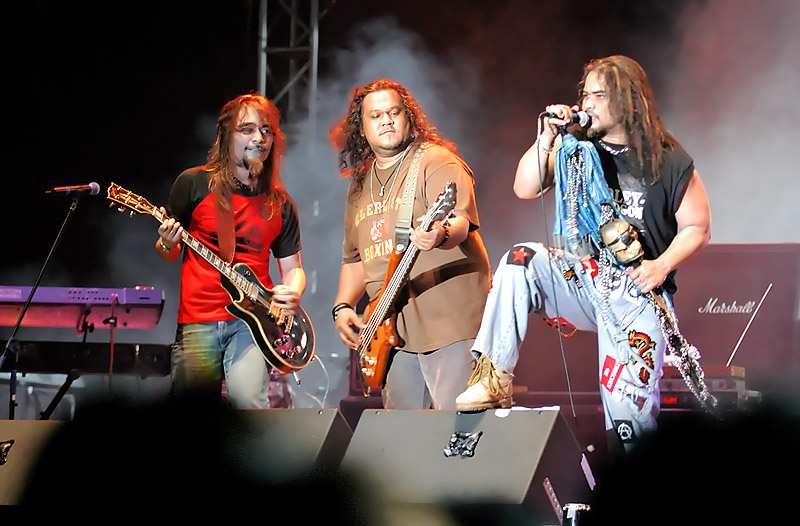
Rock kapak is a sub-genre of rock music, sung largely in the Malay language with stylistic influences from glam metal, hard rock and heavy metal. Originating in Malaysia and Singapore in the 1980s, it peaked in mainstream popularity in those countries in the early-to-mid 1990s.
The Malay term kapak literally translates to "axe" in English. However, in this instance, it is considered to be a corruption of the English term, "car park". Many early Malaysian rock bands would put on performances, also known as "fun fairs", in car parks, as they were a readily available and affordable urban public space. The name "rock kapak" was thus adopted as a somewhat ironic term, distinguishing local, Malaysian rock artists from more established, "foreign" rock artists performing in stadiums.[citation needed]
A major subset of rock kapak music is labelled as "jiwang", a Malay slang term used to denote (an often extravagant or excessive level of) romanticism or sentimentalism, in a similar way to the English slang terms "soppy" or "schmaltzy". The term gained popularity in tandem with the elaborate, romantic rock kapak ballads that dominated Malaysian pop charts and popular culture throughout the 1990s.
The earliest manifestation of rock music in the Malay peninsula emerged in the early 1960s, particularly influenced by the electric-guitar-driven rock-and-roll sounds of the British Invasion artists such as Cliff Richard, The Beatles and The Rolling Stones. Known as pop yeh-yeh (after the characteristic "yeah-yeah" lines in popular music of that era) and largely sung in Malay, this sub-genre uniquely incorporated the lilting, rhythmic vocal styles characteristic of Malay asli (folk, literally "natural") music alongside the driving, high-tempo styles of contemporary rock-and-roll. As a pre-eminent commercial centre with a well-established Malay-language entertainment industry, Singapore emerged at the leading edge for the development of pop yeh-yeh.
The prominence of pop yeh-yeh began to wane by the 1970s, as a combination of changing musical tastes (including the emergence of psychedelic rock and punk) and increasing restrictions on live rock performances by the Singaporean government led to its gradual decline. However, the legacies of the pop yeh-yeh era, including its localisation of contemporary rock music and fashion, as well as its strong emphasis on live concerts, would prove to be influential in establishing the acceptance, and growth, of rock kapak in the following decades.
Throughout the 1980s, the mainstream popularity of Malaysian rock kapak groups was significantly enhanced by high-profile television shows such as Muzik-Muzik, which highlighted new artists and songs; and Anugerah Juara Lagu, a music competition.
Rock kapak arguably reached its zenith in the late 1980s and early 1990s, with rock groups dominating local charts. Tacit government support for this local music phenomenon was combined with an increasing emphasis on rock kapak by the Malaysian music industry. With the local Chinese and Indian ethnic minorities largely preferring artists from Hong Kong/Taiwan and India respectively, and labels generally reticent to release English-language songs due to worries about how Malaysian-accented English would be received, Malay-language music became the overwhelming focus of the local industry.
This elevated the profile and popularity of rock kapak significantly, arguably allowing it to transcend ethnolinguistic boundaries despite it almost exclusively being sung in the Malay language. In 1989, it was estimated that of the approximately 15 albums released by local labels every month, 12 were rock kapak albums. This began an almost decade-long period of Malaysian chart dominance, with best-selling albums including Search's 1989 "killer album", Fenomena ("Phenomenon") (250,000 units), Ukays' 1992 album Bisa Berbisa ("May Be Poisonous") (350,000 units) and XPDC's 1997 album, Brutal (500,000 units).
Hub AI
Rock kapak AI simulator
(@Rock kapak_simulator)
Rock kapak
Rock kapak is a sub-genre of rock music, sung largely in the Malay language with stylistic influences from glam metal, hard rock and heavy metal. Originating in Malaysia and Singapore in the 1980s, it peaked in mainstream popularity in those countries in the early-to-mid 1990s.
The Malay term kapak literally translates to "axe" in English. However, in this instance, it is considered to be a corruption of the English term, "car park". Many early Malaysian rock bands would put on performances, also known as "fun fairs", in car parks, as they were a readily available and affordable urban public space. The name "rock kapak" was thus adopted as a somewhat ironic term, distinguishing local, Malaysian rock artists from more established, "foreign" rock artists performing in stadiums.[citation needed]
A major subset of rock kapak music is labelled as "jiwang", a Malay slang term used to denote (an often extravagant or excessive level of) romanticism or sentimentalism, in a similar way to the English slang terms "soppy" or "schmaltzy". The term gained popularity in tandem with the elaborate, romantic rock kapak ballads that dominated Malaysian pop charts and popular culture throughout the 1990s.
The earliest manifestation of rock music in the Malay peninsula emerged in the early 1960s, particularly influenced by the electric-guitar-driven rock-and-roll sounds of the British Invasion artists such as Cliff Richard, The Beatles and The Rolling Stones. Known as pop yeh-yeh (after the characteristic "yeah-yeah" lines in popular music of that era) and largely sung in Malay, this sub-genre uniquely incorporated the lilting, rhythmic vocal styles characteristic of Malay asli (folk, literally "natural") music alongside the driving, high-tempo styles of contemporary rock-and-roll. As a pre-eminent commercial centre with a well-established Malay-language entertainment industry, Singapore emerged at the leading edge for the development of pop yeh-yeh.
The prominence of pop yeh-yeh began to wane by the 1970s, as a combination of changing musical tastes (including the emergence of psychedelic rock and punk) and increasing restrictions on live rock performances by the Singaporean government led to its gradual decline. However, the legacies of the pop yeh-yeh era, including its localisation of contemporary rock music and fashion, as well as its strong emphasis on live concerts, would prove to be influential in establishing the acceptance, and growth, of rock kapak in the following decades.
Throughout the 1980s, the mainstream popularity of Malaysian rock kapak groups was significantly enhanced by high-profile television shows such as Muzik-Muzik, which highlighted new artists and songs; and Anugerah Juara Lagu, a music competition.
Rock kapak arguably reached its zenith in the late 1980s and early 1990s, with rock groups dominating local charts. Tacit government support for this local music phenomenon was combined with an increasing emphasis on rock kapak by the Malaysian music industry. With the local Chinese and Indian ethnic minorities largely preferring artists from Hong Kong/Taiwan and India respectively, and labels generally reticent to release English-language songs due to worries about how Malaysian-accented English would be received, Malay-language music became the overwhelming focus of the local industry.
This elevated the profile and popularity of rock kapak significantly, arguably allowing it to transcend ethnolinguistic boundaries despite it almost exclusively being sung in the Malay language. In 1989, it was estimated that of the approximately 15 albums released by local labels every month, 12 were rock kapak albums. This began an almost decade-long period of Malaysian chart dominance, with best-selling albums including Search's 1989 "killer album", Fenomena ("Phenomenon") (250,000 units), Ukays' 1992 album Bisa Berbisa ("May Be Poisonous") (350,000 units) and XPDC's 1997 album, Brutal (500,000 units).