Hubbry Logo
AxeAxeMain
Open search
Axe
Community hub
Axe
logo
8 pages, 0 posts
0 subscribers
Be the first to start a discussion here.
Axe
Axe
from Wikipedia

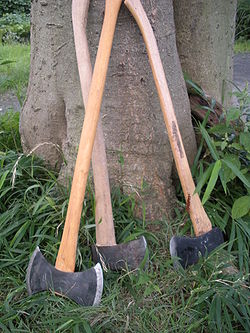
Double- and single-bit felling axes
A collection of bronze socketed axe blades from the Bronze Age found in Germany. This was the prime tool of the period, and also seems to have been used as a store of value.

An axe (/æks/; sometimes spelled ax in American English; see spelling differences) is an implement that has been used for thousands of years to shape, split, and cut wood, to harvest timber, and as a weapon. The axe has many forms and specialised uses but generally consists of a head with a handle (also called "haft" or "helve").

Before the modern axe, the stone-age hand axe without a handle was used from 1.5 million years BP. Hafted axes (those with a handle) date from at least 46,000 years BP by Northern Indigenous Australians. The earliest examples of handled axes have heads of stone with some form of wooden handle attached (hafted) in a method to suit the available materials and use. Axes made of copper, bronze, iron and steel appeared as these technologies developed.

The axe is an example of a simple machine, as it is a type of wedge, or dual inclined plane. This reduces the effort needed by the wood chopper. It splits the wood into two parts by the pressure concentration at the blade. The handle of the axe also acts as a lever allowing the user to increase the force at the cutting edge. Generally, cutting axes, which are used for felling, limbing, and bucking, have a shallow (acute) wedge angle, whereas splitting axes have a deeper (more obtuse) angle. Most axes are double bevelled (i.e. symmetrical about the axis of the blade), but some specialist broadaxes have a single bevel blade.

Most modern axes have steel heads and wooden handles, although plastic or fibreglass handles are also common. Modern axes are specialised by use, size and form. Hafted axes with short handles designed for use with one hand are often called "hand axes" but the term "hand axe" refers to axes without handles as well. Hatchets tend to be small hafted axes often with a hammer on the back side (the poll). As an easy-to-make tool, the axe has frequently been used in combat, and is one of humanity's oldest weapons.

History

[edit]
Bronze socketed axe from the Heppeneert hoard (Belgium), about 800 BCE, collection of the King Baudouin Foundation, Gallo-Roman Museum (Tongeren)
Roman axes in an ancient Roman relief in Brescia, Italy
Shang dynasty axe

Hand axes, of stone, and used without handles (hafts) were the first axes. They had knapped (chipped) cutting edges of flint or other stone. Early examples of hand axes date back to 1.6 mya in the later Oldowan,[1] in Southern Ethiopia around 1.4 mya,[2] and in 1.2 mya deposits in Olduvai Gorge.[3] Stone axes made with ground cutting edges were first developed sometime in the late Pleistocene in Australia, where grind-edge axe fragments from sites in Arnhem Land date back at least 44,000 years;[4][5] grind-edge axes were later present in Japan some time around 38,000 BP, and are known from several Upper Palaeolithic sites on the islands of Honshu and Kyushu.[6] Hafted axes are first known from the Mesolithic period (c. 6000 BC). Few wooden hafts have been found from this period, but it seems that the axe was normally hafted by wedging. Birch-tar and rawhide lashings were used to fix the blade.[citation needed]

The distribution of stone axes is an important indication of prehistoric trade.[7] Thin sectioning is used to determine the provenance of the stone blades. In Europe, Neolithic "axe factories", where thousands of ground stone axes were roughed out, are known from many places, such as:[citation needed]

Stone axes are still produced and in use today in parts of Papua, Indonesia. The Mount Hagen area of Papua New Guinea was an important production centre.[citation needed]

From the late Neolithic/Chalcolithic onwards, axes were made of copper or copper mixed with arsenic. These axes were flat and hafted much like their stone predecessors. Axes continued to be made in this manner with the introduction of Bronze metallurgy. Eventually the hafting method changed and the flat axe developed into the "flanged axe", then palstaves, and later winged and socketed axes.[citation needed]

Hand axes from Swanscombe at the British Museum that belongs to Swanscombe Man who lived 200,000–300,000 years ago
A bronze axe from the Chinese Shang dynasty, 12th to 11th centuries BC

Symbolism, ritual, and folklore

[edit]
Jade axe, Shang dynasty
T7
Axe
in hieroglyphs
T7A
Axe alternative
in hieroglyphs

At least since the late Neolithic, elaborate axes (battle-axes, T-axes, etc.) had a religious significance and probably indicated the exalted status of their owner. Certain types almost never show traces of wear; deposits of unshafted axe blades from the middle Neolithic (such as at the Somerset Levels in Britain) may have been gifts to the deities.

A collection of old Australian cutting tools including broad axes, broad hatchets, mortising axes, carpenter's axes, and felling axes. Also five adzes, a corner chisel, two froes, and a twybil.

[citation needed]

In Minoan Crete, the double axe (labrys) had a special significance, used by priestesses in religious ceremonies.[citation needed]

In 1998, a labrys, complete with an elaborately embellished haft, was found at Cham-Eslen, Canton of Zug, Switzerland. The haft was 120 cm (47 in) long and wrapped in ornamented birch-bark. The axe blade is 17.4 cm (6.9 in) long and made of antigorite, mined in the Gotthard-area. The haft goes through a biconical drilled hole and is fastened by wedges of antler and by birch-tar. It belongs to the early Cortaillod culture.[citation needed]

The coat of arms of Norway features a lion rampant carrying an axe which represents King Olaf II of Norway, who was honoured as the Eternal King of Norway.[citation needed]

Axe pictured in the coat of arms of Tórshavn
Two axes pictured in the former coat of arms of Kalvola

In folklore, stone axes were sometimes believed to be thunderbolts and were used to guard buildings against lightning, as it was believed (mythically) that lightning never struck the same place twice. This has caused some skewing of axe distributions.[citation needed]

Steel axes were important in superstition as well. A thrown axe could keep off a hailstorm, sometimes an axe was placed in the crops, with the cutting edge to the skies to protect the harvest against bad weather. An upright axe buried under the sill of a house would keep off witches, while an axe under the bed would assure male offspring.[citation needed]

Basques, Australians and New Zealanders[8] have developed variants of rural sports that perpetuate the traditions of log cutting with axe. The Basque variants, splitting horizontally or vertically disposed logs, are generically called aizkolaritza (from aizkora: axe).[9]

In Yorùbá mythology, the oshe (double-headed axe) symbolises Shango, Orisha (god) of thunder and lightning. It is said to represent swift and balanced justice. Shango altars often contain a carved figure of a woman holding a gift to the god with a double-bladed axe sticking up from her head.[citation needed]

The Hurrian and Hittite weather god Teshub is depicted on a bas-relief at Ivriz wielding a thunderbolt and an axe.[citation needed]

The Arkalochori Axe is a bronze, Minoan, axe from the second millennium BC thought to be used for religious purposes. Inscriptions on this axe have been compared with other ancient writing systems.[citation needed]

A diagram showing the main points on an axe

Types

[edit]

Axes designed to cut or shape wood

[edit]
Splitting axe
A Swedish carpenter's axe
  • Broadaxe: Used with the grain of the wood in precision splitting or "hewing" (i.e. the squaring-off of round timbers usually for use in construction). Broad axe bits are most commonly chisel-shaped (i.e. one flat and one beveled edge) facilitating more controlled work as the flat cheek passes along the squared timber.
  • Adze: A variation featuring a head perpendicular to that of an axe. Rather than splitting wood side-by-side, it is used to rip a level surface into a horizontal piece of wood. It can also be used as a pickaxe for breaking up rocks and clay.
  • Hatchet: A small, light axe designed for use in one hand specifically while camping or travelling.
  • Carpenter's axe: A small axe, usually slightly larger than a hatchet, used in traditional woodwork, joinery and log-building. It has a pronounced beard and finger notch to allow a "choked" grip for precise control. The poll is designed for use as a hammer.
  • Hand axe: A small axe used for intermediate chopping, similar to hatchets.
  • Mortising axe: Used for creating mortises, a process which begins by drilling two holes at the ends of the intended mortise. Then the wood between the holes is removed with the mortising axe. Some forms of the tool have one blade, which may be pushed, swung or struck with a mallet. Others, such as twybil, bisaigüe and piochon have two, one of which is used for separating the fibres, and the other for levering out the waste.[10]

Axes as weapons

[edit]
  • Battle axe: In its most common form, an arm-length weapon borne in one or both hands. Compared to a sword swing, it delivers more cleaving power against a smaller target area, making it more effective against armour, due to concentrating more of its weight in the axehead.[11][original research?]
  • Dagger-axe (Ji or Ge): A variant of Chinese polearm-like weapon with a divided two-part head, composed of the usual straight blade and a scythe-like blade. The straight blade is used to stab or feint, then the foe's body or head may be cut by pulling the scythe-like horizontal blade backwards. Ge has the horizontal blade but sometimes does not have the straight spear.
  • Dane axe: a long-handled weapon with a large flat blade, often attributed to the Norsemen.
  • Halberd: a spear-like weapon with a hooked poll, effective against mounted cavalry.
  • Head axe: a type of thin-bladed axe with a distinctive shape specialized for headhunting from the Cordilleran peoples of the Philippines.
  • Hurlbat: An entirely metal throwing axe sharpened on every auxiliary end to a point or blade, practically guaranteeing some form of damage against its target.
  • Ono: a Japanese weapon wielded by sōhei warrior monks.
  • Panabas: A chopping bladed tool or weapon from the Philippines often described as a cross between a sword and a battle axe.
  • Parashu: The parashu (Sanskrit: paraṣu) is an Indian battle-axe. It is generally wielded with two hands but could also be used with only one. It is depicted as the primary weapon of Parashurama, the 6th Avatar of Lord Vishnu in Hinduism.
  • Poleaxe: designed to defeat plate armour. Its axe (or hammer) head is much narrower than other axes, which accounts for its penetrating power.
  • Sagaris: An ancient weapon used by Scythians.
  • Shepherd's axe: used by shepherds in the Carpathian Mountains, it could double as a walking stick.
  • Throwing axe: A weapon that was thrown and designed to strike with a similar splitting action as its handheld counterparts. These are often small in profile and usable with one hand.
  • Tomahawk: used almost exclusively by Native Americans, its blade was originally crafted of stone. Along with the familiar war version, which could be fashioned as a throwing weapon, the pipe tomahawk was a ceremonial and diplomatic tool.
  • Yue: A Chinese weapon with very large axe blade, also served as ceremonial weapon.

Axes as tools

[edit]
A sport throwing axe embedded into a wood target.
  • Ice axe or climbing axe: A number of different styles of ice axes are designed for ice climbing and enlarging steps used by climbers.
  • Mattock: A dual-purpose axe, combining an adze and axe blade, or sometimes a pick and adze blade.
  • Pickaxe: An axe with a large pointed end, rather than a flat blade. Sometimes exists as a double-bladed tool with a pick on one side and an axe or adze head on the other. Often used to break up hard material.
  • Pulaski: An axe with a mattock blade built into the rear of the main axe blade, used for digging ('grubbing out') through and around roots as well as chopping.
  • Splitting maul: A splitting implement that has evolved from the simple "wedge" design to more complex designs.

Axes for sport

[edit]

Hammer axe

[edit]

Hammer axes (or axe-hammers) typically feature an extended poll, opposite the blade, shaped and sometimes hardened for use as a hammer. The name axe-hammer is often applied to a characteristic shape of perforated stone axe used in the Neolithic and Bronze Ages. Iron axe-hammers are found in Roman military contexts, e.g. Cramond, Edinburgh, and South Shields, Tyne and Wear.[citation needed]

See also

[edit]

References

[edit]

Further reading

[edit]
[edit]
Revisions and contributorsEdit on WikipediaRead on Wikipedia
from Grokipedia
An axe is a handheld cutting tool consisting of a heavy metal or stone head with a sharpened affixed to a , primarily used for trees, splitting and shaping wood, and other tasks. It has also served as a in across numerous cultures for millennia. The axe's origins date to the era, where unhafted hand axes—bifacially flaked stone tools measuring 12–20 cm—emerged around 1.6 million years ago during the industry, produced by and used for butchering game, skinning animals, in , and cutting or materials. These multipurpose implements dominated early human technology for over a million years and spread from to , Asia, and beyond by approximately 500,000 years ago. Hafted axes first appeared during the late , around 40,000–50,000 years ago, improving leverage, while Neolithic ground stone axes (c. 10,000–2,000 BCE) further refined capabilities. Advancements in introduced bronze and iron axes during the (around 3000 BCE) and (from 1200 BCE in ), enabling more durable and efficient tools for , , and warfare. In the , full grooved stone axes, hafted for stability, were developed by Native American cultures during the Early Archaic period (approximately 9000–8000 years ) to chop trees and split wood, marking a key innovation in prehistoric . Common types include felling axes for tree cutting, broad axes for hewing logs into beams, and double-bit axes for versatile chopping, with specialized variants like battle axes employed in close-quarters combat from the through the medieval period. Today, axes remain essential in , , and outdoor activities, embodying a tool whose has evolved yet retained its core functionality over millions of years.

Design and Components

Parts of an Axe

An axe consists of two primary components: the head and the , also known as the haft. The head is the metal portion responsible for cutting or striking, while the provides leverage and control during use. These parts are assembled such that the 's tapered end fits into the head's eye, secured by a to prevent loosening during operation. The head features several distinct elements. The blade, or bit, is the sharpened designed to penetrate wood or other materials. Adjacent to the blade are the toe at the top and the heel at the bottom, which form the curved sides of the head for added strength and to guide the cut. The poll, or butt, is the flat, blunt end opposite the blade, often used for hammering or as a in single-bit axes. The eye is the oval-shaped hole through which the passes, typically widest in the middle to accommodate the handle's swell for a secure fit. The cheeks are the widened sections on either side of the eye, providing mass and balance to the head. The handle, usually made from hickory or ash for its strength and flexibility, includes ergonomic features for efficient use. The shoulder is the thickened section just below the head, which rests against the bottom of the eye to transfer force during swings. The grip, or belly, forms the curved main body where the user holds the tool, allowing for a natural hand position. At the base is the end knob or swell, which prevents the hand from slipping off during vigorous motion. A wooden wedge, often supplemented by a metal one in heavy-duty axes, is driven into a kerf (slot) at the top of the handle to expand the wood against the eye's interior, ensuring the head remains firmly attached. Balance and ergonomics are critical in axe design, influencing swing efficiency and user fatigue. The center of gravity, typically located near the head—often about 1/4 inch inside the front of the eye—allows for controlled during the downswing, reducing strain on the arms and wrists. length and are tailored to the axe's purpose; for axes, common measurements include a head weight of 1-3 kg and a length of 80-110 cm (31-43 inches), optimizing reach and power for chopping tasks.

Materials and Construction

Traditional axe heads are typically forged from high-carbon steels such as grades 1045 or 1055, which contain 0.45% to 0.55% carbon to balance and for effective edge retention during chopping tasks. These steels, often in the 1050-1095 range, provide sufficient carbon content to achieve a sharp, durable cutting edge while resisting chipping under impact. For handles, is the preferred wood due to its high tensile strength and superior shock absorption, which minimizes vibration transfer to the user during strikes; serves as an alternative for its lighter weight and flexibility, offering similar energy dissipation properties. In modern axes, heads are commonly made from alloy steels like 4140 or 5160, incorporating elements such as and to enhance , resistance, and overall compared to plain high-carbon variants. Handles have shifted toward fiberglass-reinforced plastics (FRPs) or composites, which provide excellent weather resistance by preventing moisture absorption and rot, while maintaining lightweight strength and vibration damping. Protective coatings, such as on metal heads, further prevent in humid environments, extending tool lifespan without compromising performance. Axe construction begins with forging the head, where hand forging involves manually shaping heated steel on an anvil for custom or artisanal pieces, while drop forging uses mechanical hammers to strike the metal between dies for consistent, high-volume production with superior grain alignment and fewer defects. Following forging, heat treatment hardens the edge through quenching—rapid cooling in oil or water to form martensite—followed by tempering at around 450°F to relieve brittleness, achieving a Rockwell hardness (HRC) of 50-60 on the bit for optimal edge holding and impact resistance. Hafting secures the handle by inserting its tapered end into the head's eye, then driving wooden and metal wedges into a kerf at the top to expand and lock the fit, ensuring stability under repeated use.

History

Origins and Early Use

The origins of the axe as a tool date back to the period, with the earliest evidence consisting of handheld stone implements known as bifaces. These tools first appeared around 1.76 million years ago in , associated with early hominins such as , and represent a significant advancement in human technology for cutting and processing materials. Crafted through bifacial flaking—chipping both sides of a stone core—these hand axes were typically made from durable materials like flint, chert, or , depending on local availability, allowing for efficient shaping into teardrop or pointed forms. Sites such as Konso-Gardula in provide key stratigraphic evidence for these early bifaces, highlighting their role in the technological tradition that persisted for over a million years. A major evolution occurred during the Neolithic period, marking the transition from handheld to hafted axes, where ground or polished stone heads were attached to wooden handles for enhanced leverage and versatility. This innovation emerged around 10,000 to 6,000 BCE in the Near East, with archaeological evidence from Pre-Pottery Neolithic sites including ground stone axe heads indicative of hafting traces and woodworking residues. At Çayönü Tepesi in southeastern Turkey, dated to circa 8,600–6,800 BCE, excavations have uncovered ground stone artifacts, including early forms of polished axes used in daily activities, reflecting the site's role as a hub for Neolithic technological development. The hafting process involved binding stone heads to handles using resin, cordage, or sockets, as preserved examples from contemporaneous European sites demonstrate, enabling more forceful strikes. Initially, these stone axes served practical purposes in and early agricultural societies, primarily for large game, butchering animals to access and marrow, and basic such as felling small trees or shaping branches. Experimental replications confirm that hand axes produced cut marks on animal bones similar to those found at prehistoric sites, underscoring their in carcasses. In the Neolithic context, hafted axes facilitated clearance for settlements and rudimentary , as wear patterns on tools from Near Eastern sites indicate repeated use on wood and hide. The technology of stone axes spread globally through human migrations, originating in and reaching and by the , with bifacial tools appearing in the and around 1.5 million years ago. In the , axe-like ground stone tools emerged later, around 8,000 BCE, carried by migrating populations via , adapting to local materials for similar uses in and resource processing. This diffusion underscores the axe's enduring utility as a foundational implement in human adaptation across continents.

Development Through Eras

The transition to the around 3000 BCE revolutionized axe design with the introduction of cast heads, first developed in southern where tin- became prevalent by the mid-third millennium BC, providing superior durability and edge retention over earlier stone tools. This metallurgical innovation spread to , where socketed axes—featuring a hollow socket for haft attachment—emerged as versatile tools for and , as demonstrated by extensive hoards unearthed in regions like Britain and dating to circa 2000–800 BCE. These axes, often found in near-pristine condition suggesting ritual or trade significance, facilitated more efficient resource exploitation and marked a shift toward specialized craftsmanship in early Eurasian societies. The , beginning around 1000 BCE in , brought further advancements through widespread iron forging, yielding axes that were lighter, sharper, and more resilient than their bronze predecessors, enabling broader applications in farming, , and warfare. By the medieval period, particularly during the from the 8th to 11th centuries CE, regional innovations proliferated; the , a long-hafted, two-handed variant with a thin, curved blade optimized for slashing and hooking shields, became iconic in Scandinavian cultures and was exported across via raids and trade. In , the poll axe (also known as ) developed as a hybrid design with a poll opposite the blade, prized for its dual utility in and against armored foes, as seen in 14th–15th-century artifacts from and that reflect evolving tactical needs in feudal warfare. The Industrial era from the 18th to 20th centuries transformed axe production from artisanal forging to mechanized mass output, with steam-powered hammers and forges—pioneered in British and American foundries around 1800—allowing for consistent quality and scale, as exemplified by Wednesbury Forge's steam-driven operations in England that produced edge tools en masse. In the United States, the logging booms of the 19th century drove standardization of felling axes, such as the double-bit designs from the Collins Axe Works in Connecticut, which by the 1840s employed water- and steam-powered machinery to support the rapid deforestation of the Midwest and Northeast. Early electrification in the late 19th and early 20th centuries further refined manufacturing, introducing powered grinding and heat treatment for enhanced blade hardness, though traditional forging techniques persisted in high-end production until the mid-20th century.

Uses

As a Tool for Woodworking and Construction

The axe serves as a fundamental tool in and , primarily employed for tasks involving the manipulation of wood through cutting, splitting, and shaping. In felling trees, axes are designed to deliver powerful blows across the , with felling axes featuring a tapered optimized for deep penetration into timber. Double-bit axes, common in operations, incorporate two blades—one sharpened finely for clean cuts and the other left slightly thicker and rougher for grubbing or initial rough work near the ground, allowing users to alternate edges without frequent . This design enhances during extended tree-felling sessions, where the tool's weight, typically 3 to 4 pounds, provides the needed to sever trunks up to 12 inches in . For splitting logs, specialized mauls with wedge-shaped heads are preferred, as their , convex poll drives apart wood fibers along the rather than slicing through them. These tools, often weighing 6 to 8 pounds, minimize blade binding by expanding the split as the head penetrates, making them ideal for processing or preparing posts from larger logs. Hewing timber follows and splitting, where or adzes flatten logs into square beams for structural use, such as in log cabins or framing; the straight-edged scores and removes bark and sapwood in controlled passes, achieving flat surfaces suitable for . Effective axe use relies on precise techniques to maximize force while minimizing and injury risk. In overhand chopping for or hewing, the user stands with feet shoulder-width apart, knees slightly bent for stability, and swings the axe in a vertical arc from overhead, releasing the top hand to slide down the for added power at impact; this stance counters potential kickback by maintaining balance over the tool's fulcrum. For controlled splitting on smaller or unstable pieces, an underhand or inverted vertical swing is used, holding the axe near the head (choke-grip) and striking downward while kneeling or positioned safely to follow the . protocols emphasize clearing an area at least two axe lengths (approximately 10-12 feet) around the work area, with larger zones for to account for fall, wearing protective gear like gloves and , and gauging swing distance with light practice strokes to prevent glancing blows or misses that could cause rebound. In modern contexts, axes remain integral to for trail maintenance, deadfall removal, and selective , where their simplicity outperforms powered tools in remote areas lacking access. In , they facilitate on-site timber dressing and rough shaping, complementing saws by enabling quick adjustments without setup time. Firefighters employ pickhead axes, combining a blade and or pike, for breaching doors and walls in emergencies, as the reinforced head withstands repeated impacts on reinforced materials. Compared to chainsaws, axes offer superior portability—no batteries or required—making them essential for lightweight kits in construction sites or backcountry work, though saws excel in straight-line cuts through larger diameters with less physical exertion.

As a Weapon in Warfare and Combat

The axe has been adapted as a formidable melee weapon throughout history, particularly in close-quarters combat where its weight and cutting power could penetrate armor or disrupt formations. One prominent example is the , a short-hafted axe wielded by the from the 5th century CE onward as a signature national . This iron-headed tool, balanced for accurate throws at ranges up to 40 feet, was hurled en masse by to shatter enemy shields and inflict casualties before charging with swords, as evidenced in Frankish tactics during the conquest of . In , the served a similar in Native American and colonial warfare from the 17th to 18th centuries, functioning as both a hand-to-hand slashing and a throwable . European traders supplied iron-bladed versions to indigenous groups starting in the during the colonial era, which were then used by warriors in raids and battles, including during the and the , where colonial forces also adopted them for their versatility in ambushes and frontier skirmishes. Combat-specific designs emphasized lethality and tactical adaptability, diverging from utilitarian forms by incorporating broader blades for deeper cuts and specialized features for battlefield maneuvers. Medieval European battle axes, such as the of the 10th to 12th centuries, featured thin, wide blades on extended hafts up to 1.8 meters, allowing to deliver powerful overhead strikes from behind walls that could cleave through helmets and . Later variants like the 16th-century , a Scottish with a hooked rear projection, were engineered for anti-cavalry roles; the hook enabled foot soldiers to pull mounted knights from their horses, while the broad axe head facilitated slashing against unarmored legs or thrusting with an integrated spike. These modifications ensured balance for both one-handed throws in open engagements and two-handed swings in dense , prioritizing momentum over precision to maximize impact against armored foes. In tactical applications, axes filled critical roles in infantry formations across eras, leveraging their reach and destructive force to counter superior weaponry. During the late medieval period, famously employed halberds—pole-mounted axes with axe blades, spikes, and hooks—as primary shock weapons from the , enabling tight-knit phalanxes to dismantle knightly charges at battles like Sempach in 1386 by hooking and toppling riders before closing with slashing blows. This infantry-centric use persisted into early modern conflicts, where axes supplemented pikes in disrupting and breaking lines. In contemporary military contexts, axes persist as survival and entrenching tools with combat potential; for instance, U.S. Marine pioneer equipment includes axes for breaching obstacles and improvised melee, while multi-function entrenching tools derived from designs allow soldiers to chop wood or wield them as clubs in close defense.

In Sports and Recreation

Axe throwing has emerged as a popular modern sport, standardized by the World Axe Throwing League (), which was founded in to promote fair and safety protocols across international venues. Participants throw a single-bitted axe at a wooden target divided into five concentric scoring zones, with the bullseye worth 6 points and outer rings decreasing to 1 point; games typically consist of 10 throws per player, alternating sides, with ties resolved in sudden-death rounds. The standard throwing distance is 12 feet (3.7 meters) from the fault line to the target face, and axes must be balanced for , with total weight up to 3 pounds (1.36 kg) and maximum length of 19 inches (48 cm) including the head. In lumberjack competitions, axes feature prominently in events like the underhand chop and standing block chop, showcased at gatherings such as the Lumberjack World Championships in , which began in 1960 to celebrate timber heritage. In the underhand chop, competitors straddle a 14-inch aspen log and use a 5-pound (2.3 kg) single-bit axe to cut through it from below, racing against the clock while maintaining balance to avoid the kerf. The standing block chop involves vertical chopping of a similar log atop a , testing precision and stamina; these events draw international athletes and spectators, emphasizing skill over brute force in timed formats. Recreational axe use often involves compact hatchets designed for preparing kindling and light wood processing in outdoor hobbies like , prioritizing portability and user safety through features such as protective sheaths, non-slip rubberized grips, and ergonomic handles to reduce and slippage. These hatchets, typically 12 to 16 inches long with forged heads weighing 1 to 1.5 pounds (0.45 to 0.68 kg), allow for controlled swings in confined spaces like campsites, where proper technique—such as maintaining a secure stance and using the axe only for appropriate tasks—minimizes injury risk. In activities, they facilitate fire-starting by splitting small branches into tinder, with emphasis on regular maintenance to ensure the edge remains effective without becoming overly hazardous.

Cultural and Symbolic Aspects

Symbolism in Art and Heraldry

The double-headed axe, or , emerges as a prominent motif in around 2000 BCE, symbolizing divine power and ritual authority in Cretan . Frequently depicted in frescoes, seals, and votive offerings alongside female deities, it represented the archetypal force of creation and protection, often linked to sacred spaces and the Minoan goddess . In heraldry, the axe embodies authority and martial prowess across cultures. The Roman fasces, a bundle of rods encircling an axe blade, served as an emblem of magisterial power and justice, borne by lictors to signify the right to punish and execute, influencing later Western iconography. In European traditions, the single-headed appears in coats of arms to denote strength and sovereignty; notably, the crowned golden lion wielding a silver axe in the Norwegian arms—incorporated into Swedish heraldry during the around 1442—symbolizes the legacy of King Saint Olaf and royal dominion. Artistic representations of the axe often convey themes of , destruction, and renewal. In paintings, it functions as the executioner's attribute in martyrdom scenes, such as beheadings of saints, underscoring and order in works by Northern European artists like those in the tradition of . In Slavic art inspired by mythology, the axe is the thunder god Perun's weapon, depicted as a fiery bolt hurling destruction on evil while renewing cosmic balance, as seen in folk icons and later illustrations. In contemporary symbolism, the axe persists in practical emblems like badges and logos, where crossed axes with ladders represent forcible entry, rescue capabilities, and unyielding resolve against peril.

Rituals, Folklore, and Mythology

In , Thor's weapon Mjölnir is primarily depicted as a forged by dwarves, capable of shattering mountains and returning to his hand, but in some folk traditions and archaeological amulets from the , thunder god symbols include axe-like forms representing strikes. These axe- hybrids symbolize Thor's role as protector against giants and chaos, as described in 13th-century Icelandic sagas like the . In , the primordial giant wields a massive axe to separate the chaotic primordial mass into heaven and earth, with his body forming the world's features after 18,000 years of labor, as recounted in 3rd- to 6th-century texts like the period accounts. This act establishes the cosmic order in Taoist lore, where the axe embodies the force of differentiation between . Aztec ceremonies often incorporated -edged tools for and offerings to sustain the sun's movement, blending warfare motifs with ritual precision in Tenochtitlan's temple complexes. Warriors used the —a wooden club with embedded blades—in battle to capture enemies for sacrificial rites honoring gods like Huitzilopochtli, as evidenced by codices and archaeological finds from the . In modern Wiccan practices, the —a double-headed axe symbolizing the Minoan —is sometimes employed in rituals for grounding or invoking earth-based , placed on altars during ceremonies like to represent strength and . European includes the of burying an axe upright under a house's foundation or sill to ward off witches and evil spirits, a practice rooted in documented in 18th- and 19th-century rural traditions across Britain and . Similarly, placing an axe beneath a was believed to ensure the birth of male children by channeling masculine potency. In Yoruba mythology of , the thunder god wields a double-headed axe (oshe) that summons lightning and enforces justice, as preserved in oral traditions and divination stories from the 16th century onward. These narratives convey moral lessons, portraying the axe as a magical tool that cleaves truth from in heroic quests.

Variants and Specialized Types

Axes for Specific Trades and Tasks

Axes designed for specific trades often feature specialized geometries and weights to optimize performance in targeted tasks, such as shaping wood or breaking rock. The carpenter's axe, for instance, typically incorporates a thin to facilitate precise shaping and , allowing for controlled cuts in timber. Its is commonly set at an angle of around 25 to 30 degrees on one side, resembling a grind, which enhances penetration and chip removal without excessive wedging in the material. This design contrasts with heavier felling axes, prioritizing finesse over brute force for and finishing work. In , a hybrid tool known as mattock combines an axe-like with a pointed pick end, enabling efficient rock breaking and excavation. The portion, oriented perpendicular to the , chops and scoops hardened or , while the pick penetrates fractures in stone, making it indispensable for underground and preparation in historical operations. Task-oriented axes further adapt to unique demands. The , with its transverse orientation at 90 degrees to the , excels at hollowing out logs or by swinging between the legs or over the , removing material in scooping motions for curved surfaces like canoe hulls or chair seats. Similarly, the is tailored for squaring logs in , featuring a wide, single-bevel —often with a scissor grind on one side for flat finishes—and an angled to keep the user's knuckles clear of the workpiece, producing smooth beams for log cabins or structural timbers. Regional variations reflect local trade needs and materials. The Hudson Bay axe, developed for the North American fur trade, boasts a compact head weighing approximately 0.7 kg (1.5 lb), providing portability for trappers navigating wilderness while retaining enough heft for camp chores like firewood processing or shelter building. In Japan, the ono serves construction tasks such as preparing thatch roofs, with its broad, sometimes slightly curved blade designed for chopping reeds and timber, offering a rectangular cutting edge that slices cleanly through fibrous materials in traditional building practices.

Hammer Axes and Hybrid Designs

Hammer axes, also known as poll axes, feature a flattened poll opposite the blade, designed specifically for striking tasks in to chopping. This dual functionality allows the tool to serve as both an and a , with the flat poll providing a broad surface for driving nails, wedges, or other objects without the need for a separate . In applications, flat-head variants of these axes are commonly used for forcible entry, where the poll acts as a striking face to pair with tools like the , enabling efficient breaching of doors and walls. A specialized example is the Pry-Axe, a lightweight hybrid that combines an axe head for cutting with an integrated adze-like and pry function, often employed in operations for enlarging openings or twisting locks. Historical hammer axes evolved into more complex hybrids during the medieval period, particularly as weapons that merged chopping power with percussive and piercing elements. The bec de corbin, emerging in the 14th century in Europe, exemplifies this design with a hammer head, a beak-like spike for penetrating armor, and sometimes an axe blade, making it effective against plate-clad opponents. Named for its "raven's beak" shape in Old French, this polearm weighed around 2-3 kg and was favored for its ability to crush, stab, and hook in close-quarters combat, representing a pinnacle of late medieval versatility in warfare. These weapons were hand-forged from iron or steel and mounted on hafts up to 2 meters long, balancing the weight for both swinging strikes and targeted pounding. In modern contexts, mechanic's axes incorporate pry bar elements to enhance utility in repair and salvage work, such as the or tactical axes that integrate a hammer poll with a pry for nail removal and leveraging in confined automotive or structural tasks. These hybrids typically total 1.5-2 kg, distributing weight to allow balanced swings for chopping while maintaining control for precise hammering or prying, which is crucial in tight spaces like engine bays or disaster sites. The versatility of such designs reduces the need for multiple tools, improving efficiency for professionals in and response by combining cutting, striking, and leveraging in a single, portable implement.

Modern and Industrial Variants

In the realm of powered axes, hydraulic log splitters represent a significant modern advancement, utilizing hydraulic rams to generate substantial force for splitting large logs efficiently and safely. These devices, often powered by engines or , can exert forces ranging from 20 to 37 tons, enabling the processing of timber diameters up to 24 inches in seconds, which minimizes manual labor and injury risk compared to traditional swinging axes. For instance, horizontal-vertical models allow versatile positioning for both standing and horizontal splitting, with cycle times as low as 10-15 seconds per log, making them indispensable in commercial production and operations. Industrial variants of axes have scaled up for specialized heavy-duty applications, such as ship's crash axes designed for maritime emergencies and timber handling. These tools feature robust heads weighing approximately 0.7-1 kg (1.5-2.2 lbs), optimized for cutting through dense hardwoods like used in hull construction or situations. In rescue contexts, axes integrate multifunctional elements like sharpened picks or claws that serve as glass breakers, allowing rapid shattering of vehicle windshields and side windows during extrication operations. The Titan Crash Axe, for example, combines a stainless steel blade with a pike end for prying and breaking , weighing under 3 pounds for maneuverability in confined spaces. Such designs enhance response times in accidents, where the integrated breaker can fracture automotive glass without scattering shards excessively. Recent innovations in axe design emphasize material science and to improve performance across demanding environments. Since the early , titanium alloys have been incorporated into axe heads and frames for their high strength-to-weight ratio, resulting in tools that are 40-50% lighter than traditional versions while resisting and fatigue—ideal for prolonged fieldwork or backpacking. handles, often made from fiberglass-reinforced composites, incorporate vibration-dampening properties that reduce impact shock, helping to mitigate hand-arm vibration syndrome risks for users in repetitive tasks like . For hazardous industrial settings, such as oil refineries or grain silos, non-sparking axe heads crafted from or aluminum bronze alloys prevent ignition of explosive atmospheres by generating no sparks upon impact with metal surfaces. These adaptations, certified for ATEX zones, ensure compliance with standards in flammable environments.

References

Add your contribution
Related Hubs
User Avatar
No comments yet.