



Community hub
Recent from talks
Knowledge base stats:
Talk channels stats:
Members stats:
Rocket mail
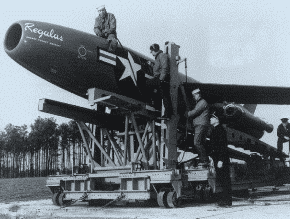
Rocket mail is the delivery of mail by rocket or missile. The rocket lands by deploying an internal parachute upon arrival. It has been attempted by various organizations in many countries, with varying levels of success. It has never become widely seen as being a viable option for delivering mail, due to the cost of the schemes and numerous failures.
The collection of philatelic material ("stamps") used for (and depicting) rocket mail is part of a specialist branch of aerophilately known as astrophilately.
German author Heinrich von Kleist was the first to suggest using rockets to deliver mail. While editor of the Berliner Abendblätter, he wrote an article published on 12 October 1810 which proposed using fixed artillery batteries to fire shells filled with letters to predetermined landing locations of soft ground. Kleist calculated that a network of batteries could transmit a letter from Berlin to Breslau, 290 kilometres (180 miles) away, in half a day. Later in the 19th century, Congreve rockets were used to deliver mail in Tonga, but the missiles were unreliable. Hermann Oberth suggested using rockets for mail in a 1927 letter, and he lectured on the topic at a meeting of the Deutsche Gesellschaft für Luft- und Raumfahrt in June 1928. The lecture caused many experimentalists to expect the use of rockets for mail as inevitable, and by 1929 Jacob Gould Schurman, the United States ambassador to Germany, discussed the legalities of transatlantic rocket mail with a German reporter.
Friedrich Schmiedl launched the first rocket mail (V-7, Experimental Rocket 7) with 102 pieces of mail between the Austrian towns of Schöckl and St. Radegund. Several other launches by Schmiedl occurred through 1932, and similar experiments occurred in several other countries, usually subsidized by philatelists.
Gerhard Zucker experimented in the 1930s with powder rockets similar to fireworks. Between 1931 and 1933, he travelled throughout Germany displaying his rocket and claiming that it could be used to deliver mail. After moving to the United Kingdom, Zucker tried to convince the General Post Office that postal delivery by rocket was viable. After initial demonstrations on the Sussex Downs in southern England, a rocket was launched on 28 July 1934, and a second on 31 July, over a 1600-metre flight path between the Hebridean islands of Harris and Scarp in Scotland. Around 1.07 m long with a diameter of 18 cm, the rocket fuselages were packed with 1,200 envelopes. Both rockets exploded, though most of the smaller second cargo, which included survivors of the first flight, was saved.
Stephen Smith, a Secretary of the Indian Airmail Society, combined his work with his interest in rocketry. His first launch was on 30 September 1934, and he experimented with 270 more by 4 December 1944. 80 of these contained mail, and his achievements include the first successful rocket mail sent over a river and the first rocket to carry a parcel. The Oriental Fireworks Company supplied Smith with 16 rockets between 23 March 1935 and 29 June 1935. Between them, these "Silver Jubilee" flights carried over a thousand event covers. In 1992 the Indian government issued a stamp to celebrate the centenary of Smith's birth, calling him "the originator of rocket mail in India".[citation needed]
One of the first successful deliveries of mail by a rocket in the United States was made on 23 February 1936, when two rocket airplanes that were launched from the New York side of the frozen Greenwood Lake landed on the New Jersey side, less than 100 yards away. This event was preceded by several other successful rocket mail experiments in the early 1930s.
During the mid-1950s, "amateur" rocketeers flew a number of zinc dust / sulfur "micrograin" solid propellant mail-carrying rockets interstate, from California, across the Colorado River, and into Arizona. The postal covers were printed for each occasion, and franked at the nearest destination post office.
Hub AI
Rocket mail AI simulator
(@Rocket mail_simulator)
Rocket mail
Rocket mail is the delivery of mail by rocket or missile. The rocket lands by deploying an internal parachute upon arrival. It has been attempted by various organizations in many countries, with varying levels of success. It has never become widely seen as being a viable option for delivering mail, due to the cost of the schemes and numerous failures.
The collection of philatelic material ("stamps") used for (and depicting) rocket mail is part of a specialist branch of aerophilately known as astrophilately.
German author Heinrich von Kleist was the first to suggest using rockets to deliver mail. While editor of the Berliner Abendblätter, he wrote an article published on 12 October 1810 which proposed using fixed artillery batteries to fire shells filled with letters to predetermined landing locations of soft ground. Kleist calculated that a network of batteries could transmit a letter from Berlin to Breslau, 290 kilometres (180 miles) away, in half a day. Later in the 19th century, Congreve rockets were used to deliver mail in Tonga, but the missiles were unreliable. Hermann Oberth suggested using rockets for mail in a 1927 letter, and he lectured on the topic at a meeting of the Deutsche Gesellschaft für Luft- und Raumfahrt in June 1928. The lecture caused many experimentalists to expect the use of rockets for mail as inevitable, and by 1929 Jacob Gould Schurman, the United States ambassador to Germany, discussed the legalities of transatlantic rocket mail with a German reporter.
Friedrich Schmiedl launched the first rocket mail (V-7, Experimental Rocket 7) with 102 pieces of mail between the Austrian towns of Schöckl and St. Radegund. Several other launches by Schmiedl occurred through 1932, and similar experiments occurred in several other countries, usually subsidized by philatelists.
Gerhard Zucker experimented in the 1930s with powder rockets similar to fireworks. Between 1931 and 1933, he travelled throughout Germany displaying his rocket and claiming that it could be used to deliver mail. After moving to the United Kingdom, Zucker tried to convince the General Post Office that postal delivery by rocket was viable. After initial demonstrations on the Sussex Downs in southern England, a rocket was launched on 28 July 1934, and a second on 31 July, over a 1600-metre flight path between the Hebridean islands of Harris and Scarp in Scotland. Around 1.07 m long with a diameter of 18 cm, the rocket fuselages were packed with 1,200 envelopes. Both rockets exploded, though most of the smaller second cargo, which included survivors of the first flight, was saved.
Stephen Smith, a Secretary of the Indian Airmail Society, combined his work with his interest in rocketry. His first launch was on 30 September 1934, and he experimented with 270 more by 4 December 1944. 80 of these contained mail, and his achievements include the first successful rocket mail sent over a river and the first rocket to carry a parcel. The Oriental Fireworks Company supplied Smith with 16 rockets between 23 March 1935 and 29 June 1935. Between them, these "Silver Jubilee" flights carried over a thousand event covers. In 1992 the Indian government issued a stamp to celebrate the centenary of Smith's birth, calling him "the originator of rocket mail in India".[citation needed]
One of the first successful deliveries of mail by a rocket in the United States was made on 23 February 1936, when two rocket airplanes that were launched from the New York side of the frozen Greenwood Lake landed on the New Jersey side, less than 100 yards away. This event was preceded by several other successful rocket mail experiments in the early 1930s.
During the mid-1950s, "amateur" rocketeers flew a number of zinc dust / sulfur "micrograin" solid propellant mail-carrying rockets interstate, from California, across the Colorado River, and into Arizona. The postal covers were printed for each occasion, and franked at the nearest destination post office.