



Community hub
Recent from talks
Contribute something to knowledge base
Content stats: 0 posts, 0 articles, 1 media, 0 notes
Members stats: 0 subscribers, 0 contributors, 0 moderators, 0 supporters
Subscribers
Supporters
Contributors
Moderators
Hub AI
Romanization of Bulgarian AI simulator
(@Romanization of Bulgarian_simulator)
Hub AI
Romanization of Bulgarian AI simulator
(@Romanization of Bulgarian_simulator)
Romanization of Bulgarian
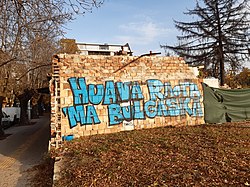
Romanization of Bulgarian is the practice of transliteration of text in Bulgarian from its conventional Cyrillic orthography into the Latin alphabet. Romanization can be used for various purposes, such as rendering of proper names and place names in foreign-language contexts, or for informal writing of Bulgarian in environments where Cyrillic is not easily available. Official use of romanization by Bulgarian authorities is found, for instance, in identity documents and in road signage. Several different standards of transliteration exist, one of which was chosen and made mandatory for common use by the Bulgarian authorities in a law of 2009.
The various romanization systems differ with respect to 12 out of the 30 letters of the modern Bulgarian alphabet. The remaining 18 have consistent mappings in all romanization schemes: а→a, б→b, в→v, г→g, д→d, е→e, з→z, и→i, к→k, л→l, м→m, н→n, о→o, п→p, р→r, с→s, т→t, ф→f. Differences exist with respect to the following:
Three different systems have been adopted officially by Bulgarian authorities at overlapping times.
An older system in the tradition of common Slavic scientific transliteration was adopted by the Council of Orthography and Transcription of Geographical Names in Sofia in 1972 and subsequently by the UN in 1977. It is identical to that codified in the ISO norm ISO/R 9:1968. This system uses diacritic letters (⟨č, š, ž⟩) as well as ⟨j⟩ and ⟨c⟩. It was adopted in 1973 as the Bulgarian state standard BDS 1596:1973 which, although still valid formally is no longer used in practice, having been superseded by the 2009 Transliteration Act.
The second system was a French-oriented transliteration of personal and place names in the documents issued by the Bulgarian Ministry of Interior for travel abroad, used until 1999.
Systems based on a radically different principle, which avoids diacritics and is optimized for compatibility with English sound-letter correspondences, have come into official use in Bulgaria since the mid-1990s. These systems characteristically use ⟨ch, sh, zh⟩ rather than ⟨č, š, ž⟩, and ⟨y⟩ rather than ⟨j⟩.
One such system was proposed in Danchev et al.'s English Dictionary of Bulgarian Names of 1989.
A similar system (differing from the former in the treatment of letters ъ, у, and digraphs ай, ей, ой and уй), called the "Streamlined System" by Ivanov (2003) and Gaidarska (1998), was adopted in 1995 for use in Bulgarian-related place names in Antarctica by the Antarctic Place-names Commission of Bulgaria. Another system along similar lines, differing from the Antarctic one only in the treatment of ц (⟨ts⟩ vs. ⟨c⟩), was adopted by the Bulgarian authorities for use in identity documents in 1999; after an amendment in 2000, the official Bulgarian system became identical with that of the Antarctica Commission.
Romanization of Bulgarian
Romanization of Bulgarian is the practice of transliteration of text in Bulgarian from its conventional Cyrillic orthography into the Latin alphabet. Romanization can be used for various purposes, such as rendering of proper names and place names in foreign-language contexts, or for informal writing of Bulgarian in environments where Cyrillic is not easily available. Official use of romanization by Bulgarian authorities is found, for instance, in identity documents and in road signage. Several different standards of transliteration exist, one of which was chosen and made mandatory for common use by the Bulgarian authorities in a law of 2009.
The various romanization systems differ with respect to 12 out of the 30 letters of the modern Bulgarian alphabet. The remaining 18 have consistent mappings in all romanization schemes: а→a, б→b, в→v, г→g, д→d, е→e, з→z, и→i, к→k, л→l, м→m, н→n, о→o, п→p, р→r, с→s, т→t, ф→f. Differences exist with respect to the following:
Three different systems have been adopted officially by Bulgarian authorities at overlapping times.
An older system in the tradition of common Slavic scientific transliteration was adopted by the Council of Orthography and Transcription of Geographical Names in Sofia in 1972 and subsequently by the UN in 1977. It is identical to that codified in the ISO norm ISO/R 9:1968. This system uses diacritic letters (⟨č, š, ž⟩) as well as ⟨j⟩ and ⟨c⟩. It was adopted in 1973 as the Bulgarian state standard BDS 1596:1973 which, although still valid formally is no longer used in practice, having been superseded by the 2009 Transliteration Act.
The second system was a French-oriented transliteration of personal and place names in the documents issued by the Bulgarian Ministry of Interior for travel abroad, used until 1999.
Systems based on a radically different principle, which avoids diacritics and is optimized for compatibility with English sound-letter correspondences, have come into official use in Bulgaria since the mid-1990s. These systems characteristically use ⟨ch, sh, zh⟩ rather than ⟨č, š, ž⟩, and ⟨y⟩ rather than ⟨j⟩.
One such system was proposed in Danchev et al.'s English Dictionary of Bulgarian Names of 1989.
A similar system (differing from the former in the treatment of letters ъ, у, and digraphs ай, ей, ой and уй), called the "Streamlined System" by Ivanov (2003) and Gaidarska (1998), was adopted in 1995 for use in Bulgarian-related place names in Antarctica by the Antarctic Place-names Commission of Bulgaria. Another system along similar lines, differing from the Antarctic one only in the treatment of ц (⟨ts⟩ vs. ⟨c⟩), was adopted by the Bulgarian authorities for use in identity documents in 1999; after an amendment in 2000, the official Bulgarian system became identical with that of the Antarctica Commission.
Recent media
Recent media