
Recent from talks
Roneat ek
Knowledge base stats:
Talk channels stats:
Members stats:
Roneat ek
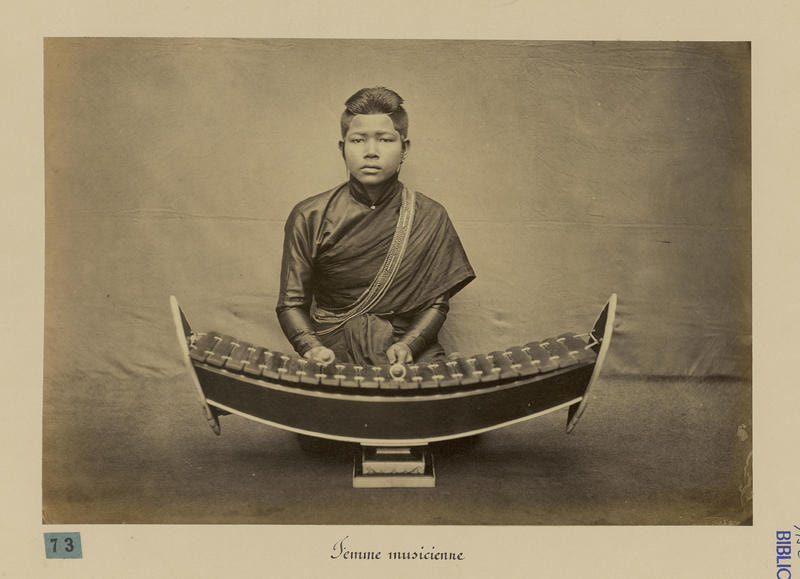
The Roneat Ek or Roneat Aek (Khmer: រនាតឯក; also called Roneat Rut) is a xylophone used in the Khmer classical music of Cambodia. It is built in the shape of a curved, rectangular shaped boat. It has twenty-one thick bamboo or hard wood bars that are suspended from strings attached to the two walls. They are cut into pieces of the same width, but of different lengths and thickness. Originally these instruments were highly decorated with inlay and carvings on the sides of the sound box. Now they are simpler. The Roneat is played in the Pinpeat ensemble. In that ensemble, sits on the right of the Roneat Thung, a lower-pitched xylophone. The roneat ek is the analogous equivalent to the Thai xylophone called ranat ek, and the Burmese bamboo xylophone called "pattala".
The word "roneat" is a Khmer word for the bamboo xylophone, which is an ancient musical instrument of Cambodia. According to the Khmer national dictionary, roneat means xylophone and is described as "the percussive musical instrument that has a long body where its bars are made from bamboo or other good quality woods or metal bars striking with a pair of two roneat sticks played in the Pinpeat and Mohaori Orchestras."
According to the Garland Handbook of Southeast Asian Music edited by Terry E. Miller and Sean Williams, the word roneat is a Khmer generic term refers to xylophones or metallophones-idiophones, with bars of bamboo, wood, or metal. The word roneat derives from the word "roneap" which means bamboo strips or bamboo bars. It's quite possible in Khmer language and its word derivations as the note bars of this Roneat are made mostly from bamboo bars or strips.
Moreover, a research compiled by Cambodian professor Hun Sarnin indicated that the Khmer word roneat, which probably derived from the Sanskrit word raghunâ tha-vinâ, appeared since the early Cambodian history during the Funan kingdom.
While the Khmer word "ek or aek" is derived from the Sanskrit word ekam or Pali word eka, which has several meanings such as first, supreme, significant, or the leading,...
When put together, the word roneat ek means "the significant or the leading xylophone". This indicates its role as the leading musical instrument in the Khmer traditional Pinpeat and Mahori orchestras, and its role starting a piece of music and cueing the other instruments.
Moreover, roneat ek is sometimes known as roneat rut as well, which literally means the running xylophone, maybe due to its technique of making sound that runs from one note to the other while playing or from one bamboo bar to the other.
Music has been part of Khmer daily life since at least the first Khmer kingdom Funan, as music along with dancing were performed in religious temples. Therefore, Roneat is thought to have originated since before Angkor empire. As Roneat Thung, the sister musical instrument of Roneat Ek was already established itself as the member of the Pinpeat orchestra since before Angkor period, so researchers believed that Roneat Ek is thought to be predated the Angkorian period as well. One of the oldest xylophone nearby Cambodia can be found in Lam Dong Province, Central Highland, Vietnam. Early form of xylophone are in the form of Stone Xylophone or Known in native language as Goonglu. Researchers have found many stone xylophones in Vietnam's Central Highland where Mon-Khmer indigenous minority, the K'ho lives. The Koho people know how to use the stone xylophone longs ago where some stone xylophones found there aged to some 2500 years. In Cambodia, this type of prehistoric stone xylophone or known as Roneat Thmor in Khmer was also found in a site known as Along Tra Reach in Kampong Chhnang province, Central Cambodia. Each stone xylophone is more than 1,5 meter long. However, the age is unknown, but probably as old as those found in Vietnam's Central Highland or much older.
Hub AI
Roneat ek AI simulator
(@Roneat ek_simulator)
Roneat ek
The Roneat Ek or Roneat Aek (Khmer: រនាតឯក; also called Roneat Rut) is a xylophone used in the Khmer classical music of Cambodia. It is built in the shape of a curved, rectangular shaped boat. It has twenty-one thick bamboo or hard wood bars that are suspended from strings attached to the two walls. They are cut into pieces of the same width, but of different lengths and thickness. Originally these instruments were highly decorated with inlay and carvings on the sides of the sound box. Now they are simpler. The Roneat is played in the Pinpeat ensemble. In that ensemble, sits on the right of the Roneat Thung, a lower-pitched xylophone. The roneat ek is the analogous equivalent to the Thai xylophone called ranat ek, and the Burmese bamboo xylophone called "pattala".
The word "roneat" is a Khmer word for the bamboo xylophone, which is an ancient musical instrument of Cambodia. According to the Khmer national dictionary, roneat means xylophone and is described as "the percussive musical instrument that has a long body where its bars are made from bamboo or other good quality woods or metal bars striking with a pair of two roneat sticks played in the Pinpeat and Mohaori Orchestras."
According to the Garland Handbook of Southeast Asian Music edited by Terry E. Miller and Sean Williams, the word roneat is a Khmer generic term refers to xylophones or metallophones-idiophones, with bars of bamboo, wood, or metal. The word roneat derives from the word "roneap" which means bamboo strips or bamboo bars. It's quite possible in Khmer language and its word derivations as the note bars of this Roneat are made mostly from bamboo bars or strips.
Moreover, a research compiled by Cambodian professor Hun Sarnin indicated that the Khmer word roneat, which probably derived from the Sanskrit word raghunâ tha-vinâ, appeared since the early Cambodian history during the Funan kingdom.
While the Khmer word "ek or aek" is derived from the Sanskrit word ekam or Pali word eka, which has several meanings such as first, supreme, significant, or the leading,...
When put together, the word roneat ek means "the significant or the leading xylophone". This indicates its role as the leading musical instrument in the Khmer traditional Pinpeat and Mahori orchestras, and its role starting a piece of music and cueing the other instruments.
Moreover, roneat ek is sometimes known as roneat rut as well, which literally means the running xylophone, maybe due to its technique of making sound that runs from one note to the other while playing or from one bamboo bar to the other.
Music has been part of Khmer daily life since at least the first Khmer kingdom Funan, as music along with dancing were performed in religious temples. Therefore, Roneat is thought to have originated since before Angkor empire. As Roneat Thung, the sister musical instrument of Roneat Ek was already established itself as the member of the Pinpeat orchestra since before Angkor period, so researchers believed that Roneat Ek is thought to be predated the Angkorian period as well. One of the oldest xylophone nearby Cambodia can be found in Lam Dong Province, Central Highland, Vietnam. Early form of xylophone are in the form of Stone Xylophone or Known in native language as Goonglu. Researchers have found many stone xylophones in Vietnam's Central Highland where Mon-Khmer indigenous minority, the K'ho lives. The Koho people know how to use the stone xylophone longs ago where some stone xylophones found there aged to some 2500 years. In Cambodia, this type of prehistoric stone xylophone or known as Roneat Thmor in Khmer was also found in a site known as Along Tra Reach in Kampong Chhnang province, Central Cambodia. Each stone xylophone is more than 1,5 meter long. However, the age is unknown, but probably as old as those found in Vietnam's Central Highland or much older.
Recent media