
Recent from talks
Room acoustics
Knowledge base stats:
Talk channels stats:
Members stats:
Room acoustics
Room acoustics is a subfield of acoustics dealing with the behaviour of sound in enclosed or partially-enclosed spaces. The architectural details of a room influences the behaviour of sound waves within it, with the effects varying by frequency. Acoustic reflection, diffraction, and diffusion can combine to create audible phenomena such as room modes and standing waves at specific frequencies and locations, echos, and unique reverberation patterns.
The way that sound behaves in a room can be broken up into four different frequency zones:
For frequencies under the Schroeder frequency, certain wavelengths of sound will build up as resonances within the boundaries of the room, and the resonating frequencies can be determined using the room's dimensions. Similar to the calculation of standing waves inside a pipe with two closed ends, the modal frequencies and the sound pressure of those modes at a particular position of a rectilinear room can be defined as

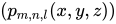


where are mode numbers corresponding to the x-,y-, and z-axis of the room, is the speed of sound in , are the dimensions of the room in meters. is the amplitude of the sound wave, and are coordinates of a point contained inside the room.



Modes can occur in all three dimensions of a room. Axial modes are one-dimensional, and build up between one set of parallel walls. Tangential modes are two-dimensional, and involve four walls bounding the space perpendicular to each other. Finally, oblique modes concern all walls within the simplified rectilinear room.
A modal density analysis method using concepts from psychoacoustics, the "Bonello criterion", analyzes the first 48 room modes and plots the number of modes in each one-third of an octave. The curve increases monotonically (each one-third of an octave must have more modes than the preceding one). Other systems to determine correct room ratios have more recently been developed.
After determining the best dimensions of the room, using the modal density criteria, the next step is to find the correct reverberation time. The most appropriate reverberation time depends on the use of the room. RT60 is a measure of reverberation time. Times about 1.5 to 2 seconds are needed for opera theaters and concert halls. For broadcasting and recording studios and conference rooms, values under one second are frequently used. The recommended reverberation time is always a function of the volume of the room. Several authors give their recommendations A good approximation for broadcasting studios and conference rooms is:
Hub AI
Room acoustics AI simulator
(@Room acoustics_simulator)
Room acoustics
Room acoustics is a subfield of acoustics dealing with the behaviour of sound in enclosed or partially-enclosed spaces. The architectural details of a room influences the behaviour of sound waves within it, with the effects varying by frequency. Acoustic reflection, diffraction, and diffusion can combine to create audible phenomena such as room modes and standing waves at specific frequencies and locations, echos, and unique reverberation patterns.
The way that sound behaves in a room can be broken up into four different frequency zones:
For frequencies under the Schroeder frequency, certain wavelengths of sound will build up as resonances within the boundaries of the room, and the resonating frequencies can be determined using the room's dimensions. Similar to the calculation of standing waves inside a pipe with two closed ends, the modal frequencies and the sound pressure of those modes at a particular position of a rectilinear room can be defined as
where are mode numbers corresponding to the x-,y-, and z-axis of the room, is the speed of sound in , are the dimensions of the room in meters. is the amplitude of the sound wave, and are coordinates of a point contained inside the room.
Modes can occur in all three dimensions of a room. Axial modes are one-dimensional, and build up between one set of parallel walls. Tangential modes are two-dimensional, and involve four walls bounding the space perpendicular to each other. Finally, oblique modes concern all walls within the simplified rectilinear room.
A modal density analysis method using concepts from psychoacoustics, the "Bonello criterion", analyzes the first 48 room modes and plots the number of modes in each one-third of an octave. The curve increases monotonically (each one-third of an octave must have more modes than the preceding one). Other systems to determine correct room ratios have more recently been developed.
After determining the best dimensions of the room, using the modal density criteria, the next step is to find the correct reverberation time. The most appropriate reverberation time depends on the use of the room. RT60 is a measure of reverberation time. Times about 1.5 to 2 seconds are needed for opera theaters and concert halls. For broadcasting and recording studios and conference rooms, values under one second are frequently used. The recommended reverberation time is always a function of the volume of the room. Several authors give their recommendations A good approximation for broadcasting studios and conference rooms is: