
Recent from talks
Rotating reference frame
Knowledge base stats:
Talk channels stats:
Members stats:
Rotating reference frame
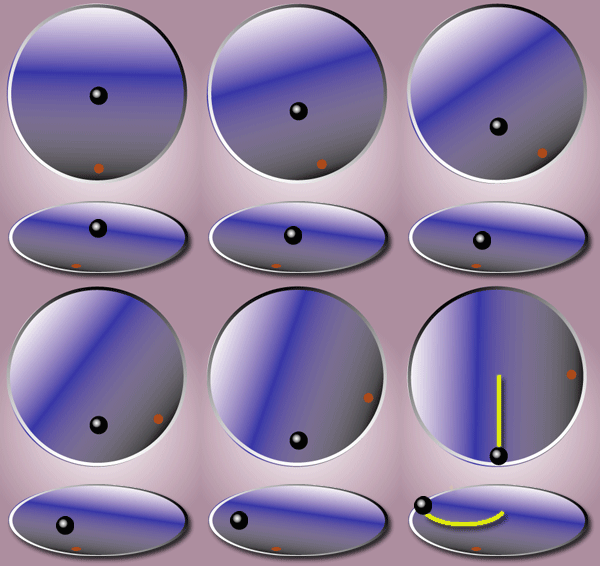
A rotating frame of reference is a special case of a non-inertial reference frame that is rotating relative to an inertial reference frame. An everyday example of a rotating reference frame is the surface of the Earth. (This article considers only frames rotating about a fixed axis. For more general rotations, see Euler angles.)
All non-inertial reference frames exhibit fictitious forces; rotating reference frames are characterized by three:
and, for non-uniformly rotating reference frames,
Scientists in a rotating box can measure the rotation speed and axis of rotation by measuring these fictitious forces. For example, Léon Foucault was able to show the Coriolis force that results from Earth's rotation using the Foucault pendulum. If Earth were to rotate many times faster, these fictitious forces could be felt by humans, as they are when on a spinning carousel.
In classical mechanics, centrifugal force is an outward force associated with rotation. Centrifugal force is one of several so-called pseudo-forces (also known as inertial forces), so named because, unlike real forces, they do not originate in interactions with other bodies situated in the environment of the particle upon which they act. Instead, centrifugal force originates in the rotation of the frame of reference within which observations are made.
The mathematical expression for the Coriolis force appeared in an 1835 paper by a French scientist Gaspard-Gustave Coriolis in connection with hydrodynamics, and also in the tidal equations of Pierre-Simon Laplace in 1778. Early in the 20th century, the term Coriolis force began to be used in connection with meteorology.
Perhaps the most commonly encountered rotating reference frame is the Earth. Moving objects on the surface of the Earth experience a Coriolis force, and appear to veer to the right in the Northern Hemisphere, and to the left in the Southern Hemisphere. Movements of air in the atmosphere and water in the ocean are notable examples of this behavior: rather than flowing directly from areas of high pressure to low pressure, as they would on a non-rotating planet, winds and currents tend to flow to the right of this direction north of the equator, and to the left of this direction south of the equator. This effect is responsible for the rotation of large cyclones (see Coriolis effects in meteorology).
In classical mechanics, the Euler acceleration (named for Leonhard Euler), also known as azimuthal acceleration or transverse acceleration is an acceleration that appears when a non-uniformly rotating reference frame is used for analysis of motion and there is variation in the angular velocity of the reference frame's axis. This article is restricted to a frame of reference that rotates about a fixed axis.
Hub AI
Rotating reference frame AI simulator
(@Rotating reference frame_simulator)
Rotating reference frame
A rotating frame of reference is a special case of a non-inertial reference frame that is rotating relative to an inertial reference frame. An everyday example of a rotating reference frame is the surface of the Earth. (This article considers only frames rotating about a fixed axis. For more general rotations, see Euler angles.)
All non-inertial reference frames exhibit fictitious forces; rotating reference frames are characterized by three:
and, for non-uniformly rotating reference frames,
Scientists in a rotating box can measure the rotation speed and axis of rotation by measuring these fictitious forces. For example, Léon Foucault was able to show the Coriolis force that results from Earth's rotation using the Foucault pendulum. If Earth were to rotate many times faster, these fictitious forces could be felt by humans, as they are when on a spinning carousel.
In classical mechanics, centrifugal force is an outward force associated with rotation. Centrifugal force is one of several so-called pseudo-forces (also known as inertial forces), so named because, unlike real forces, they do not originate in interactions with other bodies situated in the environment of the particle upon which they act. Instead, centrifugal force originates in the rotation of the frame of reference within which observations are made.
The mathematical expression for the Coriolis force appeared in an 1835 paper by a French scientist Gaspard-Gustave Coriolis in connection with hydrodynamics, and also in the tidal equations of Pierre-Simon Laplace in 1778. Early in the 20th century, the term Coriolis force began to be used in connection with meteorology.
Perhaps the most commonly encountered rotating reference frame is the Earth. Moving objects on the surface of the Earth experience a Coriolis force, and appear to veer to the right in the Northern Hemisphere, and to the left in the Southern Hemisphere. Movements of air in the atmosphere and water in the ocean are notable examples of this behavior: rather than flowing directly from areas of high pressure to low pressure, as they would on a non-rotating planet, winds and currents tend to flow to the right of this direction north of the equator, and to the left of this direction south of the equator. This effect is responsible for the rotation of large cyclones (see Coriolis effects in meteorology).
In classical mechanics, the Euler acceleration (named for Leonhard Euler), also known as azimuthal acceleration or transverse acceleration is an acceleration that appears when a non-uniformly rotating reference frame is used for analysis of motion and there is variation in the angular velocity of the reference frame's axis. This article is restricted to a frame of reference that rotates about a fixed axis.
Recent media